Business.com aims to help business owners make informed decisions to support and grow their companies. We research and recommend products and services suitable for various business types, investing thousands of hours each year in this process.
As a business, we need to generate revenue to sustain our content. We have financial relationships with some companies we cover, earning commissions when readers purchase from our partners or share information about their needs. These relationships do not dictate our advice and recommendations. Our editorial team independently evaluates and recommends products and services based on their research and expertise. Learn more about our process and partners here.
Learn how to protect your intellectual property with trademarks and how trademarks differ from copyrights.

Famous brands are often recognizable instantly because of their signature logos, symbols and slogans. They’ve created and trademarked these brand identifiers to protect their market position. Businesses of all sizes may consider trademarking their brand indicators so competitors can’t use them and consumers won’t be confused.
We’ll explain trademarks, how to register and submit trademarks and how to decide whether a copyright or trademark is the right way to protect your brand reputation and valuable intellectual property (IP).
Trademark disputes can lead to business lawsuits to stop an entity from infringing on your brand indicators.
A trademark is a word, phrase or symbol that functions as a brand image or indicator. It includes words, names, images and symbols that identify a company or brand and distinguish it from other companies or brands. “Trademarks can be used to protect a business name, logo, hashtag, slogan, color, sound clip and trade dress (think Hard Rock Hotel — their shape is a trademark),” explained Lauren A. Morgan, Esq., an expert in IP law and attorney at Activated Law.
The concept dates back to ancient times when skilled artisans working with metal or ceramic would imprint their distinct maker’s mark on a finished product. Even today, you can often distinguish between a high-quality piece of jewelry and a knockoff by the maker’s mark.
Registering your IP with the government gives you a registered trademark, allowing legal enforcement for both physical products and digital assets. “Being proactive not only protects your brand but also keeps you from being sued for infringing on someone else’s brand, even if that brand came after yours but was trademarked first,” Morgan noted.
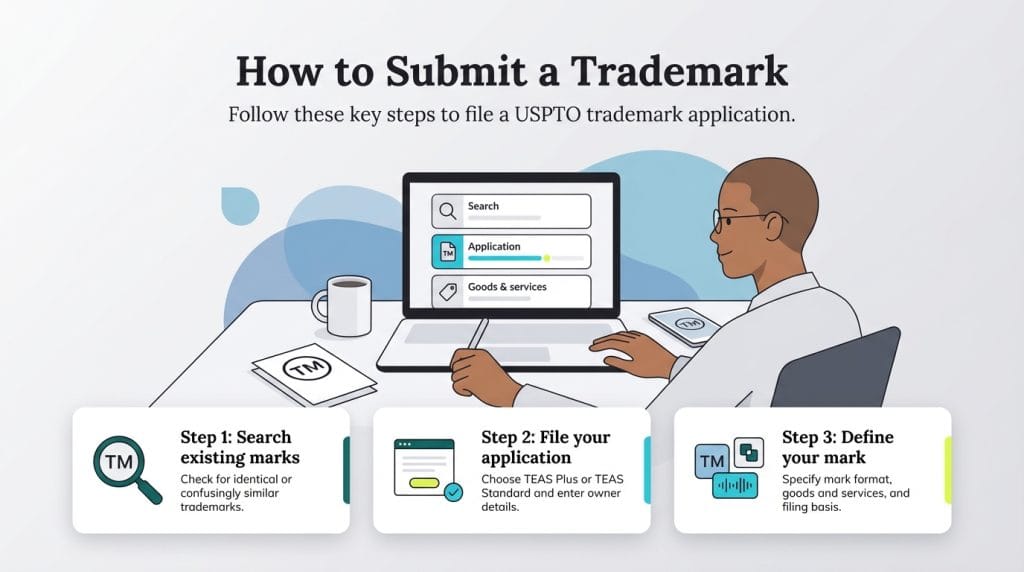
Take the following steps to pursue a registered trademark for your assets.
Your application will be rejected if an existing trademark is identical or confusingly similar to the one you’re trying to get. To ensure this isn’t the case, visit the USPTO’s online Trademark Center, select Search the trademark database and perform a search.
If your search returns results that are too similar to your proposed trademark within the same class of goods or services, make changes and conduct another search.
In this step, you’ll select your mark format, provide the required image or audio file and submit any supporting specimens to show how your mark is used in commerce.
If you select this option, you’ll attach a hand-drawn or computer-generated image in JPEG format that meets USPTO size and resolution requirements.
You may need to provide a specimen to demonstrate how your trademark is used in commerce. The type of specimen you submit depends on the mark format:
Note: If you’re filing an intent-to-use application, you don’t need to submit a specimen at this stage. You’ll submit it later when filing a Statement of Use.
In this section of the TEAS, detail the goods and services for which you’ll use your mark. Follow the Trademark ID Manual as a guide to select pre-approved wording that matches your goods and services. This can streamline the application process and reduce the likelihood of errors or additional scrutiny. If necessary, you can detail your goods and services in your own words. However, ensure your description is clear, specific and concise to avoid rejection or delays.
After you submit your TEAS form, you can’t change your trademark’s goods and services.
Choose one of the four bases below:
After paying your filing fee, which is generally $350 per class of goods or services, the USPTO will refer your application to an attorney, who will review it within three to nine months. You will be contacted if you must remedy any mistakes before your application reaches the USPTO’s weekly publication, the Trademark Official Gazette, where other trademark holders can counter your application if it appears similar to their marks.
If you counter any challenges successfully (or face no challenges), your trademark will be approved, though the entire process can take a year or more.
After your trademark is registered, it’s crucial to remember your trademark renewal dates and monitor new trademark filings to ensure no one infringes on your trademark.
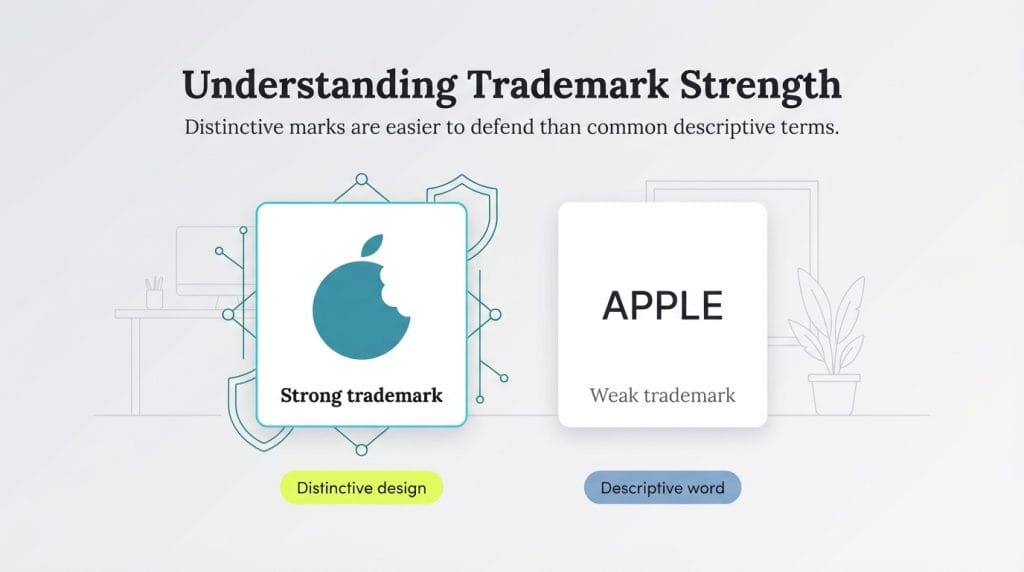
A trademark has an associated “strength” that shows how defensible it is as your unique mark vs. how widely other entities can use it.
Consider the Apple logo — an apple with a bite taken out of it. It’s a strong trademark because other entities can’t use that specific symbol or even somewhat similar symbols defensibly. Apple has been involved in many trademark lawsuits preventing other companies from using logos that are simple graphic designs of a single fruit, such as the pear-shaped logo for a meal prep app called Prepear, arguing that they will confuse customers.
Meanwhile, Apple trying to trademark the word “apple” would be weak. A bakery using apples does not violate Apple’s registered trademark if it describes its pies as apple pies. Nor is Big Apple Bagels in violation for using New York City’s nickname.
A strong trademark is entirely original. The brand name Xerox is an example. No entity was called Xerox before the company created and used the name in its branding.
Strong trademarks are either completely unique words or images or ones that have a unique use. Returning to the Apple example, the word “apple” is far from unique. However, its use for a technology company is unique, making it a strong trademark. If another company wanted to use the name Apple Technology, it would be sued for trademark infringement.
Choose an original, effective brand name that’s easy to remember, appeals to your target audience and relates to your products or services. But don’t make it too specific — you may want to expand eventually.
Registering and defending your trademark is crucial to protect your brand.
Obtaining IP insurance can help protect your trademark against entities using your IP without authorization.
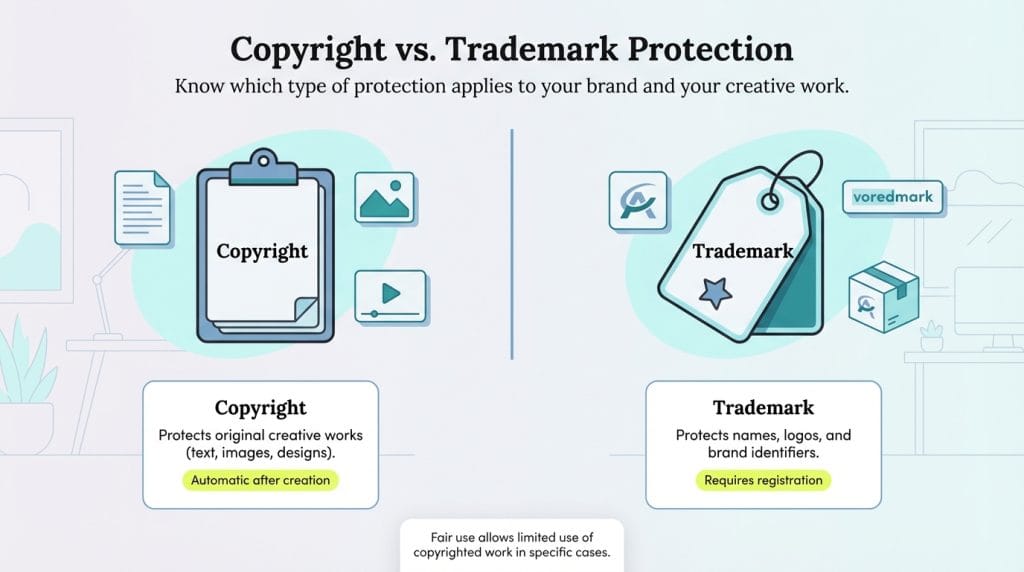
While trademarks are words, names, images and symbols that identify your brand, copyrights protect unique created works. Unlike trademarks, you can’t copyright specific words (barring unique brand identifiers like “Xerox”).
When choosing whether a copyright or trademark provides the best protection for your business, keep the following considerations in mind:
Registering a copyright isn’t required. However, not registering your copyright can be a critical IP mistake that can harm your company.
There are many guidelines for what constitutes a trademark, and the USPTO provides a series of Trademark Basics resources to help you navigate trademark law.
In general, you can’t trademark your website’s graphic design, even if it’s unique. You also likely won’t be able to trademark website graphics and illustrations. If you create illustrated characters for use in your branding, you can copyright them but can’t trademark them.
Yes. You can trademark your brand logo and, if it’s sufficiently unique, your brand name. If you have individual products with their own logos, you can trademark those logos and names as well. Otherwise, you’re looking at copyrights, not trademarks, to defend your creations.
There are two kinds of trademark indications: the small ™ and the ® mark (the letter R enclosed in a circle). You can only use the ® after your trademark is successfully registered with the USPTO. You can use the ™ symbol to indicate that your name or image is either an unregistered trademark or that your trademark is currently pending.
Processing times vary based on application volume. Currently, it takes approximately 12 to 18 months to complete the registration process, provided there are no significant legal complications or oppositions filed against your mark.
Sheldon Brown, IP attorney and contributor to Patent Experts, noted that there are some cases where pursuing a trademark isn’t worth it. “For example, if a business is just a small local shop with no plans to expand, it may not see a huge benefit from registering a trademark — especially if brand recognition beyond the local area isn’t important to them,” Brown explained.
Brown also pointed out that generic names, like “Best Pizza” for a pizza place, can be challenging to trademark because they don’t distinguish the brand uniquely. “Trademarks are meant to make a brand stand out, so terms that describe the product rather than a unique brand aren’t usually approved,” Brown said.
Technically, trademarks are only granted for interstate commerce, but if your small business ever wants to have the option of selling online, you might want to consider going through the trademarking process.
Jennifer Dublino contributed to the reporting and writing in this article. Source interviews were conducted for a previous version of this article.