Business.com aims to help business owners make informed decisions to support and grow their companies. We research and recommend products and services suitable for various business types, investing thousands of hours each year in this process.
As a business, we need to generate revenue to sustain our content. We have financial relationships with some companies we cover, earning commissions when readers purchase from our partners or share information about their needs. These relationships do not dictate our advice and recommendations. Our editorial team independently evaluates and recommends products and services based on their research and expertise. Learn more about our process and partners here.
Debt and equity financing are two sources of capital you can consider when raising money for your startup.


When getting ready to launch a new business, you must find the thousands — sometimes hundreds of thousands — of dollars often required to get started. Options for startup capital include debt financing and equity financing. While debt financing involves borrowing money and repaying it with interest, equity financing involves selling shares of your company. While you can pursue both types of funding, you should understand the differences before making a decision.
In finance, a company’s capital structure consists of debt and equity. If you look at a statement of shareholder equity, you’ll see that equity is calculated as the difference between the value of the business’s total assets and liabilities. Debt financing and equity financing both have pros and cons. The right option for your business depends on your startup’s financial situation and your goals as a business owner.
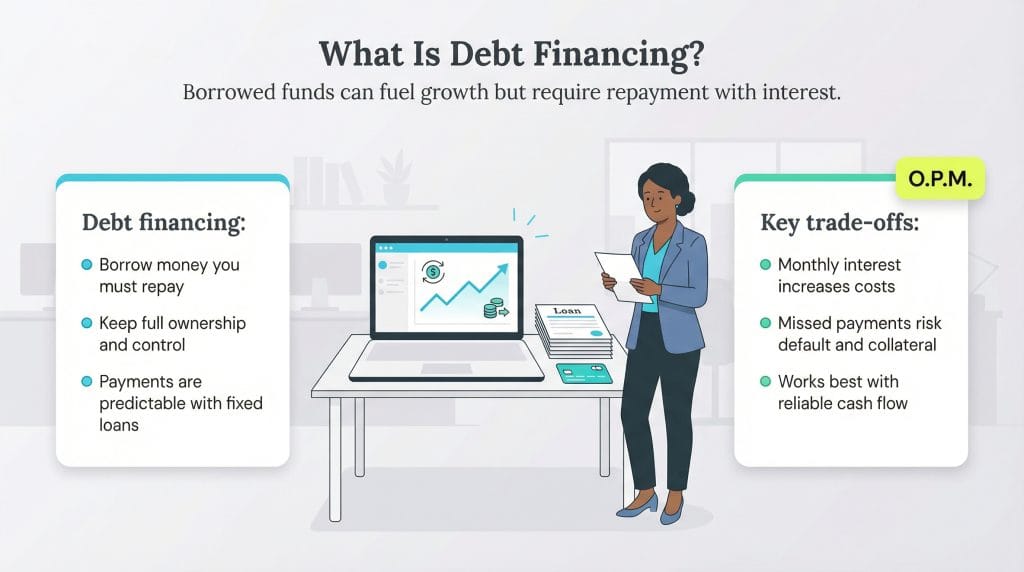
Debt financing involves taking out a loan to fund your startup. As with any loan, you pay back the principal with interest over a specified time period. Term loans and lines of credit are two common types of business loans.
“Debt financing in simple terms is ‘using other people’s money,’ a.k.a. O.P.M. In exchange, you pay them interest for a specific period of time until paid back in full,” said Katrina Cooks Fitten, CEO and CFO of New Day For You Financial.
>> Looking to borrow money? Check out our picks for the best small business loans.
These are some of the benefits of debt financing.
These are some drawbacks of debt financing.
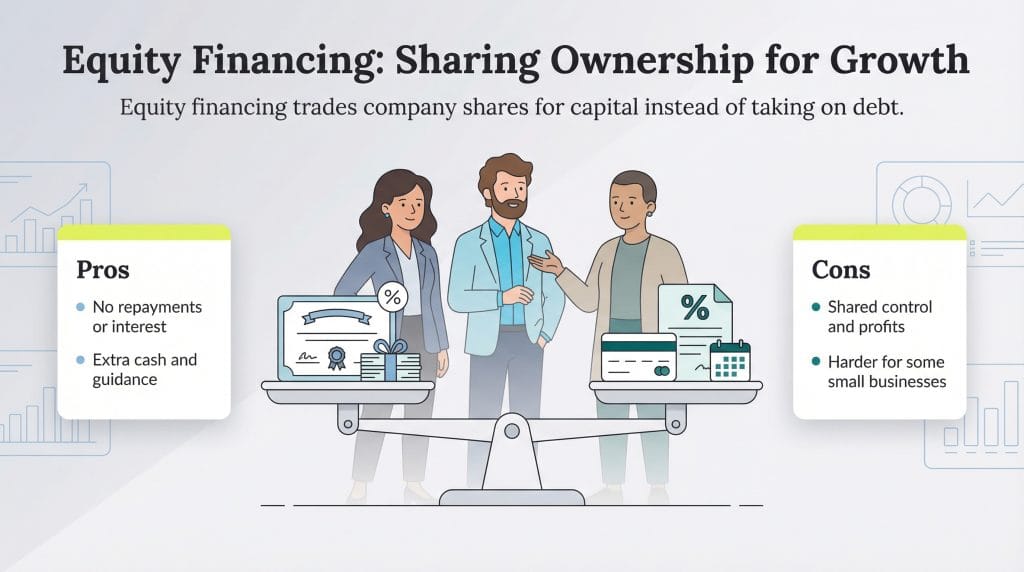
Equity financing involves selling a stake in your company to an investor in exchange for the capital your business needs to grow.
“Instead of a loan, someone is investing in your business and typically receiving shares of the company in return,” said Joe DiSanto, a fractional CFO and financial consultant. “Essentially, you’re taking on a partner who now owns a portion of the company.”
Startup investors include angel investors and venture capitalists. Angel investors are often individuals who provide early-stage funding, while venture capitalists are firms that step in at a later stage.
These are some of the advantages of equity financing as a source of capital.
The drawbacks of equity financing primarily relate to the ownership you grant your investor.
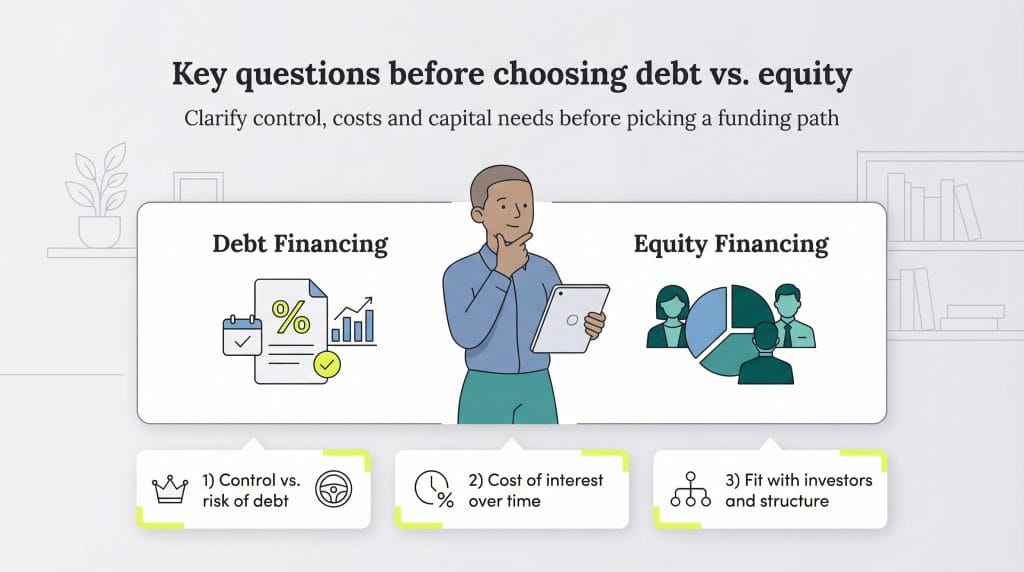
Before you decide between debt and equity financing, you should ask yourself the following questions.
Are you the kind of business owner who can’t stand the thought of sharing decision-making authority with someone else? Then you might see debt financing as your way out. However, let’s say you forecast your budget and determine that you might struggle to repay debt financing. In this case, it may be best to play it safe and accept the loss of control that accompanies equity funding.
Interest rates deserve careful attention when weighing your debt financing options. Even a modest rate shift can significantly drive up borrowing costs — a reality many business owners learned firsthand during recent Federal Reserve rate cycles. Average interest rates on commercial and industrial loans have shifted considerably in recent years, making it critical to assess your repayment capacity before committing. Interest rates can make or break a new company, especially because it often takes years for a startup to achieve profitable growth.
Do you need so much capital that you’re already worried about repaying the debt financing for it? If so, equity financing may be a safer bet. However, when you provide equity in return for a large amount of capital, your investors will likely require a proportionately large share of your company. If your investor requests more than 50 percent ownership of your company, your decision-making authority could disappear. This is especially true when you are no longer a startup.
Equity financing requires you to give ownership shares to your investors. However, not all business structures can easily explore this funding route. For example, if your company is a partnership, its ownership structure may not be flexible enough to accommodate new shareholders. You can always change your type of business operation, but it’s a lengthy process. [Learn how to dissolve a partnership agreement.]
Entrepreneurs often assume equity financing is readily available, but that isn’t always true. Not all business owners find investors who are interested in their companies. Other startup founders find investors only after months of searching. So, this funding option might not work for you if you need cash fast.
“For many tech startups and early-stage companies, equity financing is often the default choice,” said Jung. “These businesses typically lack the hard assets or steady cash flow required to secure traditional debt. Exceptions may include venture debt, which is underwritten based on institutional backing rather than cash flow.”
Beyond startups, equity financing is also well-suited for businesses planning significant expansion or scaling efforts — such as acquiring another company, launching new product lines or entering new markets. According to the National Venture Capital Association’s 2024 Yearbook, U.S. venture capital investment totaled more than $170 billion across nearly 14,000 deals in 2023, underscoring that equity capital remains a viable and active funding path for high-growth businesses.
On the other hand, debt financing providers will lend money to virtually any entity that qualifies. Can you show a strong credit history, present a convincing business plan and prove that you can repay the loan? If so, you might be in good shape for approval.
Whether you ultimately go with debt financing, equity financing or both, the right choice depends on your business model, growth stage and long-term goals. Taking time to evaluate both options thoroughly puts you in the best position to fuel sustainable growth.
Anna Baluch and Mike Berner contributed to this article. Source interviews were conducted for a previous version of this article.