Business.com aims to help business owners make informed decisions to support and grow their companies. We research and recommend products and services suitable for various business types, investing thousands of hours each year in this process.
As a business, we need to generate revenue to sustain our content. We have financial relationships with some companies we cover, earning commissions when readers purchase from our partners or share information about their needs. These relationships do not dictate our advice and recommendations. Our editorial team independently evaluates and recommends products and services based on their research and expertise. Learn more about our process and partners here.
Business.com earns commissions from some listed providers. Editorial Guidelines.
Table of Contents
Editors Score:9.4/10
Zoho CRM's extensive lead management, team collaboration, AI-powered tools, workflow automation and analytics, along with its vast list of available integrations, make it our pick for the best CRM for growing businesses.
Pros
Zoho's AI tools, including its Zia assistant, stand out for the practical insights they provide. They can help qualify leads, spot business trends and buyer intent, identify new opportunities and automate routine tasks.
Zoho offers a wide range of reporting and visualization tools, including butterfly charts that compare two datasets side by side.
The vendor offers a comprehensive selection of apps and business integrations through Zoho Marketplace, so you can combine all the tools you need in one system.
Cons
Zoho's Standard plan is affordable, but it lacks key features like Google Ads integration, contact deduplication, data encryption and webhooks.
Many of Zoho's advanced AI features and automation tools are locked behind higher-tier plans.
With five plans and a wide range of features, choosing the most cost-effective option can be challenging.
All businesses appreciate an affordable, intuitive and well-designed customer relationship management (CRM) platform. However, growing businesses need flexible CRM software with specific features, including extensive customization options. Zoho CRM fits the bill perfectly, offering sales, marketing, customer service and collaboration tools to help companies manage growth. Zoho’s usability can reduce stress and improve performance across your teams, while its customization options and AI-powered tools help you create a tailored solution that grows with your business. This highly usable platform packs a lot of power without breaking the bank.
Zoho CRM Editor's Rating:
9.4 / 10
Pricing/value
9.7/10
Features
9.5/10
Customization, add-ons and integrations
9.1/10
Ease of use
9.6/10
Customer service
9.3/10
Why We Chose Zoho as the Best CRM for Growing Businesses
Growing businesses face unique challenges and pressures. Ramping up employee numbers and boosting revenue while running your business can be challenging. However, marketing and selling efficiently while also growing and sustaining customer relationships is crucial.
Zoho CRM is an easy-to-use, uncluttered and scalable CRM system that grows with your business. It’s easy to implement and adopt due to its intuitive user interface, while its built-in AI tools power a wide range of features, from contact and deal management to prospecting and advanced data analytics. Zoho’s omnichannel communication features ensure all your customer conversations are managed from a single, central location, improving response times and helping your team stay on top of every customer interaction.
Setup and training time are minimal, which is a huge plus for a busy, growing business. Support on paid plans is available through Zoho agents or an online knowledge base when you need it. Additionally, Zoho’s extensive app marketplace allows you to connect the platform to many popular business tools, as well as other products within Zoho’s ecosystem.
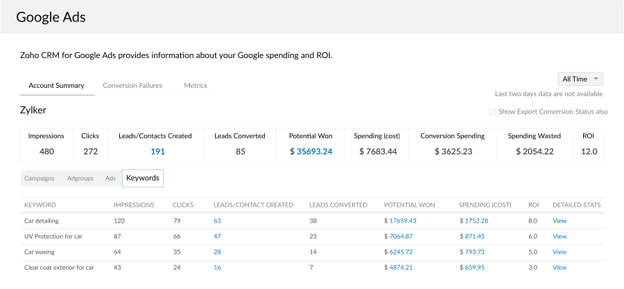
Zoho CRM’s Google Ads integration lets businesses monitor campaign performance, lead conversions and return on investment from a centralized dashboard. Source: Zoho
FYI
If your business eventually outgrows Zoho CRM, Zoho CRM Plus is a separate customer experience platform that combines CRM, customer service, marketing, analytics and other business applications into one integrated solution. Businesses already using Zoho CRM can upgrade to CRM Plus as their needs evolve instead of moving to a different vendor.
Ease of Use
We were impressed by Zoho’s pleasingly simple interface. Here are a few elements we felt added to the platform’s ease of use:
Navigation bar: Zoho’s navigation bar gives you quick access to sales tasks, notifications and modules. Like many other features in the platform, it can be customized to match your sales process.
Manager’s Home view: In addition to classic, personalized and custom homepages, Zoho offers a Manager’s Home view to help sales leaders track and analyze their team’s daily work. It displays key performance indicators (KPIs) like newly generated leads, deals and revenue by default but can be tailored to your needs.
No-code dashboard and form builder: We liked Canvas, Zoho’s no-code dashboard and record form builder. It lets you build customized interfaces for users and departments, choose from a range of templates, apply your brand styles and drag and drop custom elements with ease. In our experience, the process is straightforward enough that even technically cautious users should feel comfortable customizing their workspace.
Marketplace: The sidebar makes it easy to access Zoho Marketplace, where you can connect third-party apps and other Zoho products like Zoho Projects, Zoho Campaigns and Zoho Desk.
Sandbox: If you have developers who like to work “under the hood,” Zoho CRM includes a sandbox for testing custom apps and workflows before deploying them. The platform also offers six APIs, including REST APIs, and supports multiple programming languages.
Mobile apps: We appreciate that Zoho offers mobile apps for iOS and Android. That’s a valuable feature for businesses with remote staff and sales representatives. Zoho’s mobile apps are intuitive and functional for both managers and other users, giving growing businesses even more flexibility.
Tip
Zoho's customer support team promises response times as short as one hour, depending on your service plan. This is a particularly helpful perk for businesses switching to a new CRM.
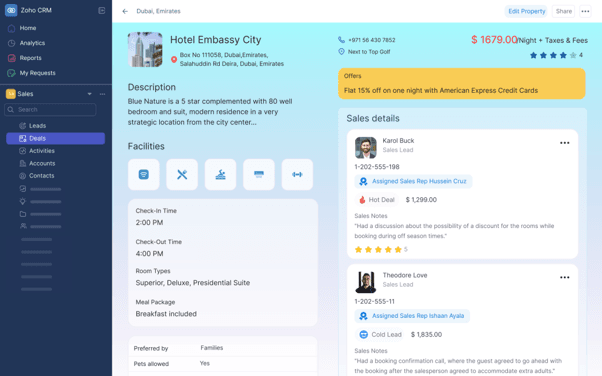
Caption: Personalize your Zoho CRM home page using Zoho Canvas with no code required. Source: Zoho
Zoho CRM Features
Zoho offers a wide range of CRM features for growing businesses. Here are a few we found particularly notable.
Customization
Zoho’s customization options are more extensive than many competitors we reviewed. All Zoho CRM paid plans include customization features, such as custom fields and list views. We also like that you can share your custom setup with other team members. That’s uncommon among the CRMs we reviewed and helps keep everyone working from the same configuration. Another standout is Canvas, Zoho’s no-code design studio, which lets you customize record pages and interfaces without writing code.
We were particularly impressed by the customization functionality offered on Zoho’s Enterprise plan, which allows you to:
Create advanced custom views
Change page layouts
Add custom buttons and conditional fields
Build custom modules with AI-assisted prompts
At the Ultimate level, you get higher limits for custom modules and fields, along with enhanced customer support.
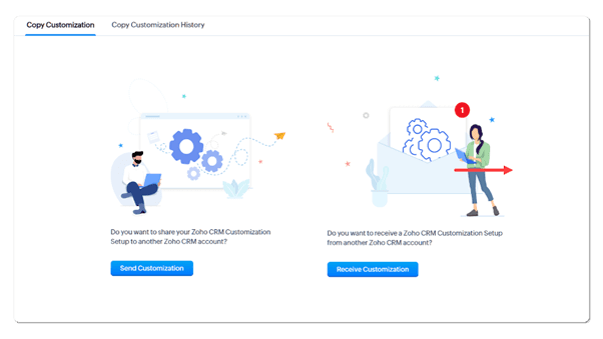
Zoho lets you share and receive custom configurations from your team, speeding up setup and helping ensure consistency. Source: Zoho
Information Sharing and Automation
As companies grow, they must become proficient at lead generation and converting prospects into customers. Zoho helps growing businesses accomplish these tasks with strong information-sharing and automation features. Here are some highlights:
Information-sharing: We were pleased to see that Zoho gives sales, marketing and customer service teams access to the same up-to-date information. This allows them to share insights, collaborate more effectively and work toward the same goals. Users can also share dashboards with teammates or clients through direct email links or exported PDFs and PNGs.
Workflow automation: Sales managers can identify repetitive but necessary tasks and create workflow automations to streamline them, freeing staff to focus on more valuable work. Zia, Zoho’s AI assistant, uses trigger-condition-action logic to build workflows that nurture leads, support onboarding and update customer records automatically as they move through the sales funnel. It can also suggest workflows based on past activity and generate them with AI prompts.
Lead automation: Zoho’s lead automation tools also impressed us. The CRM captures leads from multiple channels, including web forms, website chatbots and social media, and makes them available immediately to your sales team. We especially liked the integration with Zoho SalesIQ, which identifies high-potential website visitors and adds them to the CRM for timely follow-up. Zoho also tracks touchpoints across the customer journey, helping marketing teams identify where prospects drop off and refine their campaigns.
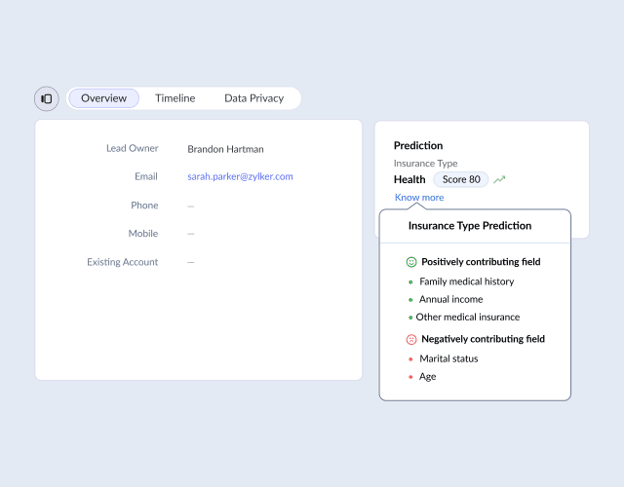
Automated lead scoring: We found Zoho’s lead scoring tools particularly useful. After prospect information is captured and analyzed, Zia identifies the leads most likely to convert so your sales team can prioritize follow-up efforts. It can also evaluate deal health based on engagement, activity history and other CRM signals. (Another top CRM, monday.com, also offers excellent lead-scoring functionality.)
Zia, Zoho’s AI assistant, helps analyze a deal’s health and score it depending on a range of factors, including engagement and follow-ups. Source: Zoho
Did You Know?
Zoho CRM also helps automate campaign management. For example, in-house marketing teams can manage Google Ads and other campaigns from within the platform.
AI Integration
AI has become a key differentiator among today’s CRM platforms, and Zoho has invested heavily in expanding its AI capabilities. We were impressed not only by Zia, Zoho’s AI assistant, but also by the platform’s growing collection of AI-powered sales, automation and analytics tools. Here’s an overview:
Zia: Zia has evolved well beyond a simple AI chatbot. It provides a conversational interface that lets users ask questions in natural language — including by voice — and retrieve insights from CRM data almost instantly. We liked how it can analyze team performance, summarize customer interactions, detect trends and identify potential risks before they become problems. Zia also helps automate repetitive work by generating emails and workflows, recommending the best time to contact prospects, scoring leads, analyzing deal health and customer sentiment, enriching contact records and suggesting upsell and cross-sell opportunities. One of the most notable additions is Zia Agents, AI assistants that can automate specific sales and business tasks while helping sales reps prepare for customer conversations.
Zia Hubs: Zia Hubs expands AI beyond CRM records by letting businesses connect documents and other business content stored in Zoho WorkDrive. It can search PDFs, documents, presentations, videos and other supported files, answer questions using that information and provide citations back to the original source. Businesses can also organize and automate document management for projects and departments.
Zia LLM: Zoho has also introduced its own large language model, Zia LLM, giving businesses another option for running AI tasks without relying exclusively on third-party AI providers. The company says this can help organizations with stricter privacy or data-governance requirements keep more AI processing within the Zoho ecosystem. Zoho still integrates with external models when businesses prefer that approach.
Creator: We also liked Zoho Creator, the company’s no-code application builder. Creator lets users build custom business apps, automate workflows and create AI-powered processes with little or no coding. More recently, Zoho has added generative AI capabilities that allow users to create applications, reports, workflows and other components using natural-language prompts, making it even easier for growing businesses to customize the platform.
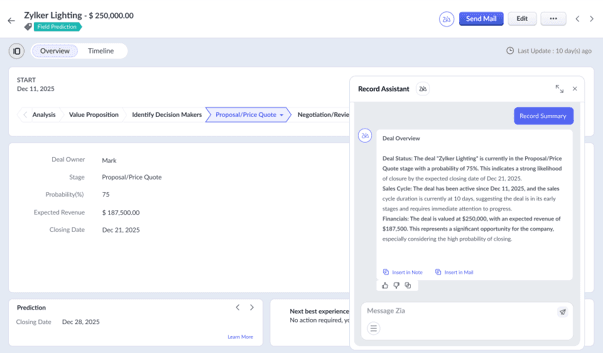
Zia AI can quickly summarize CRM records and retrieve key business insights using simple natural-language prompts. Source: Zoho
Omnichannel Capabilities
Omnichannel communication is a game-changer for businesses that want to interact with customers through their preferred channels. We were impressed with Zoho’s well-executed omnichannel capabilities, which compare favorably with other CRM systems we reviewed.
Zoho offers the following omnichannel capabilities:
Telephony: Connect to more than 130 telephony systems, set up call reminders, auto-log and record calls, use call analytics to measure sales and service team performance and create a list of blocked numbers to avoid spam calls. Zia can also recommend the best time to call or email customers based on past interactions.
Email marketing: Send and receive customer emails, automate follow-ups and launch email marketing campaigns through the integrated Zoho Campaigns platform.
Social media: Manage your social media marketing and accounts, monitor brand mentions, engage with customers and organize campaigns from within the CRM.
Messaging apps: Send and receive messages through apps including WhatsApp, Facebook Messenger, WeChat and LINE, keeping customer conversations in one place.
Website: Add live chat to your website with Zoho SalesIQ, deploy AI-powered chatbots and create web forms to capture leads and customer inquiries.
Zoho’s omnichannel tools are impressive and can drive significant business benefits by helping sales teams respond faster, maintain conversation history across channels and uncover new sales opportunities. This is a major plus for growing companies.
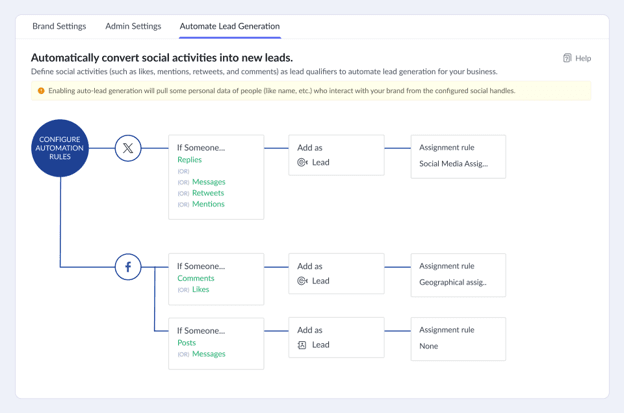
Zoho allows you to add CRM leads directly from connected social media channels. Source: Zoho
FYI
Freshsales by Freshworks is another CRM with strong omnichannel capabilities, though its features are especially well-suited for sales teams and sales managers. Read our review of Freshworks to learn more.
Data Analytics
We love that Zoho offers abundant CRM metrics and AI-powered analytics that take the guesswork out of strategic decisions. Custom reports and cohort metrics help business owners examine data from multiple angles by curating information from marketing campaigns, quotes, leads, deals and sales activities.
Here are a few data analytics features that stood out to us:
Anomaly Detector: Zoho’s AI-powered Analytics tool highlights potential issues in your sales process so you don’t have to dig for bottlenecks. It also identifies positive anomalies, like a surge in website visits or purchases of a specific product, so you can act on the opportunity. The platform’s Comparator and Quadrant Analysis features can help you discover your best-performing products or sales reps.
CRM reports: Create CRM reports from scratch or choose from several templates before exporting or sharing them as CSV, Excel or PDF files. We like that you can share reports with team members and stakeholders outside your Zoho account, making this a great option for budget-conscious small businesses. Zoho’s robust filtering options are impressive, allowing you to focus on the data that delivers meaningful insights. You can turn reports into charts quickly and add them to custom dashboards with just a couple of clicks, while Zia can also help generate reports and presentations from your CRM data, making it easier to surface meaningful insights.
ABM add-on: The Zoho ABM (account-based marketing) add-on helps users identify high-value accounts, enrich them with available data and segment them for highly targeted follow-ups. Companies can also use this information to build personalized email campaigns that nurture their most promising leads.
Data visualization options: We were impressed by Zoho CRM’s data visualization tools, including Sankey diagrams, treemap charts and other advanced chart types, which let you view key KPIs in a way that suits your team.
Target Meters: We liked Zoho’s Target Meters, which let you set goals and monitor performance in real time. Growing businesses face pressure to drive revenue while managing expansion costs. Target Meters help identify the most profitable areas to focus on, keeping cash flow healthy. We also appreciate that Zoho offers multiple meter styles, including dial gauges and traffic lights, adding a touch of gamification to an otherwise stressful process.
Configure, Price, Quote (CPQ): We also liked Zoho’s built-in CPQ functionality. While some other CRMs offer CPQ through third-party tools, Zoho’s is built directly into the platform. Zia AI can update quotes automatically with relevant add-ons and suggest products to support your team’s cross-selling and upselling efforts. (Read our Pipedrive review to learn how this platform handles CPQ functions.)
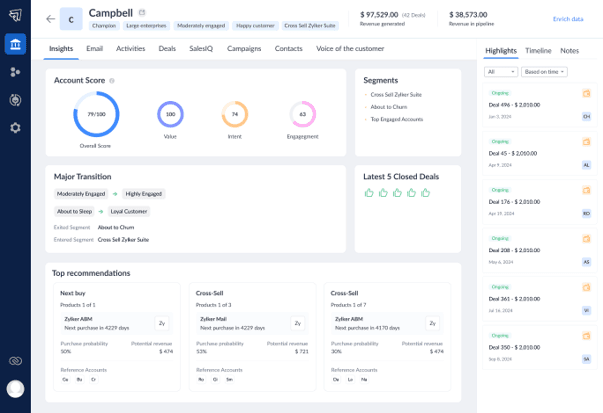
Zoho’s ABM add-on presents key account information for your most promising leads on a single custom dashboard. Source: Zoho
Tip
To encourage healthy workplace competition, use Zoho's Motivator to visualize and track KPIs while rewarding top performers with digital trophies.
App Marketplace
Many CRMs offer app marketplaces, but Zoho makes integrating tools especially easy. The Zoho Marketplace spans dozens of categories across the company’s product ecosystem, while the CRM section alone includes more than 20 categories, including marketing, employee collaboration, analytics and WhatsApp. Its expansive app store supports your business as it grows.
Here’s what stands out about Zoho’s marketplace:
Breadth of options: Zoho has one of the largest marketplaces among CRM providers, featuring more than 2,500 extensions and 1,100 ready-to-go integrations. Users can access 160-plus custom apps and choose from integrations with popular tools, including Zoom, Zapier, Twilio, DocuSign, Shopify and PandaDoc. Essential business apps like Google Workspace, Microsoft Teams and Slack are also available, along with social platforms like Facebook and LinkedIn.
Industry-specific tools: Additional vertical-specific solutions are also available, including Zadarma for phone systems and Credit Data Direct, which features a loan calculator and allows users to import consumer and business credit reports directly into the CRM.
Connect to the Zoho ecosystem: We also appreciate how easy it is to integrate Zoho CRM with dozens of other Zoho products, including Zoho Projects for project management, Zoho Desk for customer service and Zoho Assist, which is among the best remote PC access software solutions available.
App overviews: Many integrations include short videos that highlight an app’s functionality. We love how these make the integration process even easier.
FYI
Our review of HubSpot CRM spotlights this CRM platform's similarly impressive marketplace and streamlined app integrations.
Mobile App
We like that Zoho CRM’s mobile app offerings go beyond the basics to provide valuable tools for users. Here’s an overview of its mobile apps that complement the CRM software:
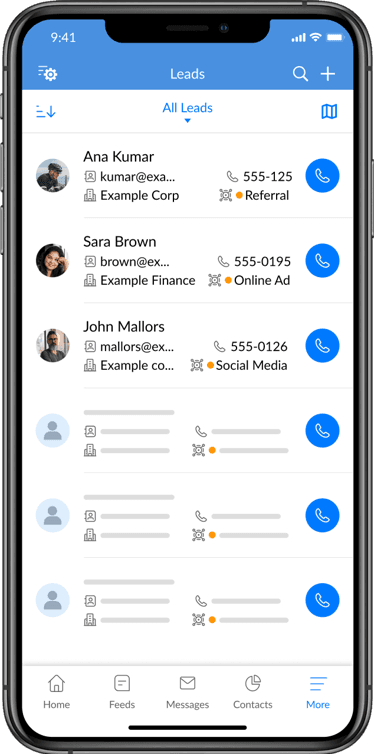
Zoho CRM app: This is the primary app for managing CRM data, including leads, contacts, deals and tasks. We like that it includes interactive dashboards, anomaly alerts, voice notes, call logging, map integration, offline access and collaboration tools.
Zia (in-app AI assistant): We were impressed that Zia is built into the CRM app. It helps reps update records, add notes and manage the sales pipeline with ease. Users can also trigger Zia with voice commands by saying “Hey, Zia.”
Zoho Card Scanner app: This separate app allows users to snap a photo of a business card and send the details directly into Zoho CRM. It’s a great tool for quickly capturing lead information at events or meetings.
Zoho One app: For Zoho One users, this app provides access to 45-plus Zoho applications, including CRM, marketing, support, human resources and more, from one place.
Other mobile tools: We also like that Zoho offers apps for team messaging, document scanning and task management. These extras extend functionality and help keep work moving wherever your team is.
Tip
Connect Zoho CRM to Zoho RouteIQ (available as an add-on) to build optimized sales routes with visual maps and turn-by-turn navigation.
Zoho’s CRM mobile app lets users view leads, contact details and lead sources from anywhere. Source: Zoho
Zoho CRM Pricing
Zoho offers one of the strongest free CRM plans we tested. Unlike many competitors, its free edition doesn’t require a credit card, force upgrades or lock key features behind paywalls, making it an easy way to explore the software before committing.
Beyond the free plan, Zoho offers Standard, Professional, Enterprise and Ultimate tiers. The vendor publishes a detailed feature comparison covering nearly 400 features across more than 20 categories, making it easy to verify whether a specific capability is included before upgrading.
Here’s a summary of how the plans compare.
Plan
Pricing
Highlights
Free
$0
Up to three users
Basic lead and deal management
Basic workflow automation
One sales pipeline and one web form
Standard reports and limited email templates
1 GB storage
Mobile app access
Standard
$14 per user, per month (billed annually)
$20 per user, per month (billed monthly)
Everything in the Free plan, plus:
Email integration and 250 mass emails daily
Lead scoring, sales forecasting and multiple pipelines
Multiple web forms
Unlimited custom dashboards and lead forms
Custom fields, modules and reports
Charts, KPIs and social data enrichment
AI Studio customization
Zoho Marketplace integrations
Professional
$23 per user, per month (billed annually)
$35 per user, per month (billed monthly)
Everything in Standard, plus:
Inventory management
AI-powered email and call transcription, translation and analysis
Quote and invoice management
Workflow blueprints and webhooks
Recommendation analytics
Unlimited custom list views
Google Ads integration
Enterprise
$40 per user, per month (billed annually)
$50 per user, per month (billed monthly)
Everything in Professional, plus:
Conversational AI (Zia)
AI-powered sales insights
Advanced analytics and customization
Custom modules, buttons and page layouts
Territory-specific forecasting
Autoresponders and multiuser portals
Sandbox environments and data enrichment
Ultimate
$52 per user, per month (billed annually)
$65 per user, per month (billed monthly)
Everything in Enterprise, plus:
Premium Analytics subscription
Dedicated database clusters
Data storytelling
Higher storage and feature limits
Enhanced customer support
5 GB of free file storage plus 1 GB per user license
Additional pricing considerations include the following:
Free trials: Ultimate includes an extended 30-day free trial. Standard, Professional and Enterprise each include a 15-day free trial.
Feature comparison: Zoho’s online comparison tool is one of the most detailed we’ve seen, covering nearly 400 features across more than 20 categories. However, the sheer volume of information can be overwhelming, and we’d like to see a summary or highlights view to make comparing plans easier — especially on mobile devices.
File storage: Paid plans include increasing amounts of storage as you move up the pricing tiers, with additional storage available for purchase.
No setup fees: Zoho does not charge setup fees.
Impressive entry-level plan: We were impressed by how much functionality Standard includes. Many competitors reserve capabilities like multiple pipelines, lead scoring and sales forecasting for higher-priced plans.
Did You Know?
Even on the Standard plan, Zoho's daily email limits are generous. Read our Zendesk CRM review to compare its email limitations.
Onboarding and Implementation
Putting aside the complexity of choosing between five different product tiers, Zoho’s CRM implementation process is quick and easy, thanks to detailed instructions on the company’s website and the provided sample data. All paid Zoho customers receive personalized onboarding assistance from a specialist who guides you through a tailored implementation plan through a series of remote one-on-one meetings and demos, helping you set up and configure the platform to meet your needs. For instance, customers with Classic support receive four one-on-one, 90-minute online sessions with video recaps.
A few deployment steps are required before the CRM is ready to use:
Enter the time zone, language and basic company information.
Configure the security settings.
Set user roles and permissions.
Invite your team members.
Customize the modules, record details and page layout.
Import existing data.
Connect your email account and preferred apps.
Most of these steps can be completed within a few days, although more extensive customization and integrations may require additional time as your business needs become more clearly defined.
Tip
If you need extra help or prefer to hand off implementation, Zoho offers a Jumpstart service with a dedicated implementation specialist. Pricing starts at $200 per hour with a minimum of 10 hours of service.
Customer Support
In addition to a wealth of online resources, Zoho CRM offers four support levels:
Basic: Included with Zoho’s free plan; offers email support within one to two business days.
Classic: Included with all paid plans. You receive email, phone and chat support, as well as remote assistance for smoother troubleshooting. Support is available eight hours per day, five days per week, with a maximum eight-hour initial response time. Classic Support also includes four one-on-one, 90-minute onboarding sessions with video recaps at no additional cost.
Premium: Costs an additional 20 percent of your subscription fee. You receive 24/5 support via live chat, phone, email and remote assistance, with a maximum three-hour initial response time. Premium Support also includes a dedicated onboarding specialist who creates a personalized implementation plan and provides guided one-on-one onboarding sessions tailored to your business.
Enterprise: Costs an additional 25 percent of your annual subscription fee and requires a minimum of 50 user licenses. You receive 24/7 support via live chat, phone, email and remote assistance, along with a maximum one-hour initial response time. Enterprise Support also includes a dedicated Technical Account Manager, quarterly feature usage reports with recommendations, personalized product demos and early access to new features.
Did You Know?
If your business expects to rely heavily on Zoho CRM, Premium and Enterprise Support offer more than faster response times. Both plans provide personalized guidance that can help your team get more value from the platform over time.
Limitations
Zoho CRM has many upsides, but we did identify the following potential drawbacks:
Complexity: While we applaud the variety of plans on offer, choosing one quickly becomes daunting if you’re not steeped in CRM terminology. To help simplify the process, Zoho introduced its Edition Selector, which recommends a plan based on your business needs.
Feature availability: Zoho CRM’s tiered plans mean you may need to upgrade to access a specific feature your business needs. For example, Google Ads integration is available only with the Professional plan and above. We were also surprised that Zoho Marketplace integrations aren’t included with the Free plan.
Performance: During our testing, Zoho CRM was responsive, but some users have reported occasional slowdowns. If your team spends most of the day in the CRM, it’s worth keeping this feedback in mind.
One thing we found mildly frustrating is Zoho’s website geolocation. If you’re researching the product outside the United States, you may have to switch regions to view U.S. pricing and contact information.
All in all, Zoho CRM is an excellent choice for growing businesses that want powerful customization, automation and AI features without enterprise-level pricing. However, organizations with highly complex sales operations or extensive enterprise requirements may prefer a platform like Salesforce. Read our Salesforce CRM review and Salesforce vs. Zoho comparison for a deeper look at its advanced features.
When evaluating the best CRM software, we conducted in-depth comparative research on dozens of solutions. Our review process included communication with customer support teams, evaluations of product functionality, attending live webinars and reviewing tutorials and support materials. We also took pricing into account. When identifying the best CRM for growing businesses specifically, we examined mobile app functionality, lead and deal management, sales automation, reporting and analytics, customization options and available integrations. Our goal is to help you find the right CRM for your business.
Zoho CRM FAQs
Zoho CRM offers a free plan with basic lead and deal management features, a document library, limited workflow automation, email integration and standard reporting. All paid plans include a complimentary 15-day trial to help you evaluate more advanced features (30 days for the Ultimate plan). Zoho also offers a free version of its pipeline-based CRM solution, Bigin, for entrepreneurs and very small businesses that are ready to move beyond spreadsheets but don't necessarily need full CRM functionality.
While it offers feature-rich Enterprise and Ultimate plans, Zoho CRM is best suited for small and midsize businesses that want to track contacts, deals and team performance while managing sales activities on the go with its mobile apps.
Bottom Line
We recommend Zoho CRM for …
Companies that want to connect their CRM with customer support, marketing and other business tools, especially those already invested in the Zoho ecosystem.
Small and midsize businesses seeking relatively advanced CRM functionality at an affordable price to support scaling.
Companies looking for an AI-powered CRM they can customize with low-code or no-code tools.
We don’t recommend Zoho CRM for …
Large enterprises with highly complex sales operations or governance requirements that are better served by enterprise platforms like Salesforce.
Businesses that prefer an all-inclusive pricing model instead of unlocking features through higher-tier plans.
Businesses looking for a simple, out-of-the-box CRM with minimal setup or customization.
Mark Fairlie brings decades of expertise in telecommunications and telemarketing to the forefront as the former business owner of a direct marketing company. Also well-versed in a variety of other B2B topics, such as taxation, investments and cybersecurity, he now advises fellow entrepreneurs on the best business practices.
At business.com, Fairlie covers a range of technology solutions, including CRM software, email and text message marketing services, fleet management services, call center software and more.
With a background in advertising and sales, Fairlie made his mark as the former co-owner of Meridian Delta, which saw a successful transition of ownership in 2015. Through this journey, Fairlie gained invaluable hands-on experience in everything from founding a business to expanding and selling it. Since then, Fairlie has embarked on new ventures, launching a second marketing company and establishing a thriving sole proprietorship.