Business.com aims to help business owners make informed decisions to support and grow their companies. We research and recommend products and services suitable for various business types, investing thousands of hours each year in this process.
As a business, we need to generate revenue to sustain our content. We have financial relationships with some companies we cover, earning commissions when readers purchase from our partners or share information about their needs. These relationships do not dictate our advice and recommendations. Our editorial team independently evaluates and recommends products and services based on their research and expertise. Learn more about our process and partners here.
Google Ads helps businesses reach customers at the exact moment they're searching for products, services and solutions online.


Marketing is all about reaching the people interested in buying your products and services. What better way to reach them than advertising on the world’s most popular search engine? Alongside Google’s other valuable marketing tools, including Google Analytics, Google Trends and Google Search Console, Google Ads is one of the most effective ways to get your business in front of motivated buyers.
Through Google Ads, businesses can reach people using Google Search, Gmail, Google Maps and YouTube to find information, products and services online. In this guide, we’ll explain what Google Ads is, how it works and how to use it to connect with the right customers at the right time.
Google Ads is a platform where businesses pay to display ads that potential customers see when they search for relevant terms across Google’s platforms. Google Ads (formerly known as Google AdWords) can be a vital part of a business’s digital marketing strategy, helping companies place relevant ads in front of their target audience.
“Due to great reach and effective targeting, every business entity should grow with Google Ads,” advised Tom Jauncey, head nerd at Nautilus Marketing. “Having over a couple of billion searches a day, Google presents unparalleled access to customers.”
Almost every time you see a company’s sponsored listing appear near the top of Google search results, it’s not simply the result of strong search engine optimization (SEO). The business likely has a Google Ads campaign running alongside its organic search efforts. Today, Google labels these paid placements with a “Sponsored” tag so users can distinguish them from organic results.
Through Google Ads, you pay only for actual, measurable results, such as website clicks and business calls. This structure is known as a pay-per-click (PPC) campaign. You can set a monthly ad spend cap that Google will automatically follow, and you can target customers in specific neighborhoods, cities, regions, countries or worldwide.
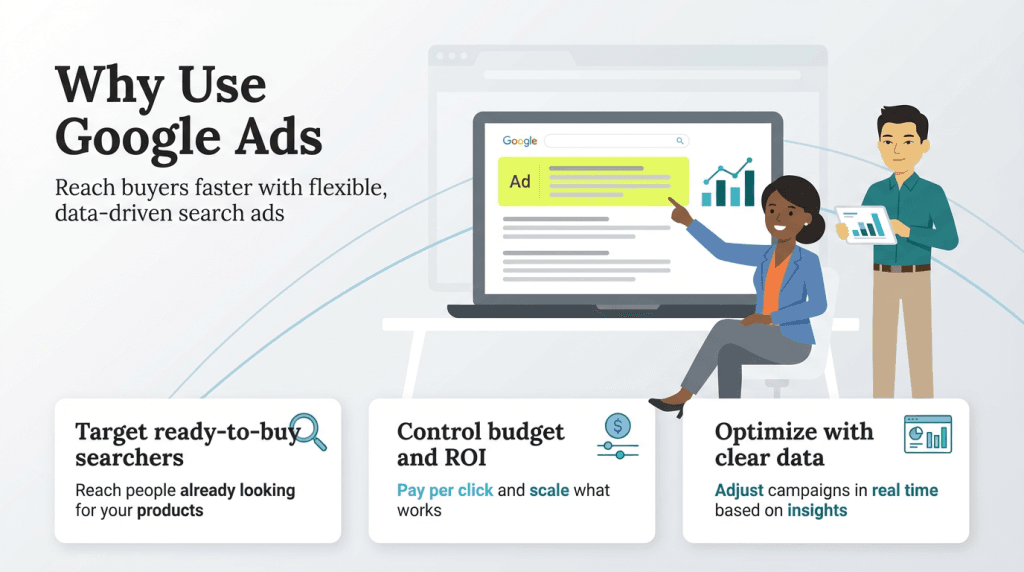
Here are some top benefits of using Google Ads in your digital marketing strategy.
Google Ads is one of the best tools around for generating sales leads. If your campaigns are set up properly, they can send highly targeted leads to your website, opt-in form or other online destinations designed to turn interest into action.
Google Ads lets you zero in on people who are actively searching for what your business offers. That means you can continually refine your targeting so your budget is spent on the people most likely to convert — not just browse.
“Businesses should use Google Ads because it helps them quickly reach people who are looking for what they offer,” noted Ross Kernez, founder of SEO Meetup. “It boosts visibility, brings in potential customers and can increase sales, all while letting businesses control their budget.”
Anyone who regularly uses Google Ads will tell you it’s an extremely flexible marketing tool for organizations of all types and sizes. This platform can essentially turn internet traffic on and off. It’s also compatible with a wide range of other marketing platforms and software systems.
You can easily customize campaigns to focus on specific types of potential customers. For example, you can target people by location, device type and the Google-owned platforms they’re using, such as Google Search, Google Maps and YouTube.
You can also set your own budget for specific campaign areas — including daily spending caps and maximum bid amounts for individual keywords — giving you precise control over costs no matter how large or small your marketing budget is.
“Google Ads offers plenty of options for small businesses to compete with larger companies without overspending,” explained Rob Sanders, a Google Ads specialist and founder of the digital marketing agency Socially Found. “With tools like local targeting and customizable budgets, [businesses] can ensure their ads are only seen by the people who are more likely to become customers.”
Unlike many other marketing strategies, Google Ads lets you pay only when someone actually clicks on your ad. Once your campaigns are optimized, Google Ads can deliver a strong digital marketing ROI, especially when your ads reach people who are already searching for what your business offers.
However, figuring out which marketing approaches work best for your business can take time. You need to continually test, track and fine-tune your campaigns to get a clearer picture of what’s actually driving results. Google Ads is ideal for this because performance data is easy to access, easy to measure and updated in real time.
“Google Ads provides a wealth of data to track and measure your campaign performance,” said Max Shak, founder and CEO of the digital marketing agency nerD AI. “You can see exactly what’s working and make real-time adjustments to optimize your spend.”
When you identify areas of your campaign that deliver a strong ROI, concentrate your efforts and budget there. If a campaign — or parts of one — are spending money without producing results, cut those elements and redirect the savings into what’s already working or into future initiatives.
Google Ads gives businesses quick access to performance data and the tools to do something with it. The platform’s dashboard puts everything in one place, from the keywords driving visitors to your site to the exact cost of each click, so it’s easier to see what’s gaining traction, what needs attention and where a campaign may need a quick adjustment.
“One of the biggest advantages of Google Ads is the access to valuable data,” Sanders said. “This allows businesses to understand customer behavior and fine-tune their ads to reach the right people. With tools to help optimize their Google Ads account, they can adjust bids in real-time to get the best results based on a customer’s interests and intent.”
Because of Google’s market dominance and enormous user base, the search giant can send businesses significant traffic every day, depending on their budget. Google continually updates its search algorithms to better match users with relevant content, products, services and ads.
Those ongoing algorithm improvements can benefit businesses advertising through Google Ads by helping their campaigns reach people with stronger purchase intent. These ads can send qualified leads and visitors to your website, e-commerce store, opt-in form or other online assets. And because those people are already searching for what you offer, they’re often more likely to opt into your email marketing list, request information, make a purchase or take the next step.
Understanding your ideal customers is crucial if you want to deliver the products, services and messaging they’re actually looking for. Traditional market research methods, such as questionnaires and interviews, can absolutely be valuable, but they often provide only a snapshot of what customers think, want or remember.
Google Ads, on the other hand, gives you real-time insight into customer behavior that business owners of previous generations could have only dreamed about. Over time, you’ll start to see things like:
This information can help you sharpen your products and services to better match what your audience actually wants. It can also fine-tune your marketing efforts, so you’re not spending money advertising to people who were never likely to convert in the first place.
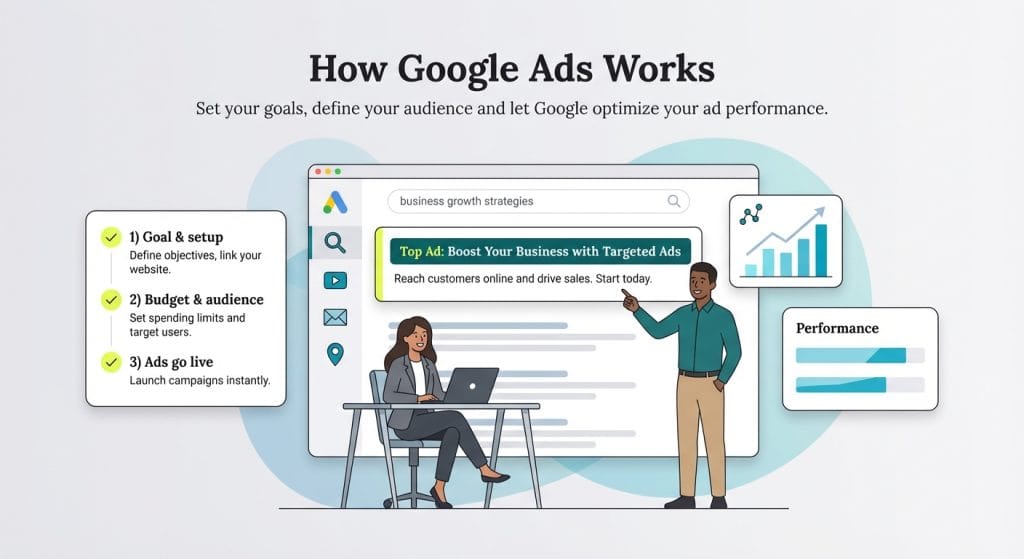
When you start working with Google Ads, you’ll enter your business information and choose a campaign objective. Next, you’ll create your ads, preview how they’ll appear and decide where you want them to run. Google then uses automation and machine learning to help match your ads with the people most likely to find them relevant.
From there, you’ll set your budget, audience and bidding preferences, and Google will put your campaign into rotation. Depending on your settings, your ads may appear in Google search results or across other Google properties, including Gmail, YouTube and Maps. As people click on your PPC ads, Google tracks your performance data in real time while your campaign spends against the budget you’ve set.
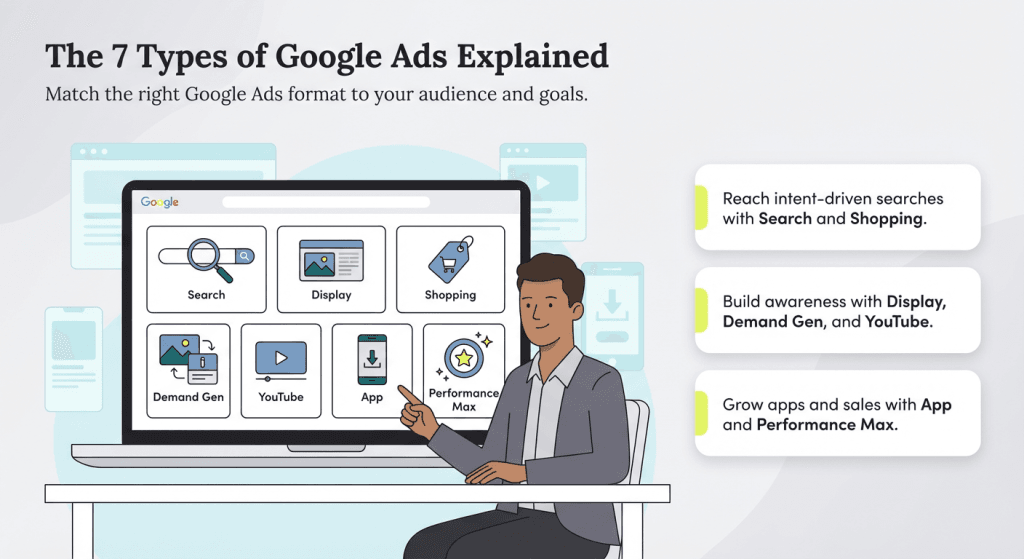
While no two campaigns are exactly alike, Google Ads offers seven core campaign types, each designed to help businesses reach customers in different ways.
With Search ads, your ad can appear on Google Search, Google Maps and across Google’s search partner network. When people search for products, services or solutions related to the keywords in your campaign, your ad may appear right alongside those results.
“The power of search ads lies in their intent-based targeting,” Shak explained. “Users are actively searching for something specific and your ad appears right at that critical moment. … The ability to bid on keywords that align with user intent is incredibly valuable for both lead generation and sales.”
Through Display ads, you can put visual ads in front of people as they browse sites, apps and other online properties across Google’s Display Network, including Gmail, YouTube and websites partnered with Google.
“Display ads help in brand awareness since they show up on different websites across the Google Display Network,” Jauncey noted. “Display ads tend to be more effective, especially in the case of retargeting previous visitors to a website.”
Through a Shopping campaign, Google uses product data from your online store, rather than just the keywords people type in, to decide when and where your products appear in Google Shopping results.
Shak emphasized that e-commerce businesses, in particular, benefit from these ads. “For businesses looking to boost product visibility, especially in competitive markets, Shopping ads are invaluable,” Shak advised. “[We have] helped clients set up Shopping campaigns, and the visibility they get with potential buyers is immediate and impactful.”
This Google Ads campaign type targets people through Gmail, YouTube and Google Discover. People may see these ads while watching YouTube Shorts or on YouTube’s In-Stream, Home and Watch Next pages. Discover ads appear as people scroll through the Discover feed, while Gmail ads are image-based and typically appear in the Social and Promotions tabs.
“For upper-funnel marketing, [Demand Gen Ads] generate more demand compared to capturing the existing demand,” Jauncey explained. “For further increasing the efficiency of your Demand Gen campaigns, high-quality and visually attractive images are recommended to amplify their engagement rate.”
With a YouTube campaign, your business can promote itself through video ads shown across YouTube. Shak noted that YouTube, as the world’s second-largest search engine, offers significant advantages as an advertising platform, particularly as video consumption continues to rise.
“With video ads on YouTube, you can capture attention in a visually engaging format … and video content is increasingly becoming the preferred way for people to consume information,” Shak said. “For businesses with strong storytelling elements, YouTube ads can make a huge impact. We’ve used video ads to share client success stories and educational content, and the engagement levels have been exceptional.”
If your business has a mobile app, Google Ads can help you get it in front of the right people. App ads can place your mobile app in front of potential users across Google Play, Google Search, YouTube and other Google properties. This ad format is especially useful for mobile-first businesses.
Google’s App ads streamline how businesses promote their apps across Google’s ecosystem by automatically optimizing placements, bidding and creative combinations. Because these ads can appear across high-traffic platforms like Google Search, YouTube and Google Play, they give businesses broad visibility among people who are already browsing, searching or discovering new apps.
Performance Max is Google’s most automated campaign type, powered heavily by AI. You set your goals, upload creative assets and define your audience signals. Next, Google’s automation gets to work, placing your ads across Search, Maps, Gmail, YouTube, Discover and Display to help you reach people who are most likely to engage.
“Performance Max … can be very powerful for businesses that do not care exactly where their ads serve; instead, they simply want to drive sales,” Jauncey explained. “For better results from Performance Max, make sure you provide high-quality assets and detailed audience signals.”
With Google Ads, you do more than get your brand in front of potential customers: You reach them on the platforms they already use, often at the exact moment they’re searching for what you offer. The people you connect with through Google Ads are often highly qualified, and you stay in control of how much you spend.
Whether you’re getting started with a modest ad budget or scaling up an established campaign, Google Ads offers a level of targeting precision, flexibility and cost control that few other advertising platforms can match.
Sean Peek and Tommy Wyher contributed to this article. Source interviews were conducted for a previous version of this article.