Business.com aims to help business owners make informed decisions to support and grow their companies. We research and recommend products and services suitable for various business types, investing thousands of hours each year in this process.
As a business, we need to generate revenue to sustain our content. We have financial relationships with some companies we cover, earning commissions when readers purchase from our partners or share information about their needs. These relationships do not dictate our advice and recommendations. Our editorial team independently evaluates and recommends products and services based on their research and expertise. Learn more about our process and partners here.
Today's employees expect more than an annual performance review. These emerging performance management trends can help you better support your team and improve business results.


Performance management has changed dramatically over the past decade. While annual performance reviews still have a place in many organizations, they’re no longer enough on their own. Instead, businesses are adopting more continuous approaches that emphasize regular feedback, employee development, goal tracking and real-time performance insights. Those changes have been driven by evolving employee expectations, advances in human resources (HR) technology and a growing recognition that effective performance management isn’t just about evaluating employees — it’s about helping them succeed.
As the workplace continues to evolve, so will the ways organizations measure, manage and improve employee performance. We’ll explore the biggest performance management trends and explain how they can help you build a stronger, more effective performance management strategy.
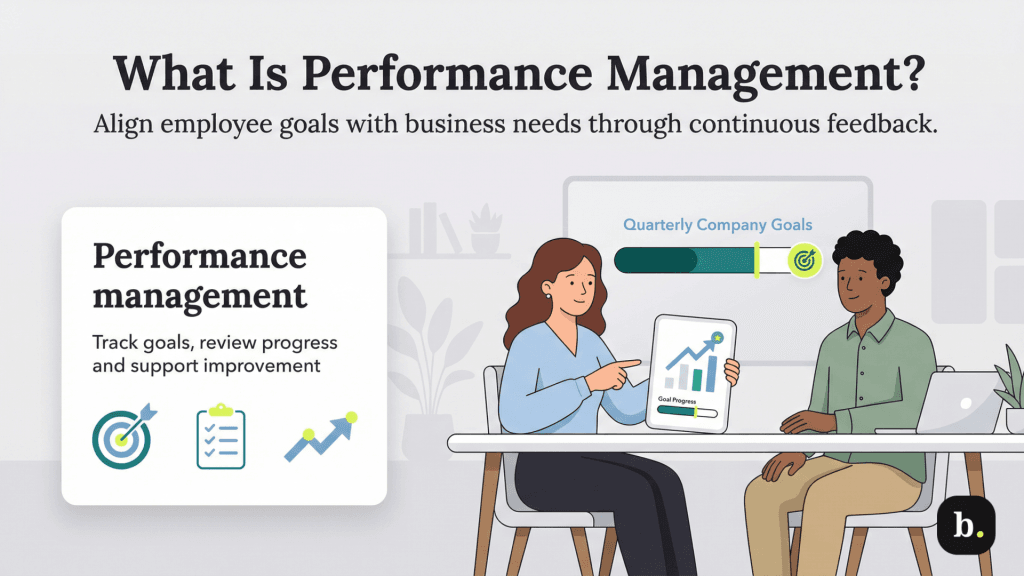
Performance management is the ongoing process of helping employees do their best work while ensuring their efforts support the organization’s goals. It goes beyond annual performance reviews by giving managers and employees regular opportunities to set expectations, discuss progress, celebrate successes and address challenges before they become bigger problems.
An effective performance management strategy benefits both employees and the organization by improving communication, accountability and long-term performance.
Modern performance management extends well beyond the annual review. Many organizations now use regular check-ins, coaching and goal discussions to address performance throughout the year. Rather than waiting until the end of the year to evaluate performance, managers work with employees throughout the year to recognize successes, discuss challenges and adjust goals as business priorities evolve.
Technology has made performance management much easier to organize. Many businesses now use HR software to track employee performance goals, document feedback and keep performance records in one place. That gives managers a clearer picture of an employee’s progress and makes performance conversations more productive.
When an employee begins struggling, managers can often resolve issues through coaching, additional training or a performance improvement plan (PIP) before problems escalate. This more proactive approach helps employees understand expectations, stay engaged and continue developing their skills over time.
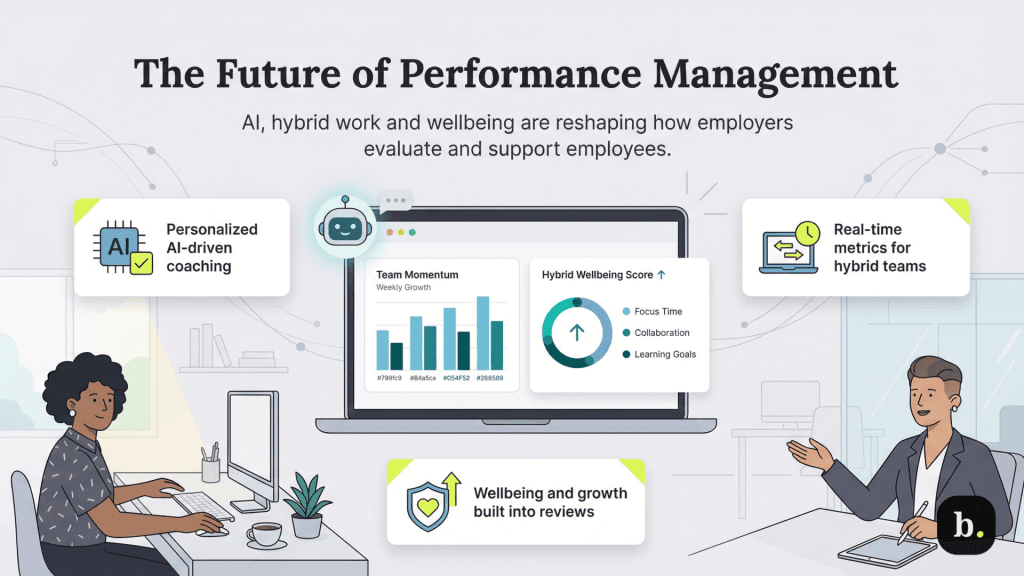
While today’s performance management practices are already more collaborative and continuous than they once were, the process continues to evolve. Advances in AI, changing employee expectations and new HR technologies are reshaping how organizations evaluate performance, support employee development and measure success.
Here are the biggest performance management trends businesses should expect to see in 2026 and beyond.
Artificial intelligence features are becoming more common in performance management software. AI can handle many of the administrative tasks that once took hours, such as organizing feedback, tracking employee goals and summarizing performance data.
The technology is also becoming more common in high-stakes employment decisions. In fact, a ResumeBuilder survey found that 60 percent of managers use AI to help evaluate decisions about their direct reports, including evaluating performance, creating development plans and informing decisions about raises and promotions.
However, AI should complement — not replace — human judgment. While AI can identify trends and surface insights, it lacks the context, empathy and discretion managers need when evaluating employee performance. Organizations should also be transparent about how AI is used and ensure people remain responsible for decisions involving performance reviews, promotions and other employment actions.
Remote work plans and hybrid work arrangements have become a permanent part of the workplace for many businesses. As a result, performance management is becoming less about tracking hours or office attendance and more about measuring results, team collaboration and progress toward goals. Companies that embrace flexible work arrangements need clear expectations and consistent ways to evaluate employees, regardless of where they work.
Managing performance across hybrid teams isn’t as simple as moving annual reviews online. Managers need to stay in touch with employees who may not be in the office very often, which means scheduling regular one-on-ones, keeping goals up to date and documenting feedback as projects are completed. Performance management software can make this easier by giving managers and employees a shared place to track progress and discuss performance over time.
Managers also need to watch out for proximity bias — the tendency to give more credit to employees they see in person. A 2025 study published in Work, Employment and Society found that when managers didn’t have objective performance data, remote employees were less likely to receive promotions and raises than their office-based peers. Once managers had documented performance information, that gap disappeared for hybrid workers. The findings reinforce why regular feedback, documented accomplishments and clear performance metrics are so important in hybrid workplaces.
More businesses are using data to guide coaching, goal setting and employee evaluations. Many of the best HR software platforms track goals, completed projects, feedback and other performance data throughout the year, giving managers a more complete picture of an employee’s contributions instead of relying on memory during an annual review.
Having access to real-time performance data also makes conversations more productive. Managers can spot trends earlier, recognize strong performance as it happens and identify employees who may need additional support before small issues become bigger problems. Employees benefit as well because they receive more timely feedback and have greater visibility into their progress toward individual and company goals.
Businesses are increasingly recognizing that employee well-being and performance go hand in hand. Rather than focusing solely on results, many managers are paying closer attention to signs of employee burnout, chronic stress and excessive workloads that can eventually affect productivity, engagement and retention. The goal isn’t to lower performance expectations but to help employees stay healthy enough to consistently do their best work.
That shift also reflects what employees want from their employers. According to the American Psychological Association’s 2025 Work in America survey, 93 percent of workers say it’s important to work for an organization that supports their mental health. The report also found that employees who work in their preferred environment — whether that’s remote, hybrid or in person — report better mental health, lower stress and higher job satisfaction.
When an employee appears to be struggling, managers no longer have to wait for an annual review to respond. That could mean redistributing work, encouraging an employee to use their PTO or simply checking in to see what’s going on.
Performance reviews are increasingly being used to identify skill gaps, discuss career goals and create development plans. Instead of focusing only on how employees are performing today, managers are also helping them build the skills they need to grow into future roles. As a result, learning and employee development are becoming a more important part of the performance management process.
Professional development can also help employers retain top talent. According to The Work Institute’s 2026 Retention Report, career-related issues — including limited growth opportunities and insufficient professional development — accounted for 19.2 percent of employee departures in 2025, making career the leading reason employees left their jobs. Organizations that invest in employee development may be better equipped to improve performance while reducing employee turnover.
Organizations are taking a closer look at how bias can influence performance evaluations as they work to make reviews fairer and more consistent. Instead of relying solely on subjective impressions, many employers are adopting standardized evaluation criteria, structured review processes and clearer performance metrics to help ensure employees are assessed on their work rather than unconscious bias.
Manager training is also becoming more common. Organizations are teaching supervisors how to deliver fair, objective feedback while recognizing common cognitive biases — such as recency bias, the halo effect and affinity bias — that can unintentionally influence performance reviews.
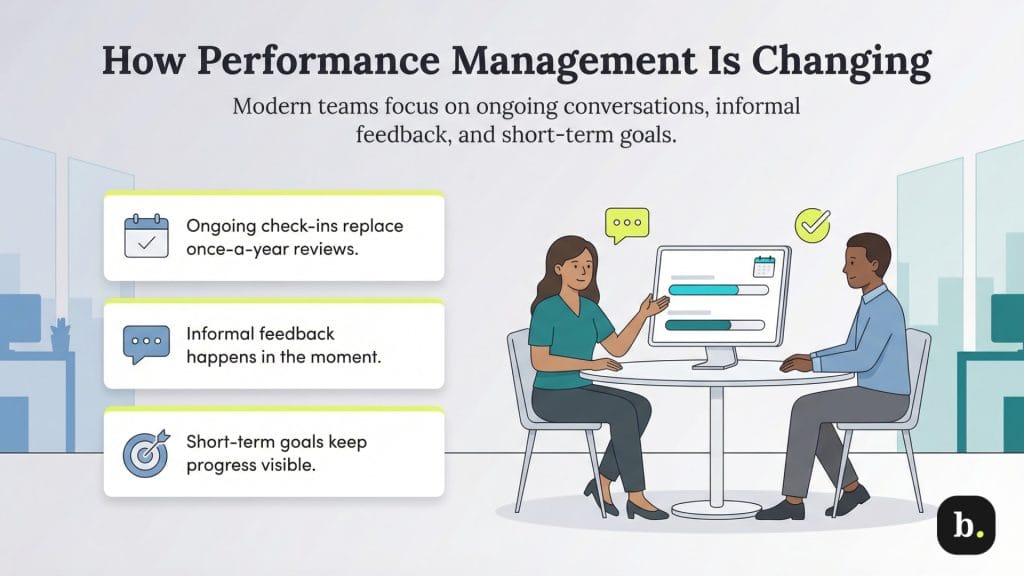
Here’s what these trends may look like in day-to-day performance management.
Although performance ratings remain common, many organizations are reconsidering how much weight to place on them. Ratings can help employers make compensation and promotion decisions, but they can also oversimplify an employee’s contributions and shift attention toward the score instead of the conversation.
According to the Talent Strategy Group’s 2026 Performance Management Report, 92.4 percent of organizations with a formal review process still use performance ratings. At the same time, many organizations are placing greater emphasis on regular feedback and revisiting employee goals throughout the year instead of waiting for the next formal review.
Instead of relying solely on annual performance reviews, many organizations now hold regular one-on-one meetings throughout the year to discuss progress, remove obstacles and adjust priorities as business needs change. For example, a manager might meet with an employee after a major project wraps up to discuss what went well, what could be improved and what support they need for the next assignment.
These conversations also strengthen manager-employee relationships. Employees have more opportunities to ask questions, share concerns and receive support before small issues become larger performance problems. Regular check-ins can also support employee engagement by helping managers stay more connected to employees’ goals, challenges and development throughout the year.
Rather than saving feedback until an annual review, managers are increasingly encouraged to address successes and challenges as they happen. Timely feedback helps employees recognize what’s working, correct mistakes sooner and make improvements while projects are still underway.
It also leads to more balanced performance discussions. Instead of relying on memory months later, managers can base conversations on documented observations and ongoing coaching throughout the year.
Long-term objectives still have value, but many organizations now break them into smaller, shorter-term milestones. For example, instead of setting a single annual sales target, a team might establish quarterly or monthly goals that can be adjusted as market conditions or business priorities change. Reviewing goals more frequently makes it easier to measure progress, adjust priorities and respond to changing business needs.
Shorter-term goals also work well alongside regular check-ins because managers and employees can celebrate wins, identify challenges and make adjustments before falling too far behind.