Business.com aims to help business owners make informed decisions to support and grow their companies. We research and recommend products and services suitable for various business types, investing thousands of hours each year in this process.
As a business, we need to generate revenue to sustain our content. We have financial relationships with some companies we cover, earning commissions when readers purchase from our partners or share information about their needs. These relationships do not dictate our advice and recommendations. Our editorial team independently evaluates and recommends products and services based on their research and expertise. Learn more about our process and partners here.
During the hiring process, you may want to verify an applicant's previous employment information. Learn what the employment verification process entails and why it's important.


Employment verification plays an important role in hiring by helping you confirm that candidates have the experience, skills and background they claim. A quick verification can uncover false employment claims, help explain gaps in a candidate’s work history and even offer valuable insight into whether someone is likely to be a strong fit for your team and company culture.
We’ll explain why employment verification matters, how the process works and what questions to ask along the way.
An employment verification background check is a preemployment screening that confirms a candidate’s past employers, job titles, dates of employment and, in some cases, job responsibilities. This step of the hiring process helps employers verify that the information a candidate provides matches their actual work history and spot any inconsistencies before making a hiring decision.
“You’re focusing in on whether the person is qualified for the job you’re hiring them for, and so part of that is you’re making sure that they have the skills and qualifications necessary for the position,” said Susan Corcoran, an employment attorney with Jackson Lewis P.C. “And that needs to match up with where they obtained the skills and qualifications.”
To complete the verification, either a member of your human resources (HR) team or a third-party background check provider may contact some of the most relevant employers listed on the candidate’s resume to confirm previous employment, job titles, dates of employment and other details that help paint a clearer picture of the candidate’s work history.
Employment verifications and reference checks both help employers evaluate candidates, but they’re looking at two very different things. Employment verification confirms what a candidate actually did on paper, while a reference check gives you a better sense of how that person performed on the job.
“A reference check really asks deeper questions,” explained Kristen Faris, senior vice president of customer success, solutions and partnership at Checkr. “All employers ask different types of questions, and they can vary around this like, ‘Talk to me about how the employee performed,’ or ‘What were some of their strengths or weaknesses?’ or ‘How did they collaborate with others?’ They’re more qualitative-type questions, where[as] employment verification is very quantitative.”
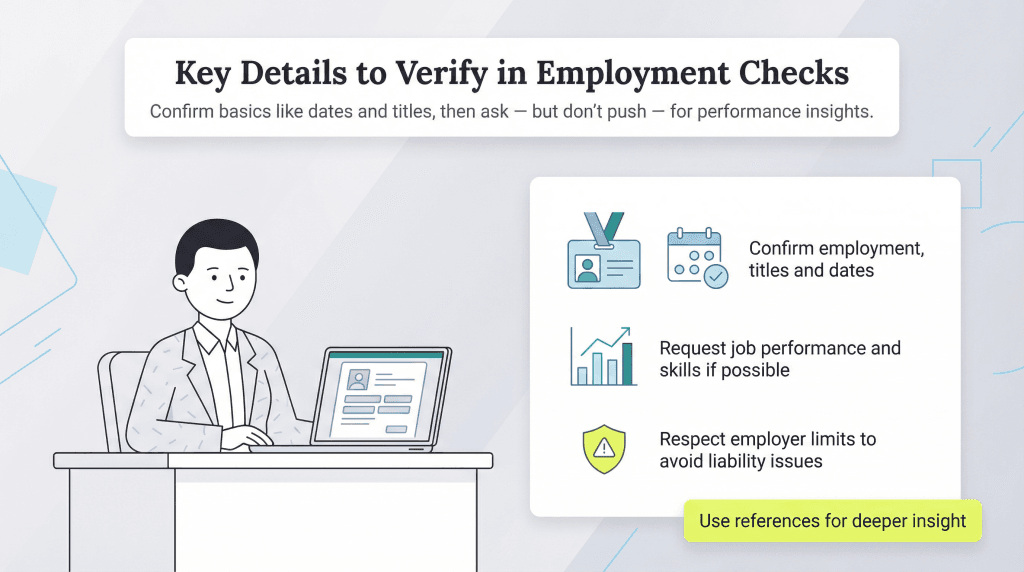
The most important information to confirm during an employment verification is the factual details that verify a candidate’s work history, such as where they worked, what positions they held and how long they worked there. In practice, however, many employers limit the employee data they’ll share, often providing only a “neutral reference,” which typically confirms whether a person worked at the organization, their job title and their dates of employment.
Corcoran explained that liability concerns can prompt former employers to be less than forthcoming. “The concern is the risk of a [defamation] claim against them if they say something negative that causes the person not to obtain the new position,” she said.
Even if a former employer keeps things brief, there are still a few basics you should always try to verify, including:
If possible, the following details can provide more context, although many former employers may decline to answer because of liability concerns:
If an employer won’t go beyond the basics, don’t push. You can often get a fuller picture of a candidate’s past performance during the reference check process.
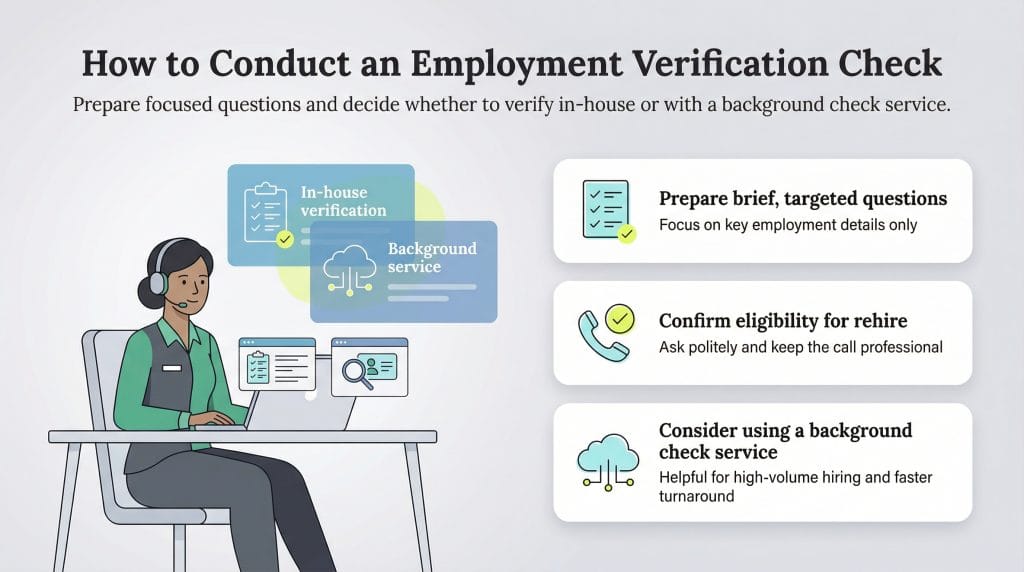
Employers typically conduct employment verifications in one of two ways: by contacting a candidate’s former employers themselves or by outsourcing the process to a background check provider. The right approach often depends on your hiring volume, available time and whether or not you have an internal HR department. Here’s how both approaches work.
If you’re handling employment verification in-house, start by reviewing the candidate’s resume, application and any notes from the interview process. This will help you identify the most important details to confirm before making the call.
Then, follow these steps:
If your team hires frequently or handles a high volume of candidates, a background check provider may save time and streamline the verification process. These services often include employment verification as part of a broader screening package, which may also include criminal background checks, identity verification and education verification. Results are typically available within a few business days through an online portal.
When evaluating providers, look for services that are accredited by the Professional Background Screening Association (PBSA) and compliant with the Fair Credit Reporting Act (FCRA) (more on this below), which governs third-party background screening providers. You should also confirm the provider has experience working with businesses in your industry.
Several federal, state and local employment and anti-discrimination laws can affect how employers conduct employment verifications, especially if they use third-party background screening providers or make hiring decisions based on the information they receive. The following are some of the most important legal considerations to keep in mind.
If you use a third party to conduct an employment verification background check or any other type of preemployment screening, such as a criminal background check, the FCRA applies. Under the FCRA, employers must provide candidates with a clear, standalone disclosure and obtain written authorization before ordering a background report from a third-party screening provider. If the report contains information that could affect your hiring decision, you must follow the FCRA’s adverse action process before rejecting the applicant.
This typically includes providing the candidate with a copy of the background report and “A Summary of Your Rights Under the Fair Credit Reporting Act,” giving them an opportunity to review the information and dispute any inaccuracies before a final hiring decision is made.
Corcoran emphasized the importance of employers ensuring their notification process complies with any applicable state and local requirements.
Title VII of the Civil Rights Act of 1964 prohibits employment discrimination on the basis of race, color, religion, sex and national origin. This applies to employment verification and other preemployment employee recruitment and screening practices.
Employers should verify employment information consistently and avoid requesting different information from candidates based on protected characteristics. The Equal Employment Opportunity Commission (EEOC) has long advised employers to ensure background screening practices do not create a disproportionate adverse impact on protected groups.
Many states and municipalities have enacted additional hiring and background screening requirements that can affect employment verification practices. Depending on your location, these rules may address candidate consent, what former employers can disclose and how background check information can be used in hiring decisions.
Because these requirements can vary significantly by jurisdiction, it’s a good idea to consult an employment attorney or HR professional familiar with the laws in your area.
When you think you’ve found a great candidate, it can be tempting to move quickly and extend an offer without fully confirming their employment history. But skipping this step can be a costly mistake. Employment verification checks help confirm a candidate has the experience they claim — and just as importantly, they can reveal inconsistencies before those issues turn into costly bad hires or culture problems down the road.
Here are some of the key reasons you should conduct employment verifications.
Resume embellishment remains surprisingly common. In GCheck’s 2026 Trust in Hiring Report, 93 percent of recent job seekers admitted to some form of embellishment or misrepresentation during the hiring process, ranging from inflated job responsibilities to fake references and unearned credentials. Just as telling, 60 percent of those candidates said they believed complete honesty might have cost them the job — a reminder that today’s competitive hiring market can create pressure on both sides of the recruiting process.
That’s why it’s important to verify where candidates worked, what positions they held and whether their experience matches what they’ve shared during the hiring process. A thorough employment verification can help you spot inconsistencies, confirm key details and ask better follow-up questions when something doesn’t line up.
“People lie on their job applications all the time, and an employment verification can help to uncover that,” Faris said. “Often, people will also try to obfuscate gaps in their employment by lying about their dates of employment.”
Hiring the right candidate isn’t just about confirming skills and experience. It’s also about understanding how that person works with others, handles feedback and fits into your team’s day-to-day dynamic. When former employers are willing to share more than basic employment details, an employment verification can provide valuable insight into a candidate’s company culture fit and overall workplace style.
Many employers stick to neutral references, but others may be willing to share a little more about how a candidate communicated, took ownership of their work or fit into the team. Those details can tell you a lot about whether someone is qualified on paper and likely to succeed once they’re on the job.
A short stint on a resume isn’t always a red flag, but it’s often worth a closer look. An employment verification can sometimes help explain why a candidate was with a previous employer for only a brief period, whether the company cut positions, relocated or eliminated the role.
Sure, you can ask the candidate about a short employment period during the interview, but verifying the circumstances can give you added confidence before making a hiring decision.
Keep in mind, however, that many employers stick to neutral references and may not be willing to share this level of detail.
Job applicants sometimes overstate the responsibilities or seniority of a previous role, for example, describing a position as managerial when it wasn’t. That may seem like a small stretch on paper, but it can affect everything from job leveling to employee compensation decisions once it’s time to make an offer.
Employment verification helps ensure you’re evaluating candidates at the right level so your pay practices stay fair and consistent across the organization.
“When you’re thinking about bringing individuals into your organization … and you want to make sure that your leveling and compensation are consistent across employees, understanding the level that the employee was working at previously and validating that is really helpful in making informed compensation decisions,” Faris said.
Employment verification doesn’t happen in a vacuum. When you’re conducting multiple types of background checks, including criminal background screenings, a candidate’s work history can provide important context and help you make a more informed hiring decision.
For example, if a criminal record appears during the screening process, employers may need to consider factors such as how long ago the offense occurred, whether it relates to the role and whether the candidate’s broader qualifications and work history help paint a more complete picture.
“Employment history may be very important in its connection to the criminal history check,” Corcoran said. “If a conviction does come back and we’re considering mitigating circumstances, then one of those mitigating circumstances is going to be the fact that someone had a strong employment history.”
If an employment verification reveals false or misleading information, don’t rush to make a hiring decision. First, confirm the discrepancy, give the candidate an opportunity to explain and make sure you’re following any applicable federal, state and local employment laws.
If you’re using a third-party service to conduct the employment verification, the FCRA may require you to follow the adverse action process before removing a candidate from consideration. This includes notifying the candidate about the discrepancy, giving them an opportunity to dispute or explain the information and providing any required notices before a final hiring decision is made.
It’s also important to work with an FCRA-compliant background screening provider that can help support this process and document each step.
Erin Donaghue and Skye Schooley contributed to this article. Source interviews were conducted for a previous version of this article.