Business.com aims to help business owners make informed decisions to support and grow their companies. We research and recommend products and services suitable for various business types, investing thousands of hours each year in this process.
As a business, we need to generate revenue to sustain our content. We have financial relationships with some companies we cover, earning commissions when readers purchase from our partners or share information about their needs. These relationships do not dictate our advice and recommendations. Our editorial team independently evaluates and recommends products and services based on their research and expertise. Learn more about our process and partners here.
Learn what AI marketing agents do, how they differ from other automation tools and how to put them to work for your small business.


This article is sponsored by Wix.
Promoting a new service can turn into a week of unfinished tasks. You need a campaign plan, email copy and social posts. Then, someone has to coordinate the work and check the results. For a small business owner handling marketing between customer appointments, even a good idea can stall.
AI agents for marketing can help carry that work forward while you focus on running your business. Depending on their capabilities and connected tools, they can plan tasks, prepare materials and perform approved actions. Platforms such as Symphony by Wix bring specialized agents together so owners can coordinate work through one conversation.
This guide explains what agents do, how to evaluate them and how to start with a workflow you can measure.
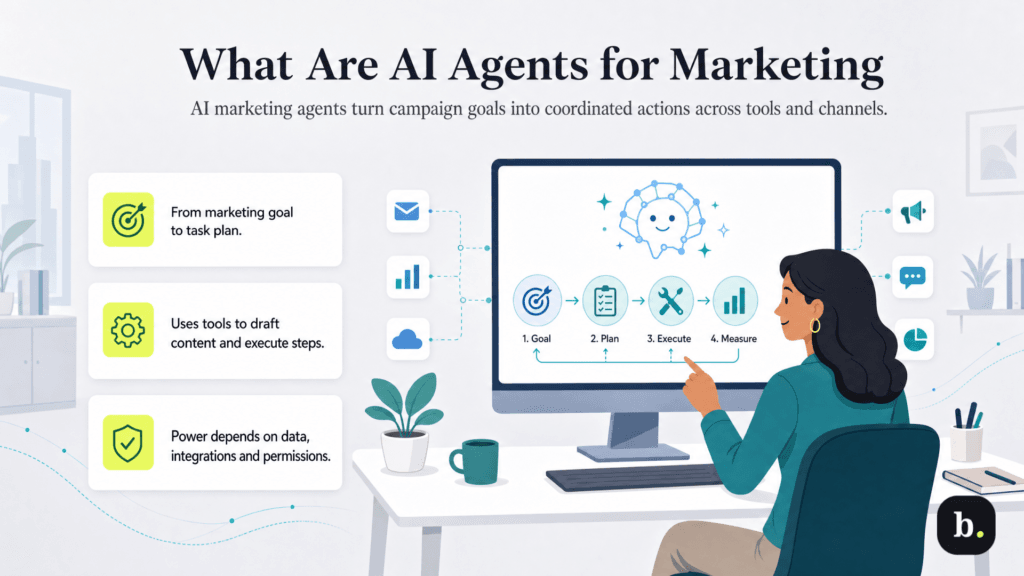
An AI marketing agent is software that uses artificial intelligence to work toward a marketing goal, drawing on relevant information and available tools to plan and complete tasks. Its role can extend beyond generating text to carrying out steps in a campaign.
For example, an owner might ask for help promoting a new class. An agent could break that request into tasks, use the supplied class details to prepare content and carry out supported actions through connected services. The owner defines the goal and the boundaries for its work. For a marketer, the practical distinction is whether a tool can help execute the work as well as recommend it.
Tool type | Main role | Marketing example |
|---|---|---|
AI content assistant | Generates or revises material in response to a request | Draft an email promoting a new class |
Conventional marketing automation | Follows predefined rules and triggers | Send a welcome message after someone subscribes |
AI marketing agent | Plans and performs connected tasks within its capabilities and permissions | Prepare campaign materials and coordinate approved next steps |
These capabilities can overlap within one platform. An agent may use a content-generation tool for drafting and an established automation for delivery. Assess the actual workflow rather than relying on the “agent” label.
An AI marketing agent can help move a goal into action, but what it can complete depends on available tools, information and its permissions.
The best starting points are tasks you already understand well enough to evaluate. Consider where marketing work currently gets delayed and which steps an agent could reasonably handle.
A broad request such as “promote our new class” leaves important questions unanswered. Who is the class for? When does it start? What should someone do after seeing the message?
An agent can help organize the answers into proposed tasks and a timeline. You still need to supply the business decisions: the offer, audience and desired outcome.
Agents with content capabilities can draft campaign messages and adapt approved information for different formats. A class announcement might become an email, a short social caption and a set of answers to common questions.
Give the agent examples of your voice and accurate details about the offer. Review dates, prices, booking links and claims before the content reaches customers. Our guide to creating an email marketing campaign explains how to connect messaging with a clear audience and purpose.
Connected tools can let an agent act on the plan. Depending on the integration, that might include preparing a scheduled post, updating a campaign record or sending an approved message.
Confirm the specific action you need. Access to an email inbox does not necessarily provide the features of a bulk email platform, and a connection that reads information may not support publishing. Ask the agent to identify what it can complete and what remains for you.
Agents with access to relevant data can help assemble updates and highlight questions to investigate. That can reduce time spent gathering information from different tools.
Keep activity and outcomes separate. A completed content calendar shows that planning happened; it does not show that the campaign generated customers. Use the summary to decide what to examine, such as whether people clicked through but failed to book.
Start with a specific job, then evaluate whether the platform can perform it with an acceptable amount of oversight. These criteria help make the comparison concrete:
Avoid buying more complexity than you need. Our guide to simple marketing automation explains why a manageable setup can be a better fit for a small team. If a straightforward rule reliably handles the job, an agent may add little value to that particular task.
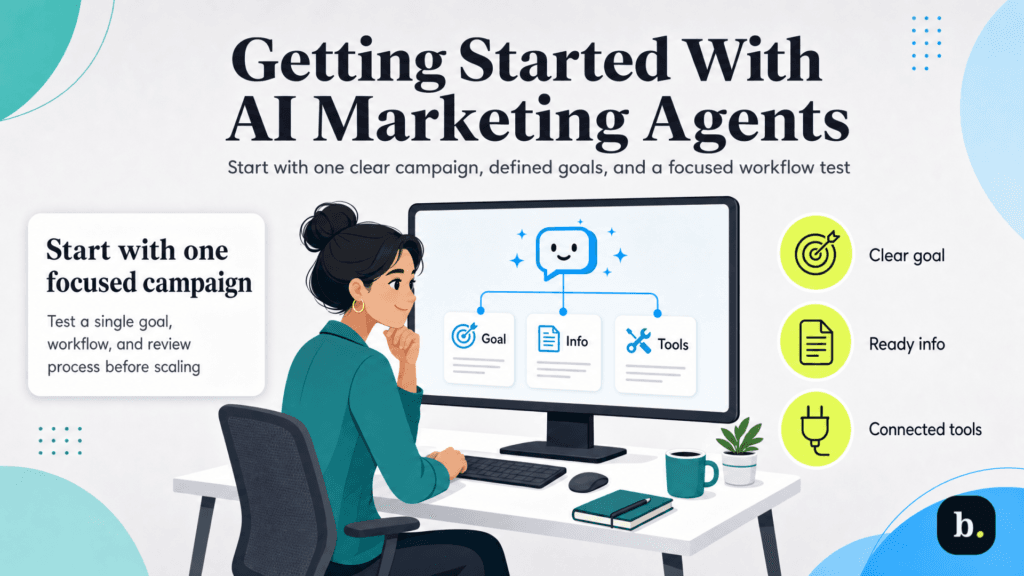
Begin with one campaign or recurring task. A focused pilot makes problems easier to diagnose and gives you a useful basis for deciding what to expand.
Pick an outcome you can observe, such as generating inquiries for a new service or filling places in a class. Name the audience and the period you will evaluate.
Identify the bottleneck, too. If you struggle to prepare campaign materials on time, test whether the agent improves that process. It is harder to assess a tool against an open-ended instruction like “grow the business.”
Provide the offer details, relevant links, approved messaging and examples of your brand voice. Explain who the campaign should reach and what action you want them to take.
If the audience is unclear, use our guide to identifying your target audience before delegating the campaign. An agent cannot reliably resolve a business decision that you have left undefined.
Choose the services necessary for the pilot and confirm what each connection supports. Test the required action with a small scope before depending on it for a full campaign.
For example, verify that the agent can prepare the intended message in the correct service. Check the destination account and the status of the resulting work.
State what the agent may prepare and what requires your approval. For a first campaign, you might review the audience, offer and final copy before distribution.
Keep instructions concrete: “Prepare the email as a draft and show me the recipient segment before sending.” Then confirm that the platform supports the control you requested. Instructions should work alongside the tool’s actual settings and capabilities.
Review the complete path from the initial brief to the completed task. Check links, dates and offer details, and verify that the intended work appears in the connected tool.
Record corrections as you go. Repeated errors may indicate missing context, a weak integration or a task that needs more direct human involvement.
Compare the pilot with your normal process, including setup time, review and rework. Keep useful instructions and improve the parts that caused confusion.
Expand only when you understand what worked. Adding another channel or recurring task should solve a clear need rather than simply increase the agent’s activity.
Begin with a task you do often and understand well. You will have a stronger basis for judging quality and time savings.
For an example of how AI agents can work together to create holistic marketing campaigns, we can examine Symphony by Wix. This standalone platform develops and coordinates specialized AI agents around a business’s needs, providing access to them through a chatbot. Marketing is one of its core functions, alongside areas such as outreach, research and design.
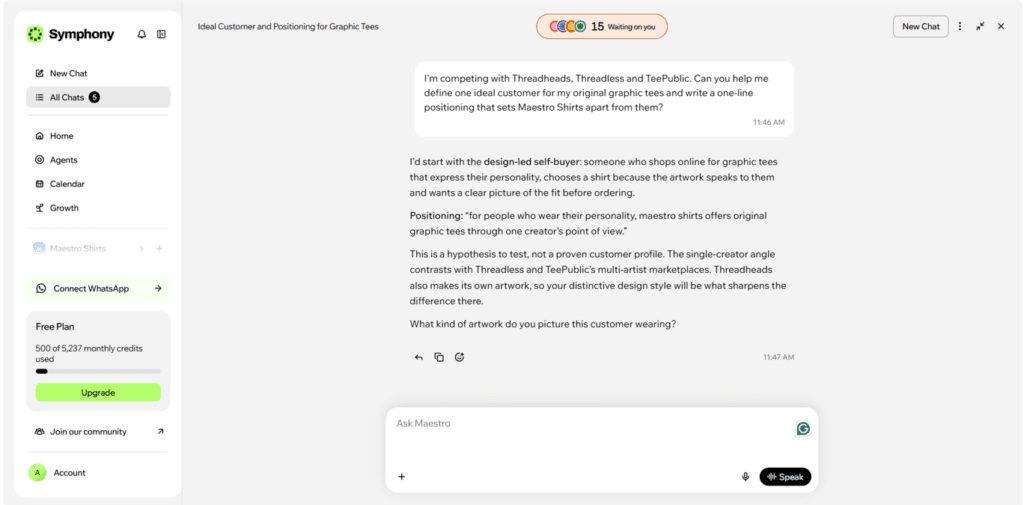
You communicate with Maestro, the central agent that learns about your business and delegates work. Maestro can suggest actions and coordinate the appropriate agents. This gives an owner one place to direct work that involves several kinds of assistance.
Wix describes Symphony’s marketing agents as capable of drafting campaigns, writing social copy, managing editorial calendars and generating content across formats. Other agents can contribute related work, such as research or outreach, within the available connections and approved scope.
For a hypothetical fitness studio, the owner might begin with this brief: “Help me promote a beginner class starting next month. Prepare a two-week campaign for local adults who are new to exercise. Use the attached class details and ask me to review messages before anything is sent.”
The owner would review the proposed work, connect any required tools and check the deliverables. A useful follow-up would ask which tasks are finished, which await approval and which need additional information. Symphony’s app guidance describes approving a request summary and tracking work in progress or completed.
During our test of Symphony, we created an ecommerce website for a dropshipping apparel business in the space of an hour. The site was fully-functional and ready to be uploaded with our products and connected to a fulfillment service (steps which Maestro and our team of agents could help us with as well).
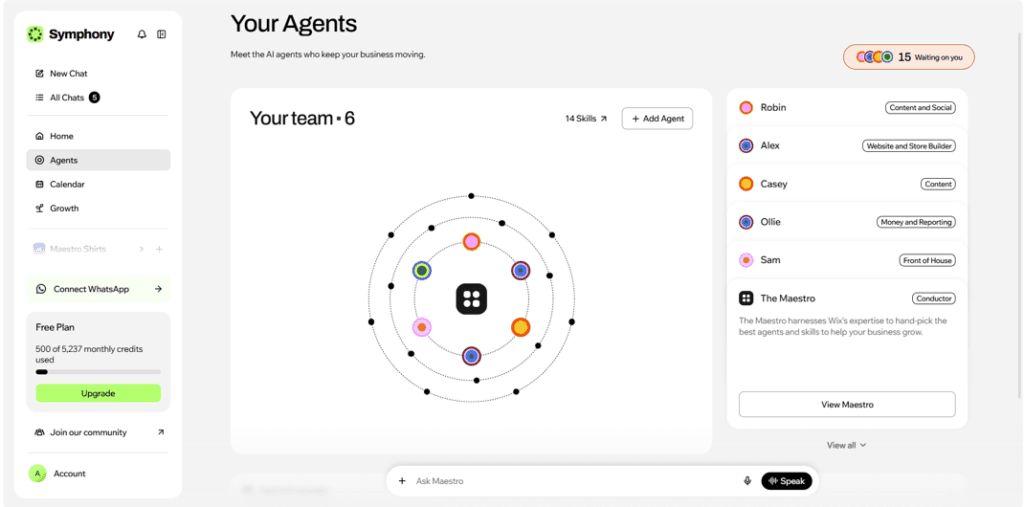
Symphony also provides daily summaries of agent activity. Wix says the platform includes an additional agent review layer to check work before presentation to the owner. That can support review, but the business should still verify customer-facing details.
You do not need a Wix website to use Symphony. Wix’s launch announcement describes it as supporting businesses on Wix, other platforms or without a website. That makes it relevant to owners seeking help with existing marketing operations as well as those building a new online presence.
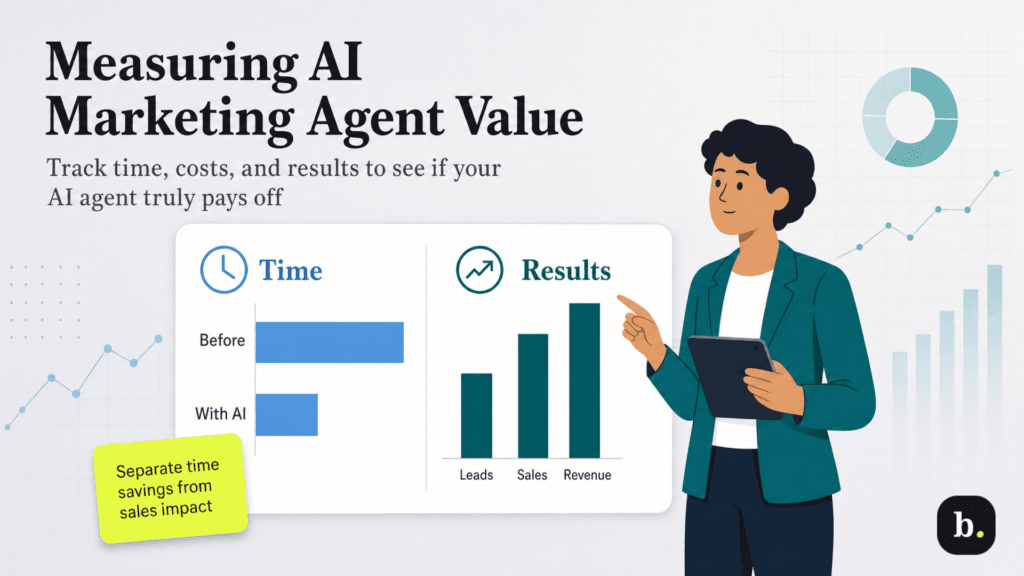
Establish your baseline before the pilot. Record how long the task normally takes, what it costs and the outcome you expect it to support. Our guide to marketing automation ROI provides a broader framework for evaluating automation investments.
Measure net time saved after checking and correcting the agent’s work. For example, suppose a recurring task normally takes four hours. With an agent, briefing takes 30 minutes, review takes 45 minutes and corrections take 15 minutes. Your involvement totals 90 minutes, an illustrative saving of two and a half hours per run. Account separately for initial setup and subscription costs.
Then evaluate the campaign’s business results. Depending on your goal, useful measures might include qualified inquiries, class bookings, purchases or cost per acquired customer. Use consistent definitions so you can compare campaigns meaningfully.
Separate productivity gains from sales gains. The agent may reduce preparation time without changing conversion rates; that can still be useful. Conversely, more content and faster execution may have little value if the campaign reaches the wrong audience.
For revenue claims, consider what else changed, including the offer, season and advertising budget. Our guide to measuring and improving marketing ROI can help you connect campaign performance with business objectives.
They can take on defined tasks and reduce coordination work, but you still need someone to own strategy and judge results. Compare the responsibilities you need covered, including creative direction, customer knowledge and campaign management, before changing how you staff marketing.
No. Symphony supports businesses beyond Wix websites. You use a Wix account to access the product and connect the tools needed for your work. Check that your particular services and intended actions are supported.
Some can, when the platform, integration and permissions support it. Others prepare content for review or perform a narrower set of actions. Check the exact workflow and approval controls before allowing distribution.
Pricing varies by product, usage and connected services. Symphony offers a free plan and paid plans. Compare the allowance your workflow requires, then include any separate email platform, advertising or other channel costs.
Try a clearly defined campaign with existing source material, such as preparing promotional drafts and a content schedule for a new service. It gives you a manageable way to assess planning and content quality before adding execution responsibilities.
