Business.com aims to help business owners make informed decisions to support and grow their companies. We research and recommend products and services suitable for various business types, investing thousands of hours each year in this process.
As a business, we need to generate revenue to sustain our content. We have financial relationships with some companies we cover, earning commissions when readers purchase from our partners or share information about their needs. These relationships do not dictate our advice and recommendations. Our editorial team independently evaluates and recommends products and services based on their research and expertise. Learn more about our process and partners here.
Small businesses are investing in artificial intelligence at record rates, but workers have mixed feelings about the pace of change.

Key Findings
Small and mid-sized businesses (SMB) have crossed a pivotal threshold in their relationship with artificial intelligence. According to business.com’s second annual AI adoption survey, conducted in partnership with Dialog, SMBs are now investing in, deploying, and depending on AI tools at rates that rival larger enterprises—though their employees are feeling both the benefits and the uncertainty that comes with rapid change.
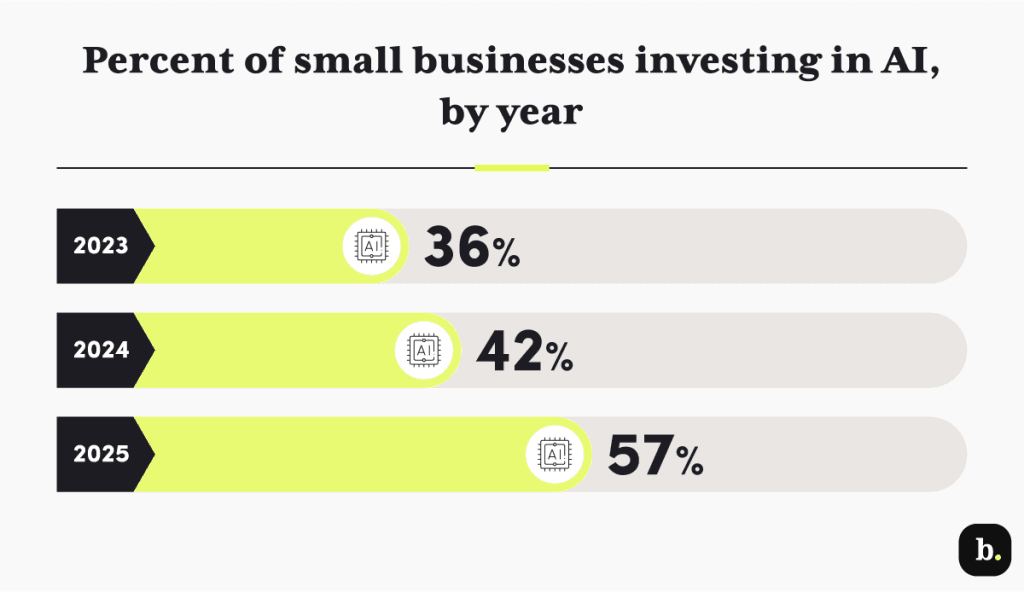
The survey of 1,009 U.S. workers at companies with fewer than 250 employees reveals that AI has moved from experimental technology to essential infrastructure in just two years. Investment in AI among SMBs has increased to 57 percent in 2025, up from 42 percent in 2024 and 36 percent in 2023—a 58 percent rise over two years.
However, not all small businesses are adopting AI at the same rate. As firms increase in size, so does the likelihood of investing in AI:
Number of employees | Percent of SMBs investing in AI | Percent of workers whose AI usage increased since last year |
|---|---|---|
1-9 | 24% | 45% |
10-49 | 45% | 58% |
75 | 75% | 67% |
Practical, low-cost applications, such as AI-driven invoicing, automated scheduling, and content-generation tools for social media marketing, can lower the barrier to entry for even the smallest firms. According to Brian Connors, vice president of enterprise and small business AI for the Infrastructure Solutions Group at Lenovo, AI has evolved sufficiently to enable affordable and straightforward applications.
“Most SMBs believe AI requires massive computers or specialized teams for a sizable ROI. The reality is that today’s infrastructure and software (especially with the rise of AI inferencing) have made AI more scalable and cost-effective,” said Connors. “Small businesses no longer need to build complex systems from scratch.”
For many SMB employees, AI is no longer an occasional tool but a daily companion. Three in ten workers report using AI at least once per day, while 61 percent say their AI usage has increased compared to a year ago. The technology is also making inroads into learning and development, with 18 percent of employees using AI in training situations.
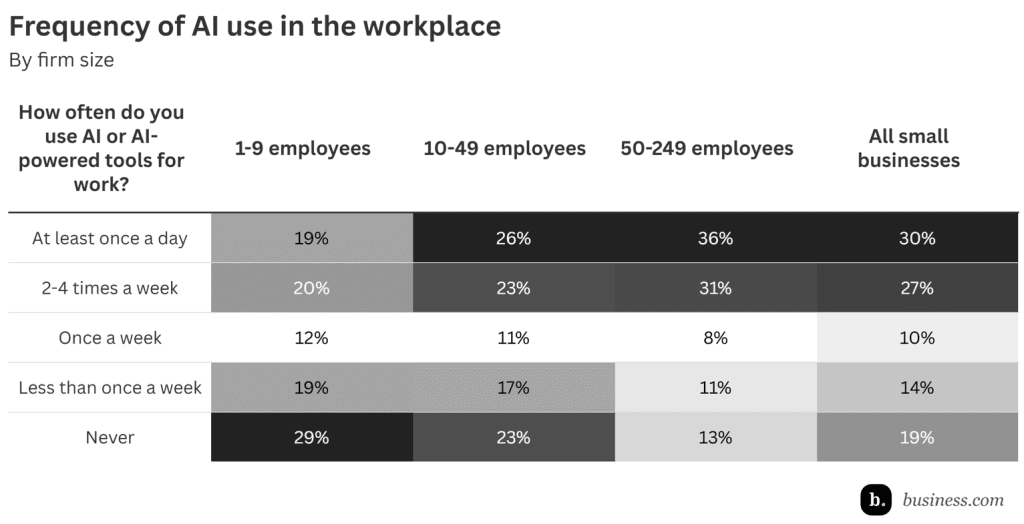
Daily usage rates differed based on small business size, with workers at the very smallest firms (under 10 employees) reporting less daily use than those at firms with at least 50 workers. Overall, nearly one in three small business workers are using AI daily in their roles. Chatbots are most commonly used, but an increasing number of workers are adopting advanced AI tools, such as predictive analytics. However, managers were more likely than non-managers to adopt most of the AI tools listed below.
Tool type | Percent of SMB employees using in the past year |
|---|---|
Chatbots (ChatGPT, Gemini, Claude) | 84% |
AI-powered search (Perplexity, Google AI Overviews) | 67% |
Image generators | 41% |
Learning tools (NotebookLM, Study Mode) | 30% |
Data or predictive analytics | 30% |
Deep research modes | 26% |
Workflow automation tools | 19% |
Specialized or niche tools | 14% |
Video generators | 11% |
The survey reveals that AI has matured beyond customer-facing applications into core operational areas. Sixty-two percent of SMBs now have at least partially adopted AI in both customer service and marketing, whether through chatbots, automated email campaigns, or AI-driven analytics. But the technology’s reach extends far beyond these traditional early-adoption areas.
More than half of small businesses have implemented AI in product development and innovation (55 percent), employee training and documentation (55 percent), and operations and supply chain management (54 percent). Financial management tools with AI capabilities have reached a 51 percent adoption rate, while half of SMBs now utilize AI for cybersecurity purposes.
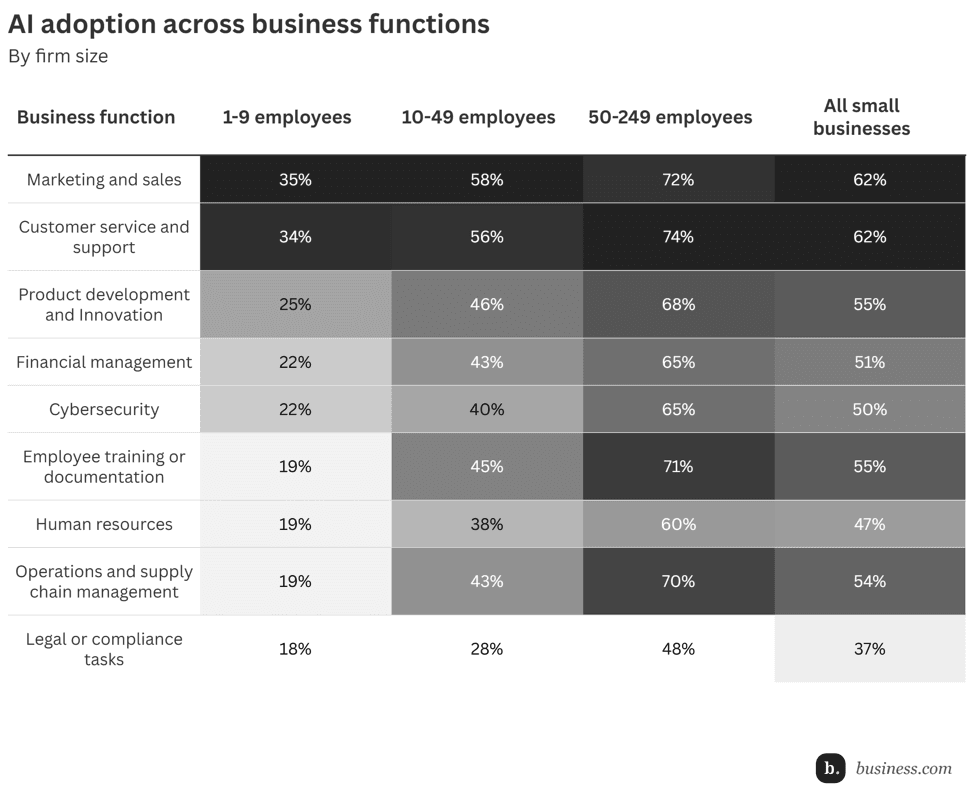
Even traditionally human-centric functions are embracing AI-powered platforms. Nearly half (47 percent) of SMBs now use AI tools in human resources for resume screening, onboarding, or employee engagement. Another 37 percent have deployed AI for legal and compliance work.
The study also revealed that AI adoption rose steadily with company size across nearly every business function. Larger small businesses (50–249 employees) are far more likely to have implemented AI in key areas such as marketing, customer service, and operations—often at twice the rate of microbusinesses. While only about one in five firms with fewer than ten employees report using AI in functions like finance or HR, adoption jumps above 60 percent among mid-sized SMBs.
Since small businesses can sometimes be more agile than larger enterprises, small teams can quickly implement and experience the impacts of AI. “Given their small size, SMBs actually stand to see the fastest value from integrating AI in terms of immediate, significant productivity gains,” said Andy Sweet, vice president of AI solutions at AnswerRocket.
However, not all small business employees are seeing the same increases in productivity or time savings. One of the survey’s most striking findings is the disparity in time savings between managers and individual contributors. On average, SMB employees save 5.6 hours per week using AI tools—but managers save more than twice as much time as individual contributors (7.2 hours versus 3.4 hours per week). The gender gap is also notable, with male employees reporting 6.3 hours saved per week compared to 4.9 hours for female employees.
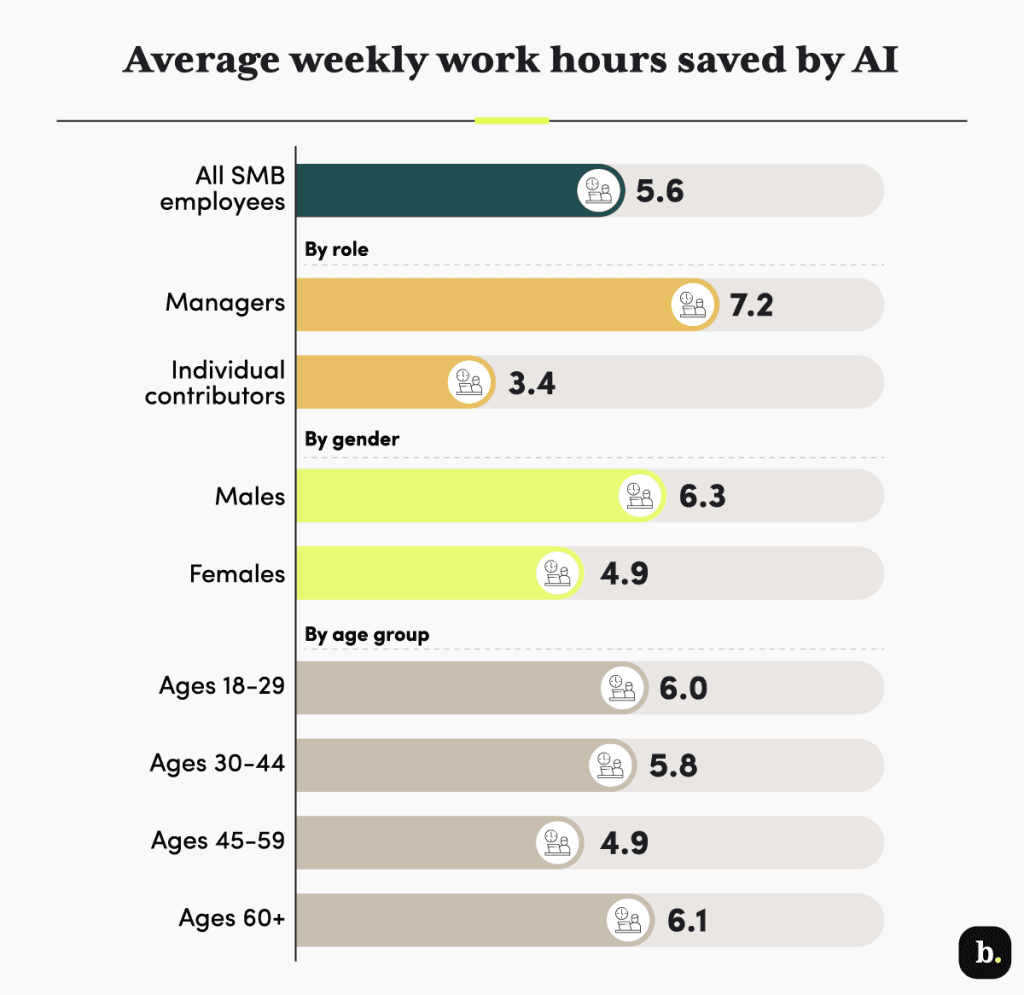
Although these disparities raise essential questions about access and training regarding AI tools, some business leaders believe that managers’ early adoption of AI can encourage their direct reports to follow suit. “When team members see upper-level managers utilizing and testing AI, they may be more likely to feel empowered to test and experiment with AI themselves,” said Jake Hyten, a serial entrepreneur and CEO of Superior Supplement Manufacturing.
Despite widespread adoption and nearly universal awareness, small business workers still harbor doubts about AI’s trajectory. While 53 percent express excitement about AI’s potential and 69 percent feel proud using new technology, nearly half (45 percent) worry that adopting “too much AI” could harm their company’s reputation—another 39 percent question whether their business even needs as much AI as industry trends suggest.
Worker sentiments toward AI | Percent who feel statements are true |
|---|---|
I am excited about the possibilities AI brings for my business or career. | 53% |
I feel proud when I effectively use new technology at work. | 69% |
I worry that adopting too much AI could hurt our company’s reputation with customers. | 45% |
I sometimes question whether my business actually needs as much AI as industry trends suggest. | 39% |
Sometimes, I act more optimistic about AI among colleagues than I really feel. | 30% |
Sometimes I feel like my job is less meaningful when machines handle challenging work. | 31% |
That last figure — 30 percent admitting they “act more optimistic about AI than they feel” — shows a disconnect between public enthusiasm and private uncertainty. Workers may feel pressure to appear technologically progressive, even when uneasy about the implications. T
Bob Hutchins, CEO of Human Voice Media, who works with small and mid-sized organizations on ethical AI adoption, explains the root of this tension: “AI anxiety is often linked to trust. We tend to trust what we can see, shape, and understand,” he said. “To counteract that anxiety and lack of trust, I focus on inclusion. Invite employees to see for themselves. Get them comfortable with seeing how AI can remove the friction from their everyday jobs and allow them to do more interesting and creative work.”
Notably, women were more likely than men to express concern about AI’s human and reputational implications. About 51 percent worry it could harm their company’s image, and over a third feel it diminishes the meaning of their work, compared to 40 percent of men. However, women are less likely than men to fear over-investing in AI (52 percent vs. 44 percent), suggesting that their caution centers on values rather than scale.
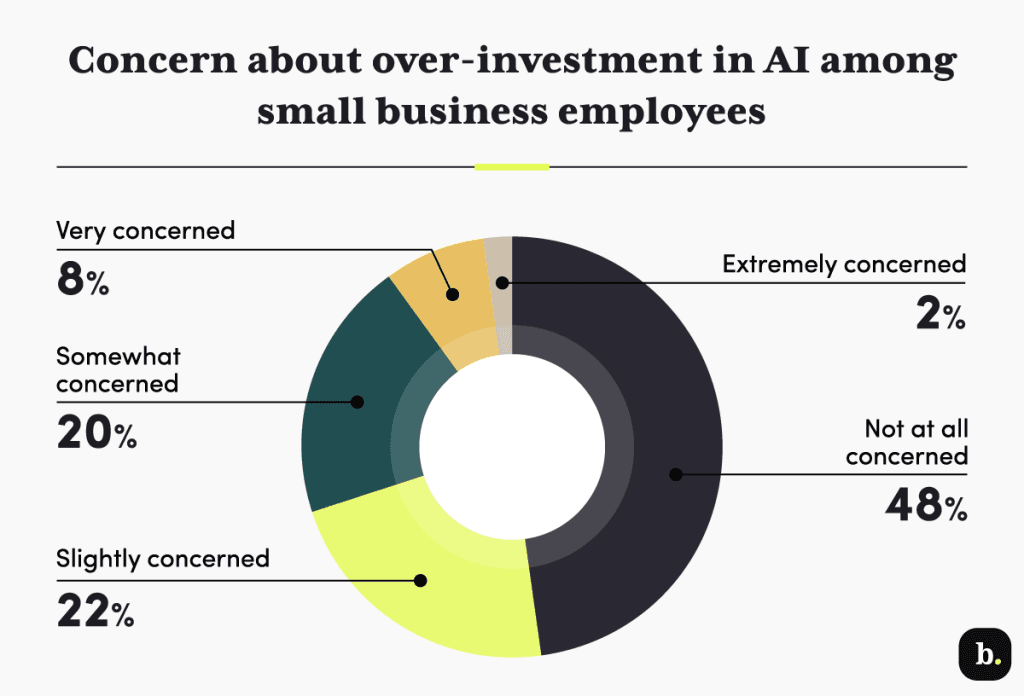
When asked directly about over-investing or over-implementing AI, a majority expressed at least mild concern.
While nearly half of respondents (48 percent) said they’re not at all concerned, the other half are uneasy about going “too far” with automation. Only a small fraction (two percent) is extremely worried. Still, the broader caution suggests a healthy degree of self-awareness within small business communities — especially as tools become cheaper, more autonomous, and more deeply embedded in daily work.
That careful approach is mirrored in managers’ attitudes toward AI adoption.
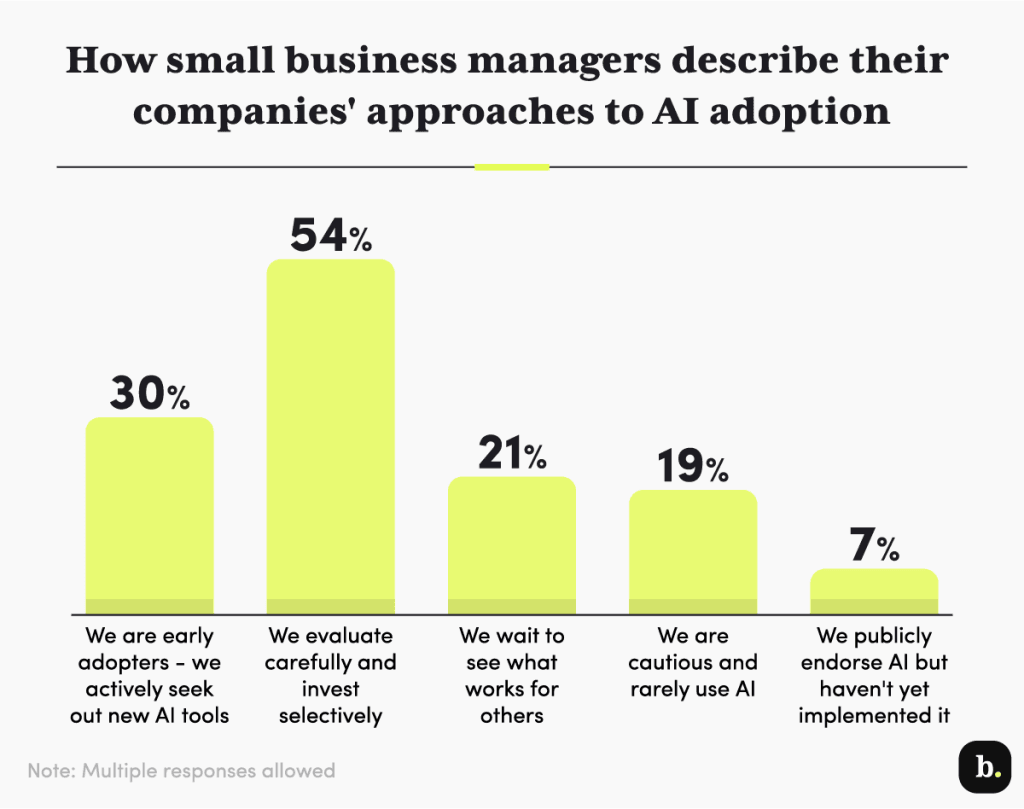
While 30 percent of small business leaders identify as early adopters, a majority (54 percent) describe themselves as careful evaluators, experimenting selectively and measuring results before expanding their efforts. Another 21 percent prefer a wait-and-see approach, and seven percent publicly endorse AI without yet implementing it, which could be a kind of “AI virtue signaling.”
Finally, the data reveal how small business employees and managers envision the right balance between human and AI involvement in operations.
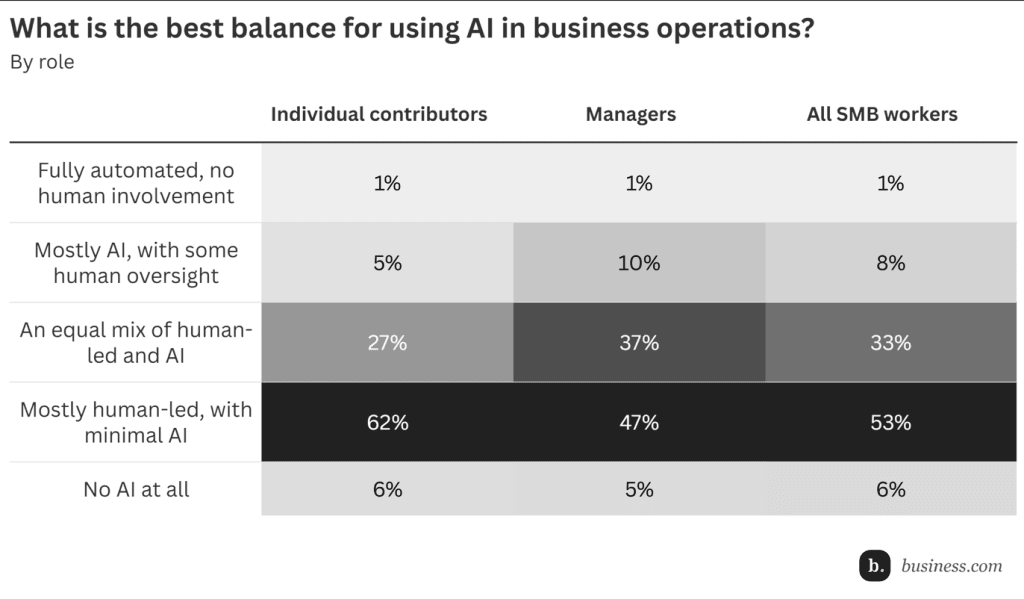
More than half of workers prefer a “mostly human-led” approach, while only eight percent favor a system dominated by AI. One in three believe an equal mix is ideal, suggesting that for most SMBs, AI is best used as a collaborator, not a replacement.
Managers are slightly more open to deeper AI integration: 10 percent say operations should be mostly AI-driven (vs. five percent of individual contributors), and 37 percent favor a 50/50 balance. That divide highlights a subtle cultural gap: leaders see potential for efficiency and scale, while frontline staff emphasize the importance of human judgment and oversight.
Taken together, these findings capture the defining mindset of AI in small businesses circa 2025: optimism grounded in caution. Small business leaders and employees are embracing AI’s potential but with clear boundaries, eager to innovate yet determined not to lose the human touch that makes their products and services shine.
The survey reveals a significant “AI comfort gap” between managers and individual contributors, which could impact how effectively small businesses scale their use of AI. Managers consistently report stronger motivations and fewer barriers to AI adoption than their direct reports.
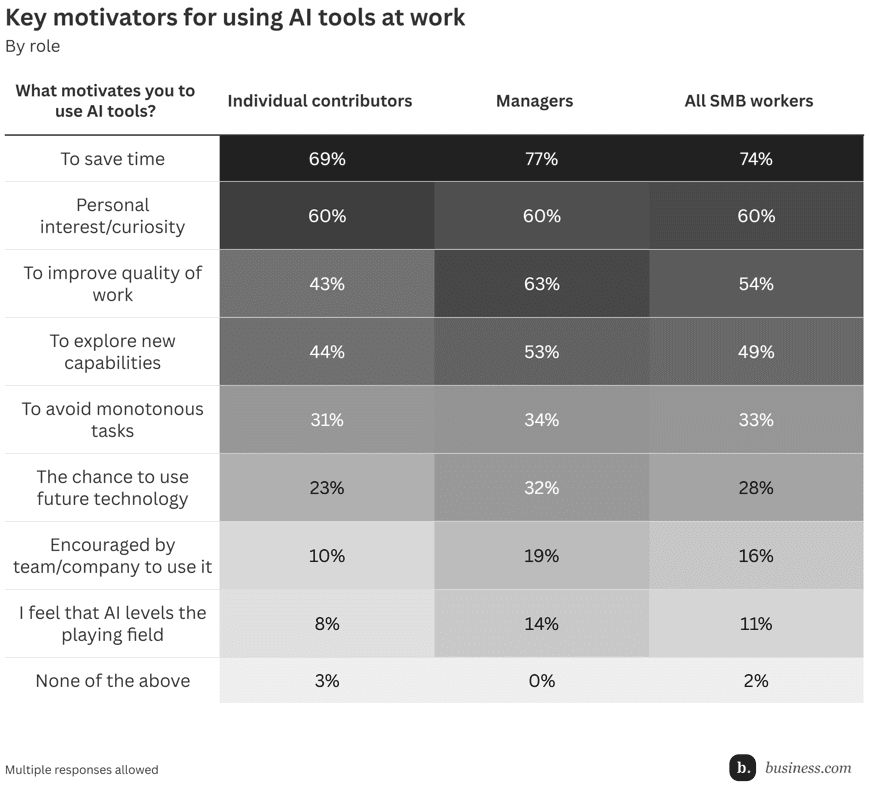
The most significant divide appears to be around workforce concerns: 22 percent of individual contributors view AI as having “anti-worker sentiment,” compared to just 11 percent of managers. This suggests that those closest to potential job displacement are understandably more wary of the technology than those managing its implementation.
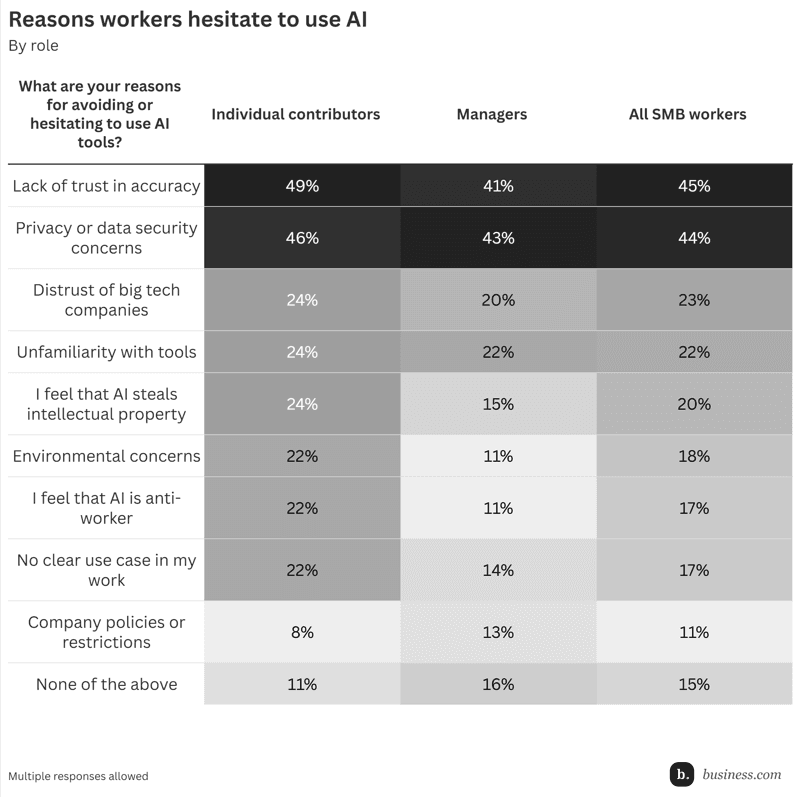
Research from meQ found that managers are 68 percent more comfortable than individual contributors in feeling that their positions are safe from replacement by generative AI, providing context for why the comfort gap exists. Individual contributors aren’t being irrational. They’re responding to a genuine asymmetry in who bears the risk of AI-driven workforce changes.
Bridging the trust gap is now one of the biggest challenges for small businesses adopting AI. Here’s what small business and AI experts recommend to increase AI trust and adoption in small teams:
Ultimately, employees trust AI most when they see it enhancing their impact and increasing their efficiency— not threatening their roles.
As small businesses plan for 2026, the emphasis is on upskilling existing employees rather than reducing staff. Sixty-four percent of SMBs say they’re somewhat or very likely to launch training programs teaching employees to leverage AI, and 60 percent say it’s somewhat or very likely they’ll use AI to help train new hires.
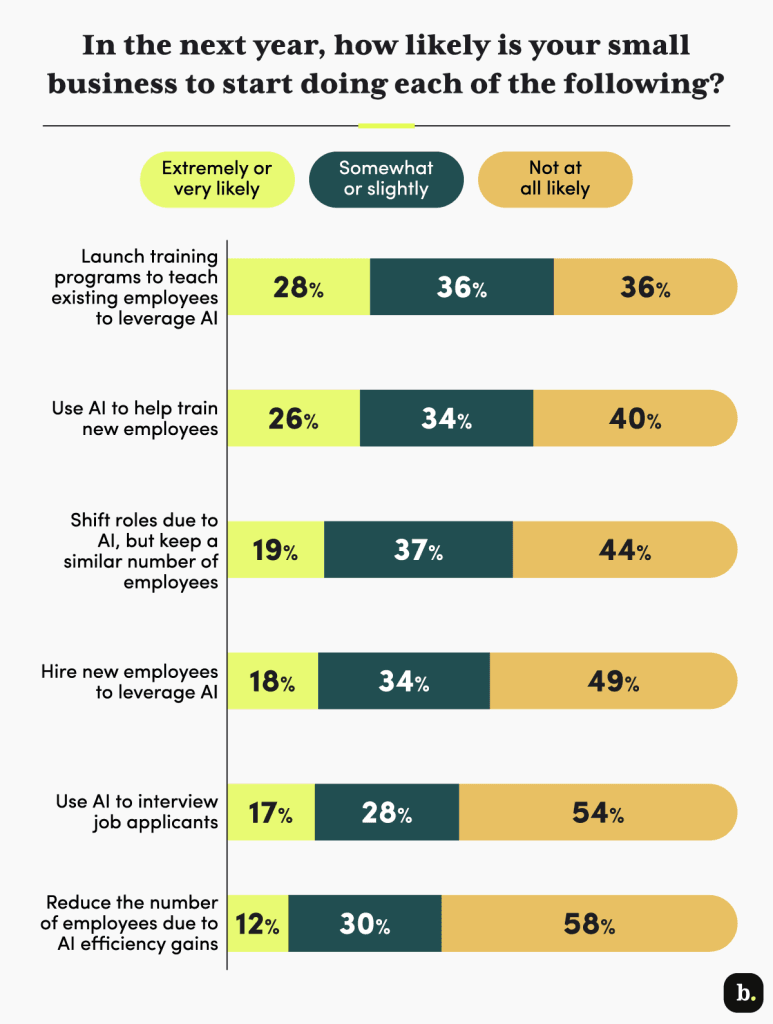
In contrast, only 18 percent say it’s highly likely their companies will hire new employees specifically to leverage AI, and 58 percent say it’s not at all possible to reduce headcount due to AI efficiency gains. While this suggests most SMBs don’t view AI as a path to downsizing, it also means that more than two in five companies (42 percent) haven’t ruled out workforce reductions.
The next year will likely see a cultural split emerge between “automation-focused” firms seeking efficiency gains through headcount reduction and “augmentation-focused” companies investing in human-AI collaboration. How SMBs navigate this choice—and whether they can bring skeptical employees along—may determine which businesses thrive in an AI-enabled economy.
Business.com and Dialog conducted a quantitative, longitudinal survey design to track the evolution of Artificial Intelligence (AI) adoption among small and medium-sized businesses (SMBs) in the United States between 2024 and 2025.
The research compares 2025 findings against baseline data established in a 2024 study to analyze trends over a 12-month period. The questionnaire utilized a mix of categorical and quantitative questions to gather data on usage, impact, and sentiment.
