Getting denied for a business bank account can be frustrating and disorienting, especially when you’re trying to do the right thing by separating your personal and business finances. But a denial isn’t a dead end. It’s just a signal that something in your application, your banking history, or your business profile triggered a red flag — and in most cases, it’s something you can address.
Understanding why denials happen, what your rights are and where to go next will help you move forward with a clear plan rather than reapplying blindly and risking additional rejections.
Why business bank accounts get denied
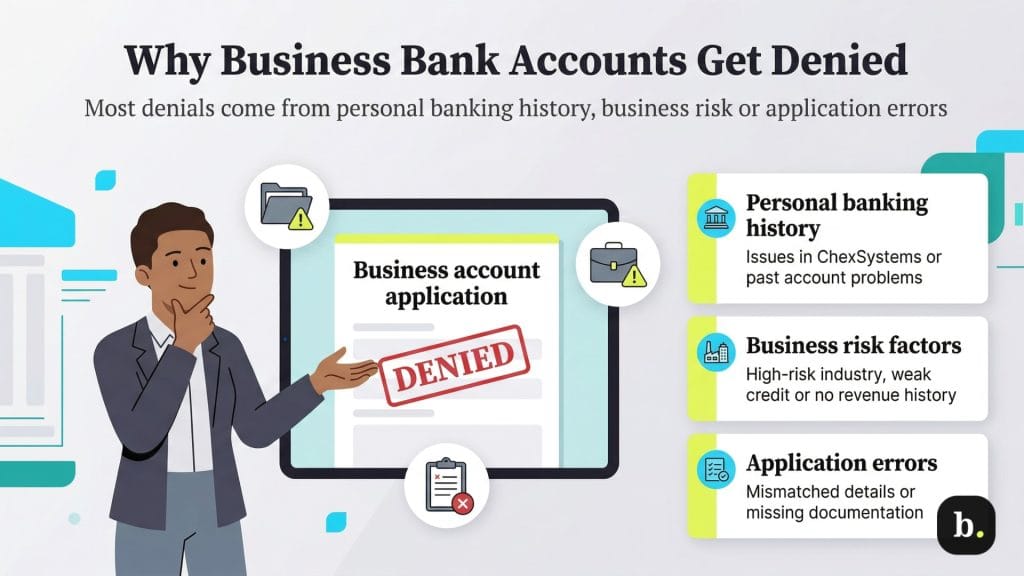
Banks assess risk when opening business accounts, just as they do with loans and credit lines. The specific criteria vary by institution, but most denials fall into three broad categories: your personal banking history, business-specific risk factors or problems with the application itself.
Personal banking history (ChexSystems)
Most people have heard of credit bureaus like Equifax, Experian and TransUnion, but fewer are familiar with ChexSystems, a consumer reporting agency that tracks banking behavior specifically. While credit bureaus focus on how you handle debt, ChexSystems focuses on how you handle bank accounts. More than 80% of banks and credit unions in the United States use ChexSystems reports as part of their account-opening process.
When you apply for a business bank account, the bank typically pulls your ChexSystems report using your Social Security number or your EIN. The report tracks negative events like unpaid overdraft fees, bounced checks, accounts closed involuntarily by a bank and suspected fraudulent activity. These items remain on your report for up to five years from the date the bank reported them.
Here’s what catches many business owners off guard: even when you’re applying for a business account under your LLC or corporation, your personal ChexSystems history still matters. Banks view the business owner’s banking track record as an indicator of how the business account will be managed. A single involuntary account closure or a pattern of unpaid fees from years ago can be enough to trigger a denial, even if your current financial situation is strong.
ChexSystems also assigns a Consumer Score ranging from 100 to 899, with higher scores indicating lower risk. There’s no universal cutoff; each bank sets its own threshold. Generally, scores below 500 to 550 raise significant concerns.
Business-specific red flags
Even with a clean personal banking history, your business itself can trigger a denial based on factors the bank considers high-risk.
- New businesses with no revenue history. Some banks require a minimum period of operation or documented revenue before they’ll open an account, particularly for certain account types or businesses requesting merchant services alongside a deposit account.
- High-risk industry classification. Banks maintain internal lists of industries they consider higher-risk from a regulatory and compliance standpoint. Common examples include cannabis, cryptocurrency, firearms and ammunition, adult entertainment, money services businesses and online gambling. Being categorized as high-risk doesn’t mean your business is doing anything wrong, it just means the bank has determined that serving your industry carries elevated compliance costs or regulatory exposure. This is an underwriting decision, not a moral judgment.
- Poor business credit. If your business has an established credit profile with negative marks — late payments to vendors, outstanding liens, judgments or a low Dun & Bradstreet PAYDEX score — some banks will factor that into their decision.
- Incomplete or inconsistent documentation. Banks verify business legitimacy through formation documents, EIN confirmation and identification. If any of these are missing or contain inconsistencies, the application may be denied outright rather than processed with gaps.
Application issues
Sometimes the denial has nothing to do with risk and everything to do with the application itself. Mismatched information between your EIN records and your application – a different business name, a wrong address or a discrepancy in the listed responsible party – can trigger an automatic rejection. Applying for the wrong type of account (a standard business checking account when your industry or transaction volume requires a specialized account) can also result in a denial. These are typically the easiest issues to fix.
Steps to take after a bank account denial
A denial is frustrating, but it’s also the starting point for a specific, actionable recovery process. Here’s how to approach it.
Get the specific reason
You have a legal right to know why you were denied. Under the Fair Credit Reporting Act (FCRA), when a bank denies a deposit account based in whole or in part on information from a consumer report, including a ChexSystems report, it must provide you with an adverse action notice. This notice must include the name and contact information of the reporting agency that supplied the information, a statement that the agency didn’t make the denial decision and can’t explain why it was made, and notice of your right to obtain a free copy of the report within 60 days.
If you didn’t receive an adverse action notice, contact the bank directly and request one. You’re also entitled to one free copy of your ChexSystems report every 12 months, regardless of whether you’ve been denied. You can request it through the ChexSystems website or by mail. If you’ve been denied within the past 60 days, you can request an additional free copy tied specifically to that denial.
Review the report carefully. It will list any negative items — unpaid fees, involuntary closures, suspected fraud — along with the dates they were reported and the institutions that reported them. This information tells you exactly what you’re dealing with and where to focus your efforts.
Fix what’s fixable
Once you know the reason for the denial, you can start addressing it.
- Dispute errors. ChexSystems reports aren’t immune to mistakes. If you find an item that’s inaccurate such as a fee you already paid, an account that was closed voluntarily rather than involuntarily or an entry that belongs to someone else, you can file a dispute directly with ChexSystems. They’re required to investigate within 30 days under the FCRA. You can also dispute directly with the bank that reported the item, as they’re obligated to verify or correct the information.
- Settle outstanding debts. If you owe money to a former bank due to unpaid overdraft fees or negative balances, contact the institution and settle the debt. Paying what you owe won’t remove the negative item from your ChexSystems report immediately (it stays for up to five years from the original report date,) but it does stop the situation from getting worse, and some banks view settled debts more favorably than unresolved ones.
- Correct documentation issues. If the denial was related to incomplete paperwork or mismatched information, this is the simplest fix. Verify that your EIN confirmation letter matches the information on your application, ensure your business formation documents are current, and confirm you’re applying under the correct legal name.
- Wait when necessary. Some flags, particularly involuntary account closures or suspected fraud, may require time to age off your report. ChexSystems entries expire after five years. If you’re close to that window, waiting a few months and reapplying may be the most practical approach.
Explore alternative options
If your ChexSystems report has legitimate negative items that won’t age off anytime soon, or if the denial was industry-related, you still have options.
- Second-chance business accounts. Some banks and credit unions offer accounts specifically designed for customers with negative banking histories. These accounts may come with higher fees, lower transaction limits or fewer features than standard business accounts, but they serve a critical purpose: they get you banked and give you the opportunity to rebuild a positive track record. After 12 to 24 months of responsible account management, many institutions will upgrade you to a standard account.
- Credit unions. Credit unions often apply more flexible underwriting criteria than large commercial banks. Because they’re member-owned and community-focused, they may be more willing to evaluate your application holistically, considering your current situation and business plan rather than relying solely on an automated ChexSystems score. It’s worth calling ahead and asking whether they offer business accounts for applicants with ChexSystems history.
- Online banks and fintechs. Several online-only banks and financial technology companies have built their business models around serving customers who don’t fit neatly into traditional banking criteria. Some don’t use ChexSystems at all, instead relying on alternative verification methods. These accounts typically offer solid digital banking features like mobile deposit, accounting software integration or ACH transfers, though they may lack branch access and cash deposit capabilities.
- Prepaid business accounts. As a last-resort bridge, prepaid business debit cards allow you to receive deposits and make payments under your business name. They’re not full bank accounts (you won’t build a banking relationship or earn interest) but they provide basic functionality while you work on resolving the underlying issues.
Special considerations for high-risk industries
If your business was denied because of its industry classification rather than your personal banking history, the path forward looks different. This isn’t a problem you can fix by settling old debts or disputing a ChexSystems entry, it’s a structural issue with how banks assess your sector.
Banks classify industries as “high-risk” primarily because of regulatory compliance costs. Serving a cannabis business, for example, requires enhanced due diligence under the Bank Secrecy Act, ongoing FinCEN reporting, and exposure to the conflict between state legality and federal prohibition. Cryptocurrency businesses face heightened anti-money laundering scrutiny. Money services businesses trigger complex reporting obligations. Banks weigh whether the revenue from your account justifies the compliance burden, and many decide it doesn’t.
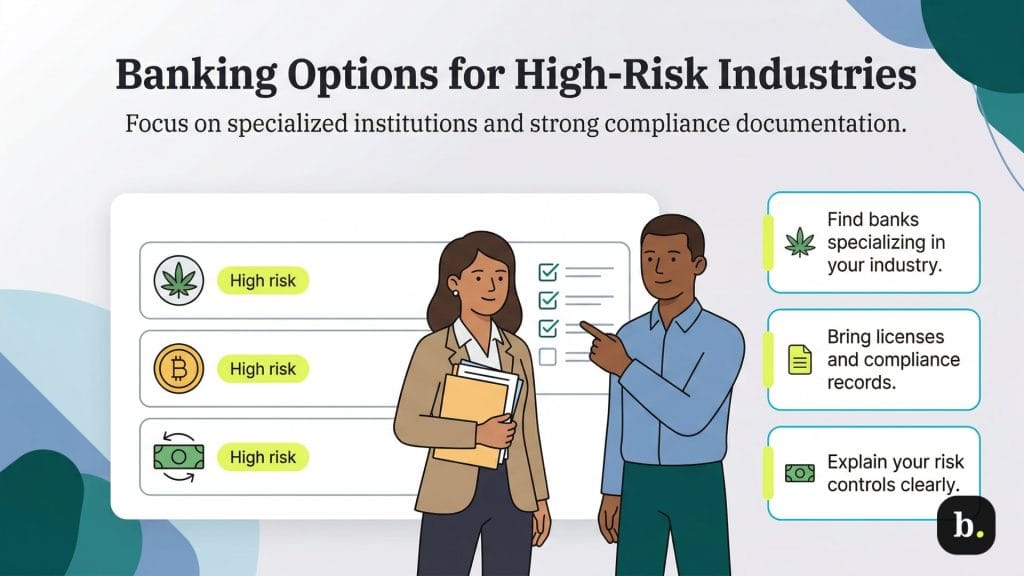
If your business operates in one of these industries, focus your search on institutions that specialize in your vertical. State-chartered banks and credit unions in legal cannabis markets, for instance, have built compliance programs specifically to serve cannabis-related businesses, though they typically charge higher account fees and require more extensive documentation. Community development financial institutions (CDFIs) and mission-driven lenders sometimes serve industries that larger banks avoid. Industry associations and trade groups can often point you toward banks that actively work with your sector.
Regardless of industry, come to the application prepared. Have your state licenses and permits organized, maintain detailed compliance documentation, and be ready to explain your business model and anti-money-laundering controls clearly. Banks that serve high-risk industries expect a higher level of transparency and documentation upfront; providing it proactively signals that you take compliance seriously.
A business bank account denial is a setback, not a verdict. The most productive response is to diagnose the specific cause — request your adverse action notice and ChexSystems report — address whatever is fixable, and explore the full range of banking options available to you. Whether that means settling old debts, correcting application errors, applying at a credit union, or finding a bank that specializes in your industry, there's almost always a path forward. The key is treating the denial as information, not as a permanent barrier.