Business.com aims to help business owners make informed decisions to support and grow their companies. We research and recommend products and services suitable for various business types, investing thousands of hours each year in this process.
As a business, we need to generate revenue to sustain our content. We have financial relationships with some companies we cover, earning commissions when readers purchase from our partners or share information about their needs. These relationships do not dictate our advice and recommendations. Our editorial team independently evaluates and recommends products and services based on their research and expertise. Learn more about our process and partners here.
When you have to pay a team across international borders, things can get complicated. That’s where a global payroll solution comes in.


This article is sponsored by Deel.
Paying a team in several countries means managing several versions of the same process. One location has a different payroll deadline, another requires different deductions and your finance team needs a reliable picture of what the entire workforce costs.
Global payroll solutions help businesses coordinate those local processes. The right service can bring payroll data, approvals and reporting together while supporting the requirements in each country. Choosing one starts with understanding what the provider will handle and what your team will continue to own.
Global payroll solutions help businesses calculate, administer and coordinate employee pay across multiple countries. They combine local payroll processes with a broader view of payroll activity and workforce costs.
A business might use a global payroll service to manage employees hired through its own entities in several countries. Another might use a platform to coordinate existing local payroll providers. The interface can be centralized even when the underlying payroll operations differ by location.
Payroll administration is also distinct from legal employment, as opposed to an employer of record (EOR) arrangement. For example, Deel, a global payroll provider, makes the distinction clear in its own documentation: Under its Global Payroll model, the client employs the worker and Deel processes payroll.
An employer of record (EOR), by contrast, provides a separate employment arrangement in which a company like Deel technically employs the worker on behalf of your business, while you direct their work. This is most commonly used when employing workers internationally in countries where you’ve not established a local entity.
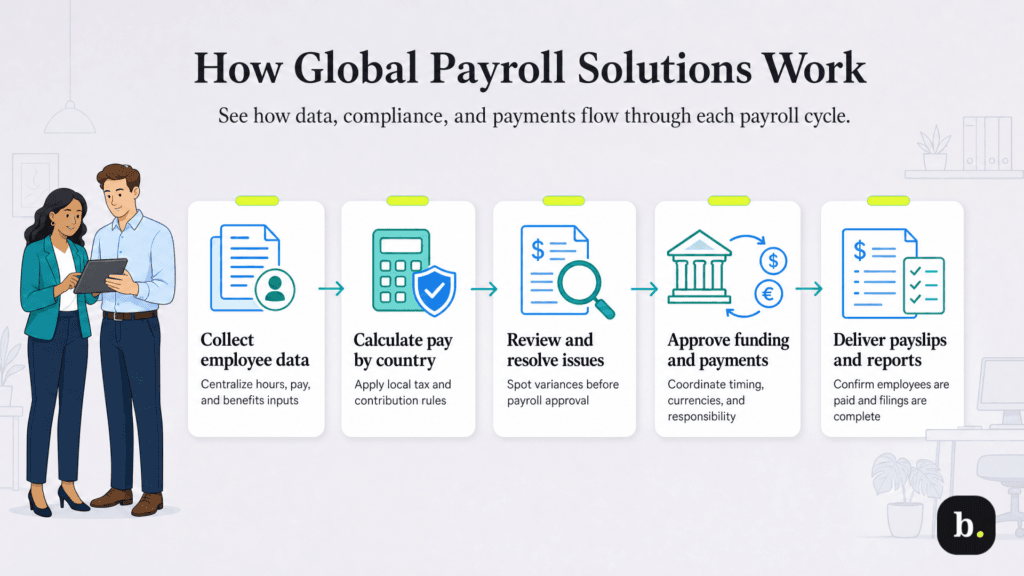
Most payroll cycles follow a similar sequence. The details, deadlines and responsibilities vary by country and by the services you purchase.
The process starts with employee records and changes for the current pay period. Inputs can include salaries, hours worked, overtime, leave, bonuses, benefits and approved expenses.
Decide where each piece of information comes from and who approves it. Connections to HR and time and attendance software can reduce duplicate entry, but your team still needs to check whether the right data is arriving before the payroll deadline.
The payroll system or processing team calculates gross earnings, employee deductions, employer contributions and net pay using the relevant local rules and employee information.
For example, the U.K. government’s payroll guidance describes tasks such as calculating deductions, producing payslips and reporting pay to HM Revenue and Customs. A global process needs to accommodate these local obligations rather than apply one country’s payroll settings everywhere.
An authorized reviewer checks the proposed payroll before approval. Useful checks include unexpected changes in net pay, missing employees, unusual deductions and differences from the previous cycle.
Ask whether the platform lets you investigate a variance without downloading several files. Decide who can correct an input and whether a correction requires a second approval.
After approval, the business supplies the funds needed to pay employees and cover other obligations. Currency conversion, banking deadlines and local payment arrangements can affect when funding is due.
Confirm who actually moves the money. A provider may calculate payroll but leave salary payments or certain statutory payments to your business. Deel’s documentation, for example, notes that direct employee payment arrangements can differ by country.
Employees receive their pay documentation, and the responsible party completes the required reporting and remittances. Finance also needs records that reconcile payroll with bank activity and accounting entries.
Define what constitutes a completed payroll cycle. An approved calculation alone does not confirm that employees have been paid or that required submissions have been accepted.
The term “global payroll” covers several operating models. Choose the level of support that fits your team’s expertise and the employment arrangements you already have.
Model | Who employs workers? | Who operates payroll? | Best fit |
|---|---|---|---|
Payroll software | Your business or its entity | Your team uses the software | Businesses with internal payroll expertise |
Managed global payroll | Your business or its entity | The provider handles agreed processing tasks | Teams seeking operational support |
Payroll consolidation | Your business or its entity | Local providers process payroll; a platform consolidates workflows or data | Businesses retaining local payroll relationships |
EOR payroll | The EOR | The EOR administers payroll within the employment service | Supported hires where you need an EOR employment arrangement |
You can use different models in different countries. For instance, a team might operate payroll internally in its home market and outsource processing elsewhere. Deel’s payroll offering supports self-service and managed options by country.
If the terms are unfamiliar, review the differences among PEOs, EORs and HR software before comparing proposals.
You do not need to wait until you have a large international workforce. The stronger signal is that coordinating payroll has become difficult to control or review.
Look for recurring problems: Managers reenter the same information in several systems, local providers send reports in incompatible formats, corrections arrive after approval or finance cannot explain changes in workforce costs without days of spreadsheet work.
Before shopping, document a recent payroll cycle. Record who supplied information, where delays occurred and which checks caught errors. That gives you concrete requirements to test during demonstrations.
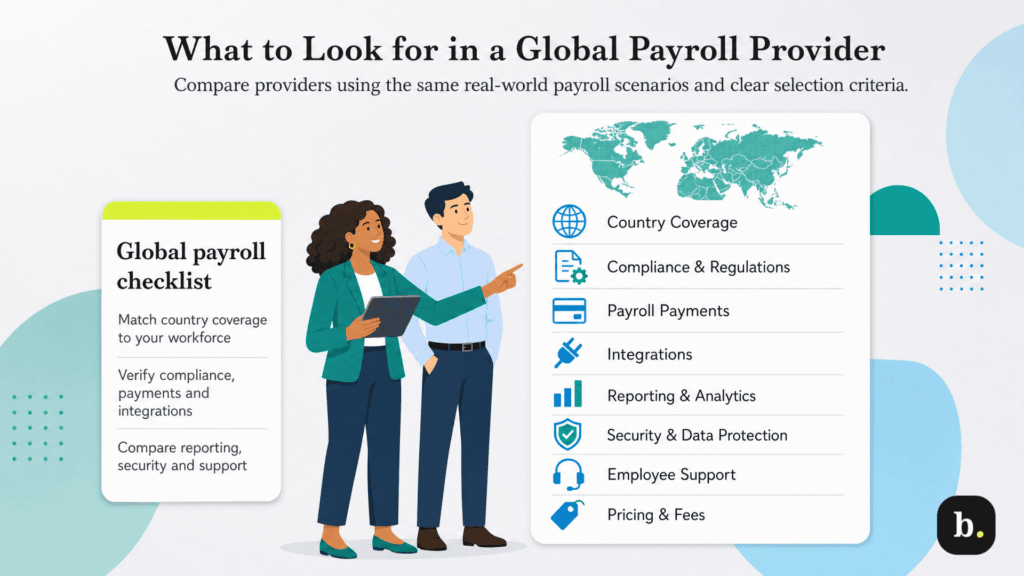
Assess global payroll providers against the countries and workflows you need today, along with realistic expansion plans. Ask each provider to demonstrate the same scenarios so you can compare their answers.
Request a country-by-country description of calculations, filings, payments, year-end work and employee support. Ask which tasks the provider performs directly and which involve partners. Coverage should be specific enough to reveal any work your team must still complete.
Ask who reviews changes to local payroll requirements, how those changes reach the system and who helps resolve an unusual case. Test the support process with a realistic question about leave, a bonus or an employee departure.
Confirm supported payment and funding currencies, conversion charges, funding deadlines and payment tracking. Ask what happens when a bank rejects a payment and who coordinates a correction. Request separate answers for employee payments and payments to authorities.
Have the provider show how a salary change travels from your HR system into payroll and then into accounting. Check the exact products, fields and subscription requirements involved. An integration is useful only if it moves the information your process needs with appropriate controls.
Look for local detail alongside consolidated reporting. Deel, for example, provides a central view of payroll status, variances and workforce costs. In a demo, ask to trace a proposed change through review, approval and reporting, including who made it and when.
Payroll contains sensitive identity, banking and compensation information. Ask how access is restricted, how files are transferred and what happens when an administrator leaves. Have your security or privacy reviewer examine the relevant documentation and contractual terms.
Ask who answers an employee’s payroll question, in which languages and during which hours. Request a demonstration of payslip access and the correction process. Employees should know where to get help without having to navigate your vendor relationships themselves.
Request a quote that separates recurring processing fees from implementation, integrations, additional payroll runs, year-end work, payment charges and currency conversion. Confirm minimum commitments, renewal terms and the cost of retrieving your data when the service ends. [Related article: Our guide to choosing payroll software explains additional buying considerations.]
Global payroll compliance involves adhering to the requirements that affect pay, deductions, reporting and records in each location. A provider can support those tasks through local expertise, software updates and agreed processing services.
Consider four areas when reviewing its approach:
Outsourcing processing does not automatically transfer every employer obligation. For U.S. payroll, the IRS explains that employers generally remain responsible for outsourced federal employment tax duties, with exceptions for certain arrangements. Have the provider explain the responsibilities in your agreement and how mistakes are handled. If you also need broader administrative support, compare the scope with HR outsourcing services.
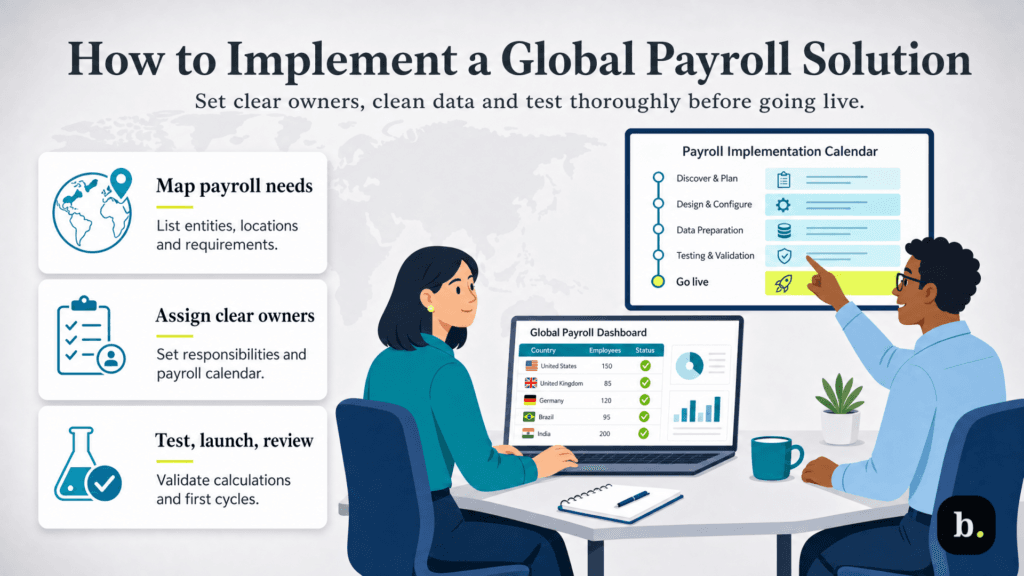
Treat implementation as a change to an essential business process. Agree on the handoff with your current team and providers before selecting a first live payroll date.
List employees by employing entity and work location, then document pay frequencies, currencies, benefits, reporting requirements and existing systems. Identify unusual arrangements early so they can be reviewed before migration.
Name an internal payroll owner and a provider contact. Work backward from payday to set deadlines for inputs, review, corrections, approval and funding. Account for relevant holidays and time zones. Arrange a backup approver for absences.
Check employee records, bank details, compensation, deductions and required historical balances. Use the agreed secure transfer method. Reconcile migrated information against the source records and resolve discrepancies before testing calculations.
Agree on parallel testing where appropriate: Compare the new system’s results with the existing process and explain differences. Include representative scenarios, such as a new hire, overtime, a bonus and a departing employee. Check payment setup without accidentally sending duplicate live payments.
Tell employees how to access payslips and request help. During the first cycles, confirm that:
Track corrections and their causes so the team can fix the process. Compare prospective payroll services partly on the implementation support they provide, not only the features available after launch.
Global payroll services administer pay across countries, commonly for workers your business employs directly. An EOR employs workers on your behalf and includes payroll within that employment service. A platform may offer both, but they are different arrangements.
Some consolidation models allow this. Ask which providers can connect, what information they exchange and whether the arrangement centralizes approvals as well as reporting. Also clarify who investigates an error involving more than one provider.
Some platforms offer contractor payments alongside employee payroll. Confirm the separate service scope and fees. Paying a contractor through the same platform as employees does not determine whether that worker is correctly classified.
Costs can depend on employee counts, countries, payroll complexity, service level, integrations and payment needs. Compare an itemized quote against a full year of expected activity, including setup, additional payroll runs and year-end work.
