Business.com aims to help business owners make informed decisions to support and grow their companies. We research and recommend products and services suitable for various business types, investing thousands of hours each year in this process.
As a business, we need to generate revenue to sustain our content. We have financial relationships with some companies we cover, earning commissions when readers purchase from our partners or share information about their needs. These relationships do not dictate our advice and recommendations. Our editorial team independently evaluates and recommends products and services based on their research and expertise. Learn more about our process and partners here.
These mistakes are common among first-time LLC owners. Make sure you avoid them with the help of this guide.


This article is sponsored by Northwest Registered Agent.
Forming a limited liability company has never been simpler. In most states the filing itself is an online form that takes a few minutes to complete. And entrepreneurs take advantage of this fact: more than 5.6 million business applications were filed in the United States in 2025, according to U.S. Census Bureau data.
Filing is the easy part. The benefit that draws people to the LLC structure — that it creates a legal wall between personal assets and business obligations — isn’t established the moment the state accepts your articles of organization. It is maintained over the months and years that follow.
First-time owners rarely lose that protection through anything dramatic. They lose it by skipping a document that seemed optional, missing a deadline they didn’t know existed or making a formation decision based on advice written for a different kind of business. Here are the five mistakes that come up most often, and what to do instead.

An operating agreement spells out who owns what share of the company, how decisions get made, how profits are distributed, and what happens if a member leaves, dies or wants out. Plenty of new owners skip it, especially single-member LLCs, where the answer to every one of those questions feels self-evident.
It isn’t always optional. Five states require LLCs to have an operating agreement: California, Delaware, Maine, Missouri and New York. The form varies even within that group. Delaware, Maine and Missouri accept oral or implied agreements, while New York requires a written one, adopted within 90 days of filing the articles of organization and kept in the company’s internal records, according to the U.S. Chamber of Commerce. No state asks you to file it.
The stronger argument for having one has nothing to do with state law. Without an operating agreement, your company is governed entirely by your state’s default statutory rules, which may allocate control or distribute assets in ways you would never have chosen. And in a dispute, a single-member LLC with no governing document looks a great deal like one person doing business under a different name.
Adopt the agreement before the business spends its first dollar. Banks routinely ask for it when you open a business account, and lenders and investors will want to see it later. Templates handle straightforward single-member and equal-partner structures fine. Unequal ownership, staggered capital contributions or passive members are worth an attorney’s review.

Every state requires an LLC to name a registered agent with a physical street address in that state (not a P.O. box) where legal documents and official state correspondence can be delivered. Naming yourself is legal in most states and costs nothing, which makes it the default for anyone running a business out of a spare bedroom.
However, that address becomes public record. Anyone can search your company name in the secretary of state’s database and pull up the registered agent’s name and address, and data brokers scrape those records at scale. For a home-based business, the registered office and the place your family sleeps are the same address, permanently and searchably.
The availability requirement is the bigger operational risk. A registered agent has to be physically present at that address during normal business hours to accept service of process, which can arrive at any point in the workday. Miss a delivery because you were at a client site or on vacation, and you may not learn a lawsuit exists until a default judgment has already been entered against your company.
Appoint a commercial registered agent. The service costs less than most business software subscriptions and solves both problems at once: the provider’s address appears on your public filings instead of yours, and someone is there to sign for documents every business day. Northwest Registered Agent, for example, includes a free year of registered agent service when you form your LLC through it, along with a business address you can list on state filings in place of your own.
The U.S. Small Business Administration puts financial separation near the top of its guidance for new owners, and for a specific reason: commingling funds, accounts and assets is what erodes the corporate veil.
When a court decides whether to hold an owner personally responsible for a company’s debts (known as “piercing the corporate veil” or “alter-ego liability”) it weighs a cluster of factors. These include the commingling of assets, treating company assets as the owner’s own, failure to maintain records, undercapitalization and use of the entity as a personal shell. Commingling appears in nearly every version of that list.
LLC owners sometimes assume the analysis doesn’t reach them, since LLCs are designed to run informally. Courts do pierce LLC veils, generally applying the same standard used for corporations, though some weigh the factors a bit differently in recognition of that informality.
The realistic risk is that a vendor sues over an unpaid invoice who discovers in the course of the case that a year of company revenue moved through a personal checking account.
Open a separate bank account for your business as soon as your EIN comes through, and route every dollar of revenue and every expense through it. Pay yourself in documented distributions rather than pulling cash when you need it. If you cover a business cost personally, move the money into the business account first and pay from there. The paper trail is the point.
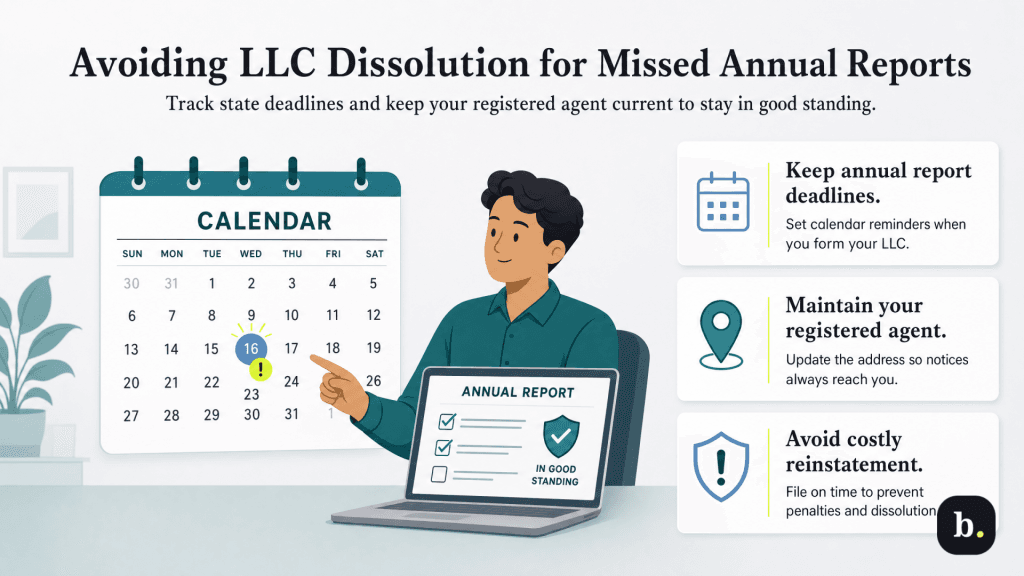
Most states require LLCs to file a periodic report confirming basic details like the registered agent, principal address and members. The fees are usually modest. The deadlines are not standardized in any useful way: some states use a fixed calendar date, others tie the due date to your formation anniversary and a handful require no report at all.
Miss one and your LLC falls out of good standing. Miss it long enough and the state administratively dissolves the company. The most common triggers are a missed report, unpaid state fees or franchise taxes, and a lapsed registered agent. A dissolved LLC can’t legally operate, sign contracts or defend itself in court, and in some states its name becomes available for another business to claim.
States send delinquency notices and dissolution warnings to the registered agent’s address on file. If that address is stale (you moved or the friend you named stopped opening the mail) you may not discover how far the process has gone until you are already dealing with reinstatement.
Look up your state’s specific filing deadline the week you form, and set two calendar reminders: one a month out and one a week out. Keep your registered agent’s address current, because that is where the warnings go. Most commercial registered agents send compliance reminders as part of the service, and many will prepare and file the report on your behalf.
Search for advice on where to form an LLC and you’ll find enthusiastic arguments for Delaware, Wyoming and Nevada: low fees, no state income tax, strong owner privacy and well-developed business courts. Those advantages are real. They mostly accrue to businesses that actually operate in those states.
An LLC is a domestic entity in the state where it was formed and a foreign entity everywhere else. Form in Wyoming but run the business from your home in another state, and you’ll generally have to register as a foreign LLC where you actually operate and pay that state’s fees and taxes anyway. You’ve added a second registered agent, a second annual filing and a second set of deadlines without shedding the first.
The tax argument tends not to survive contact with the numbers, either. The California Franchise Tax Board requires every LLC doing business in California to pay an $800 annual tax, and that obligation continues whether or not the company conducts business, until the LLC is formally canceled. Forming in Nevada doesn’t make that disappear if your company runs out of San Diego.
Form in the state where you operate unless you have a specific, articulable reason not to, such as raising institutional capital and your investors expect a Delaware entity, you hold real property in another state or owner privacy is a hard requirement you’ve already priced out. Absent a reason of that kind, the home state is cheaper, simpler and easier to keep in good standing.
None of the five mistakes mentioned above are a filing error. Every one is a maintenance failure: a document is never adopted, an address is left exposed, an account is never opened, a deadline is never tracked, a decision is made without checking what it would cost a year later.
Maintenance failures are usually a symptom of fragmentation. When the registered agent is one vendor, the compliance calendar is a note on your phone, the domain sits at a registrar you set up years ago and the business address is your kitchen table, there’s no single place where a missed item surfaces before it becomes a problem.
That’s the practical case for handling formation and ongoing compliance through one provider. Northwest Registered Agent is built around that model. Form your LLC through the company and registered agent service is free for the first year, with Northwest’s address available for your public state filings instead of your own.
None of that substitutes for the judgment calls only you can make about ownership, capital and structure, of course. But it does remove the most common failure mode for first-time owners, which is simply losing track.
