Business.com aims to help business owners make informed decisions to support and grow their companies. We research and recommend products and services suitable for various business types, investing thousands of hours each year in this process.
As a business, we need to generate revenue to sustain our content. We have financial relationships with some companies we cover, earning commissions when readers purchase from our partners or share information about their needs. These relationships do not dictate our advice and recommendations. Our editorial team independently evaluates and recommends products and services based on their research and expertise. Learn more about our process and partners here.
Fake Google reviews can do real damage to your business. Here’s how to identify and remove them before they affect your brand reputation.


This article is sponsored by Erase.com
Fake reviews are one of the most persistent threats to small business reputations online. A single coordinated attack can drop a Google rating by a full star overnight, steering potential customers to competitors before they ever walk through your door.
The good news is that Google does remove reviews that violate its policies, and business owners who understand the process can take meaningful action. The challenge is knowing which reviews actually qualify for removal, how to build a case that gets results, and what to do when the standard process falls short.
This guide walks through each of those steps so you can protect the online reputation you’ve worked to build.
Before you invest time flagging a bad review, it’s worth understanding a distinction that trips up most business owners: Google removes reviews that violate its specific content policies, not reviews that are simply negative or feel unfair. A one-star review that stings is not the same as a one-star review that breaks the rules, and knowing the difference will save you significant frustration.
Reviews that are eligible for removal fall into several categories under Google’s prohibited and restricted content policies:
Reviews that Google will not remove include:
A customer who says your service was “the worst experience of my life” may be overstating things, but if they were actually a customer, that review is likely staying up.
The key distinction is policy violation versus bad experience. A review does not have to be accurate to remain on your profile; it has to violate a specific rule to come down. Business owners who internalize this distinction early will make better decisions about which reviews to flag and which to address through a professional response instead.
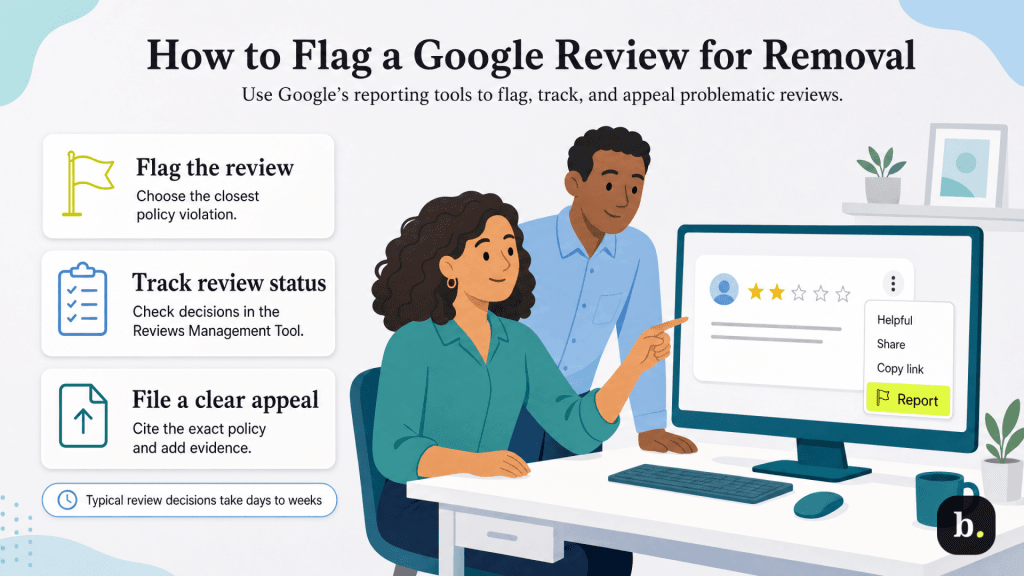
Google provides three access points for flagging a review: your Google Business Profile dashboard, Google Maps and Google Search. All three route to the same reporting flow.
To flag a review, locate it on your profile, click the three-dot menu (or the “Report” option), and select the reason that best matches the violation. Categories include spam or fake content, off-topic review, conflict of interest, profanity or harassment and others. Select the one that most closely applies and submit your report.
After flagging, you can track the status of your report using Google’s Reviews Management Tool.
You’ll see one of three statuses:
If your initial flag comes back as “no policy violation,” you can submit one appeal per review. This is your only opportunity to escalate through the standard process, so it needs to count.
When you appeal, cite the specific Google policy you believe was violated and include any supporting evidence. A vague appeal that says “this review is fake” is far less effective than one that explains, “This reviewer describes a delivery order arriving cold, but our business is a dine-in-only tasting menu restaurant that does not offer delivery.”
Automated flags typically process within a few days. Manual reviews and appeals can take a week or longer. Complex or escalated cases may take two to three weeks. Business owners should not expect same-day resolution, and planning around these timelines helps set expectations.
The stronger your documentation, the better your chances. Before you submit a flag or appeal, compile proof that the reviewer was never a customer (no matching transaction records, no appointment history), screenshots of the reviewer’s profile showing limited review history or geographic inconsistencies, and documentation of coordinated timing if multiple suspicious reviews arrived in a short window.
If you’ve received any direct communication from the reviewer, especially messages demanding payment for removal, preserve those as well. Google rolled out a dedicated Merchant Extortion reporting form in late 2025 specifically for extortion cases, and having that documentation ready is critical for using it effectively.
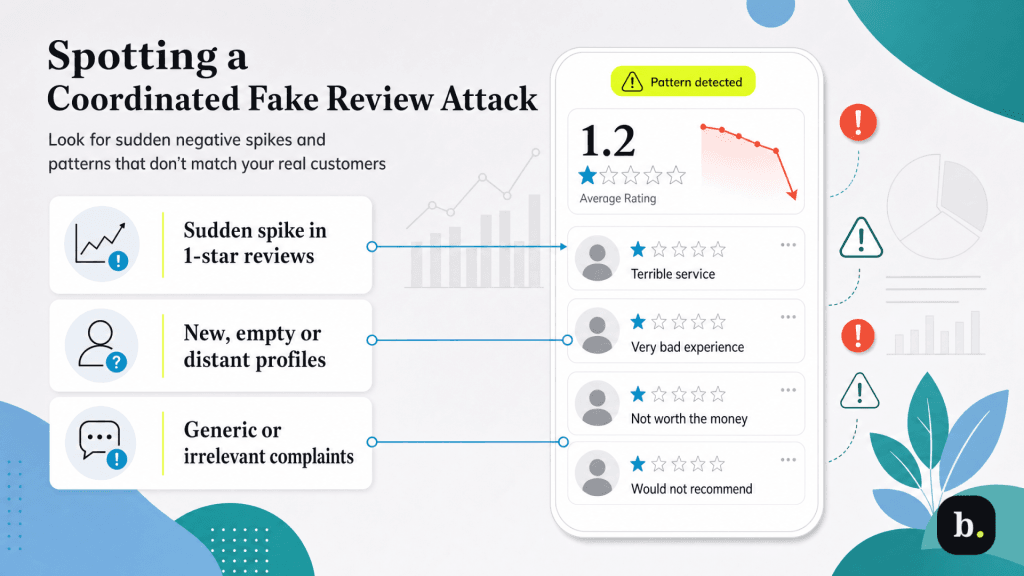
A single fake review is a nuisance. A coordinated attack is a business threat. Knowing how to recognize the difference early can mean the difference between a minor inconvenience and a significant hit to your rating and revenue.
Red flags that a review might be fake:
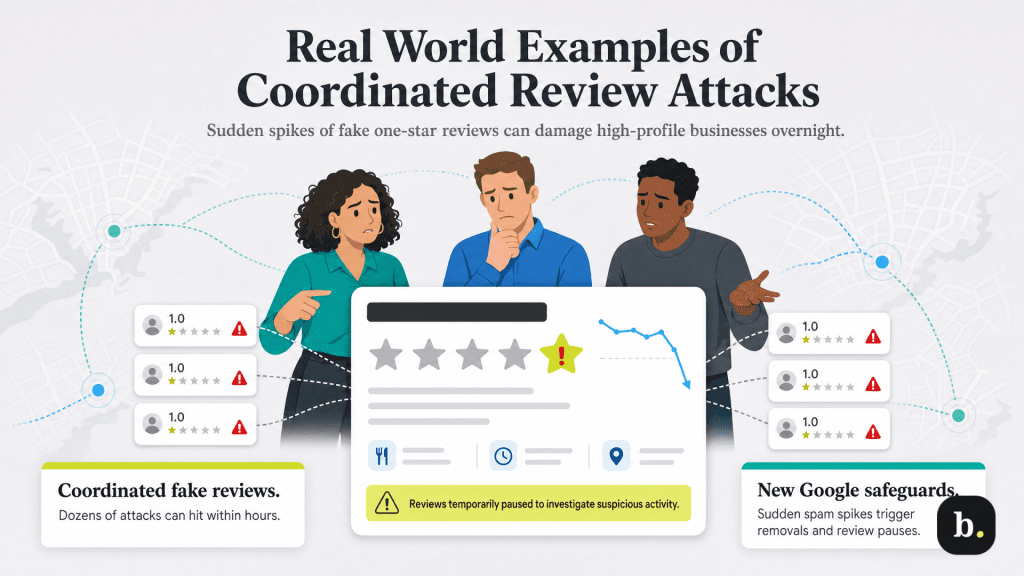
In 2022, several Miami restaurants that had recently received Michelin recognition, including Boia De, Stubborn Seed, and Mamey, were flooded with fake one-star reviews followed by emails demanding Google Play gift cards worth $75 in exchange for stopping the attacks. The scammers explicitly acknowledged the illegality of their actions in their messages.
In 2025, at least eight Philadelphia restaurants, including Provenance, Mish Mish, and Lacroix, were hit overnight with dozens of fabricated reviews. Some described delivery orders arriving cold at a restaurant that only serves $225-per-person tasting menus.
A similar wave struck Chicago restaurants around the same time, with establishments like Alpana and SHŌ reporting 20 to 50 fake reviews posted within hours. These attacks are believed to originate primarily from overseas actors, and they target businesses that depend heavily on online ratings, particularly restaurants, contractors, and service providers.
Google’s standard flagging and appeal process works in many cases, but it is not infallible. Automated systems process millions of flags and dismiss the majority without a detailed policy assessment. Even reviews that clearly violate Google’s content policies are sometimes returned as “does not violate our policies” after an automated scan. When the standard process stalls, you still have options.
Fake reviews are not going away, but the tools and enforcement mechanisms available to business owners are stronger than they have ever been. Google’s AI-powered detection continues to improve, the FTC now has direct penalty authority over fake review schemes, and dedicated services like Erase.com exist for situations where the standard process is not enough.
The most important step you can take today is understanding which reviews actually qualify for removal and building the strongest possible case when you flag them. A well-documented flag is worth more than a dozen frustrated clicks on the “Report” button.
