Business.com aims to help business owners make informed decisions to support and grow their companies. We research and recommend products and services suitable for various business types, investing thousands of hours each year in this process.
As a business, we need to generate revenue to sustain our content. We have financial relationships with some companies we cover, earning commissions when readers purchase from our partners or share information about their needs. These relationships do not dictate our advice and recommendations. Our editorial team independently evaluates and recommends products and services based on their research and expertise. Learn more about our process and partners here.
As your business grows into new states, your tax obligations change. Here’s how to remain compliant and when to consider upgrading your accounting tools to keep pace.


This article is sponsored by Intuit.
If you’ve been selling into other states for a while, there’s a good chance the rules governing your tax obligations have changed since you last checked. Economic nexus is the standard that determines whether a state can require you to collect and remit its sales tax even without a physical presence there, and these rules aren’t static. States frequently adjust their thresholds, change what counts toward them and reassign how often businesses have to file, sometimes without much notice. Fortunately, with the right organizational approach and enterprise-grade accounting software, you can stay on top of your tax obligations in each state.
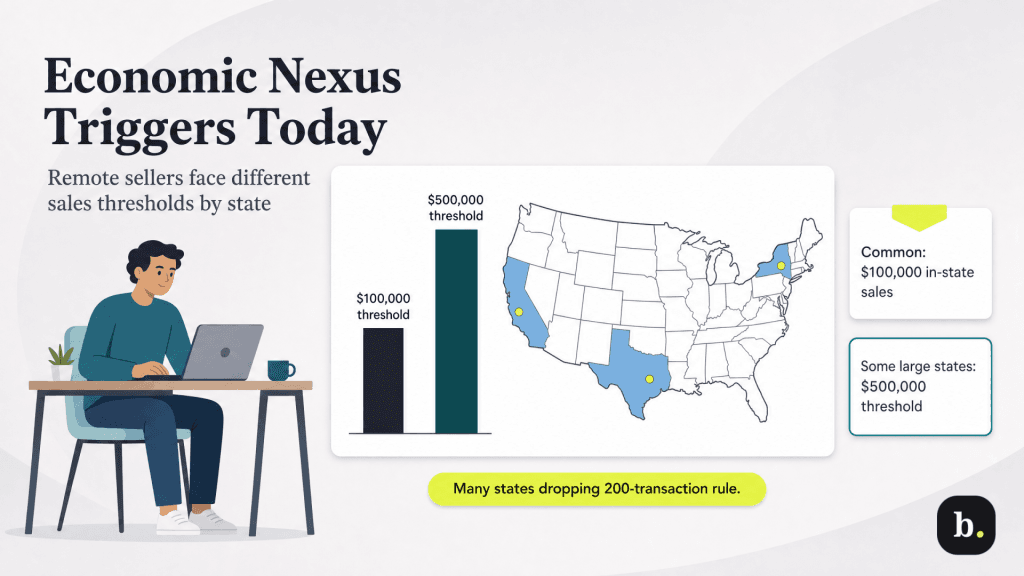
Economic nexus is the legal standard that lets a state require an out-of-state seller to collect and remit its sales tax based purely on the volume of sales into that state. There is no requirement that the business have an office, warehouse or employee located within the state. It’s a relatively recent concept, and it’s still evolving state by state.
Most states that impose economic nexus set the bar somewhere in the neighborhood of $100,000 in annual sales into the state. A handful of larger states set it meaningfully higher: California, New York and Texas, among others, use a $500,000 threshold, reflecting the scale of commerce those states expect before requiring smaller out-of-state sellers to register. (New York also maintains a 100 transaction minimum, in addition to the revenue threshold, setting an even higher bar.)
Historically, many states paired that revenue threshold with an alternate trigger based on transaction count, commonly 200 transactions, meaning a business could establish economic nexus through sheer order volume even with a modest total dollar amount. In practice, that caught businesses selling a high volume of low-priced items, even when their total revenue in the state was small.
That’s changing. State by state, more jurisdictions are dropping the transaction-count trigger altogether and moving to a revenue-only test. Because this shift is happening one state at a time and on its own schedule, the specific list of which states still use a transaction count is a moving target. If you’re not sure, it’s worth checking against your state’s department of revenue or a nexus-tracking tool, rather than assuming last year’s rules still apply.
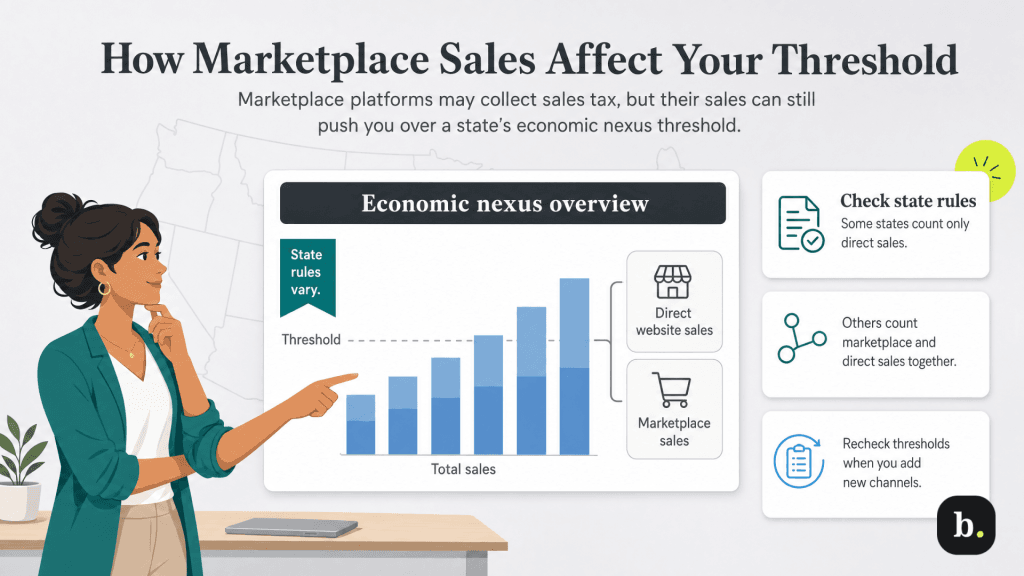
Most states now have marketplace facilitator laws, meaning platforms like Amazon, Etsy or Walmart Marketplace are responsible for collecting and remitting sales tax on the transactions they facilitate on your behalf. That means you’re not responsible for manually collecting tax on those sales, but it raises a separate question: Do those marketplace sales still count toward your own economic nexus threshold in a given state?
The answer varies by state. Some states only count direct sales through your own website or storefront, effectively giving marketplace sales a pass. Others count all sales regardless of channel, meaning a seller who does most of their volume through a marketplace could still trigger economic nexus, even though the marketplace is the one collecting the tax.
This detail is important for businesses selling across multiple channels, such as an e-commerce website plus one or more marketplaces. Don’t assume that because a marketplace is handling collection, you’re off the hook for registration in that state. Check the specific rule for each state where you have meaningful volume, or use a nexus-tracking tool that accounts for this channel by channel.
This is also worth revisiting any time you add a new sales channel, not just when you’re first setting up. A business that’s historically sold only through its own website could find that adding a large marketplace channel changes the calculation in a state that counts marketplace sales toward the threshold.
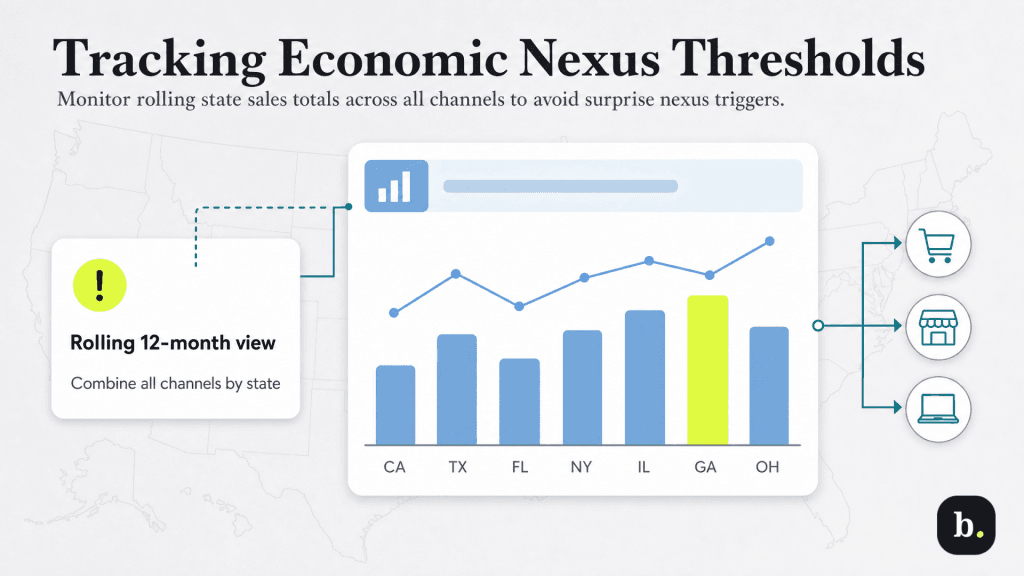
Economic nexus thresholds are typically measured over a defined look-back period, and the specifics vary: Some states use the current calendar year, others the prior calendar year and some use a rolling 12-month window that’s recalculated continuously rather than resetting each January. That last version can be tricky because a strong month could trigger economic nexus mid-year, even if your calendar-year total wouldn’t have.
The safest habit is to check your total sales by state on a rolling basis rather than waiting for year-end to run the numbers. If you sell through several channels, that means combining direct sales and marketplace sales into a single running total by state, not tracking each channel separately. A nexus-monitoring feature built into your accounting software or ERP platform can flag you automatically as you approach a threshold, which is considerably easier than reconstructing state-by-state sales history after the fact.
Once you’ve crossed the threshold for economic nexus, you’re required to register with the state before you start collecting sales tax. Registering incorrectly, or in the wrong sequence, can create its own headaches.
Start with the state itself: Most states require sales tax registration through the state’s department of revenue before you’re authorized to collect. Collecting tax before you’re registered, even briefly, can create compliance problems since you’d be holding tax you’re not yet licensed to remit.
In home-rule states, where certain cities or localities administer their own sales tax separately from the state, registration can require an extra step. A state-level registration may not automatically cover a home-rule city’s local tax, meaning you could be compliant at the state level while still exposed at the local level. This is easy to miss because it doesn’t come up in most states, so businesses that have only dealt with standard state-administered sales tax can be caught off guard the first time they cross into a home-rule jurisdiction.
Once you’re registered, note your effective date carefully. It typically starts from your registration date or the date you crossed the threshold, depending on the state, and determines how far back you may owe back taxes if you delayed registering. Some states offer a limited voluntary disclosure process that can reduce the look-back period and waive penalties for businesses that come forward before being contacted, which is worth exploring if you discover you should have registered earlier.
States don’t let you choose how often you file. Instead, they assign a filing frequency (usually monthly, quarterly or annually) based on your sales volume in that state. They also periodically reassess: A business that starts out filing annually because its volume is low can get bumped to quarterly or monthly filing once its sales in that state grow, sometimes with little advance notice.
That reassignment usually arrives by mail or through the state’s online tax portal; it’s easy to miss if nobody’s specifically watching for it, especially across multiple states. Missing the first filing under a new frequency is a common way businesses accumulate late-filing penalties even though they’ve been compliant taxpayers up to that point.
This applies in the other direction, too. A business whose sales in a state decline may eventually qualify for a less frequent filing schedule, but states generally don’t make this change automatically without a formal request, so it’s worth asking rather than assuming you’ll be moved down a tier on your own.
As a business grows into more states, the challenge becomes staying on top of different thresholds, different measurement periods and different filing frequencies, each changing independently of the others. The good news is this doesn’t require tracking every state’s rule changes by hand.
Multistate businesses generally solve this problem with purpose-built tools rather than a spreadsheet and a checklist. Intuit Enterprise Suite, for example, includes automated sales tax rate calculation and filing reminders that account for state-specific rules as a business’s footprint grows.
Whatever tool you use, the underlying discipline is the same: Track your sales by state on a rolling basis, register before you start collecting and treat filing frequency as something to verify periodically rather than something to assume.
