Business.com aims to help business owners make informed decisions to support and grow their companies. We research and recommend products and services suitable for various business types, investing thousands of hours each year in this process.
As a business, we need to generate revenue to sustain our content. We have financial relationships with some companies we cover, earning commissions when readers purchase from our partners or share information about their needs. These relationships do not dictate our advice and recommendations. Our editorial team independently evaluates and recommends products and services based on their research and expertise. Learn more about our process and partners here.
Plan ahead to ensure you’ve got a reserve of critical supplies before your busiest season hits to avoid disruption.


This article is sponsored by Staples.
Most small business planning advice focuses on January goal-setting or fourth-quarter budgeting. But for many small businesses, the middle of the year is when operations actually peak. Seasonal demand surges, summer staffing gaps and the cumulative wear on equipment purchased months ago all converge at once. It’s the stretch where things break, run out and slow down at the worst possible time.
The irony is that mid-year is also when owners are least likely to step back and evaluate whether their operational systems are keeping pace. They’re too busy fulfilling orders, serving customers and managing day-to-day demands to think strategically about something as seemingly mundane as office supplies or equipment maintenance. But that’s exactly why a smarter restocking strategy matters: it’s about reclaiming the time and mental bandwidth that disorganized purchasing quietly steals from your business.
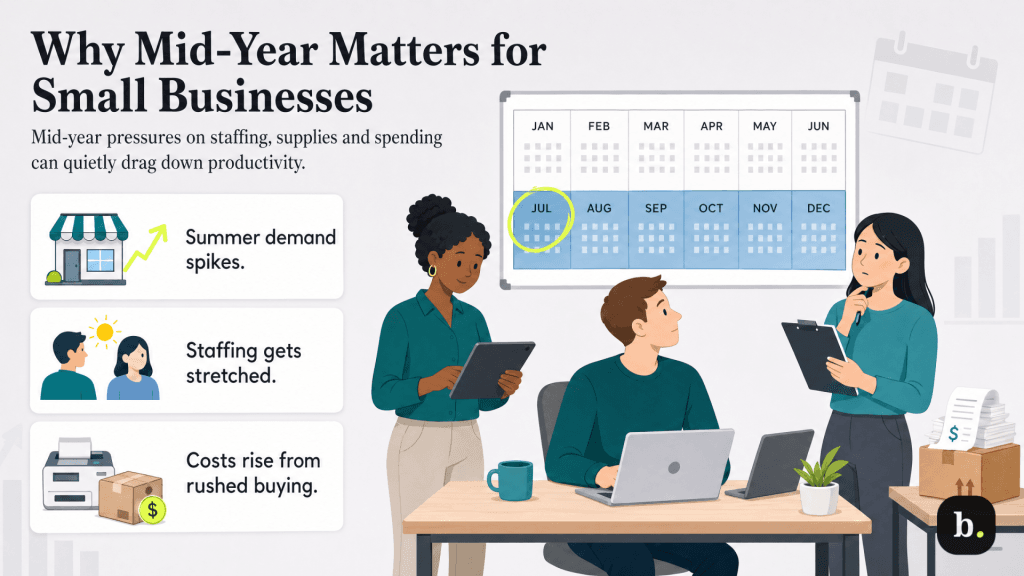
The middle of the year presents a unique set of operational pressures that don’t get as much attention as the holiday rush or new-year planning cycle. For retail and hospitality businesses, summer brings a spike in foot traffic and transaction volume. For service-based businesses, the push to hit annual targets intensifies as the halfway mark approaches. Even professional services firms see increased activity as clients try to execute on first-half plans before budgets reset.
At the same time, staffing gets stretched. Vacations, summer schedules and seasonal hires create coverage gaps that put extra strain on the people who are present. Equipment and supplies purchased at the start of the year are reaching their natural replacement cycle: toner cartridges run dry, printers slow down and packaging materials get depleted. These aren’t dramatic crises individually, but together they create a drag on productivity that compounds day after day.
Cash flow adds another layer. Revenue may be strong during peak months, but so are expenses. Wasteful or reactive purchasing – like paying rush delivery fees, buying from the nearest vendor instead of the best-value vendor or making multiple small orders instead of one consolidated purchase – eats into margins at precisely the moment when operational efficiency should be at its highest.
The businesses that handle mid-year demand smoothly tend to share a few traits in how they approach supply management. None of these are revolutionary, but in combination they eliminate the friction that reactive purchasing creates.
Sourcing from fewer vendors reduces the number of accounts to manage, shipments to track and invoices to reconcile. When you can get office supplies, shipping materials, breakroom essentials and technology peripherals from the same source, you reduce the total administrative overhead of procurement.
Not every supply need is the same. Some items, like a replacement toner cartridge when yours dies mid-print run, you need today. Others, like a scheduled restock of copy paper or packing tape, can arrive on a predictable timeline. Having access to both same-day in-store pickup and scheduled delivery from the same vendor means you can match the fulfillment method to the urgency of the need, rather than defaulting to whatever’s fastest (and most expensive) every time.
Rewards programs, bulk pricing and business account discounts don’t make headlines, but they accumulate meaningfully over time, especially for businesses that purchase the same categories of supplies on a recurring basis.
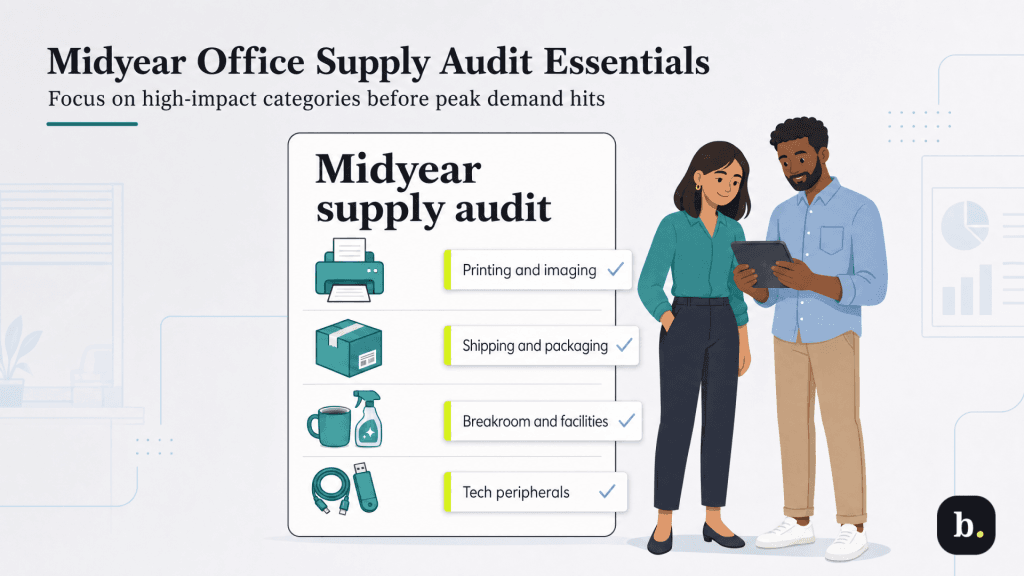
If you haven’t taken stock of your supply situation since January, mid-year is the time. Here are the categories most likely to need attention:
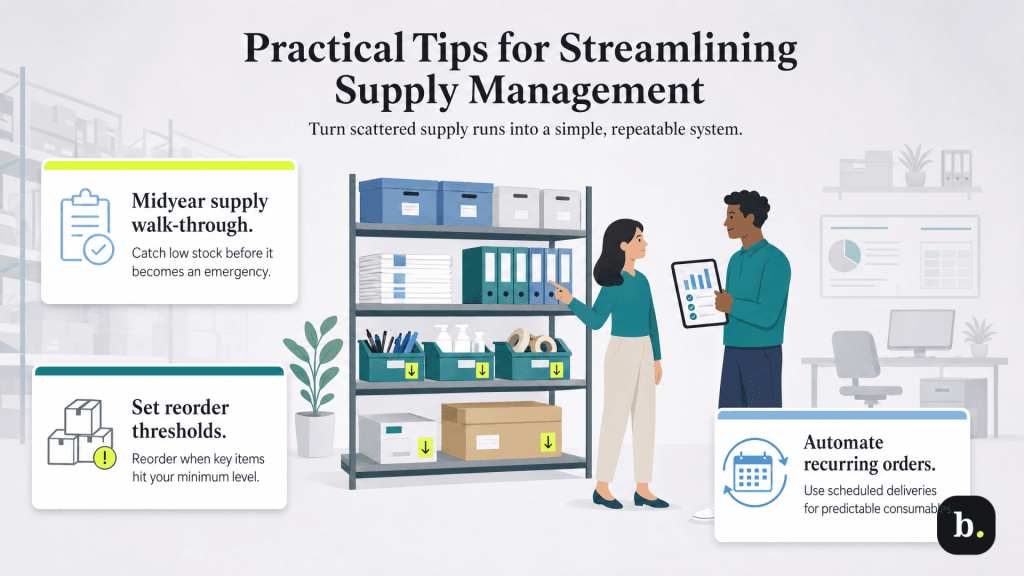
Beyond knowing what to buy, there are a few habits that can make the entire process more efficient:
Physically walk through your workspace and note what’s running low, what’s approaching end of life and what’s missing entirely. This takes 20 minutes and consistently surfaces needs that don’t make it onto digital shopping lists.
Don’t wait until you’re completely out of toner or packing tape to place an order. Establish a minimum quantity for your most-used supplies and reorder when you hit it. This simple practice converts emergency purchases into planned ones, which are almost always cheaper and less disruptive.
If you go through a certain amount of copy paper, ink or cleaning supplies every month, set up a recurring order with your primary vendor. This removes the task from your to-do list entirely and ensures you’re never caught off guard. Suppliers like Staples offer recurring delivery options for exactly this purpose, turning a weekly errand into an automated process.
Even in a small team, having one person responsible for monitoring inventory and placing orders prevents the “I thought someone else ordered it” problem that leads to emergency runs. If your business is just you, block 15 minutes on your calendar once a week to review and reorder. Treat it as a recurring operational task, not an afterthought.
Get in the habit of categorizing supply needs as “need today” versus “need this week.” Route urgent needs through in-store pickup or same-day delivery, and batch everything else into a single planned order. This prevents the common pattern of placing multiple small orders throughout the week, each with its own delivery fee and tracking overhead.
The goal of a smarter restocking strategy isn’t to become an expert in procurement. It’s to make supply management invisible enough that it stops competing for the time and attention you need for the work that actually grows your business.
Take 30 minutes this week to audit your supplies, identify your gaps and set up a system that keeps your business stocked and running. The mid-year push is coming whether you’re ready or not. Make sure your supply closet isn’t the thing that slows you down.
