This article is sponsored by Staples
Between social media feeds, search engine results, email inboxes and streaming platforms, digital ad fatigue is a well-documented phenomenon, and it’s only getting worse. Studies show that nearly 64 percent of ad-blocker users report that ads are annoying and intrusive, and roughly 41 percent of consumers can recall less than 10 percent of the digital ads they see.
In this environment, print marketing offers something increasingly rare: a tangible, tactile experience that cuts through the noise. Far from being a relic of a pre-digital era, print materials like business cards, brochures, direct mail and signage continue to deliver strong engagement and response rates. And when print is combined with digital campaigns, the results are even more compelling. This guide covers what print marketing is, why it still works, how to integrate it with your digital strategy and what to look for in a print provider.
What Is print marketing?
Print marketing encompasses any marketing material that is physically printed and distributed to prospects, customers or the general public. While digital channels dominate much of the modern marketing conversation, print remains a foundational component of many successful marketing strategies, particularly for small and local businesses that rely on community visibility and personal connections.
Common print marketing formats include business cards, brochures and flyers, direct mail pieces such as postcards, catalogs and letters, banners, posters and signage, and branded merchandise and packaging. These materials serve a wide range of purposes, from introducing your business to new prospects to reinforcing your brand with existing customers.
It’s important to think of print marketing not as a replacement for digital, but as a complement to it. The most effective marketing strategies use both channels in concert, leveraging the unique strengths of each to reach customers at different points in their journey.
Why print marketing still works
Print is tangible and memorable
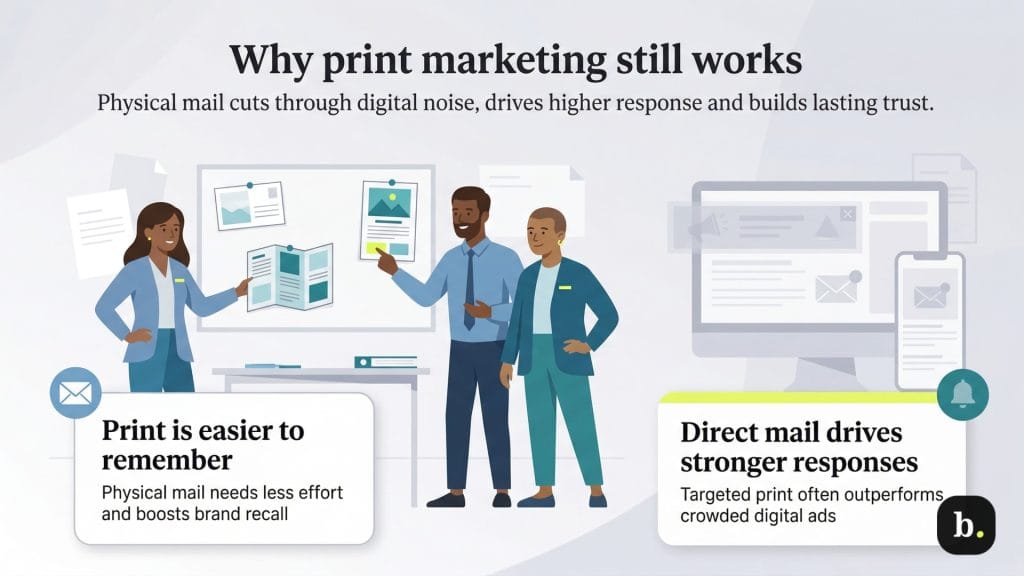
One of print’s most significant advantages is its physical nature. A neuroscience study conducted by Canada Post in partnership with True Impact Marketing found that direct mail requires 21 percent less cognitive effort to process than digital media and produces 70 percent higher brand recall. The study, titled “A Bias for Action,” used EEG and eye-tracking technology on 270 participants and concluded that physical mail is easier to understand, more memorable and more persuasive than its digital counterparts.
This makes intuitive sense. When someone holds a postcard, flips through a brochure or pins a flyer to a bulletin board, they’re engaging with the material in a way that a fleeting digital impression simply cannot replicate. Physical materials tend to stay in homes and offices for days or even weeks, offering repeated exposure that digital ads rarely achieve.
Print cuts through digital noise
Digital ad fatigue is not just anecdotal. With consumers encountering thousands of ads daily, banner blindness has become a well-documented challenge for digital marketers. Many consumers have learned to instinctively scroll past display ads, skip pre-roll videos and ignore sponsored content in their feeds.
Direct mail, by contrast, consistently outperforms digital channels in response rate. According to the ANA/DMA Response Rate Report, direct mail achieves an average response rate of approximately 4.4 percent, compared to just 0.12 percent for email, making it roughly 37 times more effective at generating responses. While direct mail costs more per impression than email, the dramatically higher engagement often translates to a stronger return on investment for targeted campaigns.
Print builds trust and credibility
Consumers often perceive printed materials as more credible and trustworthy than digital ads. A physical piece of marketing, such as a well-designed business card, a professionally printed brochure or a thoughtfully crafted direct mail piece, signals investment and legitimacy in a way that a pop-up ad or banner simply does not.
This trust factor is especially relevant for local businesses. When you’re trying to establish authority in your community, print materials create a tangible representation of your brand that people can hold, share and refer back to.
How to combine print and digital marketing
Print and digital marketing are most powerful when they work together. A multichannel approach allows businesses to reinforce messaging across touchpoints, reach customers through both physical and digital channels, and track print campaign performance with digital tools.
QR codes and personalized URLs
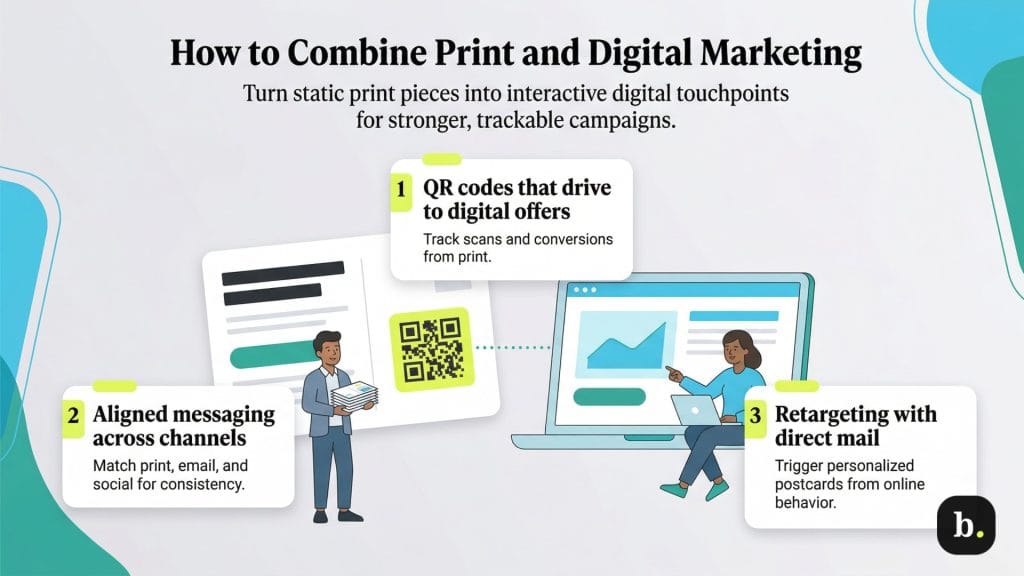
One of the simplest ways to bridge print and digital is by including QR codes or personalized URLs (PURLs) on your printed materials. A QR code on a postcard can send recipients directly to a landing page, special offer or social media profile, making it easy to measure engagement and track conversions from a specific print campaign.
This approach works especially well on business cards, flyers, product packaging and direct mail pieces. It transforms a static piece of print into an interactive gateway to your digital presence.
Direct mail and email drip campaigns
A coordinated direct mail and email retargeting strategy can significantly amplify your results. For example, you might send a physical mailer introducing a new product or promotion, followed by a series of email touchpoints that reinforce the same message. Or you could reverse the sequence, warming up prospects with email before sending a high-impact print piece to close the deal.
The key is consistency. When the messaging, branding and offer align across both channels, customers are more likely to remember your brand and take action.
Event marketing and in-store materials
Print materials remain essential at trade shows, pop-up events, retail locations and community gatherings. Branded collateral like brochures, banners and rack cards give your business a professional presence, while digital integration points such as “Scan to join our mailing list” QR codes turn in-person interactions into digital leads.
The goal is to create a seamless experience where your print materials reflect your digital brand identity, and every physical touchpoint has a clear path back to your online channels.
Retargeting with print
One of the more innovative developments in print marketing is programmatic direct mail, which uses digital behavior data to trigger personalized print pieces. For instance, if a customer visits your website, browses a product category and leaves without purchasing, a personalized postcard featuring that product can be automatically generated and mailed to them.
This approach combines the targeting precision of digital marketing with the tangible impact of print. While it requires more sophisticated infrastructure, the results can be impressive: recency-driven mail campaigns sent within 48 hours of a site visit have been shown to produce response rate lifts of 30 percent or more compared to delayed batch mailings.
How much does print marketing cost?
Print marketing costs vary widely depending on the format, quantity, materials and finishing options you choose. Here are some general ranges to help with budgeting:
- Business cards: Roughly $20 to $50 for 500 cards, depending on paper stock and finish.
- Flyers and brochures: Approximately $50 to $200 for 500 pieces, depending on size, paper quality and color options.
- Direct mail campaigns: Typically $0.30 to $1.00 or more per piece, including printing and postage. Costs increase with personalization, premium paper stock and dimensional formats.
- Banners and signage: Varies widely from approximately $50 to $300 or more, depending on size, material and finishing.
Several factors influence print pricing beyond the basics. Quantity is a major driver — per-unit costs drop significantly at higher volumes. Paper stock, color versus black-and-white printing, finishing options like lamination or foil stamping, and turnaround time all affect the final price.
When evaluating the cost of print marketing, it’s important to consider the return relative to engagement. Direct mail’s significantly higher response rates compared to email and digital display mean that even though the per-piece cost is higher, the cost per response can be very competitive, particularly for targeted local campaigns.
What to look for in a print marketing provider
Choosing the right print marketing provider can make the difference between a professional, effective campaign and one that falls flat. Here are the key factors to consider when evaluating your options:
- Range of products and services: Look for a provider that can handle everything from business cards and brochures to banners, direct mail and promotional items. Working with a one-stop shop simplifies the process and helps maintain brand consistency across materials.
- Print quality and material options: The quality of your printed materials directly reflects your brand. Make sure your provider offers a range of paper stocks, finishes and material choices.
- Design support: Not every business has an in-house designer. Providers that offer templates, online design tools or in-house design services can help you produce professional-looking materials even without design expertise.
- Turnaround time and delivery: Some projects are time-sensitive. Look for providers that offer same-day or next-day options for common items, along with reliable shipping or in-store pickup.
- Pricing transparency and volume discounts: Clear, upfront pricing helps you budget accurately. Volume discounts can make a significant difference for larger orders.
- Online ordering and proofing tools: The ability to upload your own designs, customize templates and approve proofs online streamlines the ordering process.
Staples, for example, offers a broad range of print marketing services, from business cards and brochures to banners and direct mail. All print marketing materials come with online design tools, same-day service on select products for orders placed by noon and in-store pickup options at retail locations nationwide. Staples also allows businesses to upload their own designs or build from over 400 templates, making it accessible for businesses that need professional print materials without a steep learning curve.
Tips for effective print marketing
Even the best print materials will underperform if the fundamentals are not in place. Here are some practical guidelines to ensure your print marketing efforts deliver results:
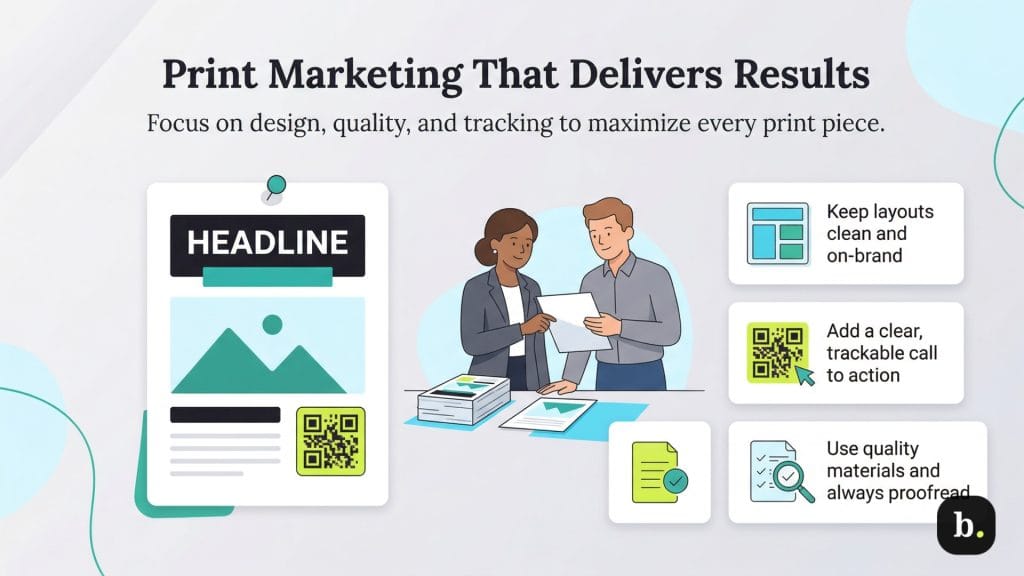
- Keep designs clean and on-brand: Cluttered layouts dilute your message. Ensure your print materials reflect the same visual identity as your website, social media and other marketing channels.
- Include a clear call to action: Every print piece should tell the reader what to do next, like visit a URL, scan a QR code, call a phone number or redeem an offer. Tying the call to action back to a digital destination makes it easier to track results.
- Use high-quality images and paper stock: Print quality directly reflects brand perception. Low-resolution images and flimsy paper can undermine even the strongest messaging.
- Test and measure: Use unique promo codes, dedicated landing pages or QR codes to track print campaign performance. This allows you to compare print ROI against other channels and optimize future campaigns.
- Proofread everything: Typos and errors on printed materials cannot be fixed after the run. Always review a proof carefully before approving a full print order. Confirm color accuracy with a physical or digital proof to avoid surprises.
Print marketing is far from obsolete. In a digital landscape crowded with ads, notifications and content, physical marketing materials offer a memorable, credible and high-engagement alternative that can strengthen your overall marketing strategy. The most effective approach is not print or digital, but print and digital working together. For businesses looking to get started, providers like Staples make it straightforward to design, order and pick up professional print materials, whether you’re printing 100 business cards or launching a full direct mail campaign.