Business.com aims to help business owners make informed decisions to support and grow their companies. We research and recommend products and services suitable for various business types, investing thousands of hours each year in this process.
As a business, we need to generate revenue to sustain our content. We have financial relationships with some companies we cover, earning commissions when readers purchase from our partners or share information about their needs. These relationships do not dictate our advice and recommendations. Our editorial team independently evaluates and recommends products and services based on their research and expertise. Learn more about our process and partners here.
Lawsuits will be coming fast and furious as many look to protect their content from AI invasion.

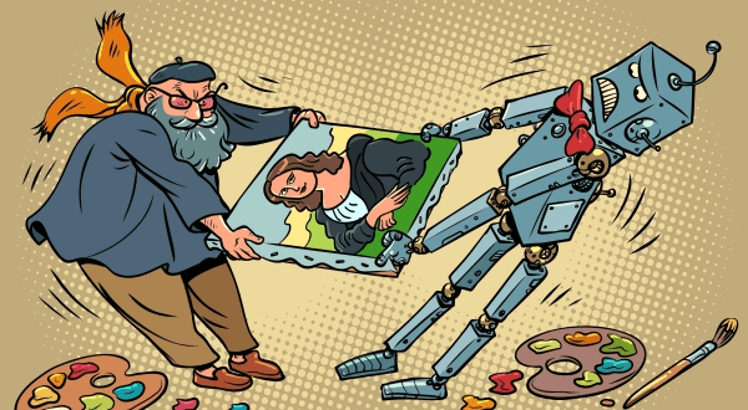
A year ago, users with beta access to DALL-E and Midjourney generated zany images like “Sam Jackson rollerskating on a pair of chili dogs” for laughs. Now, though, nobody’s laughing; businesses rely on ChatGPT and other AI apps to write code and website copy, design logos, and just about everything else. The phrase “rapid adoption” is woefully inadequate.
There’s just one problem: Who owns this stuff?
The U.S. Copyright Office has argued in court that “copyright protection does not extend to non-human authors.” Artists have filed a class-action lawsuit against generative AI companies for using their work in training models without permission, and so has Getty Images. The Authors Guild recommends a “No Generative AI Training Use” clause in book contracts, and in April, Universal Music Group demanded that streaming services remove a song that featured Drake and The Weeknd’s AI-cloned voices.
If your business’s logo can’t be copyrighted — and might itself be a copyright violation — you’re going to have problems. What if Nike didn’t own the swoosh, McDonald’s didn’t own the golden arches, Playboy didn’t own the bunny, and Apple didn’t own the, uh, apple?
Beyond branding, what if Disney didn’t own its screenplays or Meta didn’t own its code? (The counterargument is that human artists and writers learn from examining published works, so why shouldn’t machine artists?)
This new frontier is a Wild West, and while “AI prompt engineer” might be a six-figure job, caution is warranted for any entrepreneur who is uncomfortable with being a legal guinea pig. For some businesses, “augmenting” is the safeword of the moment, which means finding utility in AI without depending on it. Use AI as your mood board, jumping-off point, or digital sketchpad — a tool in the development process or creative workflow — while your final, public-facing, and purchasable output remains strictly original.
But if you have any questions, hey, you can just ask your AI lawyer.
This article first appeared in the b. Newsletter. Subscribe now!
