Business.com aims to help business owners make informed decisions to support and grow their companies. We research and recommend products and services suitable for various business types, investing thousands of hours each year in this process.
As a business, we need to generate revenue to sustain our content. We have financial relationships with some companies we cover, earning commissions when readers purchase from our partners or share information about their needs. These relationships do not dictate our advice and recommendations. Our editorial team independently evaluates and recommends products and services based on their research and expertise. Learn more about our process and partners here.
Our interview with the author of Get Pay Right: How to Achieve Pay Equity That Works

Salary.com CEO Kent Plunkett has been addressing challenges like pay transparency, fairness and industry-by-industry compensation data since he launched the site in 1999. A quarter-century later, those are hotter topics than ever.
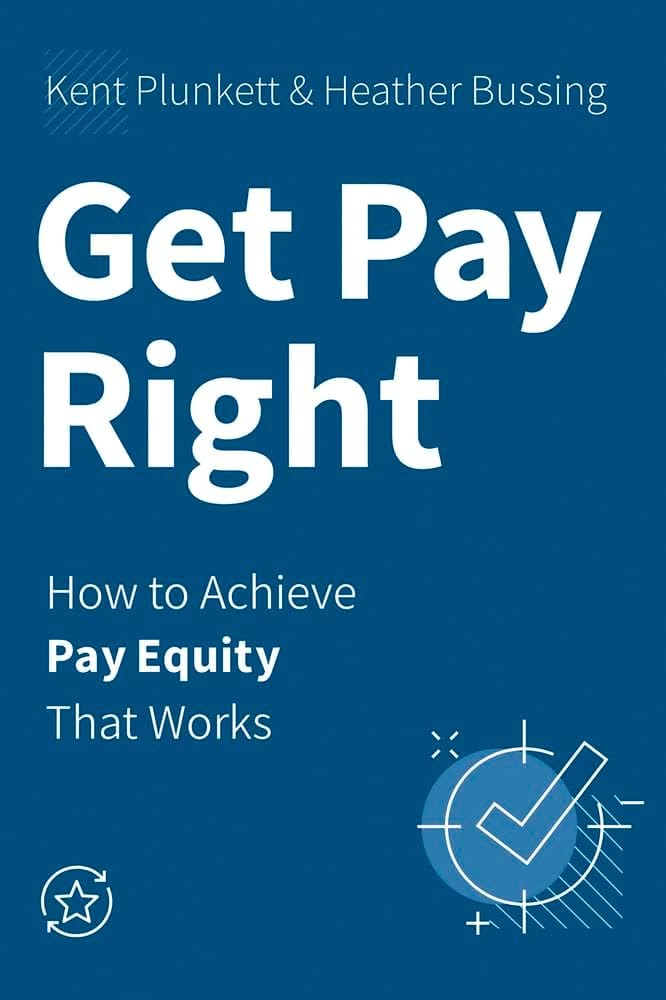
With the release of his new book, Get Pay Right: How to Achieve Pay Equity That Works, Plunkett seeks to help business owners and human resources directors make step-by-step changes to remain competitive in attracting top talent. Check out our Q&A with him below and be sure to read an excerpt from Get Pay Right.
b.: You present a unique view and definition of pay equity. What is it, exactly?
Plunkett: Generally, people think of pay equity as having to do with discrimination. We define pay equity as really having three problems you have to solve: You need to deliver pay to your employees that is internally equitable, externally competitive and communicated transparently.
b.: What’s the biggest challenge organizations face when it comes to pay equity?
Plunkett: The current biggest challenge that organizations face is something called “salary compression.” When you’re competing for talent in the outside market, there’s a recruiting number, which is what your competitors are hiring people at. That number doesn’t always match up with how people who already work in the organization and already have that job title earn. Companies hire people at numbers above the level of the people already in the job.
To solve that, sometimes you have to look at your pay ranges and actually bring other people up and adjust your pay range to be competitive in the market. That’s a hard problem for companies.
b.: Let’s talk about the “three pillars” of pay equity. Can you share a deeper dive into each facet?
Plunkett: You need to deliver pay to your employees that is internally equitable — that’s kind of the natural view of what pay equity would be. But it also has to be externally competitive because your employees are forming their opinion as to how fairly you pay based upon what they see out there as far as opportunities with competitors, [or] other companies they might go to work for. If you don’t pay fairly compared to the external labor market that you’re competing in, then your employee is going to form the impression that you don’t have pay equity, even if you pay fairly.
b.: What does pay transparency mean?
Plunkett: Transparent communication doesn’t mean you get to see what everyone else in your company earns. It means your company agrees to be transparent with you about how and why you’re paid as you’re paid. Is the company prepared to support its managers having a conversation about pay: Why people are paid and how they’re paid? That is not something that most companies prepare for.
If you can define pay equity with those three pillars, you’ve nailed 75 percent of the problem.
b.: Do you think people having conversations about compensation inside or outside the workplace is a good thing or a negative? Should employers be concerned?
Plunkett: The primary driver for pay equity right now is state legislatures. State legislatures are driving pay equity legislation to close the pay gaps. You have … structural inequity in access to opportunity and workforce and years of experience that just has to be dealt with.
Not only are there pay equity analysis laws coming into effect, but there are also a lot of pay transparency laws being put in the books. Colorado and New York are two of the leading examples where companies now have to publish their pay ranges when they publish a job advertisement. It used to be that 16 percent to 21 percent of all job postings had pay ranges in them as part of the advertisement to attract the right candidates. Now, over 50 percent of all job postings nationally [publish pay ranges]. State rules are having a national impact. That is the context for the driver of the pay transparency issue.
To address your question: If your employee is going to … come up with data that might be right or might be wrong about how much they think they should be paid, the company has to be in a position to communicate transparently and … be able to defend why the company believes that’s fair and competitive.
b.: In your book you mention a pay equity audit. Can you provide a thumbnail sketch of how an organization might approach that?
Plunkett: Let’s talk about run, walk, crawl. If you want to go all the way to running, the first step is doing a pay equity audit and potentially having an ongoing, continuous process where you’re running some analysis of your pay practices and your pay for different job groups. That’s running ─ that’s the high end.
To get there, most companies should start by doing basic market pricing compensation work, which is making sure you have job descriptions for all your jobs and making sure that you are market pricing for external competitiveness in your pay practices. In doing that, you get your company 80 percent to 90 percent of the way to pay equity.
When you’re ready to walk, you take those jobs and group them in clusters with similar jobs in your organization. You can start to cluster and then look at your data for outliers. Why is this person paid so far out of the range compared to all the other people? You look for explainable differences like, “This person has an MBA [Master of Business Administration],” or “This person has more credentials.” Years of experience are critical.
Then, you address the outliers. You either find there’s an explainable difference, so you don’t have to worry about it or you find a red flag. Then, you figure out the cost to remediate it. The goal of pay equity is not necessarily to cap the pay of people who earn a lot of money. It’s really about making sure that others aren’t discriminated against.
b.: Is it expensive to close the pay gap?
Plunkett: It’s actually fairly manageable. You don’t have to close the gap all at once. You can spread it out over three to five years.
I have a view that’s a little bit of an outlier on how we actually fix pay equity and how it’s going to unfold. And my view is that it is much faster than most pundits are forecasting. … They think it’s going to take generations. I think we get it done in one generation.
My thesis is: The state legislatures are going to make pay equity reporting a compliance issue. The larger companies are going to do full pay equity [analyses] because they want the trust and the employee engagement that it gets you for being viewed as a fair payer.
You pay fairly, you get a happier employee, a more contented employee and one that trusts the company more. The pay is the heart of the deal between the employee and the employer. It’s the center of the contract.
So, large companies are going to go all the way to full pay equity. When Walmart, McDonald’s and Amazon change their hourly rate, it actually drives the labor market. They actually took the minimum wage out of the hands of the governments for a period of time last year, right? So those [companies] drive the labor markets. When enough big companies do it, the data will shift in the labor markets to reflect pay equity analysis and impact. Smaller companies won’t have to do much pay equity work other than compliance.
This article first appeared in the b. Newsletter. Subscribe now!
