This article is sponsored by Intuit
Business owners need financial reports to make informed decisions, but the process of generating those reports has traditionally been one of the most time-consuming parts of running a business. Compiling data from multiple sources, reconciling transactions, categorizing expenses and formatting everything into a readable profit and loss statement or cash flow report can take a considerable amount of time. By the time the numbers are ready, the decisions they were supposed to inform may have already been made on instinct.
AI agents are changing this by automating the entire reporting pipeline. These tools connect to your financial accounts, aggregate transaction data in real time, categorize it, generate standard financial reports on demand and provide contextual analysis alongside the numbers. Instead of a static spreadsheet that tells you expenses went up, an AI agent explains why they went up and whether that trend warrants attention.
The shift isn’t just about speed. It’s about accessibility. Financial reports have historically required accounting expertise to produce and interpret. AI agents are making that intelligence available to business owners directly, turning financial reporting from a specialized skill into a tool anyone running a business can use to make better decisions faster.
What AI financial reporting agents actually do
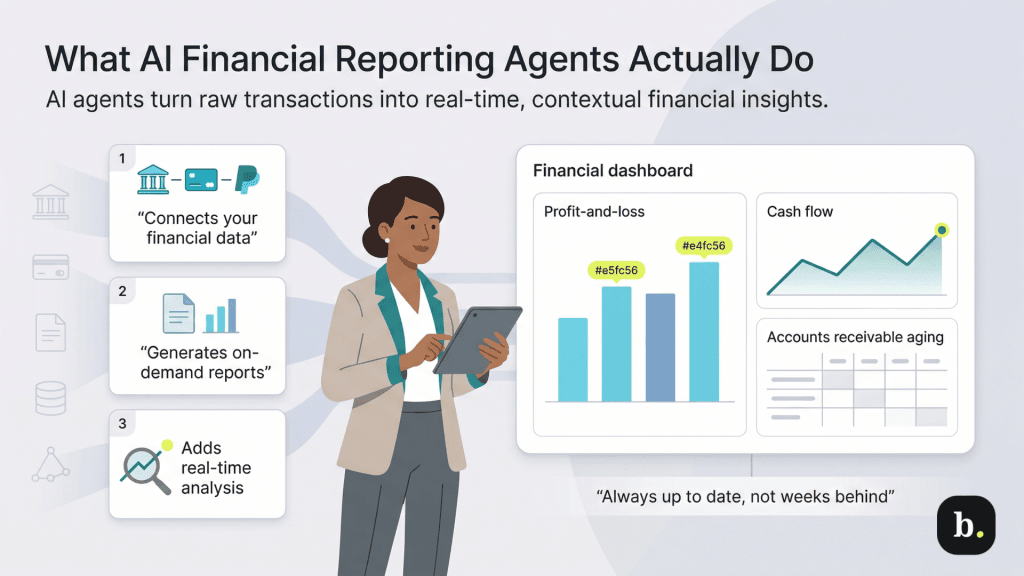
An AI financial reporting agent is software that autonomously generates financial reports by analyzing your transactional data. It connects to your bank accounts, credit cards, and payment platforms, then continuously categorizes and organizes that data so it can produce standard financial statements—profit and loss, balance sheet, cash flow, accounts receivable aging—on demand rather than on a schedule.
What separates AI agents from traditional reporting tools is the layer of analysis they add. Traditional reports give you numbers: revenue was X, expenses were Y, net income was Z. An AI agent adds context. It identifies trends across reporting periods, flags anomalies (like a 40% increase in a spending category) and provides narrative explanations of what changed and why. Some platforms take this further, benchmarking your performance against similar businesses or modeling scenarios to support forward-looking decisions.
The practical difference for most business owners is eliminating the gap between when financial activity happens and when you can see its impact. Traditional monthly reporting means you’re always looking at information that’s weeks old. AI agents update continuously, so the financial picture you’re seeing reflects what’s actually happening now.
The insights AI reporting provides beyond the numbers
Raw financial statements are useful, but most business owners don’t have the training to extract strategic insights from a balance sheet. AI reporting agents bridge that gap by analyzing your data across multiple dimensions and surfacing findings in plain language.
Profitability analysis
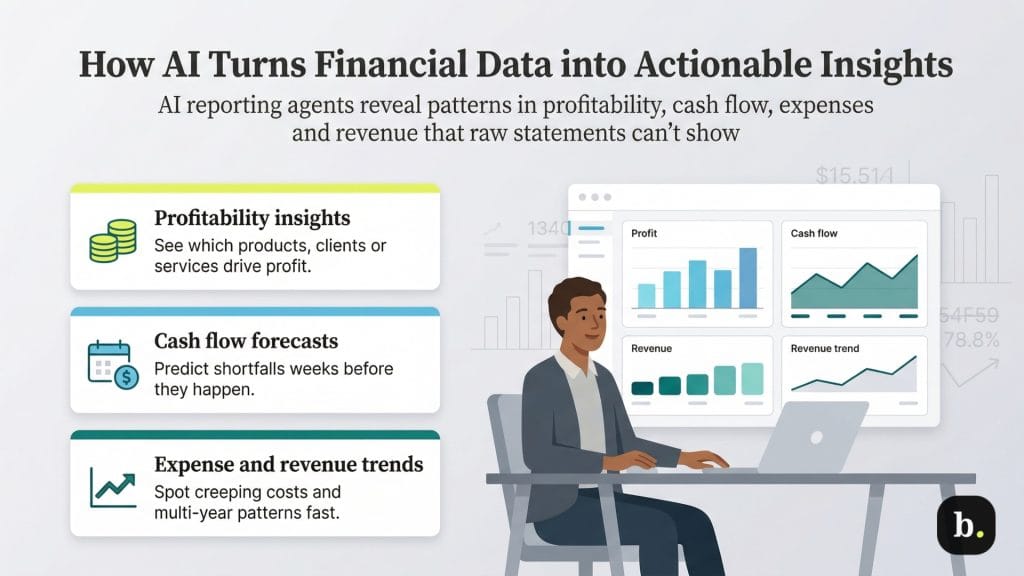
AI agents can break down profitability by product, service, customer or project, not just at the business level. This kind of granular analysis reveals which parts of your business are driving profit and which are consuming resources disproportionately. You might discover that your highest-revenue client is actually one of your least profitable because of the time and resources they require, or that a service line you’ve been treating as secondary has significantly higher margins than your primary offering. These insights inform pricing decisions, resource allocation and strategic focus.
Cash flow forecasting
By analyzing historical patterns like seasonal revenue fluctuations, recurring expense timing and accounts receivable collection trends, AI agents forecast your cash position weeks or months ahead. This turns cash flow management from reactive to proactive. Instead of discovering a shortfall when a payment bounces, you see it coming and can take action: accelerating collections on aging invoices, delaying discretionary spending or securing a line of credit before you need it. Platforms like QuickBooks provide cash flow forecasting that projects your position 30 to 90 days out based on your transaction history and upcoming obligations.
Expense trends and anomalies
AI excels at catching spending changes that humans overlook because they happen gradually. A 5% monthly increase in a category barely registers on a single statement, but compounded over a year it represents a significant cost change. AI agents track these trends automatically and flag them: software subscriptions that have crept up 40% year-over-year, duplicate vendor payments, spending categories that are outpacing revenue growth. They also identify consolidation opportunities, like three separate cloud storage subscriptions that could be replaced with one.
Revenue patterns and opportunities
AI agents analyze revenue data to surface patterns that inform forward-looking decisions. Seasonal trends become visible across years of data, allowing you to plan staffing and inventory accordingly. Customer acquisition and retention rates reveal whether growth is coming from new business or expanding relationships. Revenue concentration (how much of your income depends on your top three or five clients) gets quantified so you can assess risk and diversify strategically.
AI financial agents can process years of historical data in seconds to identify patterns that would take hours of manual analysis to uncover. The value isn’t just speed, it’s that trends spanning multiple years often go unnoticed entirely without automated analysis.
Using AI reports for strategic decisions
The purpose of financial reporting is to inform decision making. AI reporting agents make specific categories of business decisions more data-driven by providing the analysis that supports them.
Pricing and product strategy
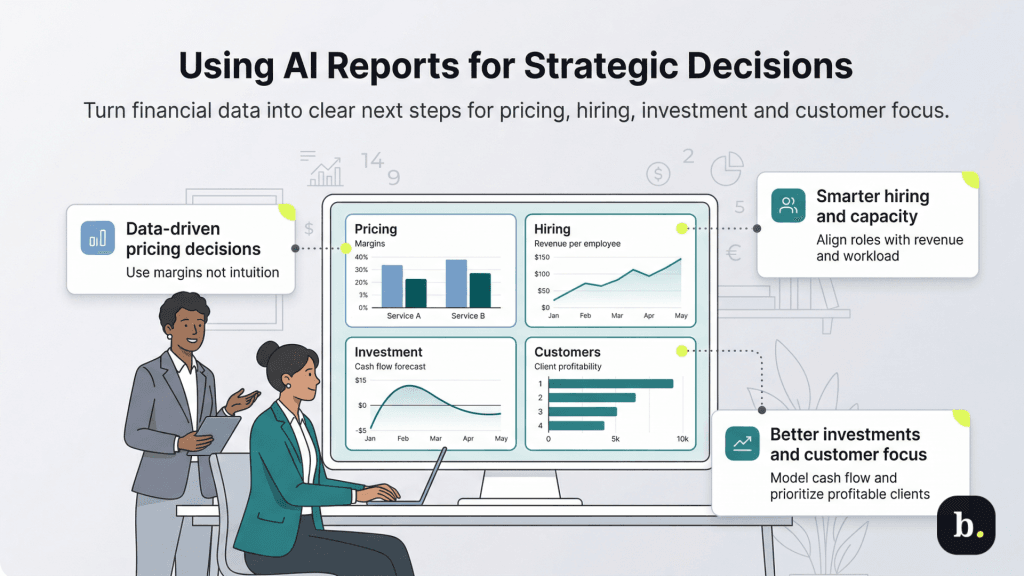
AI-generated profitability reports by product or service line show gross margins, volume trends and cost changes at a level of detail that makes pricing decisions concrete rather than instinctive. If your data shows that Service A carries a 45% margin while Service B runs at 15%, you have a clear basis for raising Service B’s price, restructuring its delivery model or shifting sales focus toward Service A. These aren’t gut calls, they’re decisions supported by actual financial performance data.
Hiring and capacity planning
Revenue-per-employee metrics, workload trends and seasonal demand patterns help you determine when to add staff, what roles to prioritize and whether full-time hires or contractors make more financial sense. AI agents surface these metrics automatically, so the conversation shifts from “we feel overwhelmed” to “revenue per team member increased 20% over six months while output quality metrics declined — it’s time to hire.”
Investment and capital allocation
Cash flow forecasts and profitability trends help you time major purchases strategically. AI reporting shows how an equipment purchase or facility expansion would affect your cash position over the next quarter, letting you compare timing scenarios before committing. QuickBooks’ Finance Agent, for example, provides KPI tracking and scenario modeling on QuickBooks Advanced, helping business owners evaluate the financial impact of investment decisions against their current performance trajectory.
Customer strategy
Customer profitability analysis reveals which relationships generate the most value relative to the resources they consume. When AI shows that your top three clients account for 70% of revenue but only 40% of your team’s time, those are your most efficient accounts and the model to replicate. Conversely, a high-revenue client requiring disproportionate resources may justify a pricing conversation or scope adjustment.
Use AI-generated reports to support loan applications, investor pitches, and board meetings. Real-time, professionally formatted financial reports demonstrate management competence and make due diligence faster for everyone involved.
Best practices for AI-powered financial reporting
Keep your data clean
AI reporting is only as accurate as the data it draws from. Connect all business accounts so the system has a complete picture. Confirm or correct AI-suggested transaction categories weekly rather than letting miscategorizations accumulate. When you do correct a categorization, the system learns from that correction, improving future accuracy. Inconsistent categorization is the most common reason financial reports produce misleading comparisons across periods. AI reduces this problem dramatically, but it doesn’t eliminate the need for human review.
Build a reporting cadence
Just because you can generate reports instantly doesn’t mean you should look at everything every day. A structured cadence keeps you informed without creating noise. We suggest the following cadence:
- Check cash position and outstanding invoices daily.
- Review revenue performance and expense tracking against budget weekly.
- Generate full profit and loss, balance sheet and cash flow statements monthly.
- Run trend analysis, year-over-year comparisons and strategic planning reports quarterly.
The value of real-time data is that it’s available when you need it, not that you need it constantly.
Schedule automated report delivery so insights come to you rather than requiring you to go looking. A weekly P&L summary emailed every Monday morning or a cash flow snapshot every Friday keeps you informed with zero effort.
Share reports with the right people
Financial reports gain value when the people who need them can access them. Share performance dashboards with business partners and co-owners so everyone is working from the same numbers. Give your accountant direct access to your books so they can review AI-generated reports, make adjustments, and provide strategic advice based on real-time data rather than exported spreadsheets.
QuickBooks allows free accountant access for this purpose. For lenders and investors, AI-generated reports in professional formats demonstrate financial management discipline and make reporting requirements less burdensome.
Use reports as a starting point, not an endpoint
AI agents surface insights and identify patterns, but the strategic decisions those insights inform still require human judgment. A report showing that expenses in a category increased 40% is a flag, not a verdict. Maybe the increase reflects a deliberate investment, or maybe it’s waste. You or your accountant needs to evaluate the context and decide on action. AI handles the analytical heavy lifting so you can spend your time on interpretation and strategy rather than data compilation.