Business.com aims to help business owners make informed decisions to support and grow their companies. We research and recommend products and services suitable for various business types, investing thousands of hours each year in this process.
As a business, we need to generate revenue to sustain our content. We have financial relationships with some companies we cover, earning commissions when readers purchase from our partners or share information about their needs. These relationships do not dictate our advice and recommendations. Our editorial team independently evaluates and recommends products and services based on their research and expertise. Learn more about our process and partners here.
AI candidate matching screens for candidates against your job requirements to identify which might be a good fit, sometimes even extending invites for them to apply.


This article is sponsored by ZipRecruiter
Hiring can take over your workday before you schedule a single interview. You have to find people with the right skills, read their resumes and determine whether the job meets their needs. When you’re running a business alongside that search, even a promising application can go unanswered.
AI candidate matching helps with this initial workload. It compares job requirements with candidate information to recommend people worth considering. Some platforms also invite those candidates to apply, giving employers a way to reach prospective employees who haven’t found their listing yet.
Here’s how the technology works, where it can save time and how to use it to build a stronger shortlist.
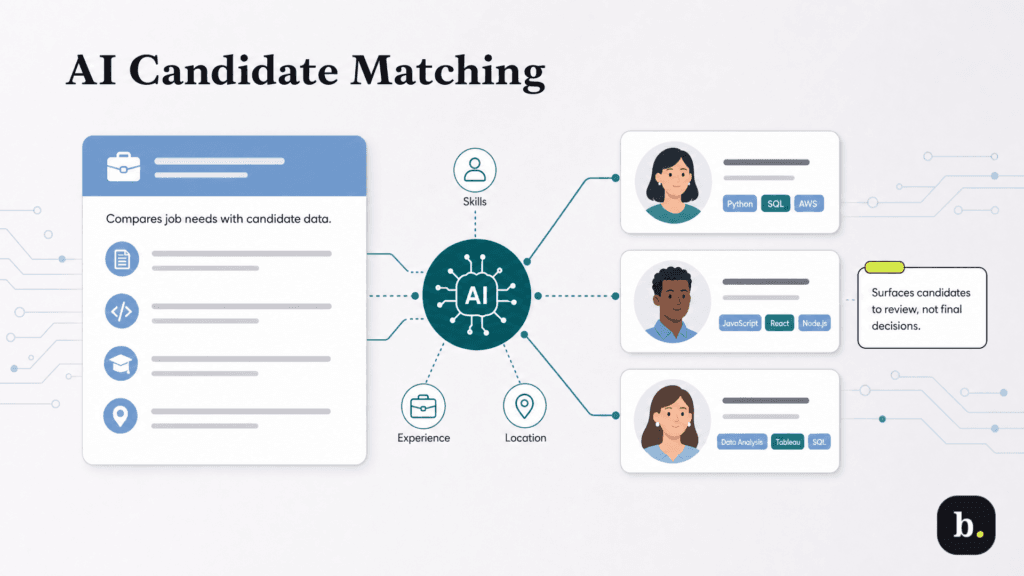
AI candidate matching uses artificial intelligence to identify potential connections between a job and a candidate. Depending on the platform, it can analyze skills, experience, education, licenses, location and job preferences to recommend candidates to employers or opportunities to job seekers.
AI matching serves a different purpose than distributing a job advertisement or writing its copy. Distribution puts your opening in front of more people. Matching helps identify which people may meet your needs. An applicant tracking system (ATS), meanwhile, organizes applications and hiring activity; some systems also include matching tools.
A recommendation gives you a starting point for review. It doesn’t establish that a candidate’s claims are accurate, that they’re interested in your offer or that they’ll succeed in the role. Those questions remain part of your process of recruiting new employees.
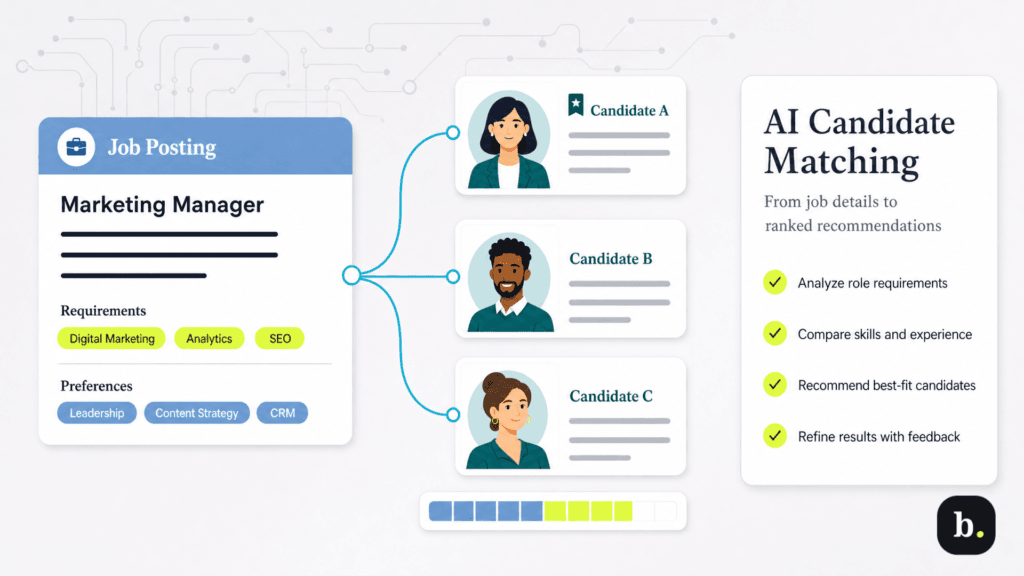
Each provider uses its own technology and data. The employer’s experience generally follows four stages: describing the role, comparing candidate information, receiving recommendations and refining the search.
The process begins with information about the opening. A job title provides context, but the responsibilities and qualifications help define what you’re actually seeking. Location and work arrangements also matter: Someone with the right experience may be unavailable for an on-site position in another city.
For example, imagine a home services company hiring a customer service representative. The employer needs someone who can resolve customer concerns, schedule appointments and work Saturdays. Experience with its particular scheduling software would be useful, but the company can train a new hire to use it too. Separating the essentials from preferences makes the requirements clearer for both the software and applicants.
Matching tools compare the role with information from resumes, profiles and other available sources. Keywords can contribute to the comparison, but some systems also interpret related skills and the context in which someone used them.
In our hypothetical example, someone with experience handling appointment changes at a medical office might have relevant customer service skills despite never working for a home services company. Whether a particular tool recognizes that connection depends on its capabilities and the information available.
The platform uses its analysis to surface possible matches. A hiring marketplace may recommend people from its candidate pool before they apply. A tool inside an ATS may instead help reviewers evaluate applications already received. Some products show match scores or highlight relevant experience; others present recommendations without a numerical score.
For our customer service role, a recommendation might highlight experience resolving customer issues and coordinating bookings. The employer would still need to ask about Saturday availability if that information wasn’t available or current.
Some platforms connect candidate matching with invitations to apply, helping employers act on recommendations. Others let hiring teams change criteria or provide feedback to improve subsequent results. The specific controls vary by product.
If the home services company receives too many recommendations for senior call center managers, it should review whether its title or requirements are too broad. If relevant people are being overlooked, an unnecessary industry-experience requirement might be narrowing the search. Review the pattern before changing the criteria.
Matching can reduce the time spent finding and reviewing potential candidates. The effect on your overall hiring timeline depends on what happens after that initial connection.
Searching profiles individually requires repeated decisions about titles, skills and experience. Automated recommendations can bring potentially relevant people into one review process, reducing the amount of searching you need to do yourself. You can spend more of that time checking qualifications and discussing the opportunity.
A published listing depends partly on job seekers discovering it. A platform that recommends the opening to suitable people or invites them to apply adds another way for them to find you. That can be useful when you’re hiring without a dedicated recruiter to conduct outreach.
Highlighted qualifications can help a reviewer see why someone was recommended. Instead of reading every application without context, you can start with the experience relevant to the job. Review the underlying resume as well, particularly when a summary omits details or suggests a connection that needs clarification.
When recommendations and invitations sit in the same workflow, employers can move from finding someone to contacting them with fewer steps. Assign someone to check responses and arrange interviews. A consistent hiring process helps turn faster sourcing into actual progress.
Identify your bottleneck before buying software. Matching may help if finding suitable candidates takes too long. If qualified applicants already wait a week for an interview, review scheduling and approvals too.
Choose a tool according to where you need help. These categories can overlap, so compare the actual features rather than relying on the product label.
Tool category | Main purpose | What to check |
|---|---|---|
Hiring marketplaces with matching | Recommend candidates and connect job seekers with openings | Relevant candidate pool, invitations to apply and employer review tools |
Applicant tracking systems with matching | Organize applications and assist with reviewing qualifications | Matching availability, criteria controls and integration with your workflow |
Resume databases and sourcing tools | Let employers search for and contact potential candidates | Profile freshness, search filters and contact limits |
ZipRecruiter’s matching technology scans resumes for relevant skills, education and experience, then actively invites candidates to apply. For an employer with little time to search manually, that connects candidate discovery with an invitation to consider the opening. The platform’s Sponsored Reach feature uses signals including resume keywords, skills, experience, licenses and past searches and applications.
ZipRecruiter also offers a searchable Resume Database for employers who want to source people directly. This database includes 56 million resumes, and 230,000 new job seekers added monthly.
Our ZipRecruiter review covers the platform’s features and plan considerations in more detail.
An ATS with matching can be useful when your challenge is assessing incoming applications. These tools can highlight relevant skills and provide match scores using criteria set by the employer. A good ATS doesn’t automatically advance or reject candidates, but helps surface the most likely to be a good fit for the hiring team to review.
Before purchasing another system, check whether your current software already offers the review tools you need. For external candidate sourcing, compare the reach and features of the best job posting sites.
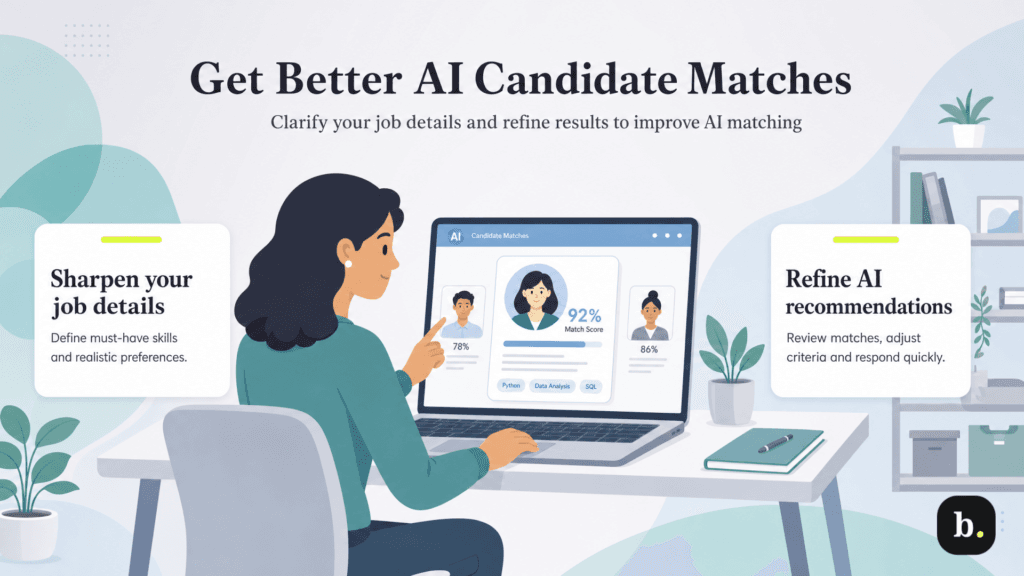
Useful recommendations start with a well-defined job and improve through careful review. Follow these steps to give the platform clearer information and make better use of the results.
Identify what a person must be able to do on day one and what they can learn on the job. Required licenses are essential, while experience with one brand of software may be negotiable. Avoid using a degree, previous title or fixed number of years as a substitute for explaining the work unless that requirement is justified.
Choose a title candidates understand and describe the tasks they’ll perform. In our example, “customer service representative” gives a clearer starting point than “customer happiness specialist.” Details about scheduling appointments and resolving service issues add useful context.
State the location, schedule, pay range and on-site or remote expectations clearly. Even when a platform doesn’t use every detail in its matching model, candidates need that information to decide whether to respond. Accurate details can reduce conversations that end because of a basic mismatch.
Look for recurring problems across recommendations. Are otherwise suitable people missing one trainable skill? Are candidates consistently too senior? Change the relevant requirement rather than adding more filters indiscriminately. Where feedback controls are available, base your feedback on job-related qualifications.
Use a common set of questions to confirm essential requirements, then assess relevant skills. A phone screen interview can establish interest, availability and expectations before a longer interview. Prompt replies help keep suitable people moving through the process.
Matching depends on the information available. An incomplete profile may omit valuable experience, while an outdated resume may suggest skills or availability that have changed. Automated summaries and recommendations can also miss context, including experience gained through an unconventional career path.
Reviewing match quality is therefore part of using the tool. A low score shouldn’t be your only reason to dismiss someone, and a high score doesn’t verify credentials. Ask vendors what information informs the AI recommendations, what employers can control and how reviewers can handle inaccurate results.
Fair evaluation also requires attention. The Equal Employment Opportunity Commission (EEOC) warns that AI and algorithmic tools can screen out people with disabilities who could perform the job. Its guidance emphasizes safeguards and a process for reasonable accommodations. State and local regulations may also apply, so be sure to review the requirements where you operate alongside appropriate HR or legal support.
Limit access to candidate information to the people who need it, and review the vendor’s data use and retention terms. Keep a person accountable for assessing qualifications and making hiring decisions throughout the process.
Yes. Hiring marketplaces can recommend people from their available talent pools and invite them to apply. An invitation doesn’t establish interest or availability; the person still needs to respond and participate in your process.
The functions overlap. Matching compares people with job requirements and can support sourcing before an application exists. Resume screening generally refers to reviewing applicants. A product may do both, so ask what its features actually cover.
No. Hiring marketplaces can provide candidate recommendations within their own employer tools. A separate ATS may become useful when multiple reviewers, more openings or reporting requirements make applications harder to manage.
Track the time to a qualified shortlist, candidate response rates and the share of reviewed candidates who reach an interview. Define “qualified” using the role’s essential requirements. Compare similar openings where possible, and track overall time to hire alongside these measures so you can see whether faster sourcing carries through to an accepted offer.
