Artificial intelligence has transformed the way small businesses handle their finances, automating tasks that once consumed hours of manual effort every week. But despite its speed and scale, AI isn’t a replacement for the human judgment that accounting demands.
Accounting requires two things: computational accuracy and professional judgment. AI excels at the first, processing thousands of transactions, flagging anomalies and generating reports in seconds. Human accountants cover the rest: interpreting tax law, making strategic financial decisions and understanding the context behind the numbers. When these strengths work together, businesses get faster, more accurate financial management without sacrificing the oversight that keeps them compliant and competitive.
Modern accounting platforms like QuickBooks Online have embraced this partnership model, building AI-powered automation into workflows that still keep human decision-makers in control. Here’s how that collaboration works in practice, and how to make the most of it.
What AI can and can’t do in accounting
Where AI excels
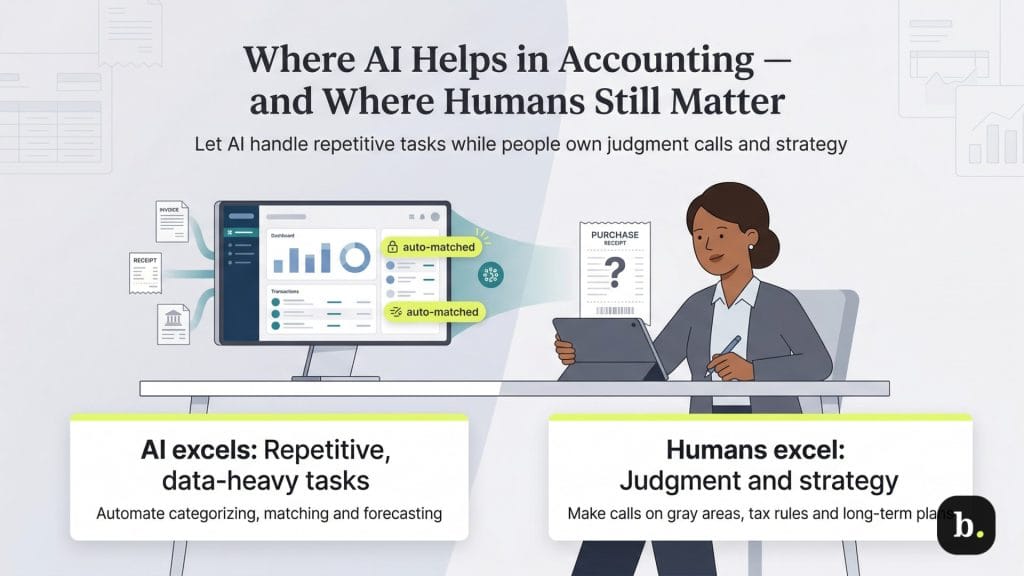
AI is built for the repetitive, data-heavy work that bogs down bookkeeping. It can categorize thousands of transactions in seconds by recognizing patterns in your spending, matching vendor names to expense categories, flagging recurring charges and identifying amounts that fall outside your normal range. Tasks like invoice generation, receipt matching and bank reconciliation that once required hours of manual data entry can now happen automatically.
AI also handles predictive work well. By analyzing historical cash flow data, it can forecast your financial position weeks or months ahead, identify seasonal trends in your revenue and alert you to potential shortfalls before they become problems. And it does all of this consistently, without fatigue or the kinds of data-entry errors that come from processing hundreds of line items by hand.
Where human intelligence is essential
AI hits its limits when accounting requires judgment, context or strategic thinking. Determining whether a $2,000 electronics purchase should be categorized as “Office Supplies” or “Equipment” – a distinction with real tax implications – requires understanding what was purchased and how it will be used. AI can guess based on patterns, but only a human can make that call with confidence.
The same is true for tax strategy, compliance interpretation and financial planning. Tax laws change frequently, and understanding how a new regulation applies to your specific business situation requires professional expertise. Growth decisions like whether to capitalize an expense, how to structure a new business entity or when to time major purchases for tax advantage, depend on the kind of contextual reasoning AI simply can’t replicate.
Human oversight also serves as a critical quality check. Even the best AI makes mistakes, and someone needs to review its recommendations, catch edge cases and validate that automated outputs align with your actual financial picture.
How AI and human expertise work together in practice
The real value of AI in accounting becomes clear when you look at specific workflows. In each of the scenarios below, AI handles the heavy lifting while human expertise provides the judgment and context that keeps everything accurate.
Expense categorization and consistency
Consider a business processing 500 transactions a month. AI can automatically categorize the vast majority of those – recurring charges from known vendors, utility payments, subscription fees – based on historical patterns. It applies rules consistently across every transaction, eliminating the variation that creeps in when different people handle data entry on different days.
But some transactions don’t fit neatly into existing categories. A new vendor, an unusually large purchase or a charge that could reasonably fall into multiple categories all require human review. The business owner or bookkeeper evaluates those flagged items, corrects any miscategorizations and sets standards for how similar transactions should be handled going forward. Platforms like QuickBooks learn from these corrections over time, improving their categorization accuracy the more you use them.
The result is consistent categorization that would take hours to do manually, condensed into a 30-minute review session.
According to a
2025 Ipsos report on behalf of Chartered Accountants Worldwide, about half of survey respondents said AI is already helping them perform their jobs more effectively. About 85% of respondents said they are at least fairly willing to use AI in the future, and 52% said the biggest barrier to adoption is lack of skills and training.
Tax preparation and compliance
Tax preparation is one of the clearest examples of why AI and human expertise need each other. Throughout the year, AI can track and organize every potentially deductible expense, sorting transactions into IRS tax categories as they occur rather than forcing a year-end scramble. It flags missing documentation, identifies receipts that haven’t been matched to transactions and automatically updates its calculations when tax laws change.
But determining whether a specific expense actually qualifies for a deduction under current tax law or whether a gray-area purchase should be classified one way or another requires professional judgment. A CPA reviews the AI-organized data, applies their knowledge of tax code to ambiguous situations and makes strategic decisions about timing and classification that maximize legitimate deductions.
The payoff is year-round tax organization instead of a frantic scramble in March, with human expertise applied where it matters most—at the decision-making level.
Cash flow management and forecasting
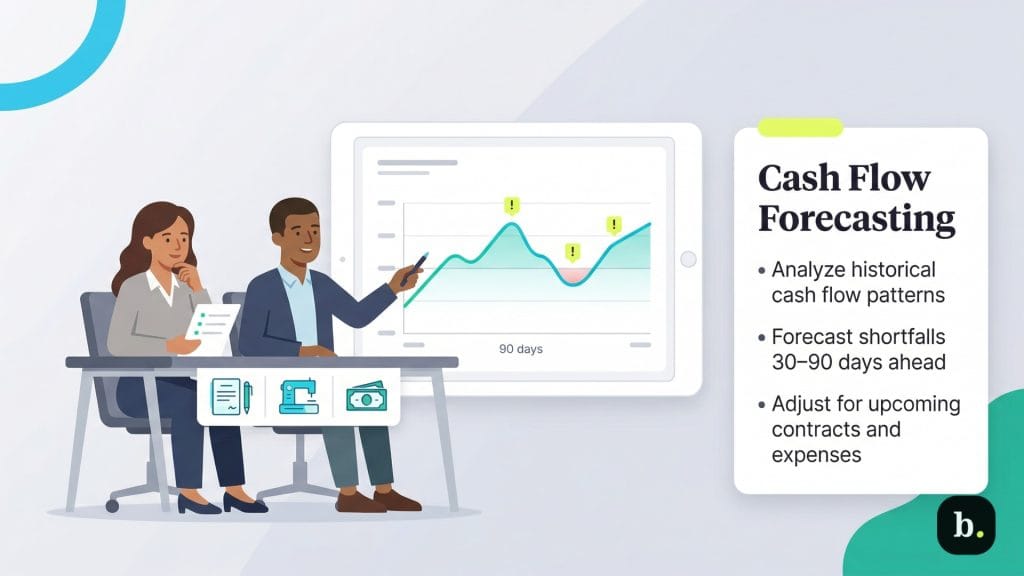
Cash flow management is another area where AI’s analytical power and human strategic thinking complement each other well. AI can analyze two to three years of historical cash flow data, identify seasonal patterns in your revenue and expenses, and forecast your cash position 30 to 90 days out. Tools like QuickBooks Cash Flow Planner surface these data patterns and alert you to potential shortfalls before they materialize.
But forecasts only tell part of the story. A business owner knows about the new contract starting next month, the equipment purchase planned for Q3 or the seasonal hiring that will affect payroll costs. Human judgment adjusts AI projections based on real-world context, turning raw data into actionable decisions, whether that means delaying a major purchase, negotiating better payment terms with a vendor or securing a line of credit ahead of a lean period.
Catching errors before they compound
Small accounting errors have a way of compounding when they go unnoticed. A duplicate transaction, an overpayment to a vendor or an unmatched bank feed entry can snowball into significant discrepancies by the time someone catches them months later.
AI addresses this by continuously scanning for anomalies like duplicate charges from the same vendor, transactions that don’t match bank feeds or amounts that deviate from contract terms. It auto-matches transactions to bank records and calculates discrepancies instantly, turning what used to be a tedious reconciliation process into a quick review.
Human review remains essential, though, because not every flagged item is actually an error. Two legitimate payments to the same vendor in one month, a timing difference between when a check was written and when it was cleared or a deposit in transit that hasn’t been posted yet all require context that AI can’t provide. The human role is to investigate flagged items, determine root causes, and make the adjusting entries that keep the books accurate.
Don’t blindly accept AI suggestions. Use them as a starting point, then apply your knowledge of your business context to make final decisions.
Best practices for using AI accounting tools
AI accounting tools deliver the best results when they’re set up thoughtfully and reviewed regularly. Think of AI as a junior bookkeeper — one that’s fast and consistent but needs training, oversight and clear instructions to perform well.
Set AI up for success
AI learns from your historical data, so the quality of its output depends on the quality of what you feed it.
Start by ensuring your existing categorizations are accurate; if your past records are inconsistent or sloppy, AI will replicate those mistakes at scale. Create clear categorization rules upfront for common transaction types, use consistent vendor names so the system can recognize patterns, and connect all of your bank and credit card accounts to give the AI a complete picture of your finances.
When setting up a platform like QuickBooks, take time to accurately categorize your first two to three months of transactions. This training period is what teaches the AI to categorize future transactions correctly, and the investment pays dividends in accuracy down the line.
Build a review habit
The biggest mistake businesses make with AI accounting tools is treating them as set-it-and-forget-it solutions. Schedule a weekly review of AI-categorized transactions; even 15 to 20 minutes is enough to catch errors, correct miscategorizations and keep the system learning from your feedback. Don’t wait until month-end or tax season to check the AI’s work. By then, small mistakes may have compounded into larger problems.
Pay attention to patterns in the AI’s errors, too. If it consistently miscategorizes a certain type of transaction, that’s a signal to update your rules or add a custom categorization. The correction-and-learning loop is what makes AI tools get smarter over time, but it only works if you’re actively participating in it.
Know when to bring in a human expert
Some accounting situations simply require professional expertise. Complex transactions that involve tax law interpretation, significant decisions like revenue recognition or expense capitalization, year-end adjustments and closing, audit preparation and strategic financial planning all benefit from a trained accountant’s eye. AI can organize and present the data that informs these decisions, but the decisions themselves should be made by someone with the professional knowledge to get them right.
For businesses that want professional oversight without the cost of a full-time hire, services like QuickBooks Live Expert Assisted connect you with QuickBooks-certified bookkeepers who can review your AI-categorized data and provide guidance on complex situations. It’s one more way the human-AI partnership model scales to fit businesses of different sizes and needs.
Think of AI as a junior bookkeeper who needs training and oversight. Review its work, provide corrections, and it will improve over time—but the responsibility for accuracy always stays with you.
AI isn’t replacing accountants — it’s making them more effective. The businesses getting the best results from AI accounting tools are the ones that treat AI as a powerful assistant, not an autonomous replacement. They let AI handle the volume, speed and consistency, while reserving human expertise for the judgment calls, strategic decisions and quality control that keep their financial management accurate and compliant.