Business checking and business savings accounts serve fundamentally different purposes, and comparing them isn’t really an either-or exercise. Most small business owners will eventually need both, but the real question is how to use each one effectively and when it makes sense to add a savings account to your banking setup.
Think of it this way: your checking account is where money moves and your savings account is where money waits. One handles daily operations; the other holds the funds you’re setting aside for future needs like taxes, emergencies, planned purchases or seasonal buffers. Getting the relationship between these two accounts right can improve your cash flow management, reduce tax-time stress and put idle cash to work earning interest.
Business checking accounts
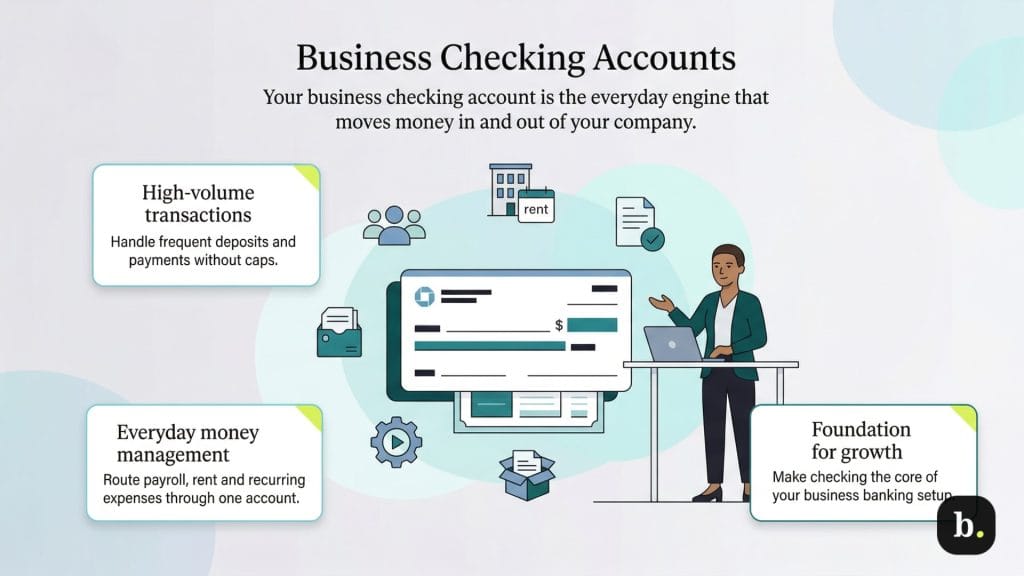
A business checking account is your operational hub. It’s where revenue comes in and where expenses go out. Payroll, rent, vendor invoices, subscription services, supplies and every other recurring cost of running your business goes through your checking account.
Checking accounts are built for high transaction volumes. Unlike savings accounts, they’re designed to handle frequent deposits and withdrawals without restrictions. You can write checks, use a debit card, set up ACH payments, process wire transfers and accept direct deposits, all without worrying about transaction caps. For most businesses, the checking account is the single most-used financial tool in daily operations.
If you only open one business bank account, this is the one to start with. It covers the basic mechanics of moving money in and out of your business and serves as the foundation for your financial infrastructure.
If you’re choosing a business checking account, we’ve done the research for you. Check out our picks for the
best business bank accounts to get up and running quickly and start your business on the road to financial success.
Key features to evaluate
Not all business checking accounts are created equal, and the differences can have a real impact on your bottom line. Here are the features worth comparing:
Transaction limits and fees
Many business checking accounts offer a set number of free transactions per month and charge per-transaction fees once you exceed that limit. If your business processes a high volume of payments, those fees can add up quickly. Look for accounts with transaction allowances that match your actual usage.
Cash deposit allowances
If your business handles cash (retail, restaurants, service businesses), pay attention to cash deposit limits. Some accounts cap free cash deposits at a certain dollar amount per month and charge a percentage on anything above that threshold.
Accounting software integration
Seamless syncing with QuickBooks, Xero, FreshBooks, or whatever accounting platform you use saves hours of manual reconciliation. This is an increasingly important differentiator, especially as more banks build direct API connections to popular accounting tools.
Mobile deposit and digital banking
The ability to deposit checks, approve transactions and monitor account activity from a mobile app is no longer a nice-to-have — it’s essential for most small business owners. Evaluate the quality of the bank’s app and the breadth of mobile features available.
Sub-accounts
Some banks allow you to create sub-accounts within your checking account for specific purposes. With sub-accounts, you can have one for payroll, one for operating expenses and one for owner draws. This can help with internal budgeting without the complexity of maintaining multiple full accounts.
Business savings accounts
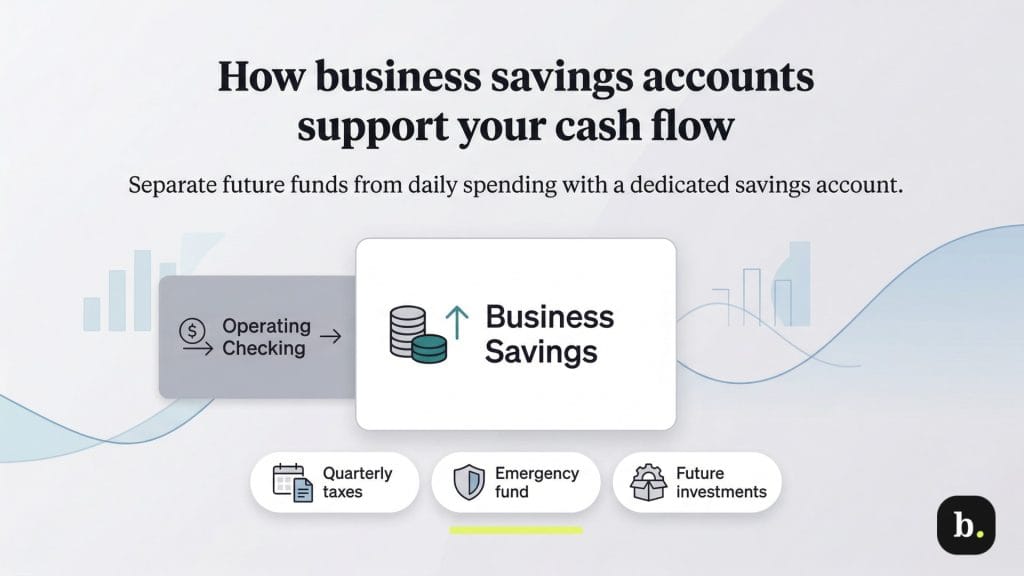
A business savings account holds the money you don’t need for daily operations but want to keep accessible. It earns interest on your balance, and it serves as a dedicated place for funds that have a specific future purpose.
The most common uses for a business savings account include setting aside estimated quarterly tax payments so they don’t compete with operating cash, building an emergency fund to cover three to six months of operating expenses in case of a revenue disruption or unexpected cost, creating a reserve for planned capital expenditures like equipment purchases, inventory pre-orders, buildouts or hiring, and maintaining a seasonal buffer for businesses with cyclical revenue patterns that need to stockpile cash during strong months to cover lean periods.
In each case, the savings account imposes a useful layer of discipline. Money that’s sitting in your checking account tends to get spent. Money that’s been moved to a designated savings account is psychologically and practically separated from your day-to-day cash flow.
Key features to evaluate
When considering a business savings account, examine the following factors to make sure you choose one that supports your business’s needs.
Annual Percentage Yield (APY)
This is the interest rate your deposits earn, and it varies significantly by institution. As of early 2026, the national average savings rate sits around 0.39% APY, but high-yield business savings accounts — particularly those offered by online banks — are offering rates between 3.5% and 4.5% APY, and some promotional offers push even higher. The gap between the average and the best available rate is substantial enough to matter, especially for businesses holding five- or six-figure reserves.
Pay attention to rate tiers. Some accounts advertise a headline rate that only applies above a certain balance threshold. If your typical balance is $10,000 but the top-tier rate kicks in at $50,000, you may be earning far less than the advertised APY.
Minimum balance requirements
Some accounts require a minimum balance to earn the advertised interest rate or to avoid monthly maintenance fees. Evaluate whether those minimums are realistic given your cash flow. An account with a $25,000 minimum balance requirement and a 2.5% APY may not make sense if you can’t consistently maintain that balance.
Withdrawal and transfer rules
The Federal Reserve’s Regulation D historically limited certain types of savings account withdrawals — online transfers, ACH transactions, and automatic payments — to six per month. In April 2020, the Fed eliminated that federal requirement permanently, and it has confirmed the change is not temporary. However, many banks have kept their own withdrawal caps in place. Before opening a business savings account, confirm whether your bank still enforces transaction limits and what fees, if any, apply for exceeding them.
Fees
Monthly maintenance fees, excess withdrawal fees and below-minimum-balance penalties can erode the interest you’re earning. Some online banks have eliminated most or all of these fees, making them particularly attractive for businesses that want a low-friction savings option.
How to use both accounts together
The real value of a business savings account isn’t the interest rate, it’s the structure it creates in your cash management. Here’s a practical framework for using checking and savings together effectively.
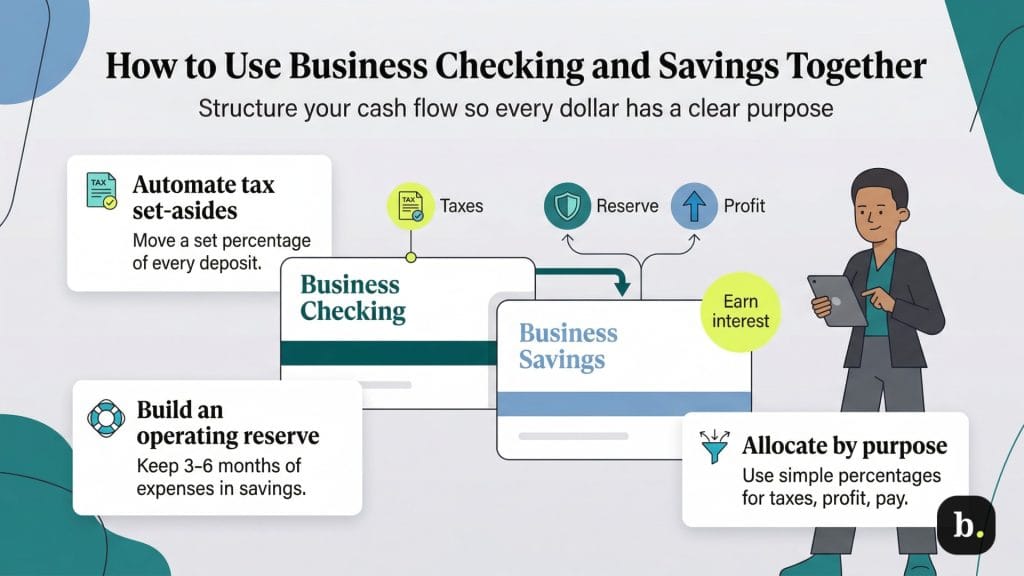
Set aside estimated taxes automatically
One of the most common cash flow mistakes small business owners make is spending money they’ll owe in quarterly taxes. A simple fix: set up an automatic transfer from your checking account to your savings account for a fixed percentage of every deposit (typically 25% to 30% of profit, depending on your tax bracket and state obligations.) When quarterly payments come due, the money is already set aside and waiting.
Maintain an operating reserve
Financial advisors generally recommend keeping three to six months of operating expenses in reserve. That money shouldn’t sit in your checking account, where it’s easy to spend on non-essential purchases. Parking it in a savings account keeps it accessible for genuine emergencies, such as an unexpected equipment failure, a major client defaulting on payment, a seasonal downturn that runs longer than expected. Meanwhile, that money earns interest while it sits in your savings account.
Use a percentage-based allocation system
Some business owners use a simplified version of the “profit first” methodology, automatically splitting incoming revenue across multiple accounts: one for operating expenses (checking), one for taxes (savings), one for profit reserves (savings) and one for owner compensation (checking or a separate account). The exact percentages depend on your business, but the principle is the same: allocate money by purpose before it gets absorbed into general spending.
Consider sweep accounts for variable cash flow
If your business has unpredictable or highly variable revenue, some banks offer sweep accounts that automatically move excess funds from checking to savings when your checking balance exceeds a set threshold, and move funds back when it drops below another threshold. This keeps your idle cash earning interest without requiring you to manually manage transfers.
When a savings account isn’t worth it
Not every business needs a savings account right away, and in some situations, it may not be the best use of your attention or capital.
- Your balance is too low for meaningful interest. If your business is in its early stages and you’re operating with minimal reserves, the interest earned on a $1,000 or $2,000 savings balance is negligible — a few dollars a year at best. Until you have enough surplus cash to make the interest meaningful, your energy is better spent building revenue and maintaining liquidity in your checking account.
- You need more flexibility than a savings account offers. If your bank still enforces transaction limits, a savings account may not work well for funds you need to access frequently. In these cases, a money market account — which typically offers comparable interest rates with check-writing privileges and debit card access — may be a better fit.
- A CD makes more sense for your timeline. If you’re saving toward a specific goal with a known timeline — a buildout six months from now, a large inventory order next quarter — a certificate of deposit (CD) may offer a higher rate than a savings account in exchange for locking your funds for a set period. CDs sacrifice liquidity for yield, so they’re only appropriate when you’re confident you won’t need the money before the term ends.
- Your priority is liquidity, not yield. Early-stage businesses that are still establishing consistent revenue should generally keep their cash as liquid as possible. A checking account gives you unlimited access to your funds, and the peace of mind that comes with having immediate access to every dollar may be worth more than the interest a savings account would generate.
Most established small businesses benefit from having both a checking and a savings account. The checking account handles the daily mechanics of running your business; the savings account gives you a structured place to set aside reserves, build an emergency fund and let idle cash earn interest.
The practical recommendation: start with a business checking account when you launch. Once your revenue is consistent enough to set aside money regularly, open a savings account and begin automating transfers. The discipline of separating operating cash from reserve cash is one of the simplest and most effective financial habits a business owner can develop.