This article is sponsored by Intuit.
You spent an hour crafting the perfect promotional email, complete with a compelling subject line, gorgeous design and a limited-time discount. But the offer expires in 24 hours, and by the time half your subscribers open it, the deadline has passed. The email performed fine by industry standards, but the time-sensitive nature of the promotion needed a faster channel to complement it.
This is one of the most common missed opportunities in small business marketing: relying on a single channel when your customers engage across multiple touchpoints throughout the day. Email excels at delivering rich, detailed content, while SMS reaches customers almost instantly. The question isn’t which channel is better; it’s how to use both together so each one amplifies the other.
This guide walks through the strategic foundations of coordinated email and SMS marketing, including when to use each channel, how to build complementary campaigns and what to measure. Whether you’re adding SMS to an existing email program or building a multi-channel strategy from scratch, the principles here will help you create a system where both channels work harder together than either one does alone.
Why multi-channel marketing matters for small businesses
People interact with email and text messages in fundamentally different ways. Email is something most people check in batches, such as during a morning routine, at lunch or at the end of the workday. SMS, on the other hand, demands immediate attention.
Industry data consistently reports that the vast majority of text messages are read within minutes of delivery, with most research placing SMS open rates in the 90% to 98% range. Email open rates for marketing messages typically hover between 20% to 40%, depending on the industry and list quality.
These metrics reflect different communication behaviors. Email gives you space for storytelling, product details and rich media. SMS gives you immediacy and a direct, personal feel. When coordinated intentionally, the two channels cover each other’s weaknesses: email provides the depth that SMS can’t deliver in 160 characters, and SMS provides the urgency that email can’t guarantee.
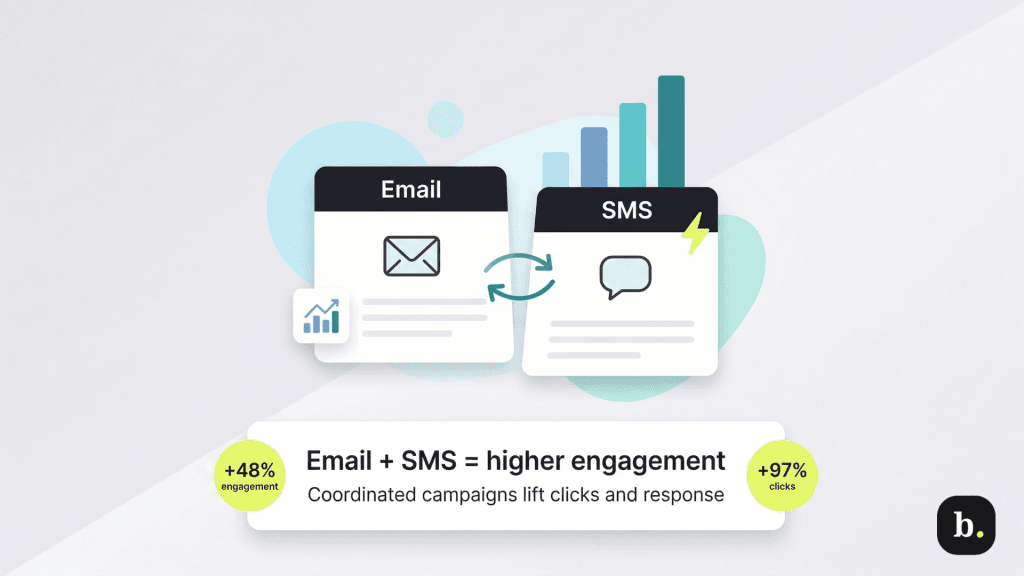
For small businesses especially, multi-channel marketing is a practical equalizer. You don’t need the budget of a national retailer to send a well-timed text message that follows up on an email campaign. According to Omnisend, brands that integrate SMS into their omnichannel strategies see a roughly 48% lift in customer engagement compared to those using email alone. And Mailchimp data shows that U.S. users who sent both email and SMS campaigns saw a 97% higher click rate than those who used only email.
Understanding the strengths of each channel
Email marketing strengths
Email’s greatest asset is space. There are no character limits, no constraints on formatting and no restrictions on the types of content you can include. A single email can contain product images, embedded videos, detailed pricing tables, customer testimonials and multiple calls to action, all within a professionally branded template.
This makes email the natural home for newsletters, product launch announcements, educational content, how-to guides, and complex promotions that need room to explain their value. Email also carries strong economics: according to Litmus research, the average return on email marketing is approximately $36 for every $1 spent, making it one of the most cost-effective marketing channels available. Many email platforms offer unlimited sends within their pricing tiers, which keeps per-message costs extremely low.
SMS marketing strengths
SMS marketing is built for immediacy. Text messages arrive directly on the customer’s lock screen, and most are read within minutes. This makes SMS ideal for time-sensitive communications: flash sale announcements, appointment reminders, order and shipping updates, cart abandonment nudges, and event-day reminders.
The constraint of SMS—roughly 160 characters for a standard text—is also its strength. It forces concise, actionable messaging that gets to the point. SMS feels personal and direct in a way that email often doesn’t, which is why opt-out rates for SMS tend to stay below 3% when messages are relevant and well-timed.
The trade-off is cost: SMS pricing is typically per-message, with costs varying by platform and volume, usually ranging from a few cents per message in the United States.
When to use each channel
Use email when you need to explain, educate or showcase, and use SMS when you need to alert, remind or create urgency.
Weekly newsletters, product deep-dives, onboarding sequences and educational series belong in email. Flash sales, appointment reminders, shipping confirmations, last-chance alerts and event-day communications belong in SMS.
The overlap zone where either channel could work is where strategic coordination matters most. Abandoned cart messages, for example, can start with an email (less intrusive, more detail) and escalate to SMS if the email goes unopened. Promotional campaigns can lead with email to build context, then follow up with a brief SMS reminder to drive action.
Think of email as the full conversation and SMS as the tap on the shoulder. If your message needs a paragraph to land, send an email. If it needs a sentence, send a text.
Building a coordinated email and SMS strategy
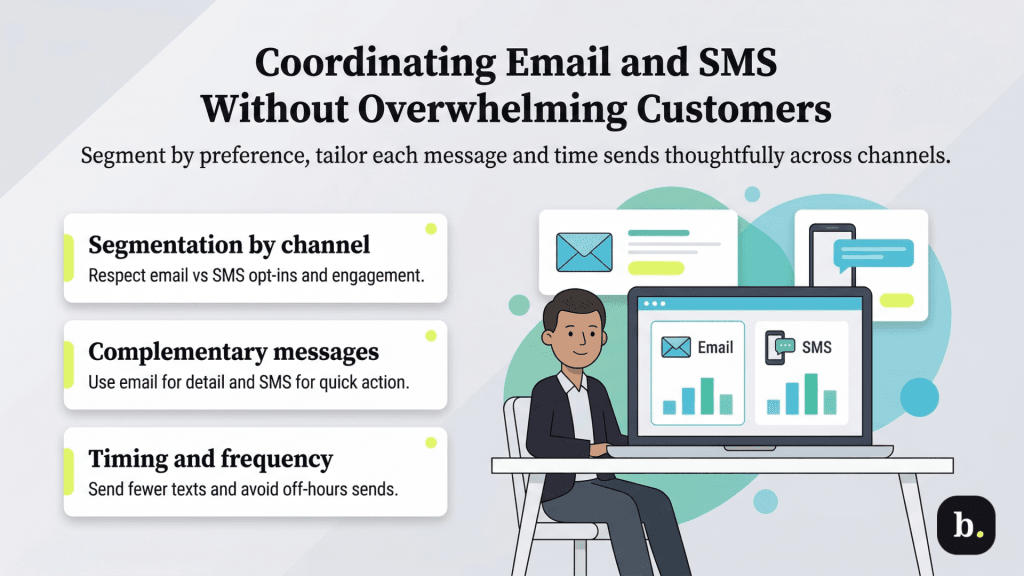
Audience segmentation across channels
Not every subscriber wants both email and text messages, and respecting that preference is both a legal requirement and a practical one. SMS requires explicit opt-in consent under the Telephone Consumer Protection Act (TCPA), separate from any email consent. Violating TCPA can carry penalties of $500 to $1,500 per unsolicited message, so compliance is non-negotiable.
From a strategy perspective, segment your audience by engagement level and channel preference. Your most engaged customers—those who regularly open emails and make purchases—are the best candidates for SMS as an additional touchpoint. Casual subscribers who occasionally open emails may not appreciate the more personal intrusion of a text. Platforms like Mailchimp allow you to manage multi-channel subscriber lists and separate opt-in preferences within a single audience, which simplifies this segmentation.
Creating complementary content
The most effective multi-channel campaigns use a “teaser and detail” approach rather than duplicating the same message across both channels. The idea is simple: each channel plays a distinct role in the same campaign narrative.
For example, in a product launch, you might send an email with the full product story—features, pricing, photos, customer testimonials—and then follow with a short SMS on launch day that says, “It’s here! [Product] now available. Shop now: [link].” The email provides context and builds desire; the SMS drives immediate action.
The critical rule is to avoid sending the same message simultaneously on both channels. Receiving an identical promotion via email and text at the same time feels spammy and erodes trust. Sequence your messages so each one adds value rather than redundancy, and coordinate frequency across channels so customers aren’t overwhelmed.
Timing and frequency guidelines
Email and SMS have different frequency tolerances. Most small businesses find a sweet spot of one to four emails per week, depending on the content mix and subscriber expectations. SMS requires more restraint; two to eight messages per month is a reasonable range for most businesses, with the lower end being safer for those just starting out.
Timing also differs by channel. Email tends to perform well on weekdays during business hours, with many studies pointing to Tuesday through Thursday between 10 AM and 2 PM as strong windows. SMS should be sent during reasonable waking hours, usually 10 AM to 8 PM in the recipient’s time zone, and never late at night or early in the morning. Some platforms, like Mailchimp, offer send-time optimization features that analyze subscriber engagement patterns to suggest optimal delivery times for each channel.
The golden rule for SMS frequency: if you wouldn’t text a friend about it at that hour, don’t text your customers. Start conservative and increase only as engagement data supports it.
Multi-channel campaign examples
Product launch
A three-week product launch illustrates how channels complement each other across a longer campaign arc. In the first week, send an email-only teaser campaign with product previews and the brand story behind the launch—no SMS yet, just building anticipation. In the second week, deliver the full product details, features, and pricing via email, and on launch day send a short SMS: “It’s here! [Product] now available. Shop now: [link].” In the third week, follow up with an email featuring customer testimonials and use cases, then close the launch window with an SMS: “Last chance—early bird pricing ends tonight.”
Abandoned cart recovery
Abandoned cart recovery is one of the highest-ROI applications for multi-channel automation. A common sequence starts with an email one hour after cart abandonment, showing the cart contents and a clear “complete your purchase” button. If the email goes unopened after 24 hours, follow up with an SMS that includes a short incentive: “You left items in your cart. Here’s 10% off if you complete your order today: [link].” Three days later, send a final email with customer reviews of the abandoned products to rebuild interest.
The logic behind this escalation is straightforward: email is less intrusive and provides more context, so it gets the first attempt. SMS follows for high-value carts where the urgency of a text message may close the sale. Mailchimp’s automation builder supports this type of if/then logic, allowing you to trigger an SMS only if the initial email goes unopened or unclicked.
Flash sale
Time-limited promotions are where SMS shines most clearly. A four-hour flash sale might start with an SMS in the morning: “4-hour flash sale! 30% off everything. Ends at 2 PM: [link].” At noon, send an email to subscribers who haven’t clicked—a visually rich showcase of featured products with full sale details. Thirty minutes before the sale ends, send a final SMS to non-purchasers: “30 minutes left! Don’t miss 30% off.”
This type of campaign works because each message serves a distinct purpose within a compressed timeline. The first SMS creates awareness and urgency. The email expands on the offering for those who need more information. The final SMS is a last-chance nudge. Mailchimp’s own data suggests that users combining email and SMS see meaningfully higher click rates than those using email alone, and time-sensitive campaigns are where this effect is most pronounced.
Event promotion
Events benefit enormously from multi-channel reminders because no-shows are often a function of forgetting rather than disinterest. Three weeks before an event, send an email with full details—agenda, speakers, registration link. One week out, send a reminder email highlighting key sessions or speakers. The day before the event, switch to SMS: “See you tomorrow! Event starts at 10 AM. Details: [link].” On the day of, send a final SMS one hour before start time.
Measuring success across channels
Each channel has its own performance benchmarks, and understanding them prevents misleading comparisons. For email, track open rates, click-through rates, conversion rates, unsubscribe rates, and revenue per email sent. For SMS, focus on delivery rates (which should exceed 95%), click-through rates on links, opt-out rates (a warning sign if consistently above 3%) and cost per conversion.
The more nuanced challenge is multi-channel attribution—understanding which channel actually drove a conversion when both were involved. In many campaigns, email plays the “assist” role, providing information that builds intent, while SMS plays the “closer” role, delivering the timely nudge that triggers the purchase. Or vice versa: an SMS might create initial awareness that leads a customer to engage more deeply with a follow-up email.
Rather than trying to assign full credit to one channel, focus on how combined campaigns perform against single-channel benchmarks. Are your coordinated campaigns producing higher overall conversion rates, higher revenue per subscriber, or lower cost per acquisition than your email-only or SMS-only efforts? That’s the metric that matters most for resource allocation decisions.
Best practices and common mistakes
The following guidelines reflect both industry consensus and practical experience from businesses running multi-channel campaigns.
- Segment by channel preference. Not every email subscriber wants SMS, and that’s fine. Respect opt-in boundaries and target SMS to your most engaged customers.
- Reserve SMS for high-value messages. Every text should deliver clear value—a meaningful discount, a timely reminder, an important update. If a message doesn’t justify the immediacy of a text, it belongs in an email.
- Maintain consistent brand voice. Your email and SMS messages should sound like they’re coming from the same business. Adapt the length and format to each channel, but keep the tone and personality consistent.
- Test before you scale. Start with a small SMS segment to test messaging, timing, and frequency before rolling out to your full list. A/B testing is just as valuable for SMS as it is for email.
- Never send identical messages simultaneously. Receiving the same promotion via email and text at the same time feels like spam. Sequence your messages with intentional gaps and distinct roles for each channel.
- Respect time boundaries for SMS. Don’t send texts before 10 AM or after 8 PM in the customer’s time zone. Many platforms enforce quiet hours automatically, but verify that yours does.
- Never purchase phone number lists. SMS requires explicit opt-in. Buying lists violates TCPA, damages your sender reputation, and produces terrible results. Build your list organically through your website, checkout flow, and in-person interactions.
Start conservative with SMS frequency. It’s much easier to increase sending as customers engage than to rebuild trust after you’ve annoyed them with too many texts.