Business.com aims to help business owners make informed decisions to support and grow their companies. We research and recommend products and services suitable for various business types, investing thousands of hours each year in this process.
As a business, we need to generate revenue to sustain our content. We have financial relationships with some companies we cover, earning commissions when readers purchase from our partners or share information about their needs. These relationships do not dictate our advice and recommendations. Our editorial team independently evaluates and recommends products and services based on their research and expertise. Learn more about our process and partners here.
If your record was expunged but still appears online, it could have ramifications for your business. Online reputation management services can help.


This article is sponsored by Erase.com
Getting a criminal record expunged feels like closing a chapter for good. You did the paperwork, went before a judge and received confirmation that the case was legally cleared. So it can be jarring to later Google your own name and find that the same charge is still sitting there in plain sight, potentially affecting your business’s reputation.
Unfortunately, what the law can erase and what the internet is willing to forget aren’t always the same thing. Understanding that gap is the first step toward closing it, whether you’re managing your own record, coaching an employee through the same situation or simply trying to understand why a background check and a Google search can tell two different stories about the same person.
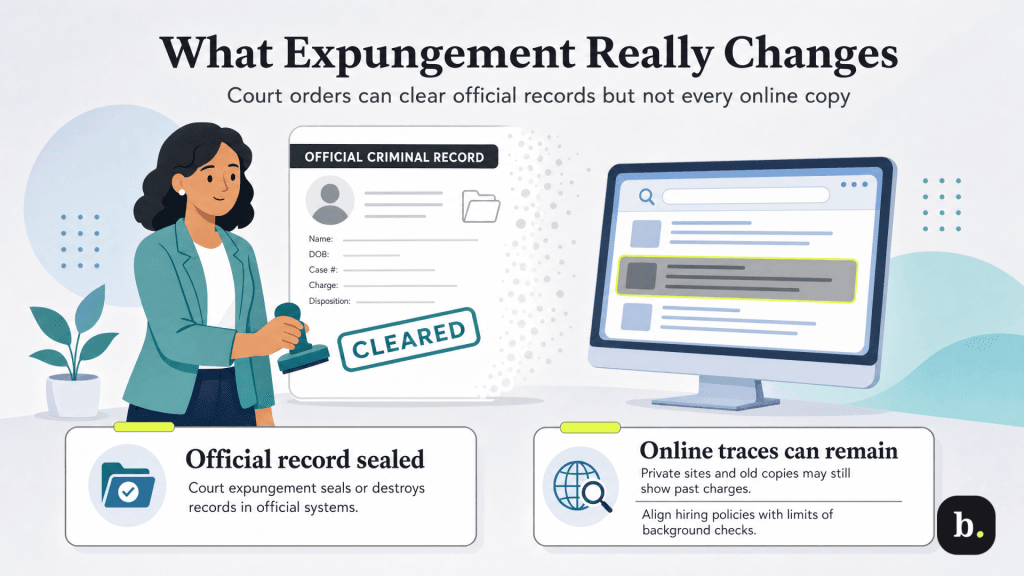
Expungement is a court order directing that a criminal record be sealed or destroyed within official systems, typically the court’s own files and the law enforcement agency that handled the arrest. Once granted, the case generally no longer appears in the government databases that private employers and landlords rely on for standard background checks, and in most states you’re legally permitted to answer “no” if asked whether you’ve ever been arrested or charged.
What an expungement order does not do is reach outside the government. It carries no authority over private companies, websites or archives that already copied the information before the case was cleared. The court can erase its own copy of the record, but it can’t reach into every server where that record has since been duplicated.
If you’re the one with the expunged record, it explains why a clean legal outcome doesn’t automatically translate into a clean online presence. If you’re the one doing the hiring, it’s worth knowing that a stray search result isn’t necessarily the full picture, and that policies around how your business uses background checks and online searches in hiring decisions should account for the difference.
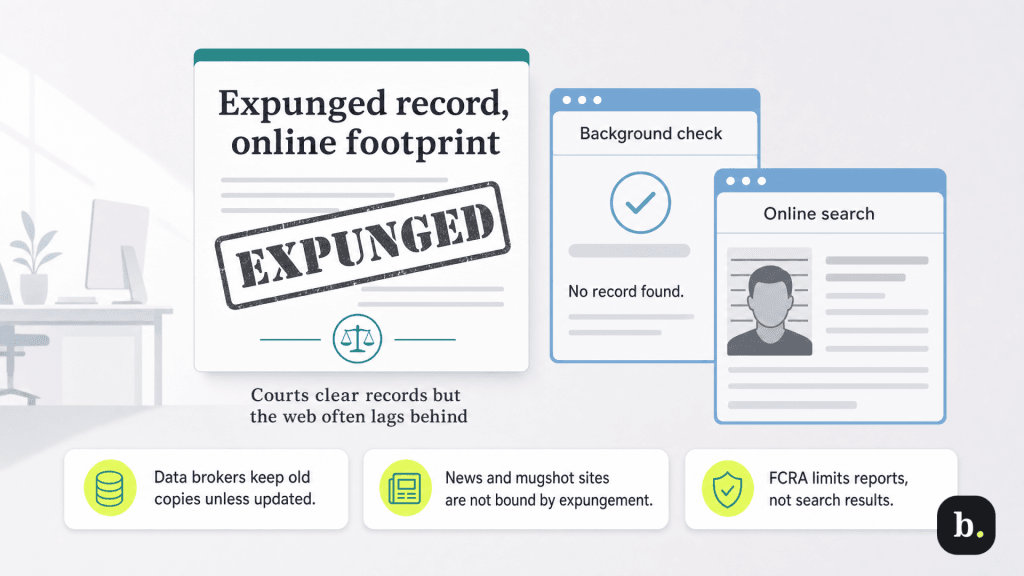
Background check companies and “people search” sites routinely scrape arrest logs, court dockets and mugshots from public county and court websites, often while a case is still open. Once that data is downloaded into a private database, it’s the broker’s responsibility, not the court’s, to keep it current. Many don’t update their records unless someone asks them to.
If a local news outlet reported on an arrest, that article typically stays live in the publication’s archive indefinitely, regardless of how the case was ultimately resolved. The same goes for standalone mugshot sites, many of which exist specifically to monetize the removal process by charging a fee to take a photo down. An expungement order has no legal claim on this kind of editorial or independently hosted content.
The Fair Credit Reporting Act (FCRA) limits how long consumer reporting agencies can include certain information in a background check report. Arrests that didn’t lead to a conviction generally can’t be reported after seven years, regardless of expungement status. However, that protection applies specifically to consumer reporting agencies conducting background checks, not to search engines, news sites or open-web databases, which is why the same record can disappear from a formal background check while still ranking on the first page of a Google search.
As a result, two employers looking into the same candidate could see entirely different things: One who orders a formal background check through a screening company may see nothing, while one who simply searches the candidate’s name could still find the original arrest report or mugshot. The legal cleanup and the search engine cleanup are two separate jobs.
None of this means you’re stuck. It does mean the process looks different from the original expungement filing, since you’re now dealing with private companies rather than the court.
Chasing down dozens of data brokers, background check sites and news archives one at a time is realistic for some people and overwhelming for others, especially while also running a business. That’s the gap that online reputation management services are built to close.
Erase.com, for example, works through this process on a client’s behalf: auditing where a record appears across the web, submitting removal requests to data brokers and other sites, and monitoring for the record’s reappearance afterward (since some sites are known to re-scrape and repost information that was previously taken down.) Services like this don’t have any more legal authority over private websites than an individual does, but they bring the practiced templates, contacts and persistence that make the process faster and less frustrating to manage alone.
If your expunged record is actively costing you job offers, housing applications or client trust, that’s usually the point at which it’s worth weighing the cost of professional help against the time and stress of handling it entirely on your own. If you do look into a reputation management service, ask specifically how it verifies removals, whether it monitors for reappearance afterward, and what happens if a site refuses to comply. A service that can answer those questions clearly is generally a better bet than one that only promises fast results, since no company — however experienced — can force a private website to take content down.
