Business.com aims to help business owners make informed decisions to support and grow their companies. We research and recommend products and services suitable for various business types, investing thousands of hours each year in this process.
As a business, we need to generate revenue to sustain our content. We have financial relationships with some companies we cover, earning commissions when readers purchase from our partners or share information about their needs. These relationships do not dictate our advice and recommendations. Our editorial team independently evaluates and recommends products and services based on their research and expertise. Learn more about our process and partners here.
Fiber-optic internet is now widely available for small businesses, and it offers competitive advantages that entrepreneurs shouldn’t ignore.


This article is sponsored by AT&T
The way small businesses use the internet has changed almost beyond recognition in the last decade. What used to be a utility for email and the occasional file download is now the backbone of daily operations. Cloud-based accounting, CRM platforms, video meetings, shared design files, VoIP phones, POS systems, remote team collaboration — all of it runs through your internet connection, simultaneously, all day long.
The infrastructure underneath many small businesses, though, hasn’t kept pace. A lot of companies are still operating on cable or DSL connections designed for an earlier era of internet usage. In that era, uploading something meant sending a 2 MB attachment, not backing up 50 GB of project files to the cloud or running a four-person video call while the POS system syncs inventory in the background.
That gap is where fiber-optic internet comes in. Fiber isn’t just a faster version of what you already have. It’s a different kind of connection that fundamentally changes what a small business can do reliably and, increasingly, what it needs to do to keep up.
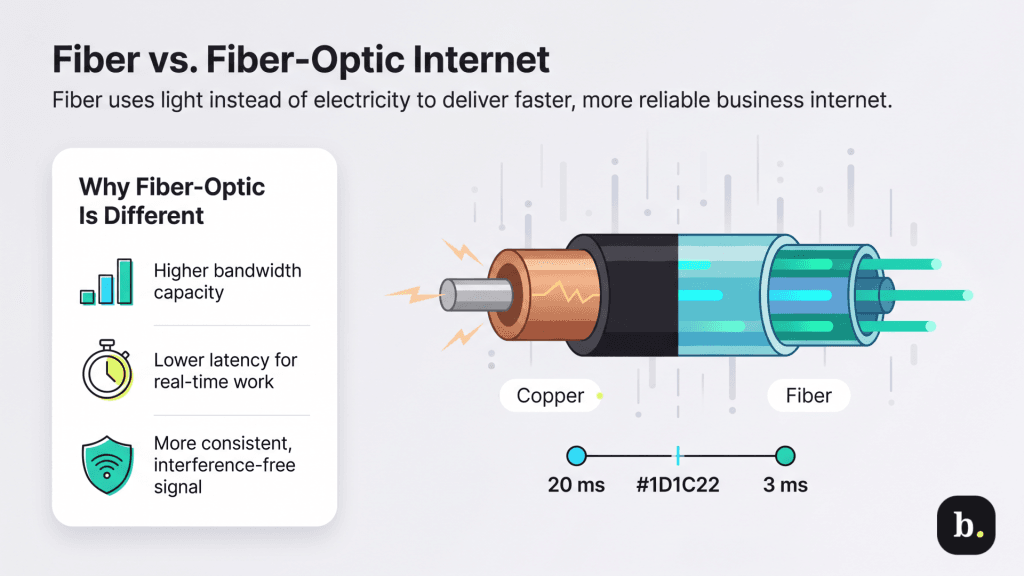
At a technical level, the difference between fiber and older internet technologies comes down to how data gets from point A to point B.
Cable and DSL internet transmit data as electrical signals through copper wires. Cable uses coaxial copper, while DSL uses the telephone lines that were originally designed to carry voice calls.
Fiber-optic internet uses pulses of light traveling through thin strands of glass or plastic. That one difference in transmission medium has major practical consequences:
You don’t need to understand the physics to benefit from it. The practical takeaway is that fiber is faster, more consistent and built to handle the demands modern businesses actually place on their internet.
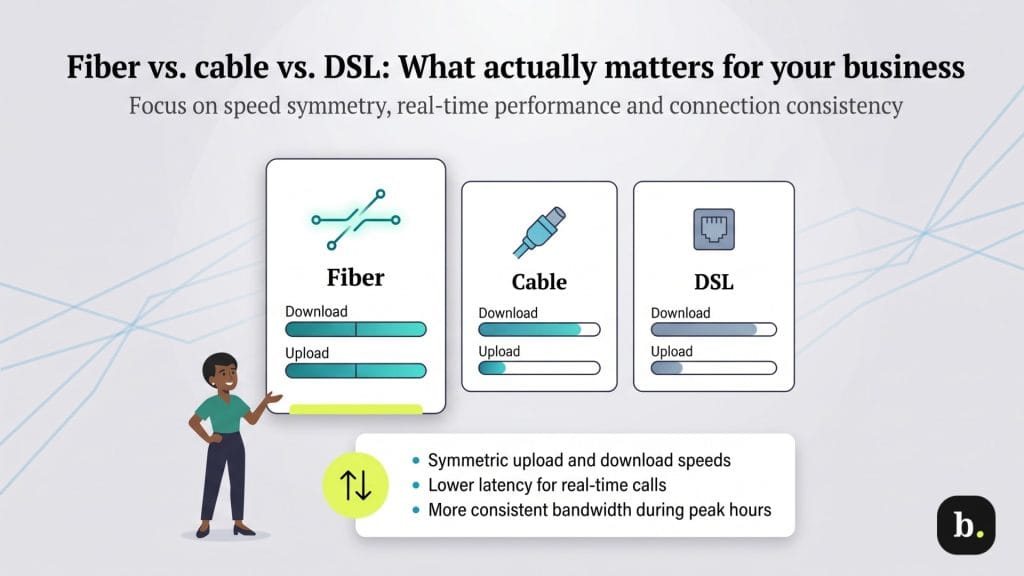
Comparing business internet options can quickly devolve into a confusing spec sheet of numbers that don’t mean much in context. For most small businesses, three factors do most of the real work in determining whether a connection is adequate.
Internet speed is the single biggest practical difference between fiber and everything else. Cable and DSL connections are asymmetric, meaning download speeds are much faster than upload speeds. A cable plan advertised at 1 Gbps download often caps upload speeds at somewhere between 10 and 35 Mbps.
For the way businesses used to use the internet, that was fine; most activity involved pulling data down. But modern business usage goes in both directions. Backing up files to the cloud, uploading video for a marketing campaign, sending large deliverables to clients, running video calls (which use 3–8 Mbps of upload per participant) and using cloud-based apps that constantly sync changes back to a server all depend on upload speed.
Fiber delivers symmetric speeds, meaning your upload performance matches your download performance. A 500 Mbps fiber plan gives you 500 Mbps in both directions.
Latency is the delay between sending a signal and getting a response. Jitter is the variation in that delay over time. Both are close to invisible when you’re loading a web page, but they show up clearly in real-time applications.
A VoIP call with high latency sounds awkward and clipped. A video call with high jitter freezes, pixelates and drops. Fiber’s consistently low latency is a meaningful advantage for any business that relies on real-time communication (which, at this point, is most of them.)
Cable internet uses a shared bandwidth model. You share the available bandwidth in your area with your neighbors, which is why cable performance often dips during peak usage hours.
Fiber connections, particularly business-grade fiber, are typically dedicated. That means your bandwidth is your own. That consistency is especially valuable during business hours, which is precisely when cable networks tend to be most congested.
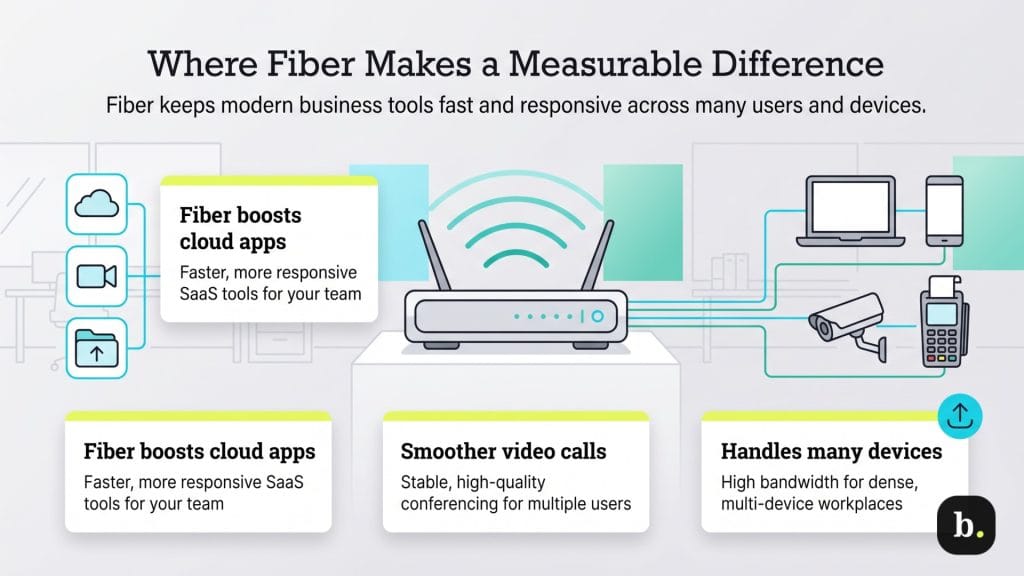
The advantages of fiber aren’t abstract. They show up in specific, everyday business scenarios.
If your business runs on cloud-based tools (Salesforce, QuickBooks Online, HubSpot, Asana, Google Workspace, Microsoft 365), every action your team takes involves data flowing back and forth between your office and a remote server.
Fiber’s combination of high upload speed and low latency makes these tools feel responsive instead of sluggish, even with multiple people working on them simultaneously.
A stable, high-quality video call requires consistent upload bandwidth for each participant. A four-person office running simultaneous client calls on a cable connection is competing for a small upload pipe, which is why calls often degrade in multi-user environments.
On fiber, every participant has the upload capacity they need, and the low-latency connection keeps conversations feeling natural rather than stilted.
Any business that regularly moves large files in and out of the office feels the upload bottleneck on cable most acutely. This applies to businesses as diverse as design firms, marketing agencies, architectural firms, videographers and legal teams handling discovery files.
A 5 GB video file that takes an hour to upload on cable can move in a few minutes on fiber. Over a month, that time adds up to a meaningful productivity difference.
A modern small business office isn’t just running a handful of computers. It’s running laptops, phones, tablets, security cameras, smart thermostats, printers, POS systems, VoIP handsets and an increasingly growing number of connected devices all pulling on the same connection.
Fiber’s higher bandwidth ceiling handles dense, multi-device environments without the slowdowns that cable users often notice as their team and tools grow.
A lot of small business owners have heard fiber is better but haven’t implemented it because of a handful of persistent concerns. Most of them are based on outdated information.
Fiber availability has expanded dramatically over the past few years. The Fiber Broadband Association reports that fiber now passes more than 60% of U.S. households, with roughly 100 million total fiber passings as of late 2025. Deployment hit a record 11.8 million new homes passed in 2025 alone.
AT&T is a useful reference point for the pace of expansion. The company now passes more than 31 million consumer and business fiber locations across 100+ U.S. metros as of September 30, 2025. The company plans to expand that network aggressively, too, aiming to reach approximately 60 million total fiber locations by the end of 2030.
Even if your address wasn’t served a year or two ago, it’s worth checking again, because the footprint is moving quickly.
Business fiber installation typically involves a technician running a fiber line from a nearby network connection point to your building, installing a small piece of equipment (often called an Optical Network Terminal or Fiber Network Terminal) where the fiber line enters, and connecting it to your internal network.
For most small businesses in areas where fiber is already available, installation can be completed in a few hours with minimal disruption. Timelines can stretch if new construction is required to bring fiber to your specific address, but for locations already in a fiber-served area, it’s rarely the ordeal people expect.
Fiber used to carry a significant price premium over cable. That’s much less true today. As fiber has expanded and competition has intensified, business fiber pricing has become competitive with comparable cable business plans. In many markets, fiber costs less per Mbps than what businesses are currently paying for slower cable service.
AT&T Business Fiber, as one example, offers multiple tiers that make it straightforward to match speed to actual business needs without overpaying for capacity you won’t use. When you factor in the productivity gains, reliability improvements and avoided downtime costs, the total cost picture often favors fiber even when the sticker price is similar.
This is the trickiest concern to address, because it’s often true, at least right now. The question is whether your current setup will still be fine in 18 months, when you’ve added two employees, rolled out a new cloud-based tool or started doing more video-heavy client work.
Internet usage grows year over year for most businesses; the average U.S. household now moves nearly 700 GB of data per month, up from about 200 GB in 2018, and business usage has grown at a similar pace. Infrastructure that’s adequate today is often a bottleneck within a year or two.
If fiber is available at your address, the decision generally comes down to how dependent your business is on the kinds of workloads where fiber shines. A simple framework:
Criterion | What to consider |
|---|---|
Current bandwidth usage | Are you noticing slowdowns during busy parts of the day? Are employees complaining about buffering or lag? |
Number of connected devices and users | More devices and users mean more strain on a shared or asymmetric connection. |
Reliance on cloud and real-time tools | The more of your day runs through cloud apps, video calls and VoIP, the more fiber’s advantages will be visible. |
Upload-intensive work | If your team regularly uploads large files, backs up to the cloud or works with media, you’re almost certainly feeling the cable upload ceiling even if you haven’t named it. |
Business growth plans | Hiring, opening a second location and adopting new tools all add load to your connection. |
Whatever provider you end up evaluating, a few questions are worth asking upfront:
AT&T’s business fiber availability checker is one tool for exploring what’s actually available at your address, along with the specific speed tiers and plan options for your location.
