Business.com aims to help business owners make informed decisions to support and grow their companies. We research and recommend products and services suitable for various business types, investing thousands of hours each year in this process.
As a business, we need to generate revenue to sustain our content. We have financial relationships with some companies we cover, earning commissions when readers purchase from our partners or share information about their needs. These relationships do not dictate our advice and recommendations. Our editorial team independently evaluates and recommends products and services based on their research and expertise. Learn more about our process and partners here.
As your business grows, its finances become more complex. Here’s how to keep up as your business evolves to more than one location.


The systems that comfortably run a single location have a way of buckling at the second or third. A spreadsheet that once captured every transaction starts sprouting tabs. The monthly close that took an afternoon now eats a week. And the simple question every owner wants answered — which locations are actually making money? — gets harder to answer.
Growth creates a financial management gap. On one side are the entry-level tools built to track a single location’s books. On the other is full enterprise resource planning (ERP) software, which is powerful but heavy, expensive and more than most growing businesses need. Companies running a handful of locations under one roof live somewhere in between; the goal is to bridge that gap with accounting software with advanced functionality without the premature sprawl of a true ERP.
This article focuses on a specific situation: a single business operating multiple locations, such as a restaurant group with several dining rooms, a fitness brand with studios across town or a retailer with a few storefronts. It walks through the financial challenges that surface when one company spreads across multiple sites (consolidated reporting, location-level profit-and-loss (P&L) tracking, shared-cost allocation and inter-location transfers) and works through two realistic scenarios to show how growing companies manage them in practice.
When a single company opens additional locations, the legal and tax picture stays simple: there’s still one entity, one set of books and one tax return. What changes is the need for visibility. Leadership has to see each location’s performance distinctly while still understanding the business as a whole. The accounting challenge becomes segmenting the books in a way that allows each location to tell its own financial story.
That segmentation is the throughline for everything below. Get it right and you can describe how the company is doing and how each site is doing. Get it wrong and you’re left with blended totals that average away exactly the detail you opened a second location to understand.
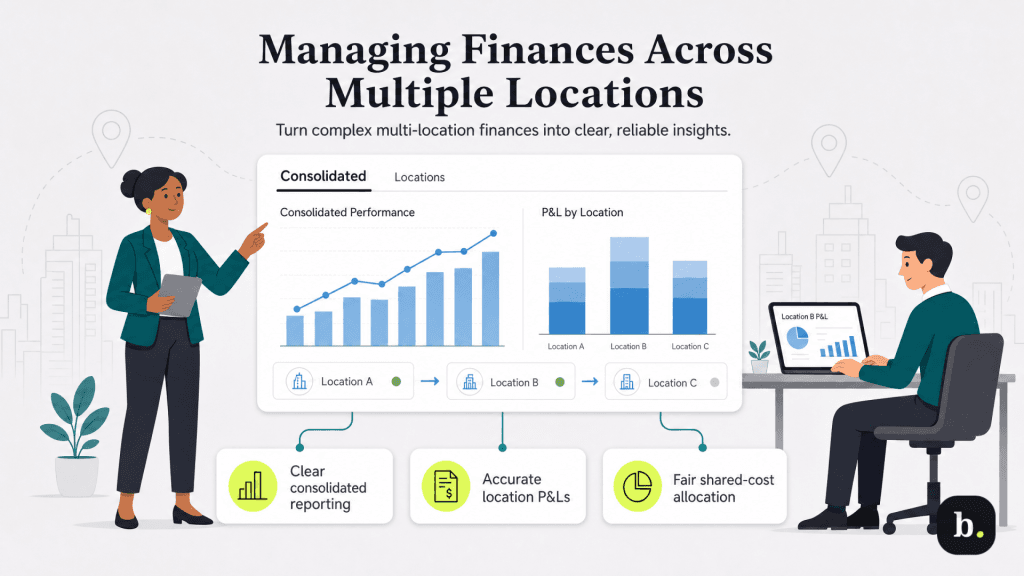
Whatever the business, expansion across locations tends to surface the same handful of challenges. Each is manageable on its own, but together they can overwhelm tools designed for a single site.
Leadership needs to see the whole business, through documents like a combined P&L and balance sheet across every location, while retaining the ability to drill into any single site. Many business owners try to export each location’s numbers into a master spreadsheet. Unfortunately, that opens the door for manual errors and outdated information. The more locations you add, the more fragile the spreadsheet becomes.
Blended totals hide as much as they reveal. A company can post healthy overall margins while one location quietly loses money, subsidized by the others. To manage that, revenue and expenses need to be tagged to their source location at the point of entry, so each site has its own true P&L. Done well, this is what lets you compare locations honestly and spot the underperformer before it drags down the group.
Some costs belong cleanly to one location, but many don’t. Marketing, administrative overhead, insurance and corporate salaries are shared, and how you split them across sites determines whether your per-location numbers mean anything. A consistent, defensible allocation method applied the same way every period is what makes location-level reporting trustworthy rather than arbitrary. Allocate shared costs haphazardly and you can make a healthy location look like a problem, or mask a real one.
As locations share resources, money and goods move between them. For example, one site may front a bulk supply order for several, or inventory may shift from a well-stocked location to one that’s run short. These exchanges need to be recorded so each location’s books reflect what it actually consumed, otherwise the location that happened to pay absorbs a cost that belonged to the whole group, and its P&L becomes deceptive.
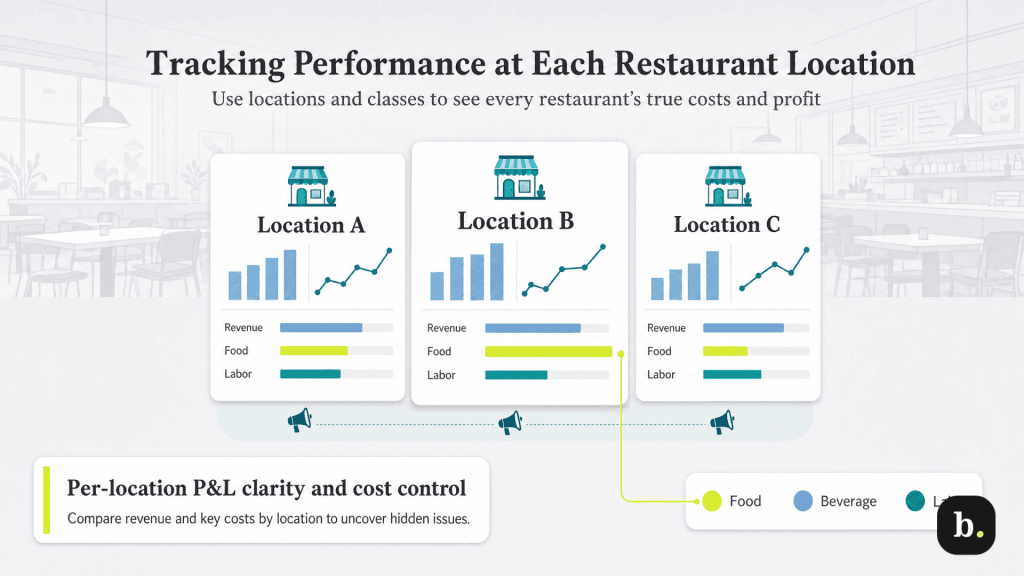
Consider a restaurant group operating two successful locations under a single LLC, now opening a third. Because it’s one legal entity, the company doesn’t need cross-entity consolidation, but it badly needs per-location visibility. With three kitchens, blended financials would make it nearly impossible to tell a genuinely underperforming location from one that’s merely newer.
The practical setup is to track each restaurant as its own location and to use classes to tag revenue and expense types (food, beverage, labor, etc.) across all three. That structure lets the group produce a P&L for each restaurant while still rolling everything up into a company-wide view.
This is the kind of segmentation that platforms in the upper tier of small-business accounting are built for. QuickBooks Online Advanced, for instance, supports unlimited classes and locations, so a growing operator can track each site and each revenue or cost category without bumping into the caps found on lower-tier plans, which limit the combined number of classes and locations. With location tracking in place, the group can generate a P&L for each restaurant and immediately see what blended numbers were hiding.
The second location’s revenue might look fine, for example, but its food costs run several points above the others. That’s an operational problem that might point to portioning, waste, supplier pricing or theft, and it’s only visible once the location’s P&L is broken out.
The same setup handles shared marketing spend: a regional campaign promoting all three restaurants can be allocated across them on a consistent basis rather than arbitrarily landing on whichever location happened to pay the invoice.
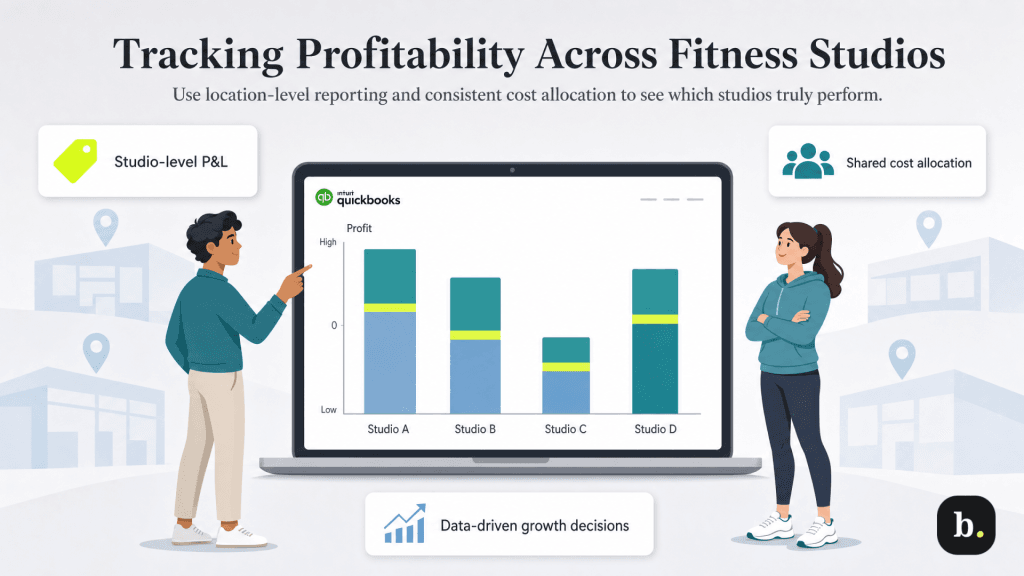
Now consider a fitness brand, a boutique studio concept, that has grown from one location to four. The legal structure is straightforward: one entity, one set of books. But the business dynamics are distinct from the restaurant’s, and they put different demands on the numbers.
Studios live on membership revenue and class attendance, with a cost base that’s heavy on rent, instructor pay and equipment. Much of the spend is shared across the brand: a single marketing budget driving sign-ups for every studio, corporate salaries, a brand-wide software stack and the founder’s time split across all four. The central question for leadership is which studios are genuinely profitable once a fair share of that shared overhead is assigned to each.
This is where consistent location-level reporting and disciplined cost allocation earn their keep. Tagging every membership sale, instructor payment and studio lease to its location lets the brand produce a true P&L per studio. Shared costs like the marketing budget and head-office overhead get allocated across studios on a defined basis (by revenue, by membership count or by square footage), applied the same way each period so the studios stay comparable.
In QuickBooks Online Advanced, custom report building lets the brand construct the views it actually runs on, whether that’s revenue per studio, contribution after shared costs or month-over-month membership trends. The payoff is the ability to answer real questions:
With clean per-location reporting and a fair allocation of shared costs, those answers come from the books rather than from gut feel.
Before opening the next location, it’s worth pressure-testing your financial setup. A few questions to work through:
Setting this structure up before you expand is far easier than retrofitting it onto books that have already grown messy. The businesses that scale financial management smoothly are usually the ones that treated it as a planning problem first.
Scaling from one location to many is a planning challenge before it is a software challenge. The pressures of consolidated reporting, location-level P&L, shared-cost allocation and inter-location activity arrive for nearly every growing multi-location business, and the structures that absorb them are best put in place before the next opening, not after.
Choosing the right platform for your stage is part of that planning. Matched well, the right tool turns multi-location management from a monthly scramble into a clear, controlled view of where the business is making money (and where it isn’t) which is exactly the visibility that makes the next location a confident decision rather than a leap of faith.
