Business.com aims to help business owners make informed decisions to support and grow their companies. We research and recommend products and services suitable for various business types, investing thousands of hours each year in this process.
As a business, we need to generate revenue to sustain our content. We have financial relationships with some companies we cover, earning commissions when readers purchase from our partners or share information about their needs. These relationships do not dictate our advice and recommendations. Our editorial team independently evaluates and recommends products and services based on their research and expertise. Learn more about our process and partners here.
Multi-entity accounting doesn't mean maintaining separate systems — here's how to consolidate financials while preserving subsidiary independence.


This article is sponsored by Intuit.
Opening a second location, acquiring a competitor or expanding into a new market is a milestone worth celebrating, but it also marks the moment when your accounting gets significantly more complex. Each new legal entity means separate books, separate tax obligations and a growing web of intercompany transactions that need to be tracked, reconciled and ultimately consolidated into a single financial picture.
For many growing businesses, the shift from single-entity to multi-entity accounting is where disconnected software systems become a real liability. The good news is that modern enterprise resource planning (ERP) platforms are purpose-built to manage this complexity, keeping each subsidiary’s financials independent while giving leadership a unified view of the entire organization.
Multi-entity accounting becomes necessary anytime a business operates more than one legal entity. Common scenarios include operating multiple LLCs or DBAs under a parent company, acquiring another business, launching a franchise model or expanding into international markets where a foreign subsidiary is required.
Each of these structures exists for good reason, like liability protection, tax advantages and regulatory compliance, but every separate entity needs its own set of books. At the same time, leadership still needs a consolidated view that combines all entities into a single, coherent financial picture for strategic decision-making, investor reporting and regulatory compliance.
The challenge compounds quickly. A business with three subsidiaries isn’t just doing three times the bookkeeping; it’s also managing the intercompany transactions between those entities, reconciling balances that should net to zero on consolidation, and navigating potentially different tax jurisdictions, currencies and compliance requirements.
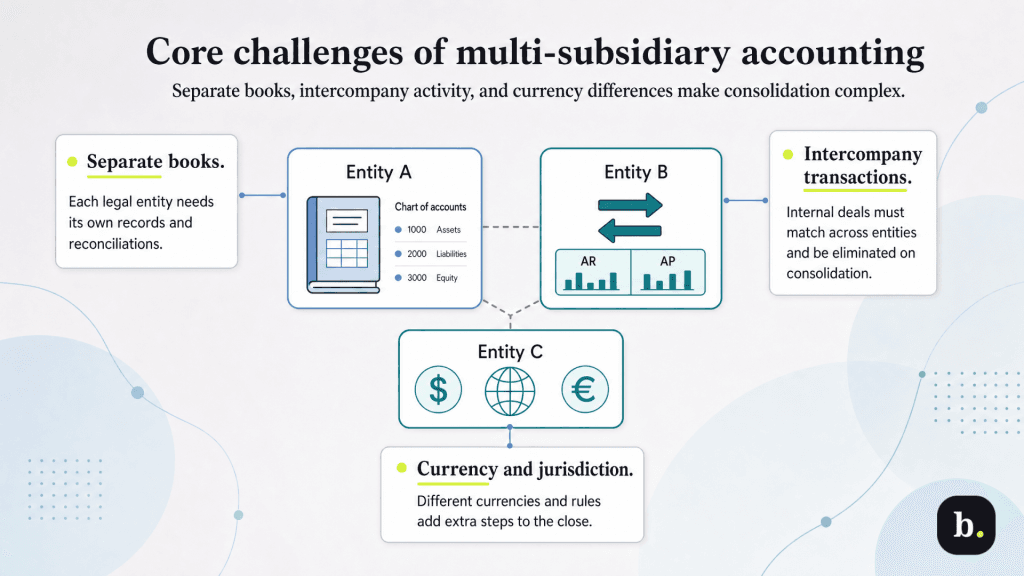
The fundamental requirement of multi-entity accounting is that each legal entity must maintain its own complete financial records. That means individual charts of accounts, dedicated bank accounts and financial statements. Each entity also needs its own tax identification number and filing obligations, which may vary by jurisdiction.
When businesses try to manage this with disconnected accounting systems, the result is a reconciliation nightmare. Data lives in silos, version control becomes a constant headache and the finance team spends more time wrangling data than analyzing it.
Intercompany transactions occur whenever one entity within a corporate group does business with another. A parent company might charge management fees to its subsidiaries. One subsidiary might provide IT services to another. A shared warehouse might allocate costs across multiple entities based on usage.
These transactions must be recorded meticulously in both entities’ books – as a payable in one and a receivable in the other – and then eliminated during consolidation so they don’t artificially inflate the group’s revenue or expenses.
When intercompany balances don’t match, the resulting discrepancies can delay financial closes by days and raise red flags with auditors. In fact, auditors may flag intercompany transaction errors as control deficiencies, and material weaknesses in this area can trigger qualified audit opinions, increased audit fees and strained relationships with audit committees.
Businesses with international subsidiaries face an additional layer of complexity. Foreign entities typically operate in their local currency, which means every transaction must eventually be translated back to the parent company’s reporting currency for consolidation. Exchange rates fluctuate constantly, and the accounting standards governing how those fluctuations are recorded (such as month-end revaluation) add another step to the close process.
Beyond currency, international subsidiaries may also operate under different accounting standards — GAAP in the United States versus IFRS internationally, for example — and face different fiscal year-end dates, local tax rules and regulatory requirements. Even domestically, subsidiaries operating in different states may have varying compliance obligations.
The ultimate goal of multi-entity accounting is a consolidated set of financial statements that presents all entities as a single economic unit. This requires combining the individual financial statements of every subsidiary, eliminating intercompany transactions and balances so internal activity isn’t double-counted, recording any necessary currency translation adjustments and calculating minority interests for partially owned subsidiaries.
For executives and investors, consolidated financials are the primary lens through which they evaluate the organization’s health. A process that might take three to five days with spreadsheets and manual effort can, with the right systems, be completed in hours or even minutes, delivering faster insights and reducing the stress of close periods.
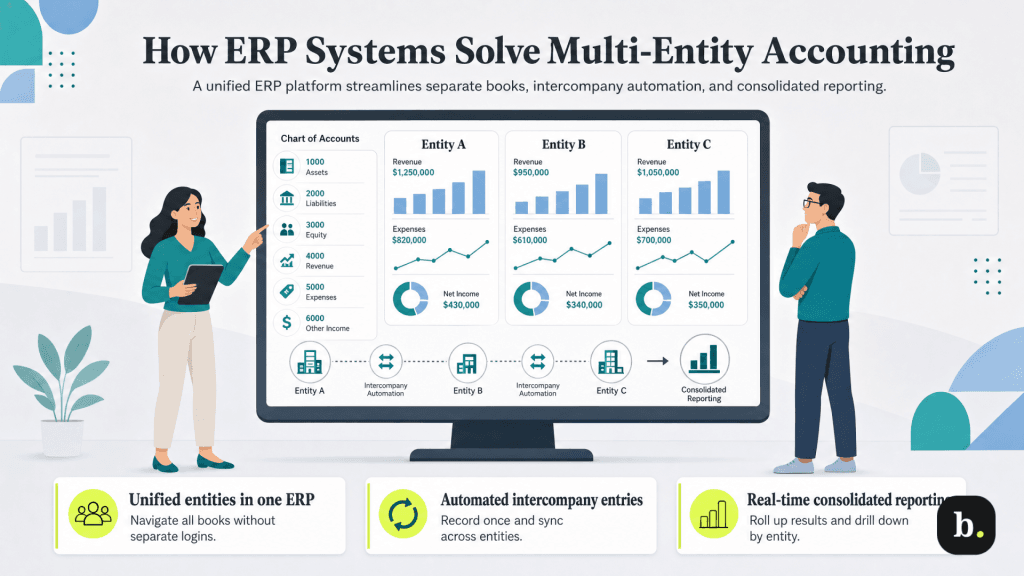
Modern ERP platforms solve the multi-entity problem by maintaining a single database with logical separation between entities. Each subsidiary keeps its own independent financials, but everything lives within one system that the finance team can navigate without logging in and out of separate files.
Intuit Enterprise Suite, for example, structures multi-company accounting so that users can switch between entities from a single dashboard, run consolidated reports across the entire portfolio and manage vendors and customers centrally, all while maintaining strict data separation and role-based access controls.
The key advantage over disconnected systems is consistency. A shared chart of accounts ensures that revenue, expenses and balance sheet items are categorized the same way across every entity, which makes consolidation straightforward and reporting reliable.
Perhaps the most impactful feature of an integrated multi-entity platform is the ability to automate intercompany transactions. Rather than recording the same transaction manually in two separate systems and hoping the entries match, integrated platforms let you record the transaction once and have it automatically reflected in both entities’ books with the correct debits and credits.
Intuit Enterprise Suite takes this a step further with intercompany allocations that can be created directly from bank feeds, expense forms or bills. Finance teams set default account mapping during setup, defining which accounts should be involved in intercompany transactions between each entity pair. From there, the system handles the accounting automatically, removing the need to manually select accounts each time and significantly reducing the risk of misclassification errors.
When it’s time to consolidate, automated elimination entries remove intercompany balances so they don’t distort the group’s financials. Reconciliation workflows flag discrepancies before they become audit findings, and the entire trail is documented for compliance purposes.
Integrated platforms make consolidated reporting a routine task rather than a quarterly ordeal. Finance teams can roll up financials across all entities with a few clicks, then drill down from the consolidated view to any individual entity’s details. Segment reporting by subsidiary, region or business unit gives leadership the flexibility to analyze performance from multiple angles.
Intuit Enterprise Suite’s multi-entity hub provides dashboards that monitor key performance indicators like sales, expenses, profit and loss, accounts receivable and accounts payable across entities at a glance. The platform generates consolidated reports with expanded detail, and AI-powered summaries highlight trends in plain language. Management reports can be packaged into branded, presentation-ready documents that combine financial data, KPIs, charts and written insights.
The difference between real-time and period-end consolidation matters, too. With an integrated system, leadership doesn’t have to wait until month-end to understand how the organization is performing — they can check at any time.
For businesses with foreign subsidiaries, multi-currency support is non-negotiable. A capable ERP platform allows each entity to operate in its local currency while automatically handling translation to the parent company’s reporting currency during consolidation. Exchange rate management, including month-end revaluation processes, should be built into the workflow rather than handled through manual journal entries.
Intuit Enterprise Suite supports multi-currency accounting and can produce consolidated reports even when entities use different currencies and accounting methods. This capability is essential for organizations scaling internationally, as it removes one of the most error-prone manual processes from the close cycle.
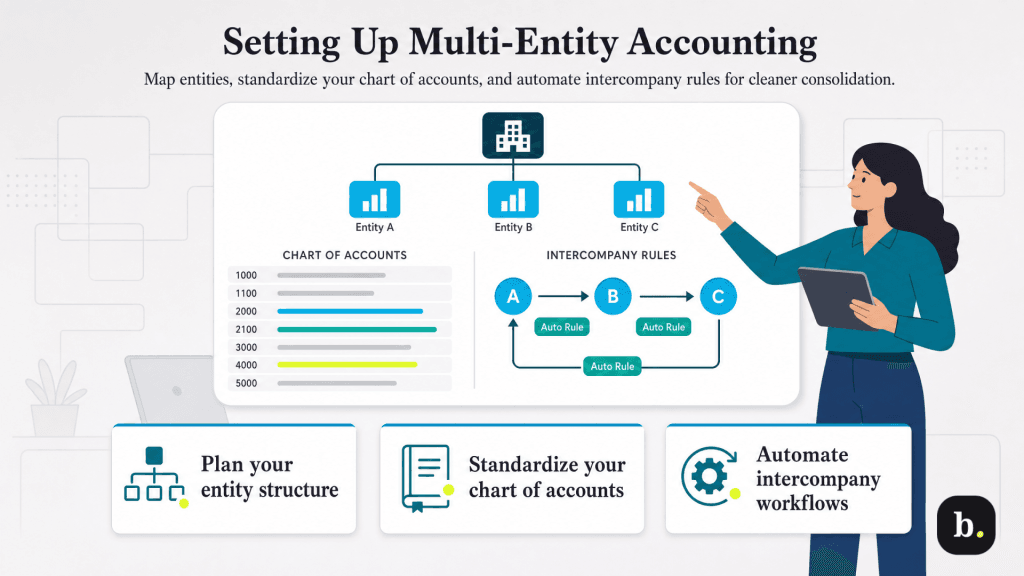
Before configuring any software, map out your legal entity structure and how it should be represented in your accounting system. Identify the parent company and all subsidiaries, determine which entities transact with each other regularly, and decide whether entities will share a common chart of accounts or maintain entity-specific variations.
This planning phase is critical because the decisions you make here affect every downstream process, from how intercompany transactions are recorded to how consolidated reports are structured. Most ERP implementations, including Intuit Enterprise Suite, assign a dedicated customer success manager to guide setup, and the platform supports adding new entities as the organization grows without requiring a system overhaul.
A well-designed chart of accounts is the foundation of effective multi-entity reporting. The most common approach is to establish a shared, parent-level chart of accounts that ensures consistency across all entities, then add entity-specific accounts only where genuinely needed. For example, you can track revenue streams that exist in one subsidiary but not others.
Intuit Enterprise Suite provides a shared chart of accounts with mapping rules that propagate changes across all entities automatically. The platform also supports up to 20 custom dimensions with unlimited values, allowing teams to tag transactions by department, region, project, or any other attribute without cluttering the chart of accounts itself. This dimensional approach keeps the account structure clean while enabling granular analysis.
Define your most common intercompany transaction types upfront, like management fees, shared service allocations and inventory transfers. Configure automation rules for each. Establish approval workflows so intercompany charges are reviewed before they’re posted, and document everything for audit purposes.
Clear policies around intercompany pricing are especially important. Transfer pricing between entities must be defensible, particularly for international subsidiaries where tax authorities scrutinize related-party transactions. Setting up these rules during implementation, rather than retrofitting them later, saves significant time and reduces compliance risk.
