Business.com aims to help business owners make informed decisions to support and grow their companies. We research and recommend products and services suitable for various business types, investing thousands of hours each year in this process.
As a business, we need to generate revenue to sustain our content. We have financial relationships with some companies we cover, earning commissions when readers purchase from our partners or share information about their needs. These relationships do not dictate our advice and recommendations. Our editorial team independently evaluates and recommends products and services based on their research and expertise. Learn more about our process and partners here.
Hiring internationally comes with logistics, compliance and tax challenges — but working with an EOR can make all that a lot easier to manage.


This article is sponsored by Justworks.
The best person for the job might live in Lisbon, Manila or São Paulo, and, for a growing number of small businesses, hiring those employees is no longer a hypothetical. Remote-first teams now recruit from talent pools that stretch well beyond their home country, competing for skilled people wherever they happen to be.
You have found the right candidate abroad, sent the offer and gotten a yes. Now, you have to navigate a foreign country’s labor laws, payroll system, tax authorities and benefits expectations. None of it works the way it does at home, and getting it wrong carries real legal and financial risk.
This is the problem an employer of record (EOR) solves. An EOR lets you hire full-time employees in countries where you have no legal entity of your own, handling compliance, payroll and benefits on your behalf. Below, we walk through when an EOR makes sense, how it compares to setting up your own entity and what to watch out for, using Justworks as a running example of how the model works in practice.
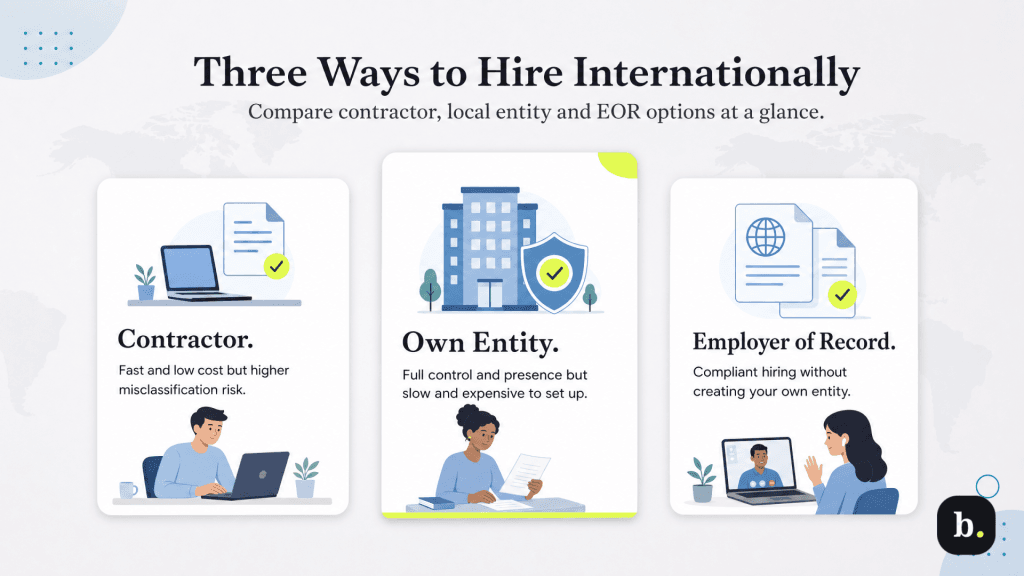
When a small business decides to hire someone in another country, there are broadly three paths available. Each comes with a different balance of speed, cost, control and risk.
Hiring an independent contractor is often the first step small businesses take because it is fast, flexible and requires little infrastructure. A contractor receives the gross amount you agree on and is responsible for filing and remitting their own taxes locally.
The catch is misclassification risk. If a worker you have labeled a contractor actually functions like an employee, working set hours, using your tools and taking direction from you, tax authorities can reclassify the relationship. Businesses found to have misclassified workers can owe back taxes and accrued benefits, plus fines and interest. As Justworks notes in its guide to global hiring, that long-term exposure is exactly what pushes many companies past the contractor stage.
Establishing a legal entity in the target country gives you full control and a permanent local presence. It is also the slowest and most expensive option. Opening a business bank account alone can take several months in many countries, and without local legal expertise, compliance and bureaucratic hurdles can stretch the process further.
Beyond setup, you take on ongoing compliance for local tax filings, payroll, benefits administration and labor-law updates, all of which become your responsibility as the employer. Depending on the country, standing up and maintaining an entity can cost tens of thousands of dollars, or considerably more, before you account for the internal HR and legal support it requires.
An EOR is the middle path. The EOR already owns a legal entity in the country and acts as the official employer of your hire, while the person works directly for you and follows your direction day to day. You get the speed and flexibility of the contractor route with the compliance and employee experience of running your own entity, minus the time-consuming legal setup.
Both an EOR and your own entity let you employ people compliantly. Choosing between them comes down to a few practical factors.
A common pattern is to start with an EOR to enter a market quickly, then build a local entity later if headcount and commitment grow enough to warrant it. The two approaches are not mutually exclusive; many companies move from one to the other as their needs evolve.
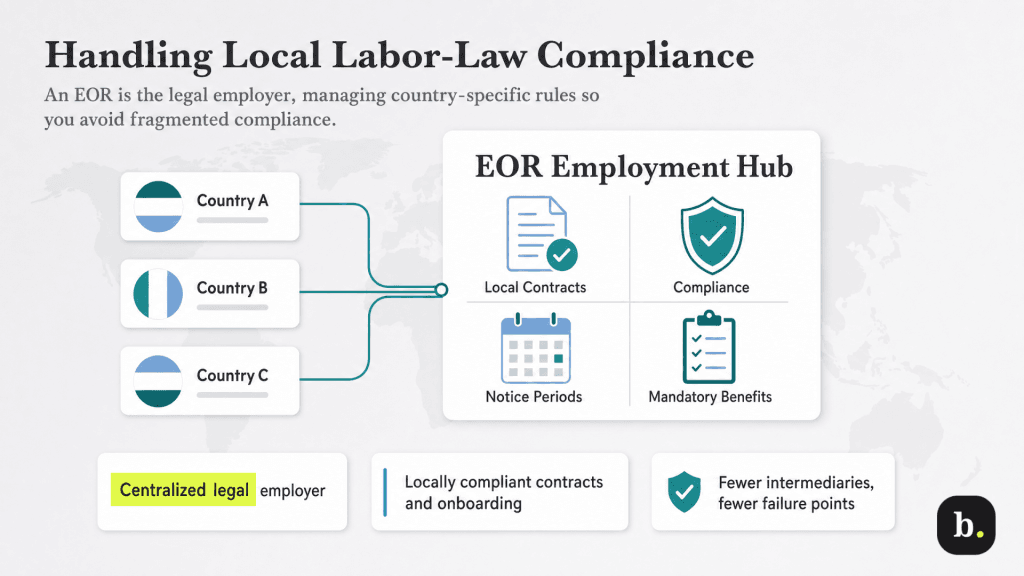
Every country writes its own rules for employment, and they vary far more than most first-time international employers expect. Mandatory benefits, minimum notice periods, termination procedures, probationary terms and required contract clauses all differ by jurisdiction, and many are not optional or negotiable.
This is the core of what an EOR absorbs. Because the EOR is the legal employer, it drafts locally compliant employment contracts, onboards the employee under local rules and keeps up with regulatory changes so you don’t have to. With Justworks, for example, the company acts as the local entity and directly employs the individual, which means the legal and compliance responsibility for that employment sits with one party rather than being scattered across your team and a patchwork of local advisors.
It is worth understanding how different EOR providers are structured, because it affects compliance depth. Some providers route employment through third-party intermediaries in each country; others, such as Justworks, operate through their own owned entities and directly employ your hires. The owned-entity model reduces the number of middlemen between you and your employee, which can mean fewer points of failure when something needs to be fixed.
Running payroll in another country means more than converting a salary into local currency. As the employer, an EOR collects and remits local taxes on both the employer and employee side, handles statutory contributions, and pays employees on the local schedule and in their local currency.
How a provider delivers that payroll matters. Justworks frames the choice as falling into two broad categories: partner- or vendor-based models, where much of the work is outsourced to localized third parties, and entity-owned or direct models, where the provider employs and pays workers through its own entities. The direct approach, the company argues, reduces the number of intermediaries and the delays and errors that can come with them.
Cost predictability is part of this picture too. Before committing to a hire, you can estimate total employment costs by country using Justworks’ International Cost Calculator, which provides a breakdown of what an employee will actually cost once local taxes and contributions are included, so the numbers do not surprise you after the fact.
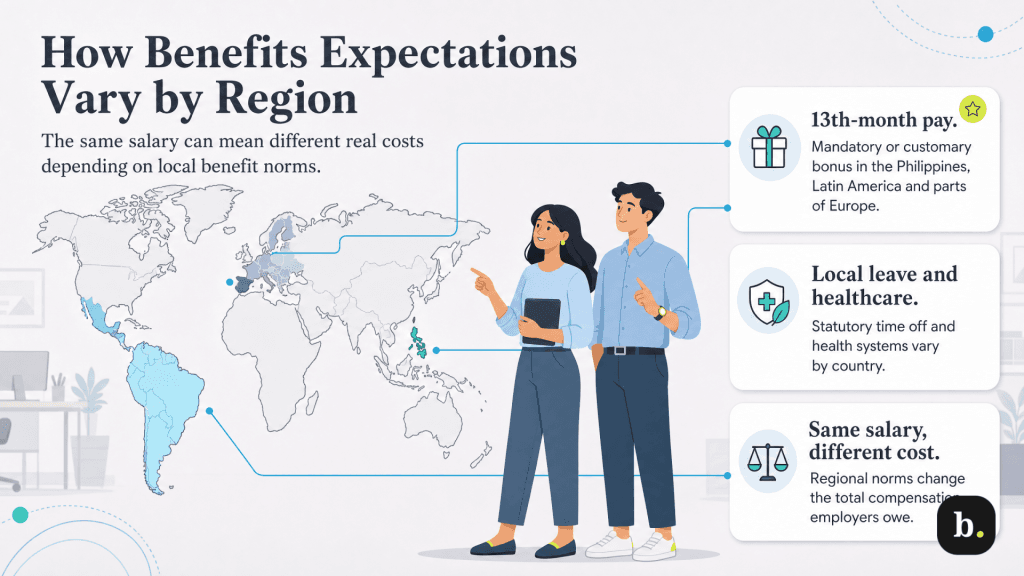
Benefits are where local norms become most visible, and where the gap between “legally required” and “competitive” matters most. Some benefits are statutory and non-negotiable; others are customary perks that strong candidates will nonetheless expect. The Philippines is a useful illustration of how layered this can get.
The 13th-month concept extends well beyond the Philippines. As Justworks explains in its overview of 13th-month pay, the bonus is deeply embedded in employment culture across Latin America, where it is known as the aguinaldo, and appears in parts of Europe as well.
In some countries it is strictly mandatory; in others it is customary. Spain even allows employers to spread the payment across the year if the employment contract specifies it. The practical takeaway for an employer is that the same headline salary carries different real costs and obligations depending on where your employee sits, which is precisely the kind of local knowledge an EOR is built to supply.
Once you have decided an EOR is the right path, the providers themselves vary in ways that matter. A few criteria are worth weighing include:
Global talent is genuinely within reach for small businesses, without the cost and multi-month timeline of establishing a foreign entity. An EOR handles the compliance, payroll and benefits machinery that makes international employment work, letting you focus on the people you are hiring rather than the bureaucracy around them. If you are weighing your first international hire, an EOR may be the right choice to streamline management and make sure your business stays compliant with local laws and tax requirements.
