Business.com aims to help business owners make informed decisions to support and grow their companies. We research and recommend products and services suitable for various business types, investing thousands of hours each year in this process.
As a business, we need to generate revenue to sustain our content. We have financial relationships with some companies we cover, earning commissions when readers purchase from our partners or share information about their needs. These relationships do not dictate our advice and recommendations. Our editorial team independently evaluates and recommends products and services based on their research and expertise. Learn more about our process and partners here.
Hiring on a Timeline: How Long Should Each Step Actually Take?
Written by: Adam Uzialko, Senior EditorUpdated Dec 17, 2025
Editor Verified:
Editor Verified
A business.com editor verified this analysis to ensure it meets our standards for accuracy, expertise and integrity.
Business.com earns commissions from some listed providers. Editorial Guidelines.
Table of Contents
In hiring, speed is strategy. Top candidates remain available for a short time before accepting offers elsewhere, yet the average time-to-hire across industries has reached 44 days, according to research conducted by AMS and the Josh Bersin Co. This mismatch between how long companies take to hire and how long the best candidates stay on the market creates a fundamental problem: by the time many employers make their decision, the candidate they want most has already moved on.
This article is sponsored by ZipRecruiter.
Understanding realistic benchmarks for each stage of your hiring process helps you identify where delays occur and where you’re performing well. This data-driven guide breaks down how long each step should actually take, explains what causes common bottlenecks and shows how to maintain both speed and quality throughout your hiring process.
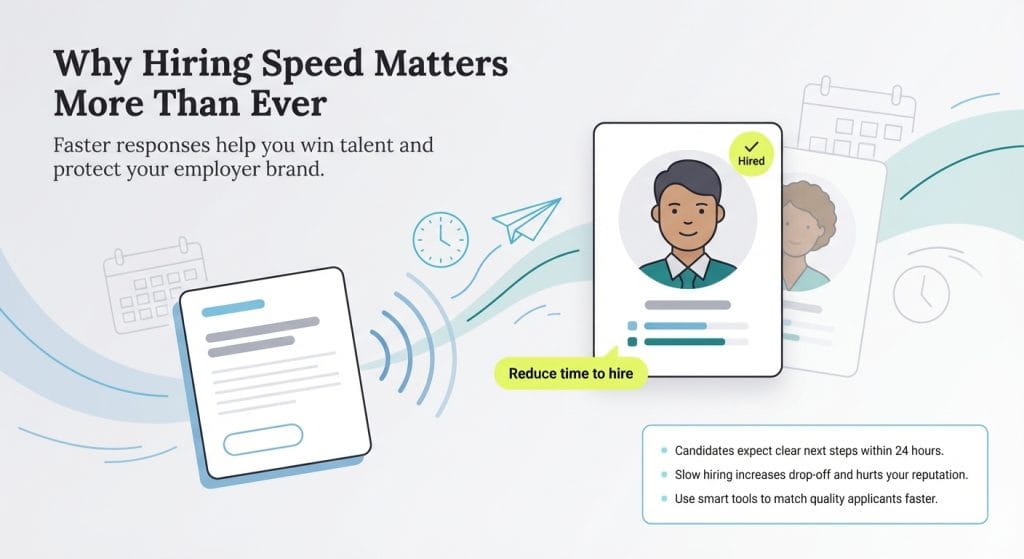
Why hiring speed matters more than ever
Before diving into stage-by-stage timelines, it’s important to understand why speed has become so critical to hiring success. According to CareerArc research, 69% of candidates want the application process to proceed quickly and see employer response time improved. When companies move slowly, they don’t just risk losing candidates to competitors — they also damage their employer brand.
The stakes go beyond just filling an open position; slow hiring affects your reputation and your ability to attract future talent. A 2023 job seeker survey by iHire found that 66.1% of candidates expect to hear back from employers in less than 24 hours. When they don’t receive timely communication, 38.7% say they’d be less likely to interact with that brand in the future, even as customers.
The challenge is balancing speed with thoroughness. For employers, especially small businesses, it’s essential to move quickly to fill vacant positions without sacrificing the careful evaluation that prevents bad hires. The solution lies in understanding realistic timelines for each stage and implementing systems that eliminate unnecessary delays.
Tip
Improve your chances of finding quality candidates quickly by posting your job on ZipRecruiter. We especially like ZipRecruiter because of its AI-powered matching algorithms, which use billions of data points to match top talent with your open roles. The result is more quality applications in a shorter period of time, helping you reduce your time to hire.
Hiring Timeline at a Glance
Stage
Aggressive Timeline (Entry-level/High-urgency)
Standard Timeline (Most Professional Roles)
Extended Timeline (Senior/Specialized Roles)
1. Job Posting to First Applications
1 to 2 days
2 to 3 days
3 to 5 days
2. Application Review & Response
1 to 2 days
2 to 3 days
3 to 5 days
3. Phone Screenings
3 to 5 days
5 to 7 days
5 to 10 days
4. Interview Rounds
7 to 10 days
10 to 14 days
14 to 21 days
5. Reference & Background Checks
3 to 5 days
5 to 7 days
7 to 10 days
6. Offer Preparation & Negotiation
2 to 3 days
4 to 5 days
5 to 7 days
TOTAL TIME TO HIRE*
21 to 28 days
30 to 40 days
45 to 60 days
*Expect about 2 to 4 weeks from the time an offer is accepted to the time a new employee begins working in their new role.
Stage 1: Job posting to first application
Target duration: 1 to 3 days
The clock starts ticking the moment your job posting goes live. In competitive markets, you should see your first applications within 24 to 48 hours if your posting is well-written and placed on the right platforms. If several days pass without applications, it signals potential problems with your job description, salary offering or where you’re advertising.
Jobs posted on high-traffic platforms like ZipRecruiter typically see applications arrive quickly because the platform’s AI matching technology uses billions of data points to match candidates with jobs. This means employers don’t have to wait for candidates to stumble across their listing, the system brings the job directly to relevant job seekers.
The fastest-moving industries see even quicker responses. Retail, consumer services and hospitality positions often receive applications within hours of posting because these sectors have large candidate pools and frequently hire for immediate needs.
What causes delays at this stage?
Vague or poorly written job descriptions that don’t attract attention
Posting only on low-traffic job boards
Failing to leverage your network or employee referrals
How to accelerate this stage
Invest time in crafting clear, compelling job descriptions that include salary ranges and key benefits. Use hiring platforms that actively distribute your posting to qualified candidates rather than waiting for passive discovery.
Tip
If you’ve never hired an employee before, check out our first time hiring guide, which will walk you through the steps you should take when bringing on your first employee.
Stage 2: Initial application review and response
Target duration: 24 to 48 hours
Once applications start arriving, the pressure is on to review and respond quickly. Best-practice employers respond to applicants within 24 to 48 hours, even if it’s just an automated acknowledgment that their application was received and is under review.
This stage often becomes a bottleneck because reviewing dozens or hundreds of applications is time-consuming. The average corporate job posting receives 250 applications. Manually screening this volume while maintaining speed is nearly impossible without help.
Applicant tracking systems solve this problem by automating initial screening based on your specified criteria. These platforms can instantly filter applications for must-have qualifications, rank candidates by how closely they match your requirements and even send automated responses to keep candidates engaged while you conduct deeper reviews.
ZipRecruiter’s smart matching feature goes further by scoring candidates based on their alignment with your job requirements before they even apply, presenting you with the most qualified candidates first. This means less time sorting through mismatched applications and more time evaluating genuinely promising candidates.
What causes delays at this stage?
Manual review of every application without prioritization
Unclear decision-making criteria
Hiring managers who aren’t checking applications regularly
Lack of automated response systems
How to accelerate this stage
Use applicant tracking systems with automated screening and candidate ranking. Set calendar reminders to review new applications at least once daily during active hiring. Have clear, predetermined criteria for what moves a candidate forward versus what disqualifies them.
Stage 3: Phone screenings
Target duration: 3 to 5 days to schedule (15 to 20 minutes per call)
After identifying promising candidates from your application pool, phone screen interviews serve as your next filter. Plan to schedule phone screens within three to five days of identifying strong candidates, with each call lasting 15 to 20 minutes.
The scheduling process itself can consume valuable time. Back-and-forth emails to find mutually available time slots often take several days, especially when hiring managers have packed calendars. By the time you connect with a candidate a week or more after they applied, they may have already interviewed elsewhere or lost interest in your position.
Automation dramatically reduces scheduling friction. Platforms with integrated scheduling tools allow candidates to book time slots directly from available openings in your calendar, eliminating the email ping-pong. Some systems even conduct preliminary screening questions automatically, so you only spend time on calls with candidates who meet your basic requirements.
What causes delays at this stage?
Manual scheduling via email
Limited calendar availability
Conducting screens with unqualified candidates
No predetermined script or criteria
How to accelerate this stage
Use scheduling automation tools. Block dedicated time slots on your calendar specifically for phone screens. Prepare a consistent script that covers must-know information in under 20 minutes. Only screen candidates who clearly meet your minimum requirements.
Stage 4: Interview rounds
Target duration: 7 to 14 days total
The interview phase typically accounts for the longest portion of your hiring timeline.
How many interview rounds do you actually need? Each additional round adds at least three to five days to your timeline when accounting for scheduling, conducting the interview, debriefing and deciding whether to advance the candidate. So, it’s important to balance thoroughness with efficiency.
The key is making each round count. First-round interviews should confirm skills and cultural fit while giving candidates a clear picture of the role. Second rounds might involve meeting the team or completing a skills assessment. Final interviews with senior leadership should focus on mutual commitment rather than redundant evaluation.
What causes delays at this stage?
Too many interview rounds
Stakeholders with limited availability
Lack of clarity about what each round should accomplish
No structured decision-making process
Scheduling interviews individually rather than in batches
How to accelerate this stage
Limit interviews to two or three rounds for most positions. Have hiring committee members block dedicated interview times each week during active hiring. Make decisions about advancing candidates within 24 hours of each interview. Consider panel interviews to gather multiple perspectives in a single session.
Stage 5: Reference checks and background verification
Target duration: 3 to 7 days
Once you’ve identified your top candidate, you’ll need to verify their background and check references before making an offer. Reference checks typically take three to five days, while background checks can take anywhere from three days to two weeks depending on what you’re verifying.
The timing here depends largely on how responsive references are and what level of background screening you require. Basic criminal background checks usually return within a few days, but more extensive employment verification checks that verify education, employment history or professional licenses take longer.
You can accelerate this stage by starting it earlier. Some employers begin preliminary reference checks after first-round interviews for strong candidates, so they have this information ready when it’s time to make an offer. Just be transparent with candidates about your process and ensure you have their permission before contacting references.
What causes delays at this stage?
Waiting until after final interviews to start checks
References who don’t respond promptly
Using slow background check services
Requiring more extensive checks than the position warrants
How to accelerate this stage
Use reputable background check services with fast turnaround times. Start reference checks as soon as you’re seriously considering a candidate. Have backup references listed in case primary contacts aren’t responsive. Tailor the depth of background checks to the position’s requirements.
Stage 6: Offer preparation and negotiation
Target duration: 2 to 5 days
You’ve completed your evaluation and you’re ready to make an offer. The offer stage should take two to five days maximum — long enough to prepare a thorough, attractive offer but short enough that you don’t lose the candidate to another employer.
This stage includes preparing the written offer, getting necessary approvals, presenting it to the candidate, and negotiating any terms. While some negotiation is normal and healthy, drawn-out back-and-forth can cost you candidates. Be prepared to move quickly while still being fair and flexible.
Remember that by this point, your top candidate has likely been interviewing elsewhere. The average offer acceptance rate is 73%, meaning about one in four candidates who reach this stage will decline. Speed matters, but so does presenting a compelling package that makes acceptance an easy decision.
What causes delays at this stage?
Complex approval processes
Unclear salary ranges or compensation authority
Slow creation of offer documents
Unprepared for common negotiation points
How to accelerate this stage
Have offer letter templates ready. Know your salary range and negotiation flexibility before reaching this stage. Streamline internal approvals by getting preliminary budget sign-off earlier. Present offers verbally first, then follow up with written documentation.
Stage 7: Offer acceptance to start date
Target duration: 2 to 4 weeks
After a candidate accepts your offer, you’ll need to allow time for them to give notice at their current employer and prepare to start. Standard notice periods range from two to four weeks, though executive positions may require longer transitions.
While you can’t compress this timeline without asking candidates to leave their current employers unprofessionally, you can use this period productively. Complete any remaining paperwork, set up equipment and accounts and begin preliminary onboarding communication. Some employers provide access to internal resources so new hires can start learning about the company before their official start date.
Industry-specific benchmarks to consider
Time-to-hire varies significantly by industry based on talent availability, role complexity, and market conditions. Understanding your industry’s norms helps you set realistic targets:
Fastest hiring (14 to 25 days):
Retail and consumer services
Hospitality and food service
Cleaning services
Transportation
Moderate hiring (30 to 40 days):
Technology and media
Sales and marketing
Administrative roles
Healthcare (non-specialized)
Longer hiring (45 to 70+ days):
Energy and defense (67+ days)
Professional services (47 days)
Investment banking (21-60+ days depending on role)
Executive positions (90-120+ days)
These variations reflect different market dynamics. Retail moves quickly because roles are numerous and candidate pools are large. Energy and defense take longer because positions require specialized skills and security clearances. Executive searches extend because the talent pool is small and evaluation is extensive.
Bottom Line
The companies that win the war for talent aren't necessarily those with the biggest budgets or most prestigious brands. They're the ones who recognize that in a market where top candidates won’t remain available forever, and every day of unnecessary delay is a competitive disadvantage. By understanding realistic timelines, eliminating bottlenecks, and leveraging technology effectively, you can find employees faster while maintaining the quality of evaluation that leads to successful, long-term hires.
Adam Uzialko, the accomplished senior editor at Business News Daily, brings a wealth of experience that extends beyond traditional writing and editing roles. With a robust background as co-founder and managing editor of a digital marketing venture, his insights are steeped in the practicalities of small business management.
At business.com, Adam contributes to our digital marketing coverage, providing guidance on everything from measuring campaign ROI to conducting a marketing analysis to using retargeting to boost conversions.
Since 2015, Adam has also meticulously evaluated a myriad of small business solutions, including document management services and email and text message marketing software. His approach is hands-on; he not only tests the products firsthand but also engages in user interviews and direct dialogues with the companies behind them. Adam's expertise spans content strategy, editorial direction and adept team management, ensuring that his work resonates with entrepreneurs navigating the dynamic landscape of online commerce.