Business.com aims to help business owners make informed decisions to support and grow their companies. We research and recommend products and services suitable for various business types, investing thousands of hours each year in this process.
As a business, we need to generate revenue to sustain our content. We have financial relationships with some companies we cover, earning commissions when readers purchase from our partners or share information about their needs. These relationships do not dictate our advice and recommendations. Our editorial team independently evaluates and recommends products and services based on their research and expertise. Learn more about our process and partners here.
Building a habit of reviewing financial statements like your profit and loss, cash flow, and balance sheet reports can help you guide your business to stronger fiscal health.


This article is sponsored by Intuit
Your sales are climbing, your team is busy and your business looks successful. So why does covering payroll still feel tight? The answer may already be sitting in your accounting software, in financial reports you rarely open.
Learning to read those reports can help you spot underpriced work, slow customer payments and expansion plans that need more funding. You don’t need a finance background to start. A profit and loss statement, balance sheet and cash flow statement give you three perspectives on your business, and a clearer basis for deciding what to do next.
Each financial statement answers a different question. The U.S. Securities and Exchange Commission explains that income statements and cash flow statements cover activity over a period, while balance sheets capture financial position at a specific point in time.
Statement | Question it answers | Time frame |
|---|---|---|
Profit and loss statement (P&L), also called an income statement | Is your business profitable? | A period, such as a month or quarter |
Balance sheet | What does your business own and owe? | A specific date |
Cash flow statement | Where did cash come from, and where did it go? | A period, such as a month or quarter |
Before interpreting the numbers, check the accounting basis, which will be either cash or accrual. Cash accounting generally records revenue when payment arrives and expenses when payment is made. Accrual accounting records revenue when earned and expenses when incurred, so a sale can appear before the customer pays. The examples below use accrual accounting.
Compare completed periods using a consistent accounting basis. Look at the previous month, the same period last year and your budget, where available. A seasonal dip means something different from a decline during your busiest months.
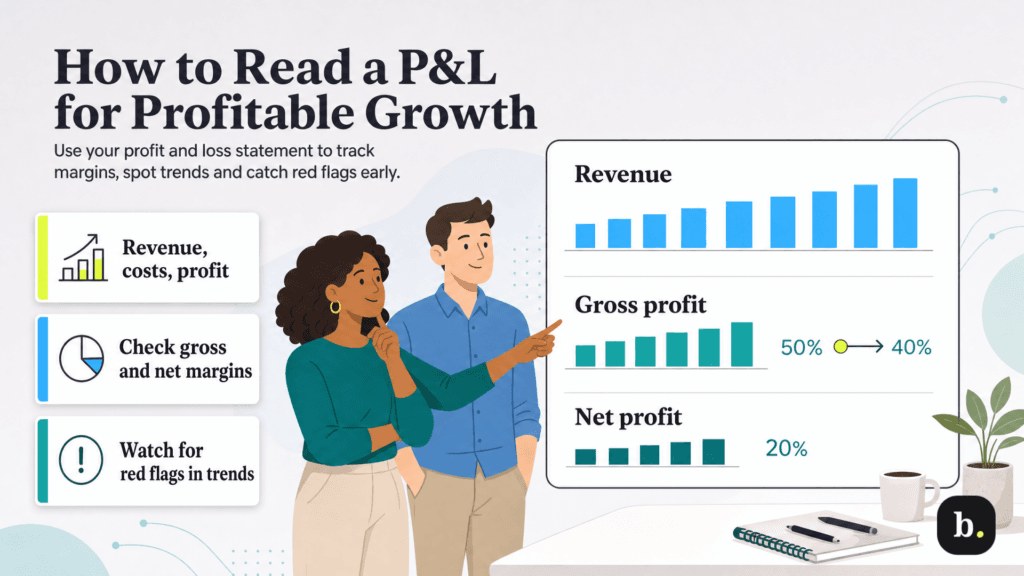
A profit and loss statement shows revenue, costs and the resulting profit or loss. Start with revenue after returns and discounts, then work down through the costs of delivering your products or services and the expenses of running the business.
Gross profit is revenue minus cost of goods sold or cost of sales. Operating expenses, such as office rent and administrative salaries, come next. Net profit reflects the expenses and other income recorded in your books, including interest and business income taxes where applicable. Some owners’ income taxes are paid personally and won’t appear as business expenses.
Margins put profit in context. As Intuit’s glossary explains, gross profit margin is gross profit divided by revenue, expressed as a percentage. Net profit margin uses net profit instead. A 10 percent net margin means the business reports $10 in profit for every $100 in revenue.
Healthy signals include stable or improving margins and recurring sales that generate enough profit to support operating expenses. Growing overhead can be reasonable if you’re investing in capacity, but check whether the expected revenue is materializing.
Watch for these warning signs:
Consider a hypothetical business, which we’ll call Maple Design. In April, the business earned $50,000 in revenue and incurred $25,000 in direct project costs, leaving $25,000 in gross profit and a 50 percent gross margin. In May, revenue reached $60,000, but direct costs rose to $36,000. Gross profit falls to $24,000 and the margin drops to 40 percent.
Maple sold more but retained less gross profit to cover overhead. The owner should investigate project pricing, subcontractor costs and rework before chasing more volume. There’s no universal healthy margin: Your business model, industry and stage of growth all matter.
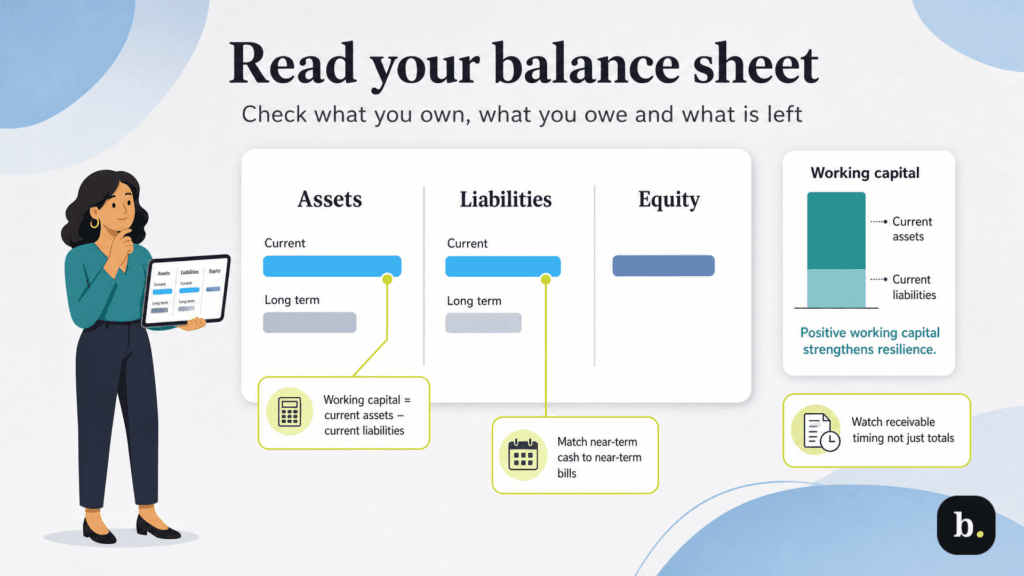
The balance sheet organizes assets, liabilities and equity. Assets include cash, equipment, inventory and accounts receivable (the money customers owe you.) Liabilities include supplier bills, loans and other obligations. Equity is the residual interest after subtracting liabilities from assets; it isn’t a separate pool of cash available to spend.
Pay particular attention to current assets and current liabilities, generally those expected to be used, collected or settled within a year or the normal operating cycle. Compare resources available in that window with obligations coming due.
Working capital is current assets minus current liabilities. For example, $80,000 in current assets and $55,000 in current liabilities leaves $25,000 in working capital. But the composition matters: $25,000 tied up in slow-selling inventory offers less immediate flexibility than $25,000 in cash.
A reassuring balance sheet has accessible resources to cover near-term obligations, receivables customers pay on schedule and debt the business can realistically service. Check payment timing as well as totals; bills due next week can’t be paid with invoices you expect to collect next month.
Investigate these patterns:
For Maple Design, a rising receivables balance could reflect a busy month or customers taking longer to pay. An accounts receivable aging report helps distinguish the two. That difference determines whether the owner should simply plan for agreed payment terms or intervene with overdue customers.
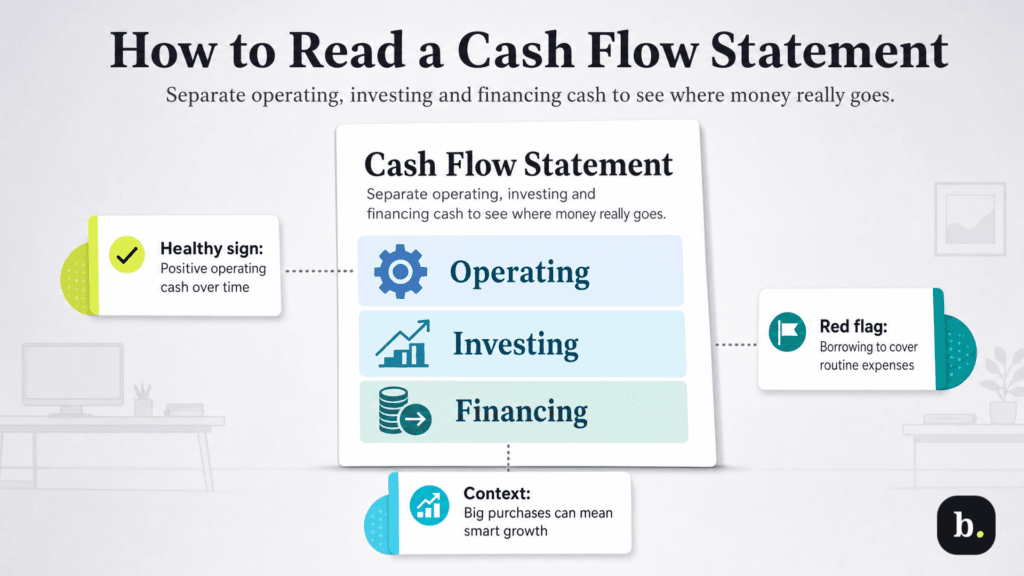
The cash flow statement explains the change between beginning and ending cash balances. It is made up of three sections:
Loan proceeds increase cash without increasing sales revenue. Likewise, purchasing long-term equipment uses cash, but its cost may be recognized as an expense over time through depreciation. These differences help explain why profit and the change in your bank balance rarely match exactly.
Positive operating cash flow over time is an encouraging sign that everyday operations generate cash. Assess it alongside seasonality, payment obligations and upcoming investments. One strong month doesn’t establish a lasting pattern.
Warning signs include persistent operating cash outflows, repeated borrowing to cover routine expenses and a rising cash balance driven mainly by new loans. Check the operating section before concluding that more cash means stronger performance.
Negative investing cash flow needs context. Buying equipment for a planned expansion may be sensible if the business can fund the purchase and still meet its obligations. Conversely, positive cash flow from selling essential equipment may warrant questions about why the sale was necessary.
Let’s return to Maple Design’s May results. Assume its $60,000 in revenue includes $20,000 in unpaid invoices, all $36,000 in direct costs and $14,000 in operating expenses were paid, and it began May with no receivables. For this simplified illustration, assume no other transactions, taxes, noncash expenses or changes in working capital.
Its P&L shows $10,000 in net profit. Its balance sheet shows $20,000 in receivables at month-end. Its cash flow statement shows $40,000 collected and $50,000 paid out, producing a $10,000 operating cash outflow.
Each report is telling the truth. Together, they show that Maple is profitable but used cash because part of its revenue hasn’t been collected. Combined with its declining gross margin, that’s a reason to examine both pricing and payment timing before adding payroll.
The next step depends on what the owner finds. Overdue invoices call for collection follow-up. Long payment terms may justify discussing deposits or milestone billing on future projects. Underpriced work calls for adjusting quotes. A forecast can then show whether those changes would provide enough cash for a hire.
Use the same approach with your own reports: Identify a pattern, investigate its cause and test the proposed response against upcoming obligations. Our guide to cash flow problems explores additional ways to address recurring shortfalls.
Getting these reports shouldn’t require assembling a new spreadsheet every month. QuickBooks Online, for example, generates financial statements from the transactions recorded in your books. Intuit’s reporting documentation explains how to run reports and compare periods to identify changes. Available reporting features vary by subscription.
Set aside time each month to review completed statements. Start with changes in revenue and margins, then examine receivables, near-term liabilities and operating cash flow. Choose a concrete action and check its effect at the next review. Monitor cash more frequently when reserves are tight or a large payment is approaching.
Bring unexplained balances or unusual trends to your accountant before making a major commitment. With that habit in place, your statements can help you decide which work to pursue, when to invest and how much growth your business can afford.
