Business.com aims to help business owners make informed decisions to support and grow their companies. We research and recommend products and services suitable for various business types, investing thousands of hours each year in this process.
As a business, we need to generate revenue to sustain our content. We have financial relationships with some companies we cover, earning commissions when readers purchase from our partners or share information about their needs. These relationships do not dictate our advice and recommendations. Our editorial team independently evaluates and recommends products and services based on their research and expertise. Learn more about our process and partners here.
Registering your business could mean exposing your home address to the public. Fortunately, there are some steps you can take to avoid doing so.


This article is sponsored by Northwest Registered Agent
Starting a business means filling out forms, and nearly every one of them asks for an address. If you work from your kitchen table, the answer seems obvious. You type in your home address and move on.
Weeks later, the mail starts arriving. Official-looking notices demanding fees. Cold calls to a phone number you only gave the state. Letters addressed to a company you formed last month, from firms you have never heard of.
That is not a coincidence. Business formation records are public by design, and the address you put on them becomes searchable by anyone with an internet connection, including marketers, scammers and the occasional person with a grievance. Most of it is also durable: filings stay in the public archive even after you correct them.
Fortunately, this exposure is largely avoidable. Here is exactly where your home address surfaces, and what you can do about each point.
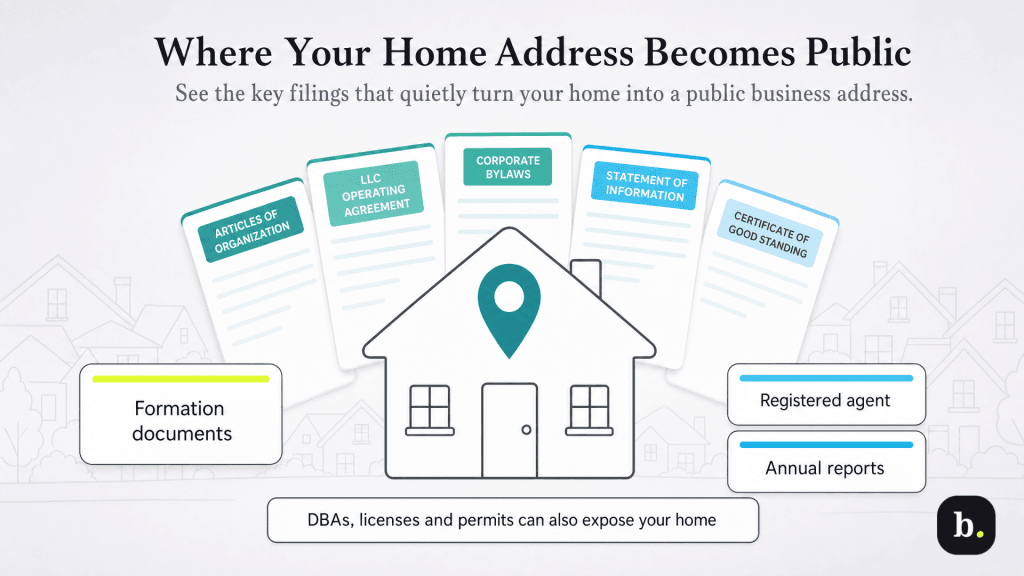
Address exposure is not a single event at formation. It happens across at least five separate filings, and each one has its own rules.
When you form an LLC or corporation, you file articles of organization or articles of incorporation with your secretary of state. That document becomes a public record the moment it is accepted, and most states publish it in a free, searchable database.
The fields vary by state, but they commonly include the principal office address, a mailing address, the organizer’s name and address, and the registered agent’s name and address. Every one of those is a chance to publish where you live, and states do not warn you about it.
Every state requires an LLC or corporation to name a registered agent (called an agent for service of process in California and New York) who can accept lawsuits and official state mail for the company.
The agent needs a physical street address in the state, staffed during normal business hours. The Idaho Secretary of State states the rule plainly: a physical street address in Idaho, no P.O. boxes. The Texas Secretary of State adds that a registered office cannot be a post office box at a commercial mail service unless that company is itself the registered agent.
Name yourself as your own agent and that street address is your home, published alongside your company name.
In some states, businesses are required to file annual reports or statements of information, which often include an address requirement.
California LLCs, for example, must file a Statement of Information (Form LLC-12) within 90 days of registering and every two years after that. The form requires the name and address of each manager, or of each member if no managers have been appointed, and at least one has to be listed. P.O. boxes are not accepted for the principal office.
All of this information is public. An owner who carefully kept their address off the articles of organization can hand it over 90 days later without realizing what the form is.
Sole proprietors often assume none of this applies to them. In practice, the rules here can be stricter than the ones for LLCs.
If you operate under any name that is not your own surname, most states require a DBA or fictitious business name statement. In California these are filed at the county level and must list the registrant’s residence address. Sacramento County spells it out: state law requires the residential address of the registrant, and post office boxes, postal mailboxes and mail service addresses are not permitted for either the residential or the business address.
Then it gets published. The statement has to run once a week for four consecutive weeks in an adjudicated newspaper, and Santa Clara County confirms that everything on the statement, residence address included, is what runs in print.
City and county licensing databases are frequently searchable as well. Home occupation permits are the sharpest version of the problem, since the permit exists specifically to authorize business activity at your residence and is filed under that address.
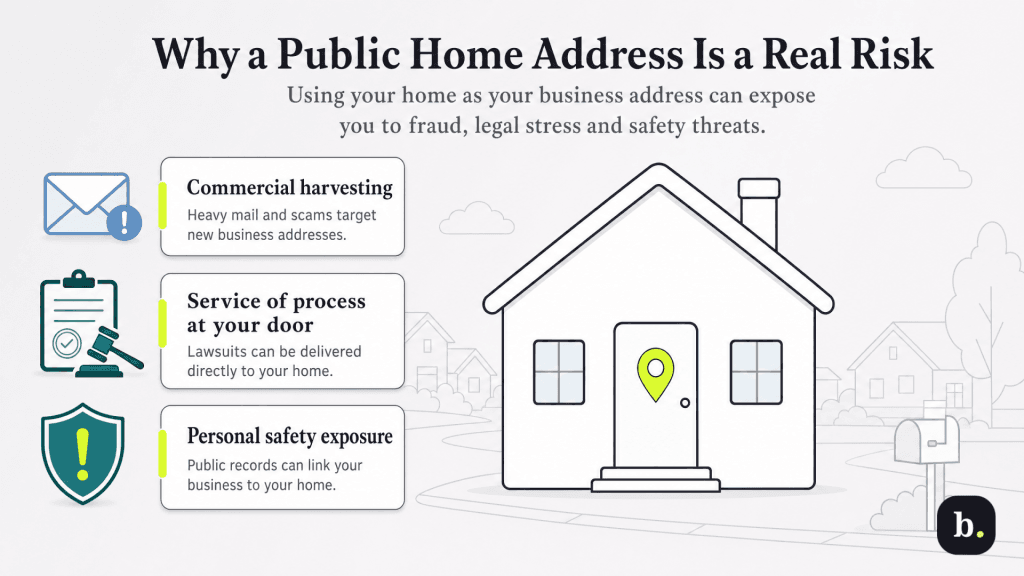
The consequences fall into three distinct categories, and they escalate.
Option | What it keeps private | What it does not cover | Best for |
|---|---|---|---|
Commercial registered agent | The registered agent line, and in many states the organizer and principal office fields | Fields where state law specifically requires a personal or residence address | Anyone forming an LLC or corporation |
Virtual business address (CMRA) | The address you give to customers, vendors, banks and your website | The registered agent designation in most states; some banks decline CMRA addresses | Owners who need a public-facing address and mail handling |
P.O. box | A general mailing address for correspondence | Registered agent and principal office fields in most states; carrier deliveries | Low-cost mail separation only |
Coworking or leased space | A genuine commercial street address for most filing fields | Mail handling, unless the operator offers it as a service | Owners who also want workspace |
This is the most direct fix. You hire a company with a staffed office in your state, and its address goes on the registered agent line instead of yours.
What separates providers is how far the substitution extends. Some swap in their address on the agent line alone and leave your home address sitting on the principal office, organizer or mailing fields. Others apply it to every field the state permits.
Northwest Registered Agent, for example, built its service around the broader approach, which it calls Privacy by Default. Its stated policy is that if it can put its address on a document instead of yours, it does, and that if a field requesting a name or address is optional, it leaves the field blank. Because the company submits the filing itself, the state also receives its payment and connection details rather than yours.
Whichever provider you choose, ask one specific question before you sign up: on my state’s forms, which fields will carry your address and which will carry mine? A provider that cannot answer that clearly is not offering much privacy.
A virtual business address gives you a real commercial street address for mail, banking, your website and your Google Business Profile. Providers operate as commercial mail receiving agencies, which the U.S. Postal Service regulates: you complete PS Form 1583, authorizing the agency to accept mail on your behalf, and the form requires identification and notarization.
Two caveats. These addresses carry a private mailbox designator, and some banks and lenders decline them when you open an account. Most states also will not accept one as a registered agent address.
A P.O. box is the cheapest option and works for general correspondence. It will not serve as a registered agent address anywhere, most states reject it for the principal office field, and it cannot receive deliveries from private carriers. Treat it as mail separation rather than privacy protection.
A coworking membership or small leased suite gives you a genuine commercial street address that satisfies most filing fields. Confirm mail handling before you rely on it, though, since not every operator accepts mail on members’ behalf, and some will not sign the postal paperwork.
No service can override a statute, and a few states write personal disclosure directly into the form.
Connecticut is the clearest example. Its Certificate of Organization requires the name, title, business address and residence address of at least one member or manager. Hiring an agent does not change that requirement. California’s biennial Statement of Information similarly requires manager or member addresses, though it asks only for an address rather than specifically a residence, which leaves more room to use a commercial one. The distinction is worth checking on your own state’s form rather than assuming.
The second limitation is self-inflicted. Owners hire an agent, feel covered and then list their home as the principal office, publish it in a website footer, attach it to a Google Business Profile or print it on invoices. Privacy on the state filing does not survive that.
One myth is also worth retiring. Beneficial ownership reporting under the Corporate Transparency Act is often confused with public disclosure, but that database was never public. And under an interim final rule issued in March 2025, FinCEN exempted all entities created in the United States from beneficial ownership reporting entirely. Only foreign entities registered to do business in a U.S. state still file. Whatever your privacy plan is, that rule is not part of it.
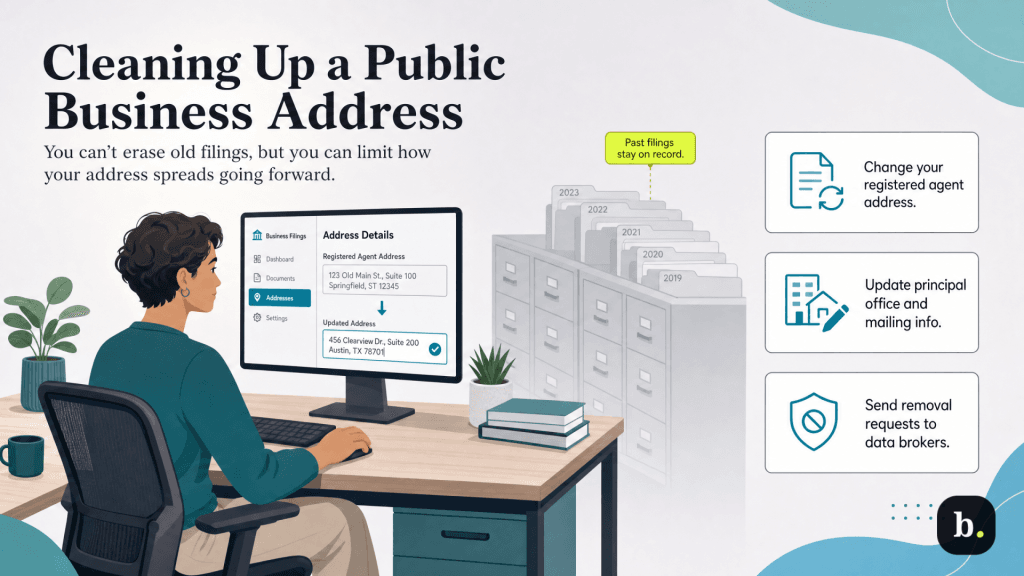
If your address is already out there, you can reduce the exposure, though not erase it. Work through the filings in order:
Set expectations honestly here. Prior filings remain in the state archive, and anyone who requests the historical document will still see the old address. What you are doing is cutting off future propagation rather than rewriting the past, which is exactly why the cheapest version of this problem is the one you prevent at formation.
