This article is sponsored by HubSpot.
Very few leads are ready to make a purchase right away; the rest require strategic nurturing before they’re ready to make a purchase decision. Unfortunately, many businesses treat lead nurturing as an afterthought. They’ll send occasional generic emails or abandon leads entirely after one or two touchpoints.
This approach wastes the investment already made in acquiring those leads. Effective nurturing keeps your company top-of-mind, builds trust, and educates prospects until they’re ready to buy. This guide shows how to design and execute multi-channel nurture strategies that systematically move prospects toward conversion.
What is lead nurturing?
Lead nurturing is the process of developing relationships with leads through targeted communication at each stage of the buyer journey. Rather than immediately pushing for a sale, nurturing provides value through educational content, relevant resources and timely engagement that addresses prospects’ evolving needs.
According to
MarketingSherpa, 79% of leads never convert without some form of nurturing.
The critical distinction between nurturing and spamming lies in relevance and value. Nurturing delivers content that helps prospects make better decisions, even if that decision isn’t immediate purchase. Spamming sends repetitive sales pitches regardless of prospect needs or readiness.
The key principle: provide value first, pitch later. Build trust and demonstrate expertise before asking for commitment.
Understanding the buyer journey
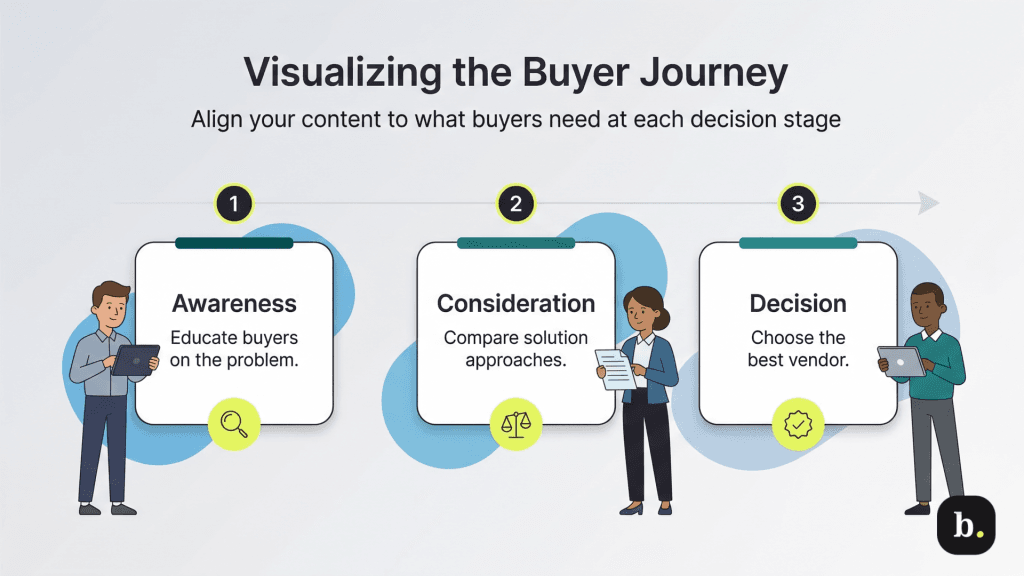
Effective nurturing aligns with how prospects actually make decisions. The buyer journey consists of three distinct stages, each requiring different content and messaging approaches.
Awareness stage
At this stage, prospects realize they have a problem but may not fully understand it or know what solutions exist.
Content focus: Educational, problem-focused material like blog posts, research reports and educational guides. Content should help prospects articulate and understand their challenge without immediately pitching specific solutions.
Nurture goal: Help them understand their challenge comprehensively and recognize why it’s worth solving.
Example messaging themes:
- “5 signs your current approach to [problem] is costing you revenue”
- “What industry benchmarks reveal about [common challenge]”
- “The hidden costs of ignoring [problem area]”
Content types: Industry research, problem-identification checklists, educational blog series, expert interviews, trend reports.
Consideration stage
Prospects now understand their problem and are evaluating different approaches to solving it. They’re comparing methodologies, not yet specific vendors.
Content focus: Comparisons between solution approaches, case studies showing different strategies, webinars exploring various options and guides that help evaluate alternatives.
Nurture goal: Position your approach as the right fit for their specific situation while remaining educational rather than promotional.
Example messaging themes:
- “Build vs. buy: Evaluating your options for [solution category]”
- “How three companies approached [problem] differently—and what happened”
- “Decision framework: Choosing the right [solution approach] for your business size”
Content types: Comparison guides, approach-level case studies (not vendor-specific yet), expert webinars, evaluation frameworks, ROI models.
Decision stage
Prospects have decided on a solution approach and are now choosing a specific vendor or product.
Content focus: Product demonstrations, free trials, ROI calculators, detailed customer stories and vendor comparisons.
Nurture goal: Demonstrate why you’re the best choice among competing vendors offering similar solutions.
Example messaging themes:
- “See how [your product] works in a live environment”
- “Customer story: How [similar company] achieved [specific results]”
- “Calculate your potential ROI with [your solution]”
Content types: Product demos, free trial access, vendor comparison sheets, detailed customer case studies, implementation timelines, pricing information.
Building nurture campaigns in HubSpot
Let’s examine how to build a nurture campaign using HubSpot, one of the top CRM systems on the market, as an example of implementing these concepts practically.
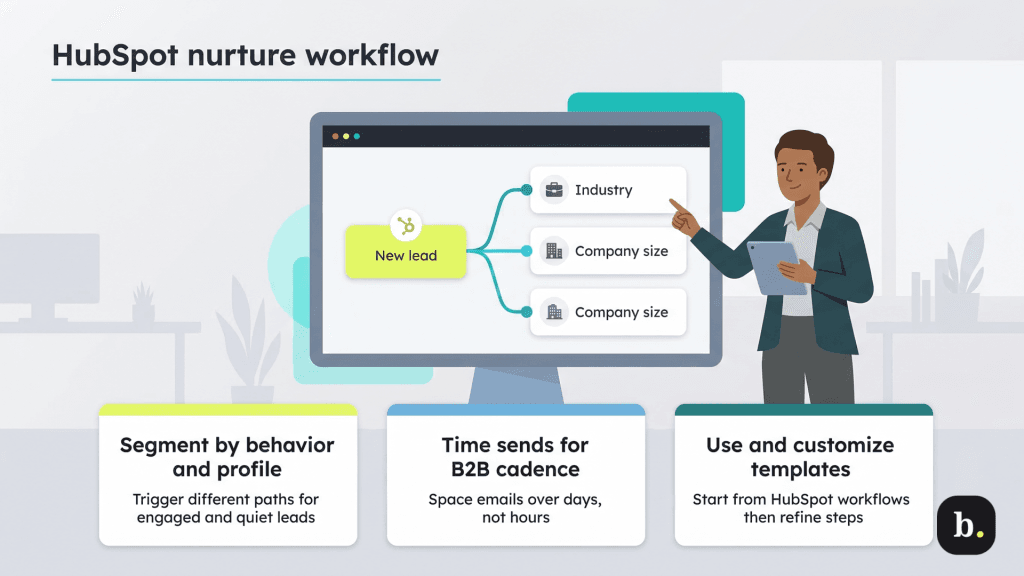
Segmented email workflows
Generic email blasts to your entire database ignore the reality that different prospects have different needs, interests, and readiness levels. Segmentation dramatically improves performance by ensuring relevance.
Creating list segments in HubSpot:
Start by defining meaningful segments based on criteria that indicate different needs:
- Industry: Healthcare companies face different challenges than manufacturing firms.
- Company size: Enterprise prospects have different buying processes than small businesses.
- Behavior: Someone who downloaded a pricing guide is further along than someone who read a blog post. [See our lead scoring guide to learn more.]
- Lead source: Webinar attendees may be more engaged than organic search visitors.
Building workflow branches based on engagement:
Effective workflows adapt based on how prospects respond. If someone clicks a link about a specific topic, subsequent emails should dive deeper into that topic. If they don’t engage, try different angles or content formats.
Setting appropriate delays between emails:
Timing matters. Too frequent and you’re spamming; too infrequent and prospects forget about you. Research from GetResponse shows Tuesday, Wednesday, and Thursday emails typically perform best, with send times around 10 AM and 2 PM showing higher open rates.
For B2B nurturing, typical cadences include:
- Email 1 (immediate): Welcome and set expectations
- Email 2 (3-4 days): First value-add content
- Email 3 (5-7 days): Second value-add content
- Email 4 (7-10 days): Deepen engagement or branch based on behavior
Use HubSpot’s workflow templates for common scenarios like “Welcome New Subscribers” or “Re-engage Cold Leads,” then customize for your specific business context and messaging.
Personalization
Generic emails get ignored. Marketing personalization shows you understand individual prospect needs and builds stronger connections.
- Personalization tokens: Insert prospect-specific information like name, company name, industry, or location dynamically. “Hi [First Name]” is basic, but “We’ve helped [Number] companies in [Industry] solve [Problem]” demonstrates deeper relevance.
- Dynamic content based on contact properties: Show different content blocks to different segments within the same email. Manufacturing prospects see manufacturing case studies; healthcare prospects see healthcare examples.
- Smart CTAs that adapt to lifecycle stage: Early-stage prospects see “Download Guide” buttons; late-stage prospects see “Schedule Demo” buttons. It’s the same email with different calls to action based on where they are in the journey.
- Behavioral triggers: Actions should trigger appropriate follow-up. Someone who visits your pricing page five times in one week is showing high intent and should receive different communication than someone who hasn’t visited in months.
For example, in HubSpot you can create an email template that shows different case studies to manufacturing versus healthcare prospects using smart content rules, ensuring every recipient sees the most relevant proof point without creating entirely separate emails.
Multi-channel nurturing
Email forms the foundation of most nurture programs, but multi-channel approaches reinforce messaging and reach prospects where they’re most active.
- Email as the foundation: HubSpot’s email editor allows creation of professional templates without design skills, with drag-and-drop functionality for adding content blocks, images, and CTAs.
- Retargeting ads through HubSpot Ads tool: Sync your contact database with advertising platforms to show targeted ads to prospects based on their stage in your nurture sequence. Someone in an awareness sequence sees educational ad content; someone in a decision sequence sees product-focused messaging.
- Social media scheduling: HubSpot’s social tools allow scheduling posts that reinforce nurture themes, ensuring prospects see consistent messaging across channels.
- SMS follow-up: Available with Marketing Hub Professional, SMS can deliver high-urgency messages like event reminders or time-sensitive offers with higher open rates than email.
- Task creation for sales touchpoints: Automated workflows can create tasks for sales representatives when prospects hit specific engagement thresholds, ensuring timely human outreach when prospects demonstrate buying intent.
Map your nurture sequences to actual prospect questions. Use HubSpot's conversations inbox to review common questions your team receives, then create content that addresses them proactively in your nurture sequences.
Key takeaways
Lead nurturing transforms prospects who aren’t ready to buy immediately into eventual customers through strategic, value-focused communication. Success requires understanding the buyer journey, segmenting audiences based on meaningful criteria, and delivering relevant content at appropriate intervals.
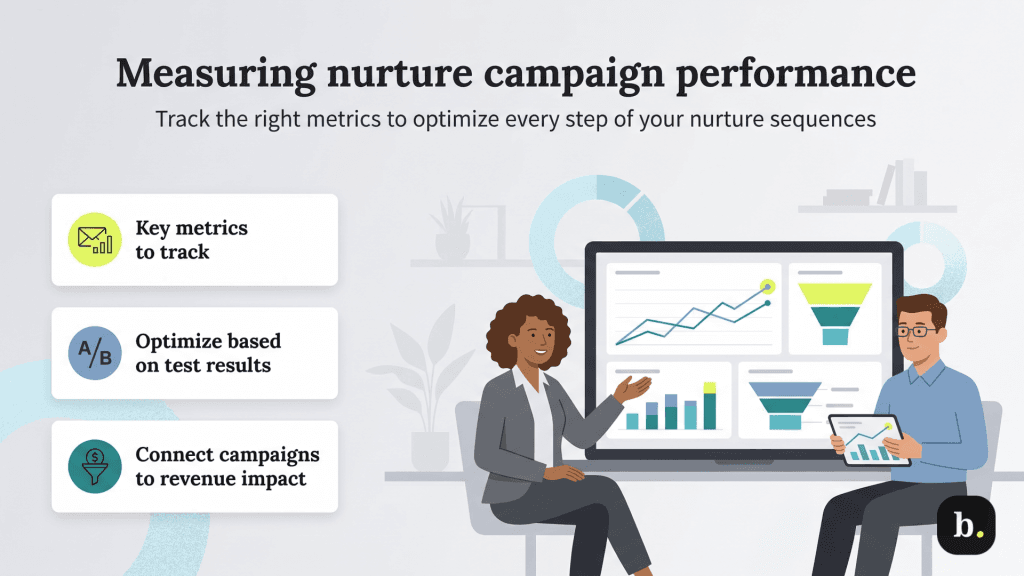
Multi-channel approaches reinforce messaging across email, retargeting ads, and social media, while behavioral triggers ensure timely responses to prospect actions. Rigorous measurement and continuous optimization based on open rates, engagement metrics, and conversion data separate high-performing programs from wasted effort.
Modern CRM platforms provide the automation capabilities needed to nurture hundreds or thousands of prospects simultaneously with personalized communication, creating scalable systems that generate consistent pipeline without proportional increases in team workload.
The investment in building systematic nurture campaigns pays dividends through higher conversion rates, shorter sales cycles, and larger deal sizes compared to un-nurtured leads.