Choosing between an online bank and a traditional bank for your business isn’t a philosophical debate — it’s a practical decision based on how your business moves money, what services you need now, and what you’ll likely need in the next year or two. Neither option is universally better. Online banks excel at some things and fall short at others; the same is true for traditional banks.
The goal isn’t to pick the “best” bank in the abstract. It’s to match your banking relationship to the way your business actually operates and to recognize that the right answer may change as your business grows.
If you’re searching for the right bank for your business, check out our picks for the
best business bank accounts. We’ve researched some of the leading online bank options, as well as those with traditional branch locations.
Online business banks
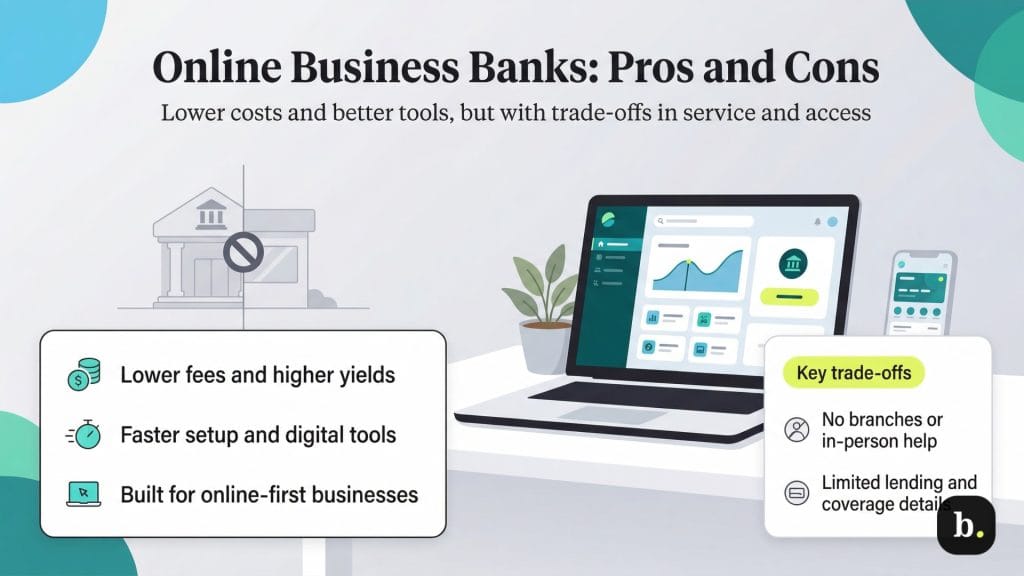
Key advantages
Online banks offer several key advantages over traditional banks, including:
- Lower fees. Many online banks charge little or no monthly maintenance fees and eliminate or dramatically reduce per-transaction charges that traditional banks commonly impose. For a business that processes most of its transactions digitally, these savings can add up to hundreds or thousands of dollars over the course of a year.
- Higher savings yields. Online banks typically offer higher APYs on business savings accounts and money market deposits than their traditional counterparts, making them a stronger option for businesses holding reserve cash.
- Faster account opening. Opening an account with an online bank is often a same-day process, compared to the multiday or in-branch timeline required by many traditional institutions. For a business owner who needs to get banking set up quickly, this speed is a meaningful advantage.
- Stronger digital tools and integrations. Mobile apps tend to be more polished, with features like instant mobile deposit, real-time transaction notifications and built-in expense categorization. API integrations with accounting software, payroll providers, and payment processors are often stronger, particularly among newer fintech-oriented banks that have built their platforms around these connections from the start.
For digital-first businesses like SaaS companies, e-commerce operations, freelancers, consultants and service-based firms that rarely handle physical cash, online banks often provide everything you need with less overhead.
Key limitations
The tradeoffs are real, and they matter more for some businesses than others.
- No branch access. If your business handles significant cash – retail stores, restaurants, trade businesses, event-based operations – the lack of physical branches is a meaningful limitation. Some online banks partner with ATM networks or offer cash deposit workarounds through retail locations, but these solutions are typically less convenient and sometimes come with their own fees.
- Limited lending products. Many online banks and fintechs focus primarily on deposit accounts and basic payment services, not business loans. If you need an SBA loan, a commercial line of credit, equipment financing or a commercial real estate loan, most online banks can’t help you directly. Lending requires a different kind of banking relationship, one built on ongoing financial review and credit assessment. Traditional banks are generally better suited to building such a relationship.
- Customer service constraints. Support at online banks tends to be chat-first or email-based, with phone support that can involve longer wait times than a branch visit would. For routine questions, this is usually fine. For complex issues like a disputed transaction, a frozen account or an urgent wire transfer, the inability to walk into a branch and speak with someone face-to-face can be a frustration.
- FDIC insurance structure. Most established online banks are FDIC-insured directly, meaning your deposits are protected up to $250,000 per depositor, per institution, just as they would be at a traditional bank. However, some newer fintech platforms are not banks themselves. Instead, they partner with FDIC-insured banks to hold your deposits. In these arrangements, your money can still be FDIC-insured through what’s called pass-through coverage, but the protection depends on proper recordkeeping between the fintech and its partner banks. Before opening an account with any fintech platform, verify whether the company is a chartered bank or operates through a partner bank, and confirm the FDIC insurance structure directly.
Traditional business banks
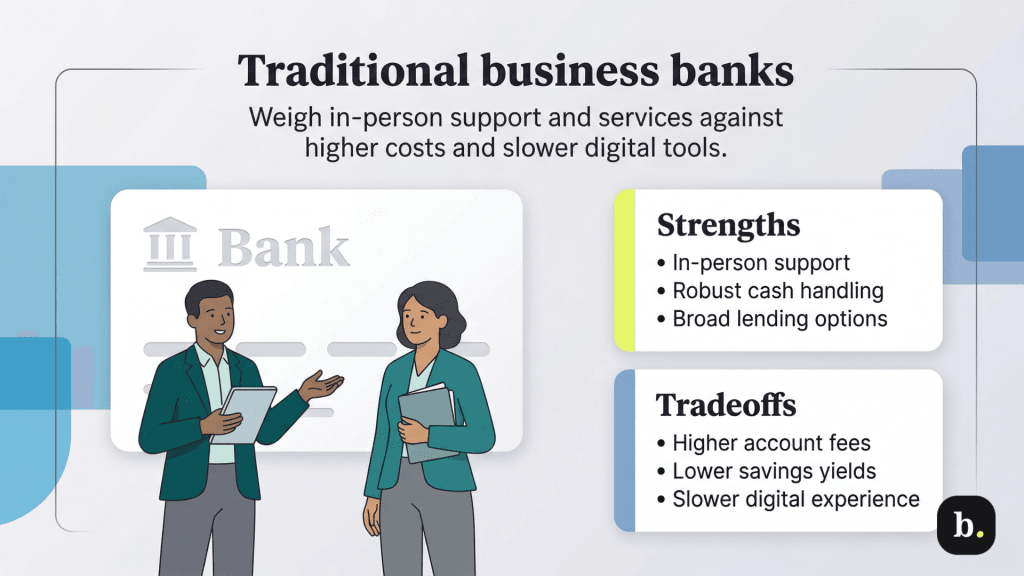
Key advantages
Traditional banks offer something online banks fundamentally can’t: physical presence and relationship depth.
- In-person service. For businesses that need to deposit cash regularly, resolve issues face-to-face or work with a banker who knows their operation, branch access remains valuable. A dedicated relationship manager, someone who understands your business, your industry and your growth trajectory, can be a meaningful asset, particularly when you need financing or need to navigate a complex banking situation.
- Cash and check infrastructure. If your business generates significant cash revenue, traditional banks provide the deposit infrastructure you need: branch tellers, night deposit boxes, coin and currency services, and commercial deposit processing. This ecosystem simply doesn’t exist in the online banking world.
- Lending products. This is one of the strongest arguments for maintaining a traditional banking relationship. SBA loans, commercial lines of credit, equipment financing and commercial real estate loans are overwhelmingly originated by traditional banks and credit unions. These products are relationship-based; lenders evaluate your deposit history, cash flow patterns and overall banking relationship when making lending decisions. Having your primary operating account at the same institution where you’re seeking a loan strengthens your application.
- Treasury management. For larger or more complex businesses, traditional banks offer treasury management services, which include lockbox processing, positive pay for check fraud prevention, sweep accounts, controlled disbursement and cash concentration tools. Online banks generally don’t provide these services.
Key limitations
The advantages of traditional banks come with higher costs and, in many cases, a less streamlined digital experience.
- Higher fees. Monthly maintenance fees, per-transaction charges, cash handling fees, wire transfer fees and minimum balance requirements are more common and typically higher at traditional banks. These fees reflect the cost of maintaining physical infrastructure, but they can eat into margins for businesses that don’t use the branch services those fees subsidize.
- Lower savings yields. Traditional banks generally offer lower interest rates on savings and money market accounts than their online counterparts. The national average savings rate is heavily weighted by traditional banks, while online banks commonly offer rates three to ten times higher on comparable accounts.
- Slower processes. Account opening at a traditional bank often requires an in-branch visit, physical document review and a multiday approval timeline. Onboarding for services like merchant processing, payroll integration, or treasury management can take weeks. For a business owner who needs to get banking set up quickly, this lag can be a real bottleneck.
- Technology gaps. While major national banks have invested heavily in digital banking, many regional and community banks still lag behind fintechs in mobile app quality, API availability and integration support. If your business relies on seamless syncing between your bank, your accounting software and your payment stack, it’s worth testing the bank’s digital tools before committing.
Which is right for your business?
Choose online if …
An online bank is likely the better fit if your business operates primarily in the digital world. Specifically, it makes sense when you rarely or never handle physical cash, your business is service-based, digital or e-commerce, you want to minimize banking fees and maximize savings yield, you don’t anticipate needing bank-originated lending in the near term and your team is comfortable managing banking entirely through a mobile app and web interface.
For freelancers, consultants, SaaS businesses and online retailers, an online bank often provides better value and a smoother operational experience than a traditional institution.
Choose traditional if …
A traditional bank is likely the better choice when your business has meaningful cash handling needs, such as retail stores, restaurants, trade services and any operation that regularly deposits physical currency. It also makes sense when you need or expect to need SBA loans, commercial credit lines or other relationship-based lending products, when you value having a dedicated relationship manager who can advocate for your business internally, or when you operate in an industry that banks classify as high-risk and where face-to-face underwriting conversations can make the difference between approval and denial.
For businesses in these categories, the higher fees of a traditional bank are often justified by the services and lending access they provide.
Could you use both?
A growing number of small businesses are adopting a two-bank approach: a traditional business checking account for daily operations and lending relationships, paired with an online savings account for higher yield on reserves. This lets you capture the best of both models: branch access and lending capacity from your traditional bank, plus a significantly higher interest rate on money you’re setting aside for taxes, emergencies or planned expenses.
Managing two accounts doesn’t have to be complicated. Set up an automatic transfer from your traditional checking account to your online savings account on a regular schedule — weekly or biweekly works for most businesses. Your accounting software can connect to both accounts, giving you a unified view of your cash position. The key is to keep the roles clear: checking is for spending, savings is for storing.
What to watch out for
Regardless of which direction you choose, a few due diligence items deserve attention before you commit.
- Verify FDIC insurance directly. Don’t rely on marketing language. If the institution is a chartered bank, look it up on the FDIC’s BankFind tool. If it’s a fintech company that uses partner banks, confirm which bank holds your deposits and verify that the pass-through insurance arrangement meets FDIC requirements. The 2023 Synapse bankruptcy, where a fintech intermediary failed and over 100,000 customers temporarily lost access to their accounts, is a real-world reminder of why this matters.
- Read the fee schedule carefully. Some banks advertise low or no monthly fees during an introductory period, then raise them after six or twelve months. Others waive fees contingent on maintaining a minimum balance or meeting a transaction threshold. Understand the full fee structure, including what happens if you don’t meet the waiver conditions.
- Check integration compatibility. Before opening an account, confirm that the bank integrates with the tools you actually use, including your accounting software, your payroll provider, your invoicing platform and your payment processor. A bank with great rates and terrible integrations will cost you time that may exceed whatever you’re saving in fees.
- Evaluate the institution’s track record. For established banks, this is rarely a concern. But for newer fintechs and digital-first platforms, it’s worth researching the company’s history, funding, regulatory status and user reviews. A bank that’s been operating for two years with venture capital funding and a small customer base carries different risk than one with a decades-long operating history.
The best business bank is the one that matches how your business actually operates, not the one with the flashiest app or the most branches. Evaluate your cash handling needs, your lending horizon, your fee sensitivity and your digital workflow, and let those factors drive the decision. And keep in mind that the answer isn't necessarily permanent. As your business grows and your needs change, your banking relationship should evolve with it. Reassessing every two to three years ensures you're always working with the best option for where your business is now, not where it was when you first opened the account.