Business.com aims to help business owners make informed decisions to support and grow their companies. We research and recommend products and services suitable for various business types, investing thousands of hours each year in this process.
As a business, we need to generate revenue to sustain our content. We have financial relationships with some companies we cover, earning commissions when readers purchase from our partners or share information about their needs. These relationships do not dictate our advice and recommendations. Our editorial team independently evaluates and recommends products and services based on their research and expertise. Learn more about our process and partners here.
AI overviews and LLMs are changing everything about online search, including how you should manage your brand reputation.


This article is sponsored by Erase.com.
For years, online reputation management followed a simple formula: create positive content, build backlinks and push the bad stuff to page two. If a negative review or unflattering article ranked high, you buried it. The strategy worked because most people never scrolled past the first page of Google results.
That era is ending.
The rise of AI-powered search tools, like Google’s AI Overviews, ChatGPT, Perplexity and others, is fundamentally changing how information about your business reaches potential customers. These systems don’t hand users a list of ten links and let them scroll. They read across dozens of sources, synthesize a conclusion and deliver a single answer. For small businesses, that shift changes everything about how reputation needs to be managed.
The old suppression playbook worked because of how traditional search engines operated. Google returned a ranked list of results and users clicked what caught their attention, which was usually the first few links. If a negative result sat at position seven or eight, it rarely got noticed. The game was about rank order.
Today, Google’s AI Overviews synthesize information from multiple sources into a single summary displayed at the very top of results, before any individual links. If a negative article, review or news story ranks on page one, the AI may incorporate it into that summary even if it’s not the number one result. You can no longer count on position alone to protect your reputation.
The problem is compounded by large language models (LLMs) like ChatGPT and Perplexity, which don’t show a page of results at all. They generate a direct answer, typically naming only a handful of brands or businesses. If your online presence is thin, inconsistent or tainted by negative content, you may not appear in those answers — or worse, you may appear in them in a way you wouldn’t choose.
The practical implication is that suppression strategies that rely on outranking negative content don’t address what AI search engines actually do, which is to draw from authoritative sources to form conclusions. The source content itself matters more than its rank position.
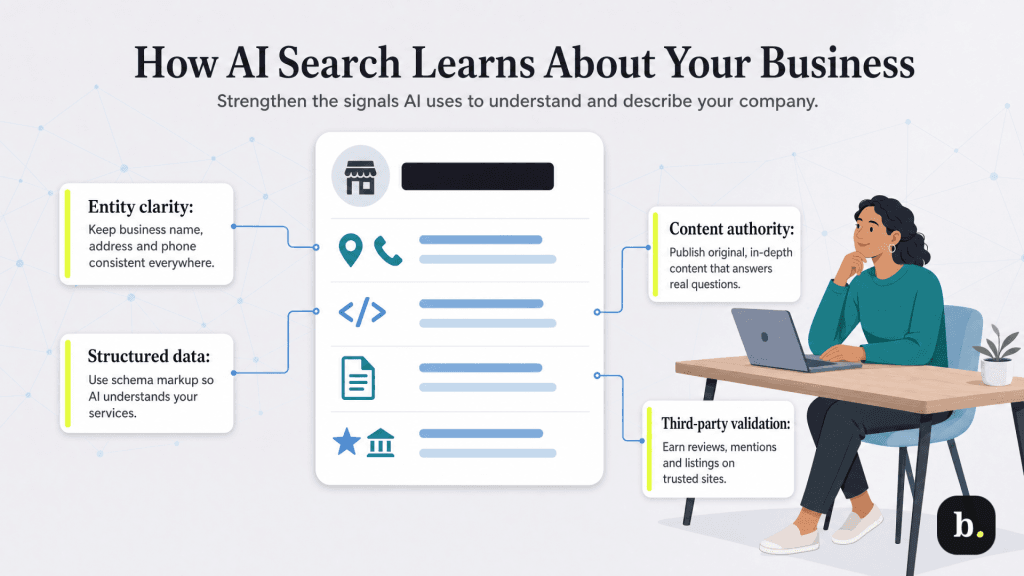
AI systems are not neutral. They pull from sources they consider authoritative, well-structured and widely referenced. Understanding what drives those decisions is the first step to influencing the narrative they construct about your business.
Several key signals shape what AI says about you:
AI search is less like a popularity contest and more like a credibility assessment. Businesses with a strong, coherent web presence across multiple authoritative sources tend to be cited. Those with weak, inconsistent or controversial footprints may be invisible or misrepresented.

You can’t manage what you can’t measure. The first step in AI reputation management is understanding what these systems currently say about you, and then systematically building a presence that gives them better material to work with.
These steps compound over time. A business that consistently maintains a credible, coherent digital presence across multiple authoritative sources becomes progressively more likely to be cited accurately and favorably in AI-generated answers.
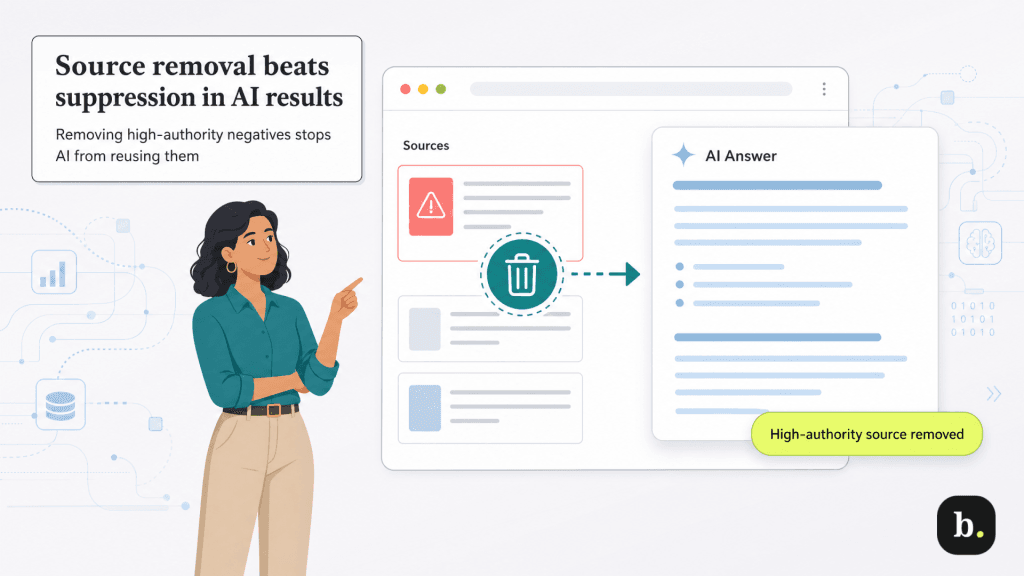
The strategies above are highly effective for building a positive AI reputation from a clean starting point. But for businesses dealing with existing negative content, such as an old news story, a damaging review thread or a misleading blog post that’s accumulated authority over years, self-produced content alone often isn’t enough.
AI systems weigh source authority heavily. If a high-authority negative article has been widely cited and linked to for several years, publishing new blog posts doesn’t override it. The negative source has too much credibility in the AI’s framework to be drowned out by volume. The AI will continue drawing from it as long as it exists and ranks.
This is where source removal becomes strategically important, and where the AI era diverges most sharply from the old suppression model. Suppression meant pushing negative content down the rankings so fewer people clicked on it. But AI systems regularly reassess the sources they draw from, and a negative article that remains live and authoritative continues influencing AI answers even if its traditional search ranking declines.
Removal at the source – getting content taken down from the site where it lives – eliminates the input, not just its visibility. That’s a fundamentally different outcome, and it’s the approach Erase.com takes. Rather than building positive content around problems and hoping AI systems shift their conclusions, Erase.com focuses on removing negative content at the source, addressing the root material that AI systems are drawing from. As search increasingly moves from ranked links to synthesized answers, that distinction becomes more consequential.
