When you’re looking for employees as a small business, it can feel like you’re bringing a slingshot to a gunfight. Large corporations have bigger budgets, household names, and comprehensive benefits packages that seem impossible to match.
This article is sponsored by ZipRecruiter.
But here’s what larger companies won’t tell you: many candidates actively prefer small businesses when given the right reasons. This guide provides practical strategies for small businesses to compete effectively for top talent, focusing on advantages you already have and showing you where to invest your limited resources for maximum impact.
Starting with a strong pool of qualified candidates can help you find job seekers who are most likely to be engaged and enthusiastic about the opportunity. We recommend
posting your job on ZipRecruiter, which helps connect you with top talent that’s perfect for your role thanks to its Resume Database of more than
320,000 resumes, which are added to Zip every month.Your natural advantages over big companies
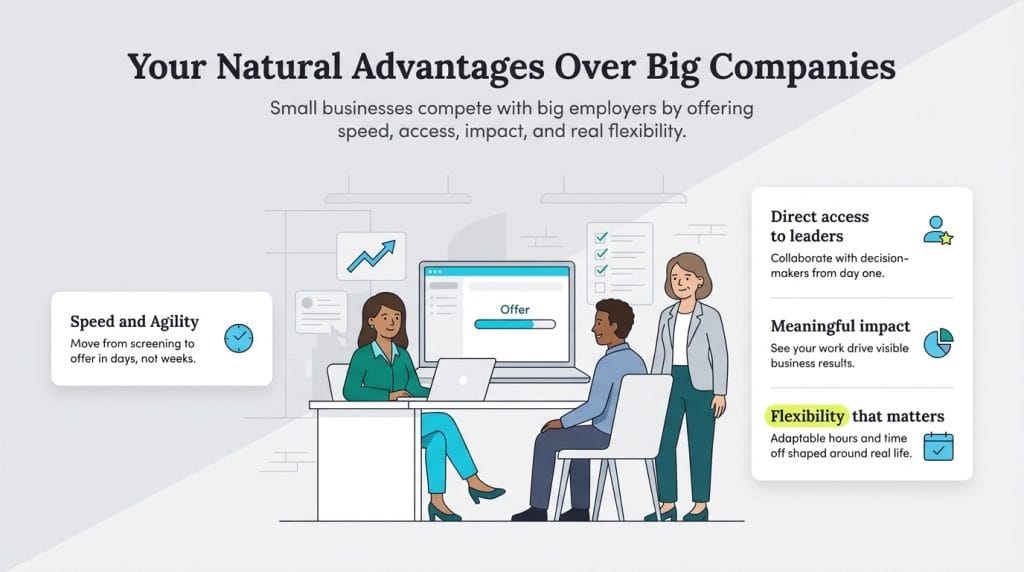
Research from Robert Half shows that nearly half of small and midsize business hiring managers cite meeting candidates’ salary expectations as their greatest obstacle heading into 2025. But before trying to beat larger employers at their own game, recognize the competitive advantages you already possess as a small business. These powerful differentiators matter deeply to many candidates:
Speed and agility: While corporate hiring processes average 44 days and involve multiple layers of approval, small businesses can move decisively. You typically have fewer stakeholders involved and less red tape, allowing you to identify strong candidates and extend offers in half the time. In a market where top candidates are only available for a short time, your ability to make fast decisions is a strategic weapon.
Direct access to leadership: At a small company, new hires often work directly with founders or senior leaders from day one. This proximity creates mentorship opportunities and gives employees visibility that would take years to achieve at a large corporation. Many ambitious candidates prize this accelerated learning and relationship-building over higher starting salaries.
Meaningful impact: In a small company, every employee’s contributions are visible and consequential. Candidates tired of being a small cog in a massive machine often seek environments where their work directly influences company success. This sense of purpose and ownership can’t easily be replicated at scale.
Culture and flexibility: Small businesses can adapt policies quickly without navigating corporate bureaucracy. If a valuable candidate needs a flexible schedule or wants to work remotely on certain days, you can make that decision in a conversation rather than submitting it through multiple approval channels. This responsiveness matters enormously to candidates whose life situations require accommodation.
Emphasize growth and learning opportunities
When you can’t match corporate salaries dollar-for-dollar, focus on the career development advantages that only small businesses can provide. A 2024 survey conducted by iMPact Business Group found that 46% of employees identified advancement opportunities as the most important job satisfaction factor.
Offer cross-functional experience. In small companies, employees often wear multiple hats and gain exposure to different aspects of the business. Frame this as an advantage: while someone at a large company might spend years in a narrowly defined role, your team members develop diverse skills that make them more valuable in the job market.
Create clear growth paths. Show candidates how their role might evolve as the company grows. Be specific: “We’re adding two team members this year, and we’ll need someone to manage that growing team. If you excel in this position, you’d be the natural choice for that leadership role.” This clarity about upward mobility addresses candidates’ concerns about career stagnation.
Invest in professional development. While you might not have a corporate training budget, you can be creative in offering professional development opportunities. Offer to cover relevant online courses, send employees to industry conferences, or provide mentorship pairings with experienced team members. According to LinkedIn research, 94% of employees would stay at a company longer if it invested in their professional development.
Showcase success stories. If previous employees have grown significantly in their roles or been promoted into leadership positions, highlight these stories during interviews. Concrete examples of internal advancement prove that opportunities aren’t just hypothetical.
Build a compelling company culture
While larger companies often struggle with impersonal environments, small businesses can cultivate tight-knit company cultures where every person matters. Research indicates that company culture ranks among the top five factors candidates consider when evaluating opportunities, with 92% of candidates considering a company’s culture as a vital factor in their decision making process.
Define and communicate your values. What makes your company special? Maybe you prioritize work-life balance, maintain a collaborative environment or are mission-driven in your industry. Whatever distinguishes your culture, make it central to your employer brand. Candidates who align with these values will prioritize your opportunity over higher-paying alternatives.
Let your team tell the story. Employee testimonials carry more weight than any recruiting pitch. Ask current team members to share what they genuinely appreciate about working at your company. Feature these perspectives on your careers page, in job postings and during interviews. Authenticity matters more than polish.
Highlight your work environment. If your team regularly has lunch together, celebrates wins or supports each other during challenges, share these examples. Many candidates have worked in environments where colleagues are just people they see in meetings, and the prospect of meaningful workplace relationships appeals strongly.
Emphasize transparency. In small companies, employees often have visibility into business performance, strategic decisions, and company direction that would never be shared at larger organizations. This inclusion makes people feel trusted and invested in outcomes.
Offer flexibility that corporations can’t match
Flexibility has become a top priority for candidates across demographics. Research from New Possible shows that 50% of employees who don’t currently have flexible working options say they’re likely to change jobs.
Customize arrangements. Large companies implement one-size-fits-all policies because they need consistency across hundreds or thousands of employees. You don’t. If a talented candidate needs to start late on Tuesdays for a standing appointment, you can accommodate that. This personalized approach attracts candidates whose needs don’t fit corporate rigidity.
Define flexibility clearly. When advertising flexible work options, be specific. “Flexible schedule” means different things to different people. Specify whether you offer remote work days, flexible hours, compressed workweeks or other arrangements. According to ADP research, 31% of workers aged 55 and older put flexible hours among their top priorities, compared to 24% of workers aged 18 to 24, so consider your target demographic.
Balance flexibility with structure. While emphasizing flexibility, also clarify expectations. Candidates want to know they can manage personal responsibilities, but they also want to work for organized companies with clear processes. Explain how your flexibility works within a framework of accountability.
Respond faster than your competition
Nearly 40% of small business hiring managers worry about losing top candidates due to slow hiring processes, according to the data from Robert Half. Since speed is one of your natural advantages, leverage it relentlessly. A 2023 job seeker survey by iHire found that 66.1% of candidates expect to hear back from employers in less than 24 hours, and 38.7% say they’d be less likely to interact with a brand in the future if they apply and don’t receive timely communication.
Streamline your process. While corporations conduct four or five interview rounds with different stakeholders, you can efficiently evaluate candidates in two or three conversations. Define upfront who needs to be involved in hiring decisions and schedule interviews promptly.
Communicate constantly. Even if you’re still evaluating candidates, acknowledge applications immediately and provide timeline updates. Simple responsiveness differentiates you from companies that leave applicants in limbo for weeks.
Make quick decisions. When you find the right candidate, don’t delay making an offer while overthinking minor concerns. Perfect candidates don’t exist, and the cost of hesitation is losing good people to faster competitors.
Automate where possible. Use technology to eliminate bottlenecks without losing personal touch. Applicant tracking systems can automatically acknowledge applications, schedule interviews and send status updates, freeing you to focus on meaningful candidate interactions.
Use one of our picks for the
best CRM systems to keep tabs on your job candidates and recent interactions with them. Automation tools can help you proactively reach out to keep them in the loop without demanding a lot of effort.
Be strategic about compensation and benefits
You can’t always match corporate salaries, but you can structure competitive compensation packages by understanding what candidates actually value and being creative with your offerings.
Research market rates carefully. Don’t guess at appropriate salaries. Use resources like Glassdoor, Payscale, and industry salary surveys to understand competitive ranges for your roles and location. You don’t need to be the highest bidder, but you do need to be in the ballpark.
Be transparent about compensation. Job postings that include salary ranges get more engagement than those that don’t. Transparency builds trust and ensures you’re attracting candidates whose expectations align with your budget.
Offer benefits that matter. Healthcare, flexible schedules and generous PTO often matter more to candidates than marginal salary differences. According to Indeed’s 2024 Workforce Insights Report, 34% of job seekers rank better benefits as a top motivator for changing jobs. Research your target demographic’s priorities and structure benefits accordingly.
Consider performance-based incentives. Profit-sharing, bonuses tied to company performance or equity options can make your total compensation competitive while managing cash flow. These also align employee interests with business success.
Highlight non-monetary compensation. Shorter commutes, opportunities to work from home or flexible schedules have real monetary value. If your role offers these benefits, calculate their worth and present them as part of the total package.
Maximize your reach with smart job posting strategies
Small businesses often struggle with visibility — candidates can’t apply if they don’t know your opportunity exists. Strategic posting ensures qualified candidates actually see your openings without requiring massive advertising budgets.
Choose the right platforms. Not all hiring websites serve small businesses equally well. The best place to post jobs for small businesses is on platforms designed specifically to help smaller employers compete, with features like ZipRecruiter’s ZipIntro candidate matching that amplify your reach beyond passive job seekers.
Use TrafficBoost strategically. Some platforms offer features that give small business postings greater visibility for short periods. These promotional tools can be cost-effective when you need to fill positions quickly, allowing you to compete for attention even in crowded job categories.
Write compelling job descriptions. Your posting is often a candidate’s first impression of your company. Be specific about responsibilities, transparent about compensation and authentic about your culture. Explain what makes this opportunity special rather than listing generic requirements.
Leverage your network. Employee referrals remain one of the most effective sources of quality hires. Encourage your team to share openings in their networks. Offer referral bonuses to incentivize these recommendations.
Accept trade-offs and train for skills gaps
Many small businesses struggle to find candidates with all required skills. Rather than holding out indefinitely for perfect candidates, adopt strategies that expand your talent pool.
Be willing to bend on requirements. If someone has 80% of what you need and demonstrates strong learning ability, they might be a better long-term hire than someone with perfect credentials but limited growth potential. Consider whether you can train for missing skills or provide time to develop them.
Hire for potential and culture fit. At small companies where every person significantly impacts the environment, cultural alignment and work ethic matter as much as technical skills. Someone who fits your team well and shows initiative will ultimately contribute more than a highly credentialed person who doesn’t mesh with your culture.
Create training plans. When you hire someone without all required skills, develop a structured onboarding plan that addresses knowledge gaps. This demonstrates commitment to their success and accelerates their ability to contribute.
Consider contract-to-hire arrangements. For specialized skills you need temporarily or want to evaluate before committing, contract workers can bridge gaps while you assess cultural fit and performance. Many contractors eventually transition to full-time roles.
Showcase your company online
Small businesses with limited brand recognition need to work harder to establish credibility and appeal. Your online presence functions as your recruiting marketing department.
Optimize your careers page. Even if your website is modest, create a dedicated careers section that explains what makes your company a great place to work. Include employee testimonials, photos of your team and information about your culture and values.
Maintain active social media. LinkedIn, in particular, serves as a window into your company for prospective employees. Share content about projects your team is working on, celebrate employee accomplishments and provide glimpses of your workplace culture.
Encourage employee reviews. Positive reviews on sites like Glassdoor build credibility. While you can’t control what people say, creating a genuinely positive workplace experience will naturally result in good reviews over time. According to research, 83% of employees and job seekers rely on company reviews and ratings when determining where to apply for a job.
Tell your company’s story. Why did you start this business? What problem are you solving? Candidates, especially those looking to work for mission-driven companies, want to understand your purpose beyond profits.
Competing with larger companies for talent requires playing to your strengths rather than trying to match their resources. You probably can't offer the highest salaries in your market. But you can offer the fastest hiring process, the most flexible work arrangements, the clearest path to leadership roles, and the tightest-knit team culture. Focus your energy on maximizing these advantages.