Business.com aims to help business owners make informed decisions to support and grow their companies. We research and recommend products and services suitable for various business types, investing thousands of hours each year in this process.
As a business, we need to generate revenue to sustain our content. We have financial relationships with some companies we cover, earning commissions when readers purchase from our partners or share information about their needs. These relationships do not dictate our advice and recommendations. Our editorial team independently evaluates and recommends products and services based on their research and expertise. Learn more about our process and partners here.
Do your customers have the same idea of your company as you do? If not, you need to work on your mission statement.

When you think about the vision and heart of your company, what comes to mind? Do your employees and customers clearly understand these same ideas? If not, it’s a pretty good sign that you don’t have a clear and effective mission statement.
A mission statement is a concise summary of your business’s purpose, values and objectives. Developing the right mission statement for your company can be a challenge. However, once it’s established, it can serve as your guiding principle. A good mission statement can ensure your workforce is aligned and differentiate your company from your competitors.
The most effective mission statements inspire and educate. While the result is a short, concise statement, the process of developing your mission statement can be anything but brief. You can choose to involve as many or as few collaborators as you’d like; however, the final message should resonate with everyone at your organization — from leadership to your frontline workers.
Follow these steps to craft an effective mission statement:
Your mission statement should incorporate three things:
By defining these three elements, you’ll understand the problems your business solves. You’ll also realize the customers you’re aiming to serve and how your business differs from your competitors. One way to do this concisely is to share what inspired you to launch your business. Origin stories are often compelling ways to effectively tell your story. Incorporating the main elements of yours into the mission statement celebrates your company history and future goals.
Think of your mission statement as your company’s elevator pitch. Aim for brevity — ideally under 30 words. The shorter and more focused your mission statement is, the more likely people are to remember and understand it.
Your mission statement needs to resonate with both internal and external audiences. Therefore, your mission statement creation process should include sharing your draft with applicable stakeholders — including some trusted customers, vendors and partners. This will ensure the message rings true across the business. Be open to customer feedback and tweak your messaging to ensure clarity.
A common way to ensure your mission statement aligns with all audiences is to develop one statement to share internally and another to share externally. From there, work to consolidate and polish your messaging so it applies to anyone who reads it.
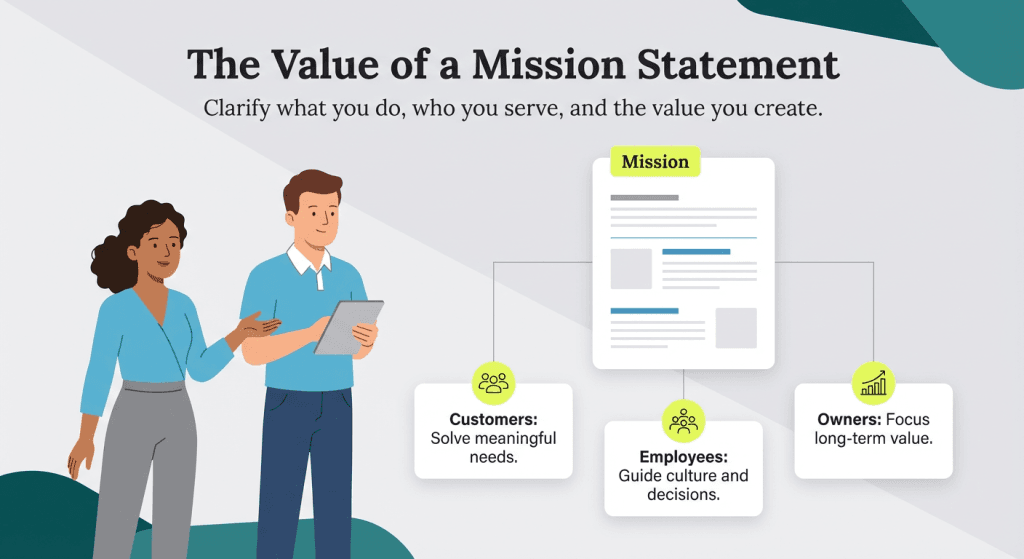
Many misunderstand the role of a mission statement. It is not a marketing slogan designed to grab attention, nor is it a vision statement outlining the organization’s future trajectory. Instead, it is a precise strategic tool.
“Your company’s mission statement is your opportunity to define the company’s goals, ethics, culture and norms for decision-making,” said entrepreneur Tim Berry. “The best mission statements define a company’s goals in at least three dimensions: What the company does for its customers, what it does for its employees, and what it does for its owners.” He added that there are also fourth and fifth dimensions in some cases: What the company does for the community and for the world. [Learn more about the keys to scaling your business.]
Because mission statements must convey complex ideas concisely, many end up vague or generic. However, if you look at successful companies, you’ll notice that their mission statements are well crafted and incredibly valuable.
So, what makes a mission statement work? Most experts agree that an effective mission statement answers several key questions:
This is an oversimplified look at the mission statement development process. But, you’ll notice that each of these questions is addressed (in one way or another) in quality mission statements.
Analyzing successful companies is the best way to grasp what makes a mission statement effective. Doing so can help you identify the common characteristics needed to develop your own.
Let’s look at three case studies and highlight a few of their commonalities. Consider these companies’ mission statements:
These companies operate in vastly different sectors: outdoor apparel, electric vehicles and energy storage, and eyewear. However, each company does an effective job of revealing these common characteristics of a strong mission statement:
Wendy Maynard, a business strategist, marketing consultant and business coach, challenges every company she works with to write a mission statement that’s actionable and quantifiable. It shouldn’t be sentimental or nebulous, as the former is the only way to extract real value.
“If you have an old, wonky mission statement that sounds like a corporate Hallmark card (you know what I’m talking about), then take it and rip it to shreds,” she said. “Then reflect on your true passions and values, and write a mission statement using the guidelines above that reflects the difference your business will make in the world.”
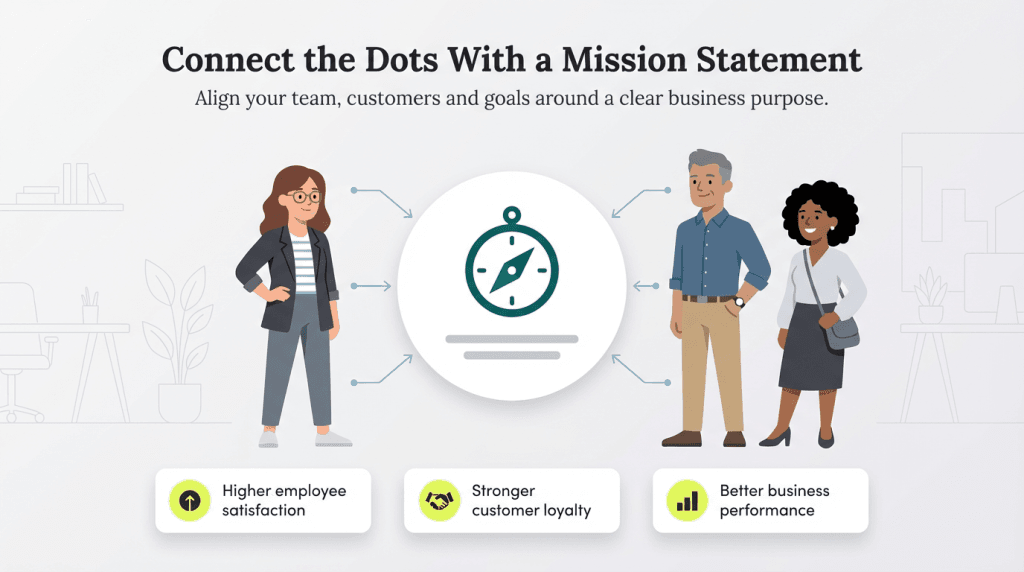
Your mission statement connects the dots, uniting customers, employees and leaders under a shared definition of the business’s goals and ethics.
Don’t rush it. But, the sooner you find your mission statement, the sooner you’ll truly understand and be able to communicate the purpose of your business. Creating a mission statement that accurately reflects the passions and values of your business isn’t easy, but the rewards for doing so are great. Companies with well-defined mission statements often see higher levels of employee satisfaction, customer loyalty and overall business performance. Take the time to craft a mission statement that truly represents your company’s core purpose — it will serve as your North Star for years to come.
Kimberlee Leonard and Larry Alton contributed to the reporting and writing in this article. Source interviews were conducted for a previous version of this article.