Business.com aims to help business owners make informed decisions to support and grow their companies. We research and recommend products and services suitable for various business types, investing thousands of hours each year in this process.
As a business, we need to generate revenue to sustain our content. We have financial relationships with some companies we cover, earning commissions when readers purchase from our partners or share information about their needs. These relationships do not dictate our advice and recommendations. Our editorial team independently evaluates and recommends products and services based on their research and expertise. Learn more about our process and partners here.
An employer of record can help manage the logistics and administration involved with hiring your first international employee. Here’s how it works.


This article is sponsored by Deel.
You’ve found a candidate with exactly the experience your business needs. There’s just one complication: They live in another country, and you’ve never employed anyone there. Before you agree on a start date, you need a way to handle local employment paperwork, payroll and benefits.
An employer of record (EOR) can help you make that hire without first establishing your own local entity. The EOR employs the person on your behalf while you manage their daily work. Here’s how the arrangement works and what to check before choosing a provider.

An employer of record is a third-party organization that legally employs a worker on behalf of another business. In an international hiring arrangement, the EOR handles the local employment relationship, including employment contracts, payroll and statutory benefits. Your business directs the employee’s work.
For example, Deel’s EOR service helps businesses hire abroad in more than 150 countries, with employment administration and employee support available through its platform. Since the employee is technically employed by Deel or its local partner and not your business, it saves you from needing to open a local entity (and all the regulatory requirements and costs associated with that).
Not all EORs operate in all countries. Review an EOR’s services and areas of operation to ensure they can provide the complete range of services you need for the country in which you’re hiring.
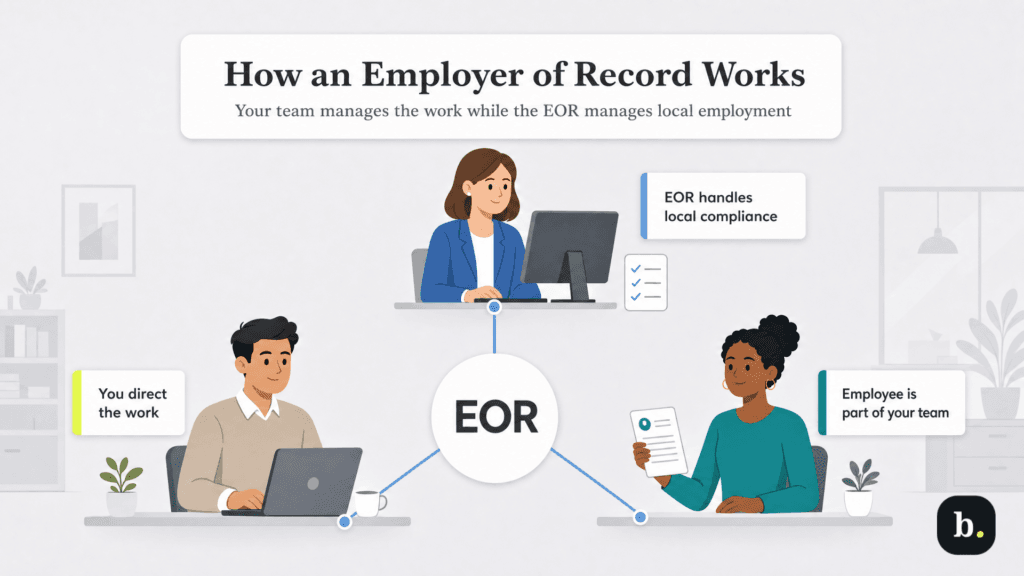
An EOR arrangement connects three parties: your business, the employee and the EOR. Your business signs a service agreement with the provider, and the employee signs a local employment agreement with the employing entity.
You still decide what the employee works on and how their performance is evaluated—they’re effectively part of your team, just like an employee your business employs directly. Employment changes, such as a pay increase or proposed termination, need to be coordinated with the EOR so the appropriate local process is followed.
Responsibility | EOR’s role | Your business’s role |
|---|---|---|
Employment paperwork | Prepares and administers local employment documents | Supplies accurate role details and reviews the commercial arrangement |
Payroll and benefits | Administers payroll, deductions and covered benefits | Funds employment costs and supplies approved payroll changes |
Daily work | Supports employment administration | Sets priorities, supervises work and provides feedback |
Leave and employment changes | Advises on local requirements and administers the process | Coordinates requests and communicates proposed changes promptly |
Employee experience | Answers employment and payroll questions within its service scope | Provides onboarding, tools, team connections and management |
An EOR is worth considering when you need to employ someone abroad but don’t have an established employment operation in that country. Common situations include:
If you expect to build a substantial, permanent operation, compare an EOR with employing people through your own entity. Consider your hiring plans, administrative capacity and broader business activities alongside employment costs.
A professional employer organization (PEO) can be useful for ongoing HR support, but a conventional domestic PEO service does not automatically provide a way to employ people abroad. Check what is being sold when a provider uses the term “international PEO.”
Similarly, hiring a contractor is appropriate only when the actual working arrangement supports that employee classification. It should not be a workaround for a role you intend to manage as employment.
Arrangement | Employment or working relationship | Typical use |
|---|---|---|
EOR | The EOR employs the worker; your business directs daily work | Hiring employees in supported locations without your own local entity |
PEO | A co-employment arrangement, typically for a business’s existing workforce | Outsourcing HR, payroll and benefits administration |
Direct employment | Your business or local entity employs and manages the worker | Building an operation you administer directly |
Independent contractor | An independent business or individual provides contracted services | Engaging appropriately classified independent service providers |
Business process outsourcing (BPO) | A supplier manages an outsourced business process and its staffing | Purchasing a managed service, such as customer support |
Compare PEOs, EORs and HR software to understand the different service models and which one is the best fit for your business.
The main advantage of working with an EOR is having an employment structure and local administrative support available for your hire. You can focus more of your attention on the employee’s work while the EOR handles the employment tasks covered by your agreement.
That support can be particularly valuable when your team lacks experience with local contracts, payroll processes or benefits. A central platform also gives managers and employees a place to find employment information. Deel, for instance, offers employee access to payslips, time-off tools and expense features.
There are trade-offs to evaluate, though:
An EOR also cannot replace good management. Your business still needs to give the employee clear expectations, suitable tools and a connection to the team. Evaluate HR outsourcing services against the work you actually need help managing.
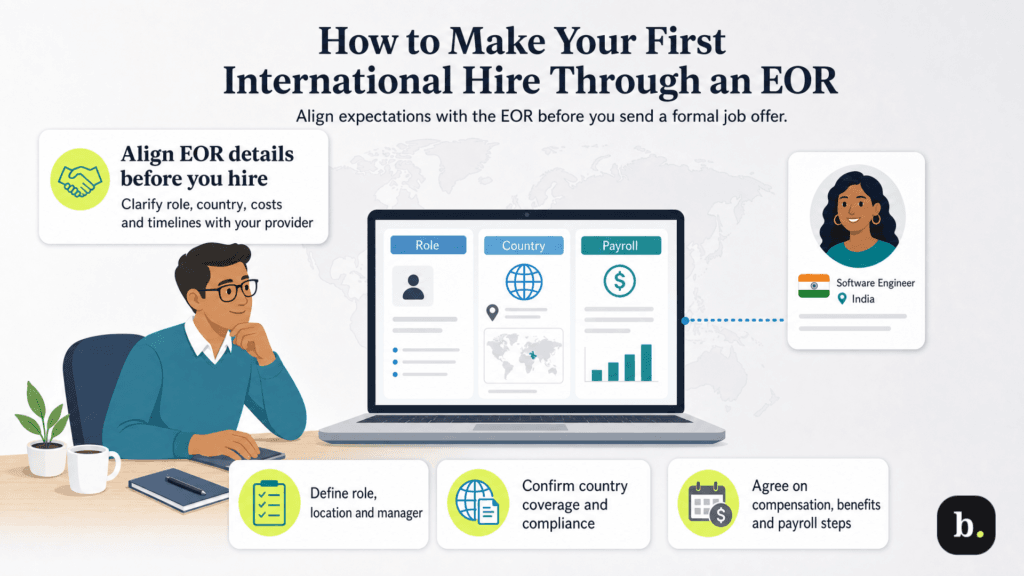
Before making a firm offer, work through the hiring requirements with the provider. A few early checks can prevent an attractive offer from becoming a difficult onboarding process.
Document what the employee will do, where they will physically work, their expected schedule and who will manage them. Be specific about travel, customer-facing responsibilities and access to sensitive information.
Ask the candidate about their intended work location rather than assuming citizenship or a mailing address tells you where employment will occur. If immigration support is needed, have the provider assess that separately.
Ask whether the provider can employ this person in this role and which entity will sign the employment agreement. Find out whether it uses its own entity or a local partner and who will answer employment questions.
Request a realistic onboarding timeline, including documents, reviews and payroll cutoffs. Build those dependencies into your hiring timeline before promising a start date.
Confirm the salary currency, pay frequency, required benefits and any optional benefits you want to offer. Ask the provider to explain the estimated employer cost and which amounts may change.
Then identify who will approve leave, submit bonuses and expenses, and notify payroll about changes. Put the deadlines on your team’s calendar. For a first hire, one clearly accountable internal contact can simplify coordination.
Review both the commercial agreement and the proposed employment terms before signing. Pay attention to confidentiality, intellectual property, notice requirements, deposits, dispute procedures and the process for transferring or ending employment.
Ask how the provider handles a performance issue or proposed termination. Do not assume your domestic process can be used unchanged. Have appropriate advisers review responsibilities that fall outside the EOR’s scope, including any corporate tax or registration questions raised by your activities.
Give the employee clear instructions for submitting their information securely. Confirm that the employment documents are complete and the start date and first payment arrangements are agreed.
Prepare your own onboarding in parallel: equipment, system access, training, introductions and a first-week plan. Explain which questions belong with their manager and which go to the EOR.
Deel provides employment administration and employee self-service tools, which can help coordinate these tasks. Ask for a demonstration of the manager and employee experience of any EOR before choosing a service.
If you later establish your own entity, review the transition with the EOR before moving anyone onto your payroll. That may also be the right time to compare payroll services for directly employed staff.
The services can overlap, but they serve different needs. A staffing agency commonly recruits or supplies workers. Businesses often use an EOR to employ a candidate they have already selected. Some EOR providers also offer recruiting services, so confirm whether sourcing talent is part of your agreement.
With an EOR, you generally select and manage an individual employee while the EOR administers the employment relationship. With BPO, you contract with a supplier to operate a process or deliver a service. Decide whether you need a person on your team or an outside company responsible for a defined business function.
Potential drawbacks include service fees, packaged benefits or service options, and dependence on the provider’s systems. A PEO may also be the wrong fit if your main need is an employment structure in another country. Our guide to the pros and cons of PEOs explains the broader trade-offs.
An EOR can be an option for a single international hire. Ask about minimum commitments, country eligibility and all applicable fees. Evaluate the experience and support that employee will receive, as well as the administrative work the service will remove from your team.
