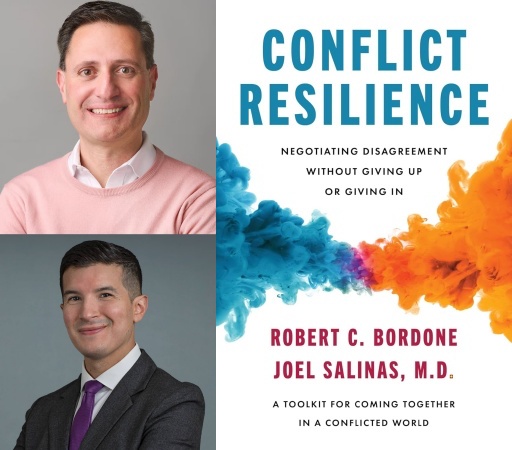
Do you shudder at the thought of conflict? Many people do — and go out of their way to dodge it. But that’s a problem, according to Harvard Law School senior fellow Bob Bordone and neurologist Dr. Joel Salinas, the co-authors of Conflict Resilience: Negotiating Disagreement Without Giving Up or Giving In.
The duo spoke with b. about getting more comfortable with conflict in an effective, productive manner.
b.: What factors have led to the decline of conflict resilience?
Bordone: The rise of social media, the ability to create our own cocoons of comfort — so that we are not necessarily exposed to people with whom we disagree — has been a big contributor here. The algorithms don’t help because the more we click on people we like and agree with, the more we see those [types of] people.
Salinas: Conflict isn’t bad. … If you think about your own relationships, it’s those where you do openly work through conflict that actually are some of the closest relationships that you’ll have.
b.: Why is conflict at work necessary, and what happens in its absence?
Bordone: The value of conflict brought into the open is that when handled well, it’s the source of dynamism and vibrance. So much talk, so much energy, is spent in corporate settings talking about creating diverse and inclusive environments … but all the effort falls apart if people aren’t actually able to bring their differences into the open … or even worse, we actually haven’t created much of a diverse environment, and we have a bunch of people who think all the same.
Salinas: The less we encounter [conflict], the more our brain becomes sensitized to it. So the physiological response to these kinds of perceived potential threats — heart rate, respiratory rate increase, blood pressure, flushing of the face, muscle tightening — all these things become that much more exaggerated. [They become] much more intense and happen much more frequently, even at the mere thought or [potential] of conflict.
b.: How specifically can business leaders better handle conflict?
Bordone: If we look across a range of catastrophic business calamities, so much of it is due to avoidance. … One [example] is what has happened to Boeing over the past decade. It was completely preventable because … engineers were raising concerns. There were people in the process saying, “Hey, take a look here.”
The failure to be resilient to hearing that bad news, the failure then to engage with it in a constructive way … has really put this iconic American brand in serious jeopardy. And even worse, human lives. The consequences around this are quite serious. It’s not just a matter of, “Wouldn’t it be nice if we handled conflict better?”
Conflict Resilience will be available on March 18.
This article has been edited for length. Read our full Q&A at business.com.