Written for the leaders, owners and professionals of the 11 million businesses with between $50,000 and $50 million in revenue.
|
Which is a better signifier of knowledge: a college degree or on-the-job experience? Traditionally, employers favored the former, but the latter has momentum in hiring at companies like Google, IBM, and Delta.
Now, Walmart and McDonald’s are making the case to universities that retail and fast food work — for example, customer service and safe food prep — should count for credit toward certain degrees, NPR reports. It’s an expansion of corporate training programs that already qualify as course equivalents, but those focus on management and finance. The goal is to increase opportunity with less debt, all while building company loyalty.
For more, read business.com’s guide to Comparing Candidates: Should You Hire Experienced Workers or Recent College Graduates?
|
Food52: CEO Erika Ayres Badan shares her playbook
1:1 meetings: How both participants can benefit more
|
|
|
Food52 CEO (and Former Barstool Sports CEO) Erika Ayres Badan Shares Her Playbook of “Hard Truths”
|
(Source: St. Martin’s Press)
|
In Nobody Cares About Your Career: Why Failure Is Good, the Great Ones Play Hurt, and Other Hard Truths, Food52 CEO and former Barstool Sports CEO Erika Ayres Badan keeps her advice as blunt as the title. What we accomplish — or fail to accomplish — is on us alone, she argues.
That bluntness is resonating; the book hit No. 1 on Amazon Charts for its sales category. Badan, who was previously an executive at Microsoft and Yahoo, spoke with b. about what she’s learned from her tenures at the top of numerous well-known companies.
b.: Business owners might not think of what they’re building in terms of a “career.” What can they learn from your book?
Badan: One of the things we always said at Barstool Sports is that nobody is coming to help us. … Entrepreneurs should think the same way. The more you can take on — and the more you can make happen of your own propulsion — the better off you will be. The more you will know, the more you will control, and the more adept and efficient at steering the company you will be.
b.: Can you talk about why you didn’t want to change Barstool’s admittedly crude, messy vision when you joined?
Badan: Understanding what makes a company tick is critical. Often, new leaders and management miss what’s most critical and obvious. … In this case, it was the freedom to say pretty much whatever they wanted, however they wanted. I knew that if I shut that down on day one — versus evolving it over time — I would hurt the essence of what made the company great: fearlessness, unfettered creativity, empowerment.
Understanding what fuels your company emotionally is really important. Being able to harness it, channel it, and evolve it is the opportunity.
b.: How should business leaders show they care about employees’ careers, even if “nobody” does?
Badan: People need feedback. They need to know when they’re falling down or falling short … and when they’re crushing it and winning. Companies are becoming worse and worse at giving feedback. If you neglect to say when things go wrong or when things go right, you’re really not managing — or rewarding — progress. … If you can do this within your company, you empower people to understand what works, what doesn’t, and most importantly, why.
You write that “falling down and getting back up … not the work itself, is what has made my life fulfilling and interesting.” Why was failure so important to your growth?
Badan: If you aren’t failing, you’re either not trying or you don’t have a pulse. Failure is an incredible way to learn [and] feel your way through things so that you understand them in a way that’s emotional and lasting.
Nobody Cares About Your Career is available now.
|
|
|
Manage your team and pay your employees with Gusto
|
When it comes to taking care of your employees, you should be doing it with gusto.
And thanks to Gusto’s HR software, you can! It centralizes helpful features, allowing you to manage your payroll and administer employee benefits in one place, as well as track professional development progress and extend your employees the growth opportunities they want. Look to the future, too, with hiring and onboarding tools that make it easy to select the right candidate and grow your team with purpose.
See the difference that a comprehensive HR management software can make in your business, when you sign up for Gusto today.
|
|
|
It Takes Two to Tango in 1:1 Meetings: Advice for Managers and Directs
|
Dr. Steven Rogelberg is a chancellor’s professor at UNC Charlotte and former president of the Society for Industrial and Organizational Psychology.
1:1 meetings between a manager and their directs are critical to the thriving and success of all, if done effectively. They promote employee thriving, engagement, success, and retention.
Here are a few key insights for managers to optimize the outcomes:
- Talk less, listen more. The biggest predictor of 1:1 ineffectiveness is a manager talking more than the direct. While the agenda will dictate some of this, 1:1s yield the best results when centered on the employee — their needs, worries, and aspirations — rather than addressing the manager’s immediate concerns.
- Meet every week or every other week. Research indicates that this frequency maximizes the positive impact of 1:1s, and employees also prefer the cadence.
- A lightweight agenda is helpful: Having a simple plan significantly predicts the effectiveness of a 1:1 meeting, whether it’s drafted beforehand or during the meeting itself. This isn’t a time for multiple status updates. Avoid that trap by asking broad questions such as, “What is going well and not so well as you reflect on your job and our team? Is there anything I can do to better support you?”
Directs can also enhance the effectiveness of their 1:1 meetings, and have a responsibility to do so. Here are three key behaviors they should consider:
- Know what you want. What are your top issues and topics to discuss? Clarity of purpose helps you prioritize and organize your talking points around your needs.
- Don’t be afraid to speak up. This is your meeting, so ask questions, express yourself, and be forthcoming. Taking notes can also foster engagement and signal being fully present.
- Welcome all feedback. Those who are adept at receiving feedback — good or bad — begin by thanking the feedback-giver for sharing. Next, they ask probing questions to gain further insight. They avoid speaking when agitated, as it can make things spiral in a bad direction. (They also know that not everyone is great at communicating feedback, but continue to have an overall appreciation.)
Given the proven engagement and success returns 1:1 meetings can produce when done effectively, it’s well worth the time for all involved.
For more tips, read Glad We Met: The Art and Science of 1:1 Meetings.
|
|
|
On July 26 in Business History:
|
- 1803: The world’s first public railway, the Surrey Iron Railway, opened today in South London.
- 1984: George Gallup, founder of analytics firm Gallup Inc., passed away. At its peak in 2023, the company he founded was worth nearly $200 million.
- 1991: The first Sonic the Hedgehog game was released on Sega Genesis. Since then, the Sonic franchise — with nearly 100 games and a few movies — has grossed nearly $12 billion.
- 2023: India’s Surat Diamond Bourse, the world’s largest office building at 660,000 square meters, was completed.
|
|
|
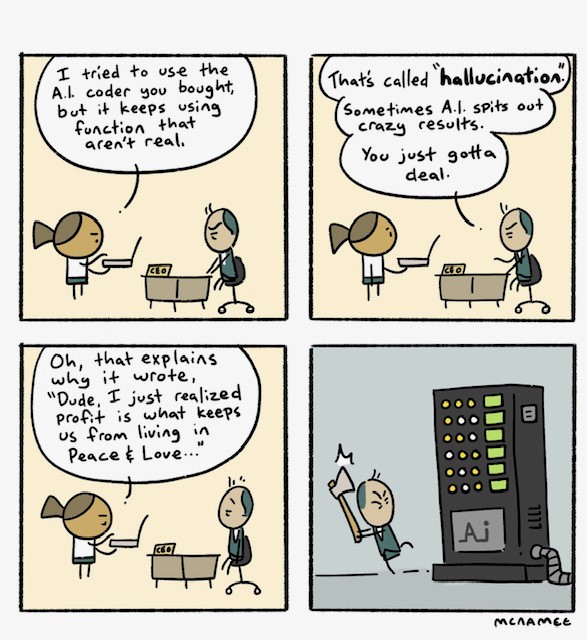
Written by Ali Saleh. Comic by John McNamee.
|
|
|
|