Have you ever found yourself answering dozens of emails, sifting through comments on document after document, jumping from meeting to meeting, and still ending the day feeling like you didn’t get much done?
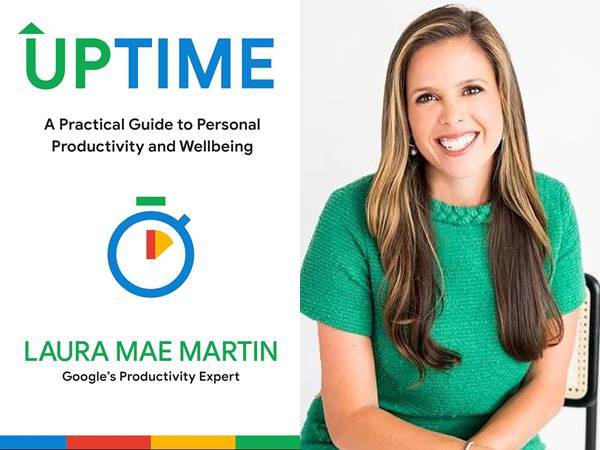
You might’ve been doing the wrong kind of work for a particular day, according to Laura Mae Martin, executive productivity advisor at Google and author of the new book Uptime: A Practical Guide to Personal Productivity and Wellbeing. She spoke with b. about how to tackle tasks effectively.
b.: Do you think it’s tougher than ever to be productive?
Martin: I do think remote and hybrid work presents new challenges with productivity. … Hybrid work can feel like we have two jobs in two places!
However, [it] allows us to capitalize on where we work best. For example, if you do your best-focused work at home, you can be intentional about keeping large work blocks free. … If someone asks you to a meeting, even a virtual one, you can offer up the days you’ll be in the office since you know you’ll be [less] focused those days. Alternatively, if you work best in the office, you can [have] large headphones or a small lamp that indicates to coworkers that if it’s on, you’re “on,” and please not to interrupt.
We can learn where we work best and optimize our locations based on those learnings.
b.: What do most people get wrong about productivity?
Martin: “Busy” is not important! Churning out work, if it’s not the right work, is not productive. Attending tons of meetings, if they’re the wrong use of your time, is not productive. An inbox full of emails is not a badge of honor; it’s a drain on your energy …
You want to keep a trade-off mindset at all times: Where am I spending energy? Where am I getting the best ROI for how I’m spending my time? … Is it the right time to do that task? Are you handling distractions ahead of time to make sure you can make the most of it?
Those are more important than the time itself. Time will come with good energy and attention practices. … Constantly play with Future You in mind, and you’ll find yourself happier and more aligned.
b.: In over a decade of helping Googlers become more productive, what are the most surprising things you’ve learned?
Martin: I’ve learned … that productivity is truly personal. It requires a reflection of yourself and how you operate, your natural rhythms. Nothing is one-size-fits-all.
For example, I don’t like the Pomodoro [technique]. It’s cited time and time again as a good productivity practice, and I’ve tried it, and it simply does not work for me. But what a great insight that is to know about myself and adjust from there. … Reflect on what works best for you and customize your days around that.
Uptime is available now.
This interview has been edited for length. Read the full Q&A at business.com.