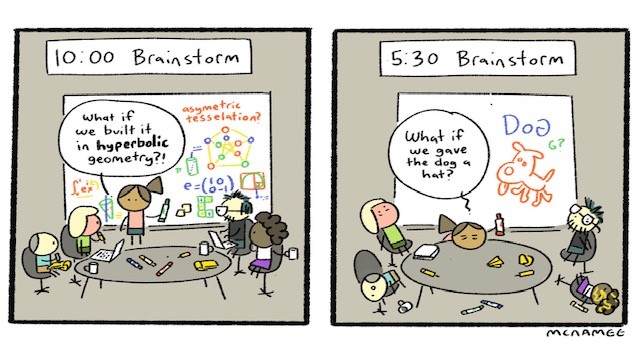
The company-sponsored happy hour is a time-honored tradition going back generations, allowing employees to relax and imbibe on the boss’s dime. But lately, nobody wants to schmooze with coworkers after 5 p.m., with attendance down across industries, according to The Wall Street Journal.
Maybe we all became introverted, antisocial homebodies during the pandemic. Maybe our Netflix, Max, Hulu, Prime, Apple TV+, Paramount+ and Disney+ (as well as every other “+”) queues aren’t going to watch themselves. Maybe alcohol has lost its appeal. Maybe the work-life balance movement has convinced us that networking — long considered the fastest path up the corporate ladder — is just more time spent on the clock.
Whatever the reason, this trend highlights the importance of creating a strong company culture and happy workforce, even without the happy hour.
|
|
|
Is an MBA Still Worth Pursuing With Today’s Tuition?
|
(Source: Midjourney/business.com)
|
In business, you get to set your own prices, but going too high will scare customers away — and major universities are on the verge of doing just that. According to The New York Times, Americans are losing faith in the value of a college education as grads are saddled with decades of debt.
Even a graduate degree is no guarantee of success. Librarians are required to earn master’s degrees, but they average less than $60,000 per year in most states, according to ZipRecruiter. Same for nutritionists.
But what about a Master of Business Administration? Will it set you apart and give you a leg up on the skills needed to run a successful company?
Most top-performing CEOs hold either an MBA or an advanced engineering degree, according to Harvard Business Review. For many professionals, any hope of climbing into the C-suite begins with acceptance to business school. An MBA is necessary for many lucrative roles in finance and operations. And, of course, the classroom is a great place to practice and hone skills in persuasion and strategic goal setting while making important connections.
But the MBA degree isn’t as prestigious as it once was. A 2022 study of 1,441 grad schools found mixed results for alumni salaries. “Over half of those degree programs do not show positive ROI,” researcher Preston Cooper told Inside Higher Ed. “So over half of students who are getting an MBA are going to be worse off for having gotten that degree.”
Professionals with advanced degrees carry double the student-loan debt of those with only bachelors’ degrees; in fact, top business schools like Wharton and Booth can cost upwards of $70,000 per year. The gamble is that a prestigious school’s name on a resume will pay for itself, but even Harvard Business School grads are feeling nervous lately, Bloomberg reports.
If you have a passion for business, an MBA could make sense and help you climb the corporate ladder. But if you’re primarily interested in money, Cooper’s research found that a STEM degree is more valuable nowadays… Maybe swap an MBA for MIT?
|
|
|
How to Identify a Solo Mission vs. a Team Project
|
Dr. Ben Baran is an associate professor at Cleveland State University and co-founder of Elevating What Works.
When a team works well, it achieves far more than any one of its members could have done on their own. And without high-performing teams, most businesses would likely struggle.
Yet teams aren’t always appropriate. For example, if a movie is credited to a half-dozen screenwriters, it’s not often a mark of quality. (Too many cooks spoil the proverbial broth.)
Before you even think about who should be on a team, consider two items: the tasks that team members would do, and the relationship — or lack thereof — among those tasks. The key idea here is what researchers call task interdependence. Here are four basic levels:
- None. Some tasks are best done by one person and require virtually no input or interaction with others to complete. In these situations, don’t use a team.
- Pooled. This occurs when several people work individually, and their individual inputs together form some sort of work product. In these situations, you probably don’t need a team; just an attentive manager to collect the inputs from each person.
- Sequential. Think about an assembly line. Each person’s task depends upon the input from another team member in a specific order. A team is likely useful in these situations.
- Reciprocal. The highest level of task interdependence requires ongoing communication and coordination. In these situations, you should definitely use a team.
Just because teamwork sounds like a good idea doesn’t mean it is one. Visualize how the tasks fit together and then decide if a team makes sense.
|
|
|
The Matrix: Your Best Hires Might Not Be ‘The One’ Right Away
|
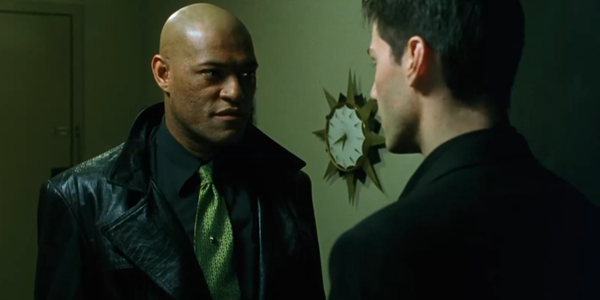
Sometimes you hire someone who looks great on paper — and sounds great in the interview — but when you give them a few tasks to start off with, they strike out. Did you make a mistake? Possibly, but maybe you should trust your gut like Morpheus (Laurence Fishburne) after recruiting Neo (Keanu Reeves) in The Matrix.
During his initial “I know kung fu” orientation, Neo botches a series of tests. Instead of hitting the ground running, he hits it falling while trying to jump across simulated rooftops. This makes the crew of Morpheus’ ship, the Nebuchadnezzar, doubt if Neo is “The One.”
But Morpheus has faith in his own recruitment decision; Neo just needs time to grow into the new role. After all, Neo isn’t a machine. As Morpheus implores, “You have to let it all go, Neo. Fear, doubt, and disbelief. … I can only show you the door, you’re the one that has to walk through it.”
By the end of the film, Neo has upskilled to the point of superheroics. It’s a reminder that your expected top performers might not impress right out of the gate — or, in this case, right out of the pod — but with training and trust, you’ll see them fly.
Speaking of machines … make sure your next hire isn’t a deep fake.
|
|
|
On Sept. 15 in Business History:
|
|
|
- 1857: Timothy Alder’s typesetting machine allowed for movable and rearrangeable printing symbols. Blame him for all your frustrations with the modern office printer.
- 1917: B.C. Forbes and Walter Drey founded Forbes magazine. At the time, it was the only major business magazine in the U.S.
- 1981: The Smithsonian restored and operated “John Bull,” the world’s oldest steam locomotive, after being out of commission for nearly 120 years.
- 2008: Lehman Brothers Holdings Inc. filed for bankruptcy protection, one of the major events that kicked off the Great Recession (and still the largest-ever U.S. bankruptcy by a margin of over 2:1).
- 2022: Patagonia founder Yvon Chouinard transferred ownership to a nonprofit so the company could devote itself to fighting climate change.
|
|
|
Written by Carolyn Neuhausen, Ali Saleh, and John McNamee. Comic by John McNamee.
|
|
|
|