Does replying with “OK” make you sound hostile? Does the thumbs-up emoji make you look old-fashioned? Does replying to emails immediately make you seem highly available or high-strung?
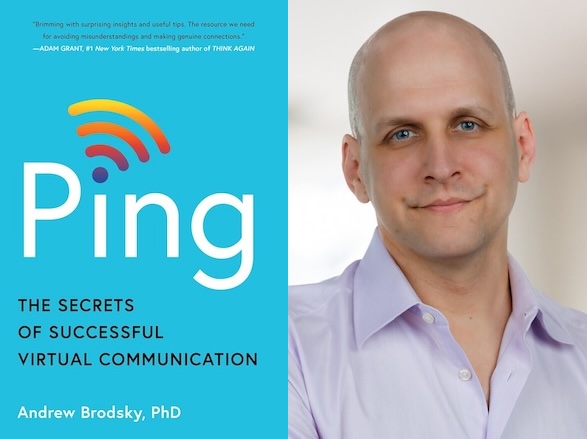
It feels like the rules are always changing, so University of Texas at Austin management professor Andrew Brodsky, Ph.D. — who holds degrees from Wharton and Harvard Business School — is clearing the digital air with Ping: The Secrets of Successful Virtual Communication. He spoke with b. about response time, AI-written emails and more.
b.: What did you set out to accomplish by writing Ping?
Brodsky: Whether you are a fast-food cashier whose manager sends you shift requests via text messaging or a corporate executive whose day is filled with emails and video meetings, we all need to understand how to use this technology to be effective and thrive at work. My goal is to help everyone be able to achieve that.
b.: How do we avoid getting bogged down by constant interruptions?
Brodsky: Some people respond to emails and instant messages as soon as they come in. Others suggest that you should check messages only once a day to avoid interruptions. Research indicates that the best approach is somewhere in between.
Specifically, it is best to “chunk” your virtual communication into about two to four confined periods throughout your workday [like] at the beginning of the workday, after lunch, and half an hour before signing off.
b.: If someone takes issue with your response time, how would you react?
Brodsky: Our communication partners don’t expect a response as quickly as we assume they do, which is referred to as the “urgency bias.” However, if someone does take issue with your response time, you can have a conversation with them in which you set expectations and give them a way to contact you in case of an urgent situation.
When it comes to someone who isn’t being communicative enough, the approach is actually the same: Have a conversation … in real time, as opposed to sending yet another message that may or may not receive a response.
b.: How do you feel about people using AI to make their emails sound friendlier or more professional?
Brodsky: AI can be useful for improving speed [but] can also backfire in many cases [as] the other person will recognize you didn’t craft the message yourself — because the AI-generated language sounds nothing like your normal writing style or leaves out knowledge you have from prior interactions, which … will significantly reduce how much the recipient trusts you.
To this point, there is a reason why handmade items [like] hand-blown glass are considered to be so much better than machine-made ones, and the same logic applies to our communication. Simply, they seem better and more effortful.
Ping is available now.
This interview has been edited for length. Read the full Q&A at business.com.