This article is sponsored by Intuit
Most small business owners know about the obvious tax deductions like office rent, insurance premiums and payroll. But the tax code contains hundreds of lesser-known deductions that go unclaimed every year, not because business owners aren’t eligible, but because they don’t know these deductions exist or don’t track the qualifying expenses properly throughout the year.
The result is a pattern of overpaying. That’s money that could be reinvested in the business, used to hire employees or simply kept as profit. AI-powered accounting tools are changing this by analyzing every transaction a business makes and matching spending patterns against comprehensive tax deduction databases, surfacing deductions that most business owners would never think to look for.
Why business owners miss tax deductions
The most common reason deductions go unclaimed is straightforward: the business owner didn’t know the deduction existed. The tax code is dense, and most people focus on the deductions they’ve always taken rather than researching what else might qualify. A freelance consultant may know to deduct their accounting software but never consider that their LinkedIn Learning subscription, industry association dues or coworking space membership are equally deductible.
Even when business owners are aware of a deduction, they often fail to document the qualifying expenses throughout the year. A receipt gets lost, a small monthly charge doesn’t seem worth tracking or a mixed-use expense – like a phone bill that’s partly personal and partly business – gets ignored because allocating the business portion feels complicated. Other times, expenses get categorized incorrectly, slotting a deductible purchase into the wrong tax category so it never surfaces during tax preparation.
Then there’s the caution factor. Many business owners err on the conservative side when it comes to gray-area expenses, choosing not to claim something they’re entitled to rather than risk drawing scrutiny. While caution is understandable, it also means leaving legitimate money on the table year after year.
How AI identifies deductions you’d otherwise miss
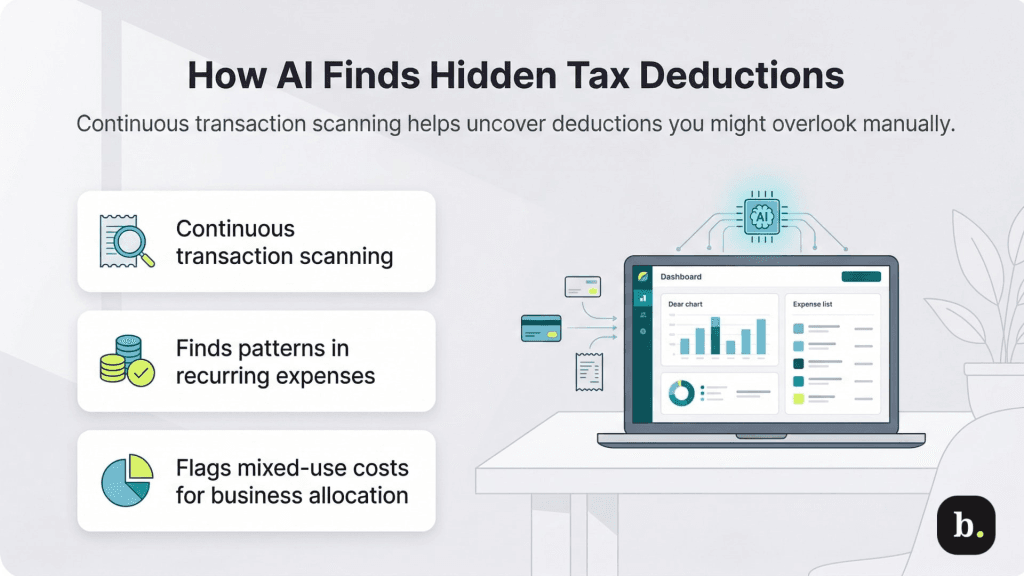
AI-powered accounting tools take a fundamentally different approach to deduction discovery than the traditional year-end review. Instead of waiting until tax season to sift through a year’s worth of transactions, AI works continuously, scanning every purchase, categorizing it in real time and matching it against IRS tax categories as the transaction occurs.
Transaction analysis and pattern recognition
AI scans all of your business transactions and matches purchases against comprehensive tax deduction databases. It recognizes deductible expenses based on vendor type, purchase amount and frequency, identifying patterns that humans typically miss.
For example, AI might notice that you’re paying a series of small monthly subscription fees across several software platforms. Individually, these might seem insignificant, but collectively, they could add up to hundreds of dollars in deductible business expenses annually.
AI also identifies mixed-use expenses and prompts you to allocate the business portion. If your phone bill, internet service or vehicle use is partly personal and partly business, the software can track and calculate the deductible percentage — a step most business owners skip because the manual math feels tedious.
Platforms like QuickBooks automatically categorize expenses into IRS-approved tax categories and can flag potential deductions you might have overlooked, such as the business-use portion of your home utilities or vehicle mileage beyond client visits.
Categorization intelligence
Beyond simply recognizing deductible expenses, AI assigns transactions to the most advantageous legitimate tax categories. It can distinguish between startup costs that should be amortized, capital expenses that qualify for depreciation, and purchases eligible for immediate deduction under Section 179. These are distinctions that have a real dollar-for-dollar impact on your tax bill.
For 2026, Section 179 allows businesses to deduct up to $2,560,000 in qualifying equipment and software in the year it’s placed in service, rather than depreciating it over multiple years. AI tools can flag qualifying purchases and recommend immediate deduction when it’s the more advantageous approach.
Deductions AI helps you find
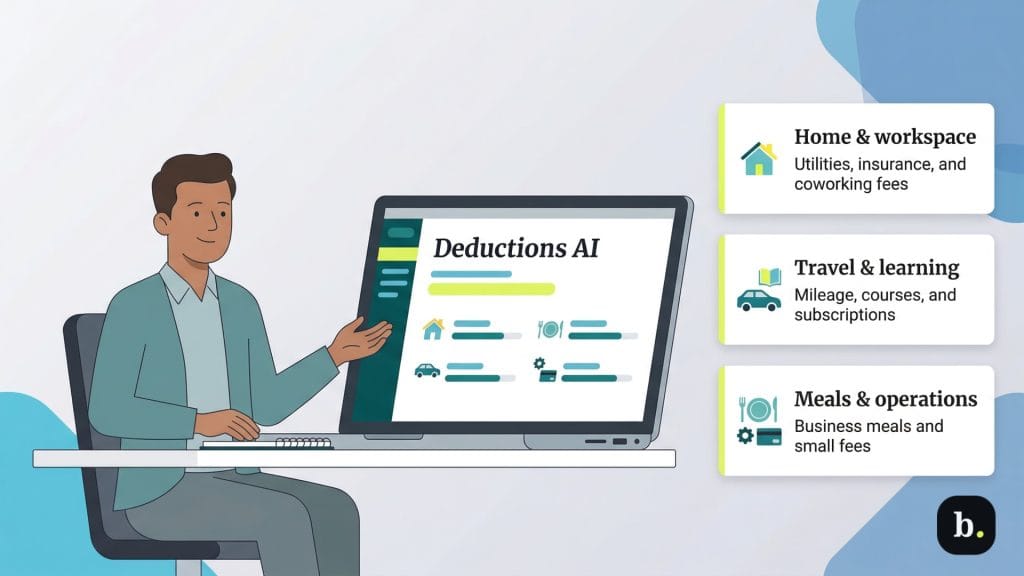
The deductions AI surfaces aren’t obscure loopholes; they’re legitimate, well-established tax benefits that most business owners simply don’t think to claim. Here are some of the most commonly overlooked categories.
Home office and workspace
Most business owners with a home office know the dedicated workspace itself is deductible. Fewer realize that a proportional share of their utilities, including electricity, water, internet and even trash removal, qualify. The same applies to homeowners insurance, property taxes and HOA fees allocated by the percentage of your home used for business.
If your office occupies 15 percent of your home’s square footage, 15 percent of those recurring bills may be deductible. AI can apply this percentage automatically once you set it, calculating the deductible portion of each utility bill without manual tracking. For those who use a coworking space instead, membership fees are typically fully deductible as a business expense.
Transportation and vehicles
Business mileage goes well beyond client visits. Trips to the bank for deposits, runs to the office supply store, drives to the post office for business mail and parking fees at any of these locations all qualify.
For 2026, the IRS standard mileage rate is 72.5 cents per mile, meaning every business trip you’re not tracking is money left unclaimed. AI mileage tracking tools can log trips automatically using GPS tracking and prompt you to categorize each trip as business or personal, creating the IRS-compliant mileage log you’d need in an audit. Some platforms also calculate whether the standard mileage rate or the actual expense method (tracking gas, insurance, maintenance and depreciation individually) produces a larger deduction for your situation.
Professional development and technology
Industry conferences get claimed as deductions, but what about online courses, professional journal subscriptions, certification exam fees or business books? All of these typically qualify, and AI is effective at catching them because they often show up as recurring subscription charges that humans overlook.
The same is true for technology expenses: domain registrations, web hosting, cloud storage, project management tools, email marketing platforms and software subscriptions like Adobe or Microsoft 365 are all deductible. Even hardware – monitors, keyboards, headsets, and other accessories – qualifies, either as an immediate deduction or through depreciation depending on the cost.
Business meals
Client dinners are the deduction everyone knows, but the category extends further. Working lunches with employees or contractors, coffee meetings with prospective clients and meals purchased during business travel all qualify at 50 percent deductibility for 2026.
It’s worth noting that the rules shifted in 2026 for employer-provided meals: meals previously offered on business premises for the convenience of the employer – like cafeteria meals or breakroom snacks – are no longer deductible as of January 1, 2026, a change enacted by the One Big Beautiful Bill Act. Client and travel meals, however, remain 50% deductible.
AI can help by identifying restaurant charges that occurred during business hours or near client locations, flagging them as potential deductions worth reviewing.
Operations, marketing and financial fees
Some of the most overlooked deductions are the small, recurring operational costs that feel too minor to bother tracking. Business bank account fees, credit card processing charges, merchant services fees, wire transfer costs and even NSF fees are all deductible. So are marketing expenses beyond paid advertising: business cards, website maintenance, logo design, promotional merchandise, sponsorships of local events and social media management tools.
Insurance premiums beyond basic liability (professional liability, cyber liability, business interruption, equipment insurance) also qualify. AI catches these because it scans every transaction regardless of size, surfacing the $9.99 monthly software subscription or the $15 wire transfer fee that a human would never bother to categorize manually.
Don’t ignore small deductions. A $10 monthly subscription is $120 a year. Multiply that across a dozen tools and platforms, and you’re looking at over $1,400 in deductions from charges you might never have tracked manually.
Best practices for maximizing AI-found deductions
Connect everything and categorize promptly
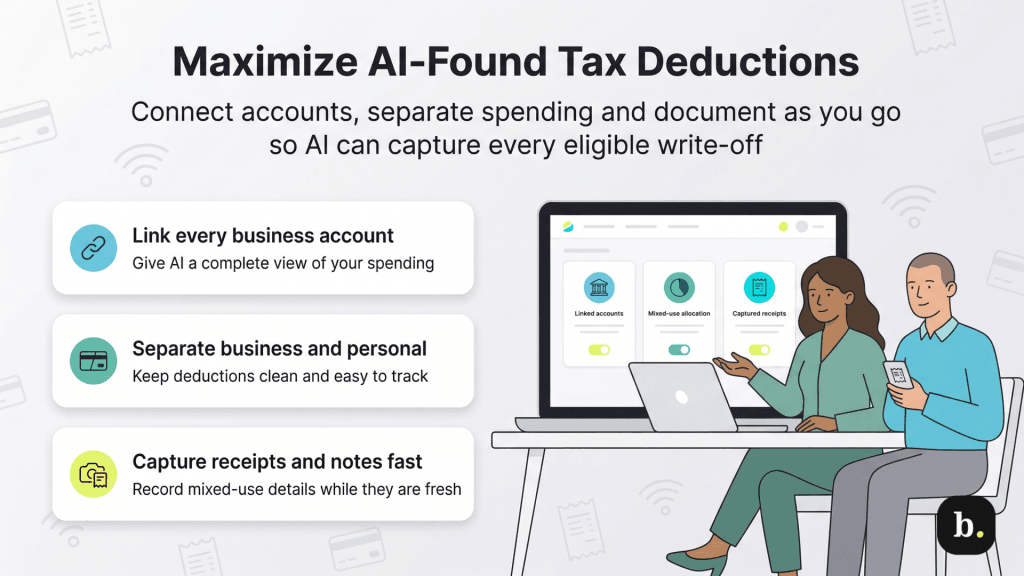
AI can only find deductions in the data it can see. Link all business bank accounts, credit cards, and payment platforms (including PayPal, Venmo for Business, Stripe and Square) so the system has a comprehensive view of your spending. Then review and confirm AI-suggested categories weekly rather than waiting until tax time.
Adding a brief note to ambiguous expenses explaining the business purpose takes seconds in the moment and saves significant headaches later. QuickBooks and similar platforms let you connect all of these accounts in one place, giving the AI a complete picture of your business finances from which to surface potential deductions.
Separate business and personal finances
One of the simplest things you can do to maximize deductions is keep business and personal spending on separate accounts. When everything runs through one card, identifying the business portion of each charge becomes a manual exercise that most people abandon. Separate accounts let AI automatically treat every transaction as a potential business deduction without the noise of personal spending mixed in. If you must use a personal account for a business expense, track it immediately and reimburse yourself through the business.
Document mixed-use expenses
Expenses that serve both personal and business purposes – your vehicle, phone, home internet, home office – require documented business-use percentages. Set these up once (your home office square footage as a percentage of total home space, for example) and AI can apply the correct allocation to every related expense automatically. Keep mileage logs for business versus personal driving, and maintain records of your business-use calculations. Once configured, platforms like QuickBooks apply these percentages to utility bills and recurring expenses without additional manual effort.
Capture receipts as they happen
The IRS requires documentation to substantiate deductions, and a missing receipt can mean a lost deduction. Mobile receipt capture tools let you photograph receipts at the point of purchase, and AI extracts the vendor, amount, date and category automatically, then matches the receipt to the corresponding bank transaction. This eliminates the shoebox-of-receipts problem and builds the documentation trail you’d need in an audit, all without any manual data entry.
Enable automatic categorization and review AI suggestions weekly. The system gets smarter over time, and consistent feedback means it catches more deductions with greater accuracy as the year progresses.
Working with your accountant on AI-found deductions
AI identifies potential deductions, your accountant confirms them. This partnership is where the real value emerges. AI surfaces expenses you might never have flagged, organizes them by tax category and generates year-to-date reports your CPA can review efficiently. Your accountant then applies professional judgment, confirming eligibility, ensuring compliance, reclassifying expenses to more advantageous categories when legitimate and making strategic recommendations about year-end purchases or timing decisions that could further reduce your tax burden.
Come prepared for that conversation with year-to-date reports organized by tax category, a list of AI-flagged deductions to review together, documentation for any unusual or large expenses, and notes explaining the business purpose of ambiguous items. QuickBooks allows you to invite your accountant for free access to your books, so they can review AI-categorized transactions and AI-identified deductions directly rather than working from exported spreadsheets.
The deadline for most tax-saving purchases is December 31, but estimated tax payments and retirement contributions have different deadlines. Your CPA can help you map out a year-round deduction strategy rather than scrambling at year-end.
The tax deductions you’re missing aren’t hidden in obscure corners of the tax code — they’re hiding in plain sight, in the transactions you make every day. AI-powered accounting tools surface these deductions by doing what humans can’t: scanning every purchase, categorizing it against comprehensive tax databases and flagging opportunities year-round instead of scrambling at tax time.
But AI is the starting point, not the finish line. The best results come from combining AI’s transaction-level analysis with a human accountant’s professional judgment. Let the technology find what you’re missing, and let your CPA confirm what you’re entitled to claim. That partnership saves time and money.