Business.com aims to help business owners make informed decisions to support and grow their companies. We research and recommend products and services suitable for various business types, investing thousands of hours each year in this process.
As a business, we need to generate revenue to sustain our content. We have financial relationships with some companies we cover, earning commissions when readers purchase from our partners or share information about their needs. These relationships do not dictate our advice and recommendations. Our editorial team independently evaluates and recommends products and services based on their research and expertise. Learn more about our process and partners here.
In a business.com survey of 1,050 workers, the top complaints show employees are not anti-AI. They’re tired of sloppy or thoughtless AI use that creates more work.

Ask workers whether AI helps them on the job, and many will say yes. Ask whether they like how AI is being used in their companies, and the answer gets a bit more complicated.
A business.com survey of 1,050 working U.S. adults found that 55 percent say AI has genuinely improved their work. At the same time, workers have a detailed list of complaints about how their colleagues and managers use it: unedited outputs, robotic messages, AI substituted for human judgment, and work that looks polished but creates more work down the line.
The survey set out to identify the specific AI behaviors that grate, first by asking workers to describe their frustrations in their own words, then by ranking those frustrations across a larger sample of respondents. What emerged was less a referendum on artificial intelligence than a set of new workplace rules for using it responsibly. The behaviors that bother people most are about effort, honesty, judgment, and who gets stuck fixing work that should have been reviewed before it was shared.
That distinction matters for any business owner rolling out AI right now. The friction your team feels may not be with the software. It may be with a workplace culture that rewards AI use without asking whether the work is accurate, thoughtful, or useful.
The survey shows that workers’ feelings about AI are more conflicted than hostile. In fact, 55 percent of professionals in the study said AI has greatly improved their work. But even as many employees recognize its value, they are far less tolerant of AI-generated work that creates more problems than it solves.
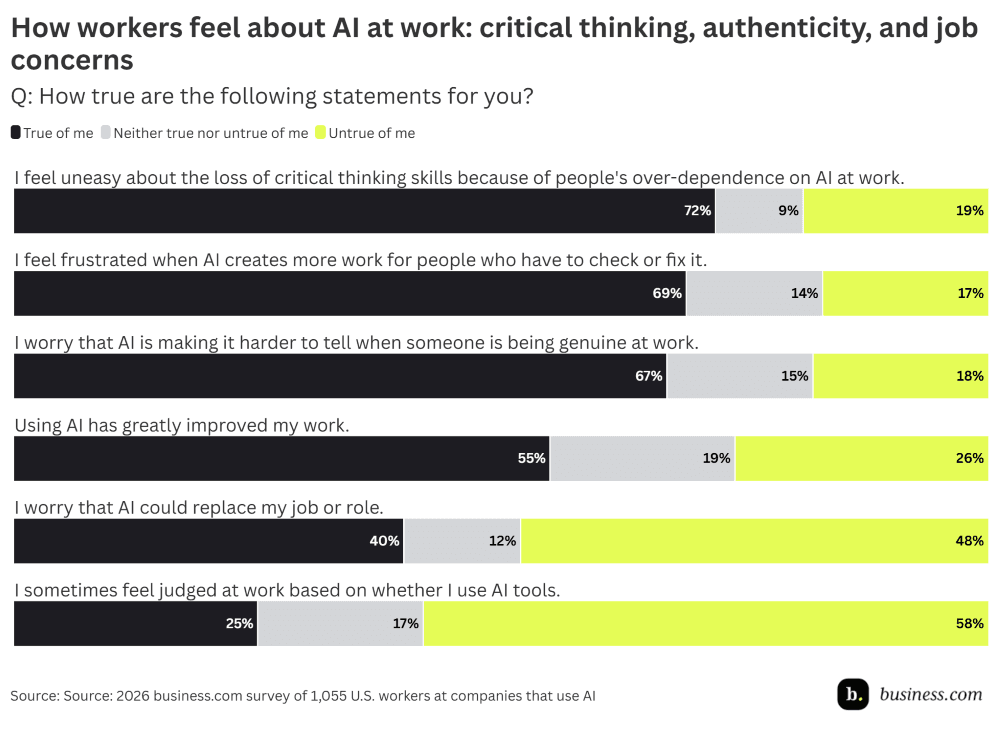
That frustration lines up with growing concerns about “work slop,” or AI-generated output that looks polished but lacks the substance, context, or judgment needed to move the task forward. Instead of saving time, it shifts the real work onto whoever has to check, fix, or redo it.
Research from BetterUp Labs and Stanford published in Harvard Business Review estimated that each instance of work slop costs nearly two hours of rework. Our data shows how that lands emotionally: 69 percent of workers say they feel frustrated when AI creates more work for the people who have to check or fix it. Meanwhile, 72 percent feel uneasy about the loss of critical thinking skills from over-dependence on AI, and 67 percent worry AI is making it harder to tell when someone is being genuine at work.
That tension helps explain the behaviors workers find most annoying. The biggest concerns are not simply about AI replacing jobs, though 40 percent do worry AI could replace their role. More often, workers are reacting to poorly reviewed outputs, unclear expectations, and workplace cultures that reward AI use without making sure it actually improves the work.
The most annoying AI behavior at work, according to a business.com survey of 1,050 workers, is someone using AI-generated work without checking it for mistakes, inaccuracies, or missing context. Sixty-two percent of workers rated this as very or extremely annoying, making it the worst offender among the 16 behaviors tested.
Here is the full ranking, based on the overall impact score, a measure from 0 to 100 that reflected how much annoyance a behavior causes across everyone surveyed.
Rank | AI practices in the workplace |
|---|---|
1 | Using AI-generated work without checking it for mistakes or missing context |
2 | Presenting AI-generated work as entirely one’s own |
3 | Relying on AI instead of one’s own judgment, expertise, or critical thinking |
4 | Assuming AI is more trustworthy than coworkers or subject-matter experts |
5 | Sending AI-generated content without editing it to reflect one’s own voice |
6 | AI work that creates extra work because errors must be corrected later |
7 | AI use that makes work feel less original, authentic, or human |
8 | Using AI to write emails or messages that feel impersonal or robotic |
9 | AI replacing the chances for direct communication with people |
10 | AI-generated images, videos, or other assets are used where human work is preferable |
11 | Managers using AI output to make decisions about employees |
12 | AI used in hiring decisions |
13 | AI use tied to performance reviews, promotions, or pay |
14 | AI used to monitor, evaluate, or track employee performance |
15 | Managers requiring AI for tasks that don’t seem to need it |
16 | An AI meeting notetaker recording without clear permission |
Source: 2026 business.com survey of 1,055 U.S. workers at companies that use AI.
The top issues on the list cluster around one theme. The five most-annoying behaviors all describe AI used as a replacement for human effort rather than a support for it: shipping unchecked work, passing AI output off as your own, trusting a chatbot over a colleague’s expertise, sending unedited AI text, and outsourcing your own thinking.
The open-ended responses from the survey make the stakes concrete. A 36-year-old compliance policy analyst described the downstream cost in her own field: “I regularly have to correct summaries sent to me by both employees and supervisors using AI to describe or create a rationale for microbiology or other laboratory procedures. It’s infuriating, and they should know better.” For workers, this is where work slop becomes more than an annoyance: one person’s shortcut becomes another person’s rework.
Women were notably more annoyed than men when AI work was passed off as human work, and workers 29 and under were more likely than older colleagues to object when AI substituted for judgment or expertise. On questions of authenticity and voice, Gen Z respondents were more protective of human input than their elders, not less.
Workers are far more resistant to AI that evaluates or tracks people than to AI that assists with tasks. When asked directly about their comfort level, 65 percent said they are uncomfortable with AI writing performance reviews or giving employee feedback, which was the most-disliked use on the list. Another 57 percent of workers say they’re uncomfortable with AI tracking their work activity, a dynamic that employers should weigh carefully before adopting employee-monitoring software.
AI application at work | Workers who are uncomfortable |
|---|---|
AI writing performance reviews or feedback about employees | 65% |
AI tracking work activity (apps, websites, keystrokes, or productivity metrics) | 57% |
AI screening job applicants (resumes, assessments, or interview tools) | 55% |
AI monitoring Slack, email, or Teams messages for policy or risk | 50% |
Source: 2026 business.com survey of 1,055 U.S. workers at companies that use AI. Multiple responses allowed.
Only a small proportion of employees in the study reported that their managers currently use AI for HR applications, such as hiring, compensation, or career advancement. However, those who work at companies where it does occur say it has a meaningfully negative impact.
What makes this finding sharper is that the people most affected are not the ones making the decisions about how AI is used. Non-managers are consistently more bothered than managers by every evaluative use of AI, which means the people choosing whether to deploy these tools are the least likely to feel their full weight.
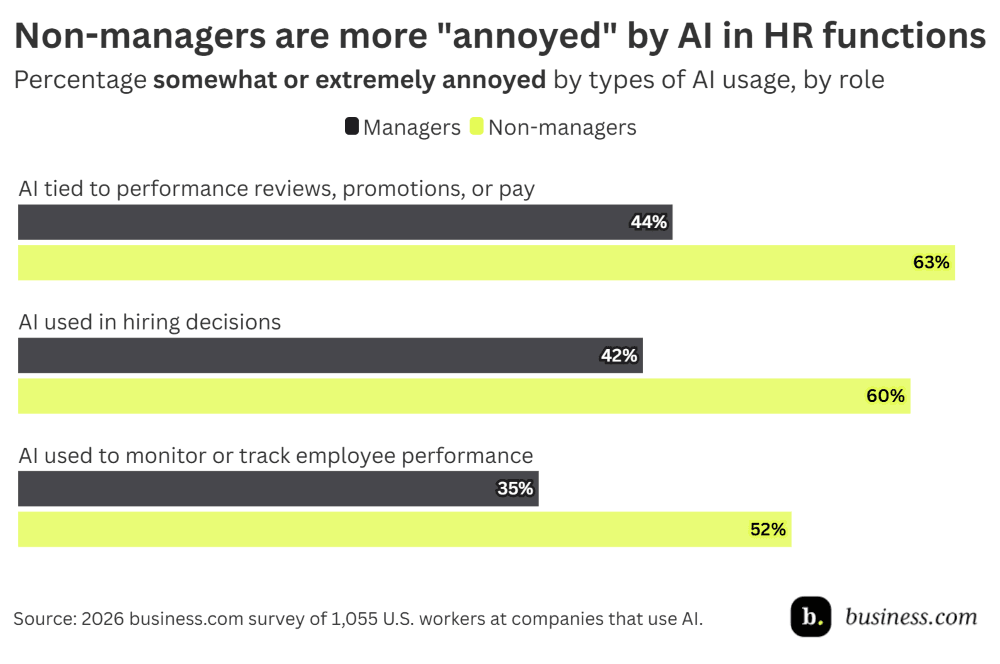
The widest gap between managers and employees is about AI tied to pay and promotions: 63 percent of non-managers find it very annoying when AI tools are used to determine pay raises or promotions, versus only 44 percent of managers, a 19-point spread.
The discomfort extends to AI surveillance as well: 77 percent of workers believe or know their employer uses AI to monitor workplace communications, and among those who attend online meetings, 44 percent say recordings or monitoring occur without their consent.
Recording meetings without consent is not just annoying; it is illegal in many states. Beginning in August 2025, the AI transcription company Otter.ai faced a wave of class-action lawsuits alleging that its notetaker recorded meetings without the consent of all participants, as documented by the National Law Review.
Workers subject to AI mandates are less annoyed by AI at work than workers in environments where AI use is optional or loosely encouraged. Given the backlash that followed Duolingo’s and Shopify’s “AI-first” announcements, it might seem as if most workers harbor anti-AI sentiments. Our research complicates that narrative. Workers in environments where AI is required or tied to performance reported lower overall annoyance with AI and were more likely to find AI suggestions helpful than workers in environments where AI usage is optional.
The data suggests the problem isn’t being told to use AI. It’s being told to use AI with no guidance on how to do it well and no tools to support it. Mandatory AI use with support and training sits better with workers than simply being given the option to use AI without guidance, which means the 24 percent of mandated workers who got little or no training are probably where most of the frustration lives.
A quieter cluster of numbers points to a fairness problem most leaders could fix by reallocating budgets or by investing in AI training programs. One in five workers (20 percent) is required to use AI for at least one task in the workplace, but mandate doesn’t always come with adequate support. Among those required to use AI, nearly one in four (24 percent) say they received little or no training. Access is rationed, too: 36 percent rely only on free-tier tools because their company won’t pay for better ones, and 10 percent pay out of their own pocket for AI tools they need for their jobs.
AI mandate, training, and access gaps | Percent of workers |
|---|---|
Required to use AI for at least one task | 20% |
Use only free-tier AI tools because the company won’t pay | 36% |
Pay out of pocket for the AI tools they use for work | 10% |
AI adoption tied to performance reviews | 5% |
Source: 2026 business.com survey of 1,055 U.S. workers at companies that use AI. Multiple responses allowed.
Companies want the productivity boosts that AI tools promise, but aren’t always funding the inputs, which pushes the costs (in money, time, and risk of data exposure) onto individual workers. That dynamic now has a name in the media: “bring-your-own-AI,” or shadow AI. This isn’t only a security headache for IT, it’s also an equity issue for staff. When some employees use limited free tools, and others quietly foot the bill for premium access on their personal credit card, you build a two-tier workforce where higher-income workers have an advantage.
Two in three workers (67 percent) never raised the behavior that annoyed them with their colleagues. The top reasons for staying silent involved conflict avoidance and feeling as though nothing would change if they raised the issue. Another 22 percent of those who didn’t speak up about their issues with AI were concerned it could impact their job or reputation.
Reasons why people don’t mention AI concerns at work | Percent of all workers who did not report concerns |
|---|---|
I didn’t want conflict | 54% |
It didn’t feel worth the effort | 53% |
I thought nothing would change | 34% |
I wasn’t sure how to bring it up | 23% |
I worried it could affect my job or reputation | 22% |
I didn’t know if it was allowed by company rules | 6% |
Source: 2026 business.com survey of 1,055 U.S. workers at companies that use AI. Multiple responses allowed.
The fear-of-reprisal concern was far more common among workers who were concerned about their managers’ use of AI: 22 percent stayed silent about a colleague’s AI use out of fear of reprisal, while 43 percent did so when the person involved was a manager. The people best positioned to fix bad AI habits are precisely the people employees are most afraid to tell. For employers, silence can be easily misread as acceptance of AI, but that might not be the whole story.
The practical takeaway of our research for business owners is that the biggest AI problems are trust, training, and accountability problems. Workers have not broadly rejected AI; many say it improves their work. What they object to is work slop being passed downstream, AI used to judge them without clear oversight, and workplace cultures that reward AI adoption without ensuring the output is accurate, useful, or fair.
Three action items stand out from our study:
First, companies need clearer norms for AI-generated work: employees should be expected to check outputs, add human judgment, and be transparent when AI meaningfully shapes the final product.
Second, employers should treat AI in evaluation and surveillance as a higher-risk use case, not just another productivity tool. With many workers uncomfortable with AI-written reviews and monitored communications, these applications require stronger guardrails, human review, and clear consent practices.
Finally, silence should not be mistaken for acceptance. With 67 percent of workers saying they never raised the AI behavior that annoyed them, and fear of job or reputational consequences rising when the behavior came from a manager, leaders may be getting very little honest signal about what is going wrong.
The companies that pull ahead will not be the ones that simply push AI hardest. They will be the ones to pair AI use expectations with training, properly funded tools, low-stakes feedback channels, and a clear rule: AI should reduce the burden on workers, not shift cleanup duties onto someone else.
The business.com survey used a two-phase design and was conducted in June 2026. In the first phase, working U.S. adults who use AI on the job answered open-ended questions about the AI behaviors they found frustrating, in their own words. Researchers coded those responses into themes, which became the behaviors rated in the second phase. The second phase was a structured online survey of 1,050 working adults, who rated the prevalence, annoyance, and impact of each behavior on five-point scales. Some open-ended responses included in this report were slightly edited for grammar and brevity.
Respondents were employed full- or part-time in professional, office, hybrid, or remote roles at companies that use at least one AI tool; all were U.S. residents. The final sample was 56.1 percent women, 43.0 percent men, and 0.9 percent who preferred not to disclose their gender. Ages ranged from 18 to 81, with a mean of 38.3 and a median of 37. No weighting was applied.
Two indices were calculated from the annoyance ratings. The Overall Impact Score (0 to 100) reflects annoyance across the entire sample; the Severity Score (0 to 100) reflects annoyance only among respondents for whom a given behavior was relevant.
