

Your free business.com+ membership unlocks exclusive tech deals and advisor support
Join Free
BDC Hamburger Icon

Menu

Close
BDC Logo with Name
Search Icon
Search Icon
Advertise with us
Advertising Disclosure
Close
Advertising Disclosure

Business.com aims to help business owners make informed decisions to support and grow their companies. We research and recommend products and services suitable for various business types, investing thousands of hours each year in this process.

As a business, we need to generate revenue to sustain our content. We have financial relationships with some companies we cover, earning commissions when readers purchase from our partners or share information about their needs. These relationships do not dictate our advice and recommendations. Our editorial team independently evaluates and recommends products and services based on their research and expertise. Learn more about our process and partners here.

Best AI Visibility Platforms for 2026

AI visibility platforms provide insight into how well your brand is performing in AI search. These are some of the best tools available.

Natalie Hamingson headshot
Written by:
Natalie Hamingson, Senior Writer
author image
Editor verified:
Adam Uzialko,Senior Editor
Last Updated Jul 02, 2026
Business.com earns commissions from some listed providers. Editorial Guidelines.
Hubspot AEO logo
HubSpot AEO
8.1 /10
Editor's rating
Best for Affordability
  • Starts at $50 per month
  • 25 initial prompts
  • Track 3 AI engines

Read Full Review

profound logo
Profound
8.0 /10
Editor's rating
Best for Enterprise Businesses
  • Starts at $99 per month
  • 50 initial prompts
  • Track up to 10 AI engines
Semrush logo
Semrush AI Visibility Toolkit
7.8 /10
Editor's rating
Best for Current Semrush Subscribers
  • $99 per month per domain
  • 25 prompts
  • Track 4 AI engines
ahrefs logo
Ahrefs Brand Radar
7.5 /10
Editor's rating
Best for AI Answer Insights
  • Starts at $199 per month
  • Custom prompts add-on
  • Track 7 AI engines
Peec AI logo
Peec AI
8.0 /10
Editor's rating
Best for Ecommerce Brands
  • Starts at $95 per month
  • 50 initial prompts
  • Track up to 11 AI engines
Table Of Contents Icon

Table of Contents

Open row

At business.com, we’ve spent years advising entrepreneurs, creating actionable guides for obtaining funding and managing business finances, and comparing and contrasting leading software and services to identify the best financial tools for small and growing businesses. Our playbooks and explainers are packed with advice from real business lenders, accountants, credit card processing experts, tax advisers and other finance professionals.

To inform our financial software and service recommendations, we put ourselves in the shoes of business owners and test each product’s effectiveness while taking into account its cost. Every review, whether it be for a credit card processing solution or invoicing software, is infused with our guiding principles: accuracy and objectivity. Learn more about our editorial process.

As AI engines have rapidly transformed the world of search and discovery, many businesses are asking how to keep up. It’s no longer enough to focus all of your organic marketing efforts on traditional search engines alone. Answer engine optimization (AEO) has emerged as a new category, now just as vital to any successful marketing strategy as SEO. Whether you’re a marketing agency running multiple campaigns or a small brand trying to find your audience, prioritizing AEO is a must.

AI visibility platforms help light the way, giving brands a clear picture of their current AI engine presence, along with the data they need to make decisions on which way to go next. We reviewed the top AI visibility platforms, from budget-friendly options for smaller organizations to more complex choices for large brands and agencies looking to scale their AI presence.

Compare Our Best Picks

BDC Ribbon
Our Top Picks for 2026
HubSpot AEO
Profound
Semrush AI Visibility Toolkit
Ahrefs Brand Radar
Peec AI
Rating (Out of 10)8.18.07.87.58.0
Best For

Affordability

Enterprise

Current Semrush Subscribers

AI Answer Insights

Ecommerce Brands

Free Trial

28 days

No

7 days

No

7 days

Pricing

$50 – $890 per month; contact for custom pricing

$99 – $399 per month; custom enterprise pricing available

$99 per month per domain; add-on services available

$129 – $1,449 per month; custom prompt packages available

$95 – $495 per month; custom enterprise pricing available

Users seats per plan

1-5 (add-on available)

1-3 (custom for enterprise plan)

1 (add-on available)

1 (add-on available)

Unlimited

AI engines tracked

ChatGPT, Gemini, Perplexity

ChatGPT, Perplexity, Google AI Mode, Gemini, Google AI Overviews, Microsoft Copilot, Meta AI, Grok, DeepSeek, Claude

ChatGPT, Google AI, Gemini, Perplexity

ChatGPT, Google AI Overviews, Google AI Mode, Gemini, Grok, Perplexity Copilot

$95 – $495 per month; custom enterprise pricing available

Prompts tracked (basic plans)

25

50

25

5

Unlimited

Customer support

Email support; guided onboarding for HubSpot Pro customers

Email support; Slack support for enterprise plans

Dedicated support contact

Live chat and email 5 days a week

ChatGPT, Google AI Mode, Google AI Overviews, Microsoft Co-pilot, Perplexity, Gemini, Qwen, Deepseek, Claude Sonnet 4, GPT 5 Search

Scroll Table

Our Reviews

Hubspot AEO logo
Editor's Rating: 8.1/10

With plans starting at just $50 a month, HubSpot AEO is our pick for the most affordable platform. The easy-to-navigate dashboard is perfect for small to mid-size organizations just dipping their toe into the AEO waters. Users get a snapshot of their overall brand visibility and a sentiment analysis immediately upon logging in.

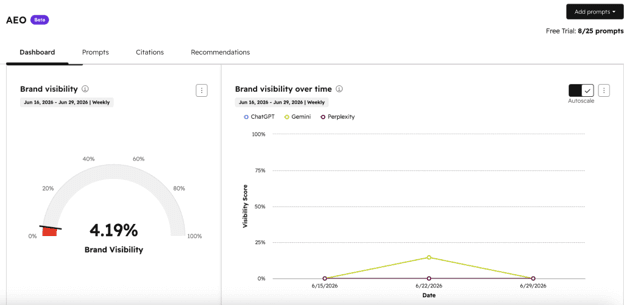
Hubspot AEO brand score

HubSpot AEO displays your brand’s visibility score over time, allowing you to easily filter between any or all of the three AI engines it tracks. In this example, we review our brand’s visibility for the last two weeks of June 2026 on all three AI engines, where we saw a notable spike on Gemini during the week of June 22.

HubSpot AEO tracks visibility across some of the most popular AI engines, ChatGPT, Gemini and Perplexity, which is plenty for brands that are just getting started out. However, some of the other platforms we reviewed include tracking of other AI engines like Claude and Microsoft Copilot at higher tiers, which larger businesses or those particularly focused on AI visibility may want to access.

Each day, HubSpot AEO offers tailored recommendations for improving visibility, including website and social media content suggestions. We really liked this feature, as it can be difficult to understand how to influence the still new and evolving AI visibility landscape; HubSpot’s recommendations offer helpful guidance so even small businesses that are new to AEO can make decisions with confidence. You’ll also get an overview of your top citations, side-by-side with an analysis of your top competitor’s performance.

The 28-day free trial (the longest free trial period we found in our review) means you have plenty of time to experiment with HubSpot before committing. Initial plans offer tracking for up to 25 prompts, which was standard among other platforms we reviewed, with options to upgrade for additional queries.

HubSpot’s AEO plan costs $50 per month (or $45 per month when you pay annually.) It includes 25 daily prompts across three AI engines daily, and if you need more than 25 prompts, you can purchase more for an add-on fee. This makes HubSpot AEO the most cost-effective AI visibility tool we found during our review. Although higher-tier plans from competitors offered access to more answer engines and more prompts, HubSpot was competitive against the base tiers of these companies and at a lower price point.

For larger organizations with more advanced needs, HubSpot’s Professional tier also includes the AEO module. This plan costs $890 per month (or $800 when paid annually) and also includes social media, lead scoring, omnichannel marketing automations and custom reporting. HubSpot’s Professional tier requires a one-time onboarding fee of $3,000.

If you need even more out of HubSpot, the Enterprise plan costs $3,600 per month. It builds on the Professional tier, offering multi-touch revenue attribution, customer journey analytics, journey automation and email approvals. The required one-time onboarding cost for the Enterprise plan is $7,000.

Users can test out the product to see if it’s a good fit in a 28-day free trial. You can also speak to a HubSpot representative about custom pricing options for your specific needs.

  • Affordable pricing for small businesses
  • Easy to understand interface and dashboard
  • Tailored recommendations for improving AI visibility
  • AI generated prompts are not the best quality
  • Not the best for larger brands and agencies with complex tracking needs
  • Limited customer service for lower tier plans

G2: 5/5

G2 users give the standalone HubSpot AEO product high reviews, with constructive recommendations for how to improve.

“I like the potential of HubSpot AEO to bring structure to how we understand and improve our discoverability. The ability to surface gaps in where we’re not being found—and recommend content to fill those gaps—is especially valuable, particularly when it can be filtered by audience or segment…I would find it much more valuable to be able to define segment-specific competitors, so that comparisons are more relevant to the audience we’re trying to reach…Having the ability to tailor competitive benchmarks by segment would make the insights far more actionable and meaningful,” one user wrote.

profound logo
Editor's Rating: 8/10

Profound is one of the most comprehensive AI visibility solutions for enterprise level organizations serving a range of sectors, including banking and tech, for multiple languages and locations. Starter plans track up to 50 prompts per month, though only on ChatGPT; if you want access to more engines, you’ll need to upgrade your plan. Profound also offers integrations with common marketing tools like Google Analytics and WordPress for all customers.

One feature that especially stood out during our review is Profound’s AI Crawler Visibility. This tool offers insight into exactly which AI engines are crawling your website, not just how you show up in AI-generated answers. Profound also benchmarks your performance beyond your top competitors, analyzing your visibility against all pages in their network.

Profound visibility score

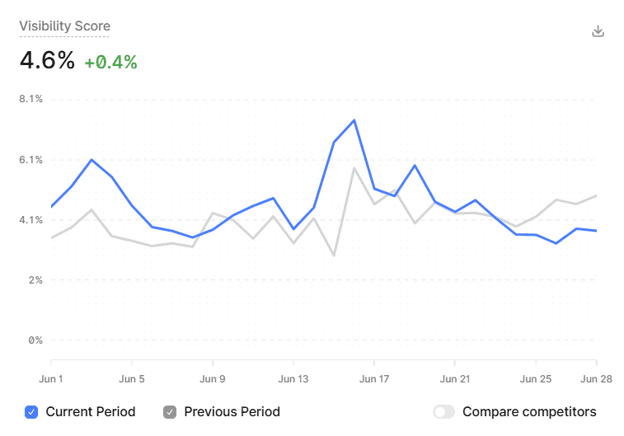
Profound offers several easy-to-use widgets that allow you to review your recent data at a glance. The visibility score (above) is just one indicator of how your brand shows up across all tracked AI engines. Profound also offers insights into share of voice, brand sentiment and competitive landscape. 

If you want extensive engine tracking, though, you’ll need to upgrade to the Enterprise level plan, which analyzes visibility for 10 engines, including ChatGPT, Perplexity, Google (AI Mode, Gemini and AI Overviews), Microsoft Copilot, Meta AI, Grok, DeepSeek and Claude. Some user reviews report that onboarding isn’t always straightforward, as self-guided learning can be a challenge with the lack of tutorials. However, Profound makes up for this in customer service, and will gladly walk you through any questions you might have.

Profound offers three pricing tiers for brands.

  • Starter: The Starter plan costs $99 per month for 50 prompts and only tracks answers on ChatGPT.
  • Growth: The Growth plan costs $399 per month and tracks 100 prompts across three major engines, ChatGPT, Perplexity and Google AI overviews.
  • Enterprise: Pricing for the Enterprise plan is custom and requires a call with Profound’s sales team. The Enterprise plan expands access to all 10 AI engines that Profound tracks.

Profound also has client-focused plans tailored for agencies specifically. The Agency Growth plan is $99 per month with add-on feature options, such as client workspaces for an additional $399 monthly. You’ll have to contact Profound directly for custom Agency Enterprise pricing.

  • In-depth analytics
  • Integrations with marketing tools available for all plans
  • Track up to 10 AI engines with the Enterprise tier.
  • Pricing can be expensive, especially for smaller companies
  • Breadth of features might not make sense for organizations just starting with AEO
  • Onboarding can be complex and time consuming.

G2: 4.5/5

“The best part of profound is that I am finally able to see how we show up in AI answers. Before this tracking our visibility across the different models was basically me guessing most of it. I also like the weekly summary a lot because I can pull the key numbers fast without having to dig. It makes it simple to share updates with the team. The dashboard is clean and easy to read so I can get the key numbers fast without digging deep,” a G2 User wrote.

Semrush logo
Editor's Rating: 7.8/10

Popular SEO tool Semrush now offers an AEO add-on to its existing suite, making it a great solution for existing Semrush customers already familiar with the platform’s interface. Users can track 25 prompts for platforms like ChatGPT and Google AI Overviews. The Visibility Overview, Prompt Research and Competitor Research features are capable of generating up to 300 daily reports. Metrics include sentiment and share of voice analysis, with detailed insight into what’s driving your current sentiment score. The tool will also flag any issues with your website that may be causing AI crawlers to overlook otherwise quality content.

Semrush’s Base plan for AI visibility starts at $99 per month for each domain you want to track. Add-on features include reporting tools for $10 to $20 per month. Businesses can add additional users starting at $45 per month, per user. Lead generation can also be added to your plan for $90 per month.

  • Easy integration for existing Semrush customers
  • Great choice for existing SEO teams
  • Base plan includes 300 daily reports
  • Additional cost as add-on to Semrush SEO suite
  • Not the best choice for those who don’t use Semrush for SEO
  • Limited number of AI engines tracked for price tag

G2: 4.4/5

“Semrush is my go-to for content strategy. The Competitor Gap and Keyword Research tools help me find missing and weak keywords so I know exactly what content to create. Domain Overview gives a quick snapshot of any site’s performance. What’s stood out recently is the AI Overview tracking. It shows where my site is being cited in AI search results. Helps me build my AEO strategy,” one G2 user wrote.

ahrefs logo
Editor's Rating: 7.5/10

Ahrefs Brand Radar tracks mentions across seven different engines, including Google AI Overviews, AI Mode, and Gemini, ChatGPT, Grok, Perplexity and Microsoft Copilot. We appreciate that Brand Radar shows exactly which AI-generated answers include your brand, word for word, as opposed to just noting which prompts earn your brand a mention.

You’ll also get a good sense of the third-party websites that are generating attention for your brand, with citation mentions from both your website and external sources. Unlike most platforms, Brand Radar allows you to purchase custom prompts as an add-on. With a database of over 250,000,000 search terms and keywords, Brand Radar also gives you the tools to see which general topics are generating visibility beyond direct brand mentions.

Ahrefs Brand Radar is available as a standalone product for $199 per month. Users can also track just their own prompts without competitor analysis starting at $50 per month for 80 prompts. Brand Radar is also included in all regular Ahrefs plans, ranging from $129 to $449 per month.

  • Able to see exactly which AI answers mention brand
  • Track visibility on seven AI engines
  • See which third-party citations generate brand mentions in AI answers
  • Somewhat expensive for limited data
  • No free trial, and Ahrefs free product doesn’t include Brand Radar
  • Some users have reported tracking over time is a challenge with changing metrics

G2: 4.5/5

“I have been using Ahrefs for the last 6 years, and it’s one of the best tools for SEO keyword research. It provides very accurate data on my current rankings, keyword trends, search volumes, and difficulty. Recently, Ahrefs also launched its AI visibility tracking feature, which is useful for tracking our visibility in AI overviews, ChatGPT, and similar platforms,” one G2 user wrote.

Peec AI logo
Editor's Rating: 8/10

Peec AI stands out as our top choice for e-commerce brands because of its AI Shopping feature. Available to all plans, Peec AI goes beyond mere brand mentions and also lets you track specific products that are showing up in AI engines.

With Peec AI, you won’t have to pay extra for additional seats. All plans, even the basic level, allow for unlimited user access. Unless you have the Enterprise plan, though, you can only track up to three AI engines. We did appreciate that users aren’t locked into specific platforms and can choose which engines they want to track, though.

All of Peec AI’s pricing plans offer unlimited seats. You can simply scale up as you need to track more prompts each month.

  • Starter: The Starter plan costs $95 per month for 50 prompts.
  • Pro: The Pro plan costs $245 per month for 100 prompts
  • Advanced: The Advanced plan costs $495 per month for up to 350 prompts.

Custom Enterprise pricing is also available. Peec AI also offers plans for agencies between $245 to $795 per month, as well as comprehensive Enterprise custom pricing options.

  • AI Shopping feature lets you track specific product mentions
  • Able to choose which AI engines to track
  • Unlimited users in every plan
  • Can only track three engines for all plans, except Enterprise
  • Difficult to track trends over time
  • Multi-country tracking only available for Advanced plans and above

G2: 4.9/5

Peec AI has earned mostly positive reviews on G2. One user wrote: “I find Peec AI easy to use and fairly straightforward. It’s the best tool for measuring how we show up in AI overviews and understanding how people are searching for us. I appreciate that it offers what more expensive companies bundle under hefty price tags. The initial setup was very quick, which I really liked.”

What Is an AI Visibility Platform?

AI visibility platforms are tools that measure your brand’s performance on popular AI engines, so you know which content is surfacing on AI overviews and in large language models (LLMs) like ChatGPT and Claude. With some AI visibility platforms, you’ll also get to see how you’re ranking compared to competitors and get tailored recommendations for how to improve.

As users continue to shift toward AI overviews and LLMs for search, AI visibility platforms help brands follow their target audience and understand how to reach them. Known by many names — Answer Engine Optimization (AEO), Generative Engine Optimization (GEO), Large Language Model Optimization (LLMO) — this evolving approach has become a priority for marketers who want to increase their brand’s reach on platforms like Google AI, ChatGPT, Gemini and Claude. But you can’t create a sound optimization strategy without the data to back it up, and that’s where AI visibility platforms come in.

AEO vs. SEO: What's the Difference?

Search engine optimization (SEO) is a strategy aimed at getting your brand to rank high on traditional search engine results pages (SERPs), such as Google or Bing. With an SEO strategy, the goal is to get your website to appear as high as possible on a list of relevant search results. AEO, on the other hand, is about getting your actual content cited within an AI-generated answer.

Let’s say a user is searching for the best chocolate chip cookie recipe. SEO is all about getting your brand’s recipe toward the top in a list of links on the first page of the SERP. A successful AEO strategy, on the other hand, encourages LLMs to pull instructions from the recipe on your page (along with a citation link pointing to your page) into an AI-generated answer.

The user may explore that answer’s citations and click on your website, leading to more organic traffic. Unlike an SEO strategy, however, clickthroughs are not the primary goal of an AEO strategy; strong AEO means your brand earns instant visibility within the answer itself.

For today’s marketers, it’s not enough to prioritize one over the other. Instead, it’s important to consider both AEO and SEO in your content strategy, which often deploy complementary tactics. Both SEO and AEO, for instance, prioritize content that’s to the point, easy to digest and features authoritative sources.

Did You Know?Did you know
In 2026, AI tools generated 45 billion monthly sessions worldwide, which is roughly 56% of online search volume. Tools like ChatGPT, Gemini, Perplexity and Claude accounted for the most growth.

Why AI Visibility Matters for Your Business

Audience discovery behavior is evolving at breakneck speed and forcing brands to change along with them. Many consumers are now engaging in zero-click searching, where the initial answer is their final one. Just as it sounds, they’re not clicking through to the original sources in an AI-generated answer’s citations. If brands want to reach their target audience, they have to assume that potential customers might not take that extra step of visiting their website. If you want future customers to find your brand, a mention in an AI-generated answer may be worth more than a page-one SERP appearance.

Key Features to Look for in an AI Visibility Platform

The right AI visibility platform for your business tracks the exact metrics you need to put together a data-informed AEO strategy. These are the top features to prioritize before committing to a platform:

  • Relevant prompt tracking: Whether you know which AI engine queries you want to monitor or you need a little guidance on what audiences are looking for, the best AEO platform lets you measure which questions are (or aren’t) getting your brand noticed in the answers.
  • Analysis of your competitors: How does the competition rank for search prompts you care about the most? A good AI visibility platform gives you insight into whose content is being featured most often, so you can see what a winning AEO strategy looks like in action.
  • Metrics for multiple AI engines: Focus on platforms that track your progress across several AI engines. You might find that your current strategy works great for Gemini but isn’t getting noticed in ChatGPT. Pay attention to which engines are available at which pricing tiers — some platforms offer tracking for a wide range of engines, but lock most of them behind their highest pricing tier.
  • Sentiment analysis tools: Go beyond brand mentions and see what AI engines are saying about your brand. Platforms with sentiment analysis tools will score how positively your brand appears in AI answers.
  • Customized recommendations: The right platforms show you what to do with all of this data, offering tailored suggestions for improving visibility, from better content to social post recommendations.
  • Measure over time: AEO often feels like it’s changing by the second, so it’s important to track your performance over a long period, so you can recognize patterns and make adjustments as you go.
TipBottom line
Look for AI visibility platforms that offer a free trial. This will give you a chance to test out the platform to make sure it’s right for your brand. A minimum of two weeks is ideal so you have time to meaningfully track your progress.

How Much Do AI Visibility Platforms Cost?

Most AI visibility platforms operate on a monthly or annual payment schedule. Plans with more limited features can start anywhere from $20 to $50 per month, perfect for small businesses that only want to track a narrow range of prompts. Should you need to expand for additional prompts or AI engines as your business grows, you can typically upgrade to a higher tier plan. Subscriptions that offer more advanced features, though, such as those that integrate with your CRM data, may run between $800 to $3,000 per month.

It’s possible to find free tools, but it may not be worth the investment of time if the platform doesn’t measure all the data you need to plan. Look for plans that offer free trials, so you have the chance to try out their tools and make sure their platform is right for your organization.

Who Needs an AI Visibility Platform?

Any brand that wants to improve their reach through cost-effective organic marketing can benefit from an AI visibility platform. Examples include:

  • In-house marketing teams: Trying to scale your marketing efforts without insight into AI visibility is like venturing into the dark without a flashlight. Marketing and communications teams for large organizations need AI visibility platforms if they plan to grow the brand at all.
  • Small to mid-size businesses: The lean teams running SMBs are often doing way more than just marketing. When you have to be a jack of all trades, saving time and money is crucial. Affordable AI visibility platforms can give SMBs the insights they need to plan effective and budget-friendly content campaigns.
  • Marketing agencies: AI visibility platforms can help agencies deliver the results their clients want to see. These platforms are vital to smart planning and tracking metrics that show concrete ROI. Agencies will likely need to invest in enterprise-level platforms that are capable of tracking multiple campaigns at a time.

Do You Need a Dedicated AEO Tool or Will Your SEO Suite Cover It?

An SEO suite alone is no longer enough for effective digital marketing. If your current SEO suite already has a built-in AI visibility tool, there’s a chance you already have what you need, but that depends on what features it offers. Small teams that only need basic tracking might be able to use their current SEO suite, or upgrade to a higher plan that includes AEO tools. Keep in mind, though, that the simpler your AI visibility platform is, the harder it may be to scale in the future.

How to Get Started With AI Visibility Tracking

1. Determine which prompts you’ll track

When starting out with an AI visibility platform, the first and most important step is to define the initial prompts you want to track. Some platforms offer AI prompt generation, but these tools don’t know your business as well as you do. Start with a few prompts targeted toward direct mentions of your brand, as well as more general prompts that cover topics related to your business. If your platform allows you to choose which AI engines to monitor, pick the ones you want to focus on. (In many cases, though, this will be pre-determined based on your plan.)

2. Identify key performance indicators

After setting up prompts, decide which metrics to prioritize. Are you concerned with benchmarking against competitors or are you focused more on tracking citations directly from your website? Or, is your main concern improving sentiment?

3. Monitor and test

Once your initial prompts are set up, decide how often you want to monitor your progress based on your metric priorities. It will likely take at least two weeks of tracking for your AI visibility platform to gather meaningful insights, as visibility scores can fluctuate quite a bit day to day. After a few weeks of tracking, it’s a good idea to check your progress on a weekly basis.

Common Mistakes to Avoid When Buying an AI Visibility Platform

When selecting the right AI visibility platform for your business, take care to avoid these common pitfalls:

  • Tracking the wrong metrics: If you’re only tracking brand visibility without considering other factors like sentiment, you’re not getting the full picture.
  • Using an AEO grader: One-time AEO graders aren’t the same as an AI visibility platform. While a free AEO grader might be a helpful first step, these tools only give you a partial snapshot of your visibility, instead of tracking progress over time.
  • Missing actionable insights: The right AI visibility platform tells you how to use all of the data you’re gaining. While your marketing team will ultimately tailor your AEO strategy, your AI visibility platform should support your planning efforts with detailed recommendations.
  • Paying for metrics you don’t need: Just because an AI visibility platform is capable of tracking a large amount of data doesn’t mean it’s useful to your brand. If your main concern is your ChatGPT performance, it’s not necessary to pay extra for a plan that tracks 10+ AI engines.

Methodology

To determine the top AI visibility platforms, we researched popular platforms, participated in free trials and conducted interviews with vendor representatives. We also did extensive research for customer feedback on community forums and review websites to get a general sense of other users’ experience.

Our top criteria for selecting the best AI visibility platform included pricing, prompt tracking, number of AI engines, recommendation offerings and capability to serve a range of organization types and sizes. We also considered ease of setup, overall usability and customer support, since many small businesses will be getting started with AI visibility tools for the first time.

FAQs

Answer engine optimization (AEO) is a strategy for improving visibility, including citations and brand mentions, in AI-generated answers for platforms such as ChatGPT, Gemini and Claude. AEO is sometimes also referred to as generative engine optimization (GEO) or large language model optimization (LLMO).

Zero-click searching occurs when users search for a question or prompt and only reference the AI-generated answer rather than click on any of the cited links.

While AEO is similar to SEO in many regards, such as creating high-quality, easy to digest content, the ultimate goal is different. With SEO, brands want to increase website traffic and clicks for their website link. AEO aims to simply get your brand mentioned in an AI-generated answer without the expectation of users visiting their website.

Unless your current SEO suite features built-in AEO tools that are included in your subscription plan, you will likely need a dedicated AI visibility platform.

It’s a good idea to review your AI visibility performance on a weekly basis.

Did you find this content helpful?
Verified CheckThank you for your feedback!
Natalie Hamingson headshot
Written by: Natalie Hamingson, Senior Writer