Check out The Best AI Visibility Platforms for 2026 business.com recommends.
Business.com aims to help business owners make informed decisions to support and grow their companies. We research and recommend products and services suitable for various business types, investing thousands of hours each year in this process.
As a business, we need to generate revenue to sustain our content. We have financial relationships with some companies we cover, earning commissions when readers purchase from our partners or share information about their needs. These relationships do not dictate our advice and recommendations. Our editorial team independently evaluates and recommends products and services based on their research and expertise. Learn more about our process and partners here.
HubSpot AEO provides detailed analytics regarding your AI search performance, including recommendations for how to improve.


Check out The Best AI Visibility Platforms for 2026 business.com recommends.
It’s no longer enough to put all your marketing eggs into one SEO basket. As users frequently turn to AI engines for search, brands are increasingly wondering how to get noticed in AI-generated answers. Enter the new realm of answer engine optimization (AEO), in which AI visibility platforms such as HubSpot AEO are pioneering tools that track and analyze how your brand shows up (or doesn’t) when users query AI engines like ChatGPT, Claude or Gemini.
HubSpot’s AEO platform gives organizations the tools to monitor and boost brand awareness across popular AI engines at a competitive price. It’s a great choice for small businesses on a budget or those just starting out with their AEO strategy.
HubSpot AEO is a standalone product that costs just $50 per month. While HubSpot Marketing Hub users can take advantage of the more advanced features, including the ability to connect directly to their HubSpot CRM software, we found in testing that the basic tier still has a lot to offer.
The HubSpot AEO starter plan covers all the bases you want to see in an AI visibility platform, such as citation tracking, competitor analysis and custom recommendations for improving your score. It’s perfect for brands that are plotting their initial AEO strategy and want to get a straightforward lay of the land. While it only tracks ChatGPT, Perplexity and Gemini, these three AI engines are among the most commonly used ones, so you can still get a solid sense of your brand’s AI visibility performance. For businesses trying to build momentum on a budget and don’t have time to implement complicated tech, HubSpot AEO is our top choice.
We found HubSpot’s interface to be intuitive and easy to navigate during setup and throughout our free trial. To get started, HubSpot requested our domain and information about our product before we were asked to generate our first prompts. Next, we were taken to the dashboard, which provided an initial snapshot of our brand’s visibility across our chosen prompts. HubSpot AEO’s dashboard also features a sentiment analysis, so you can see not just when and where your brand appears, but also whether you’re being mentioned in a positive light.
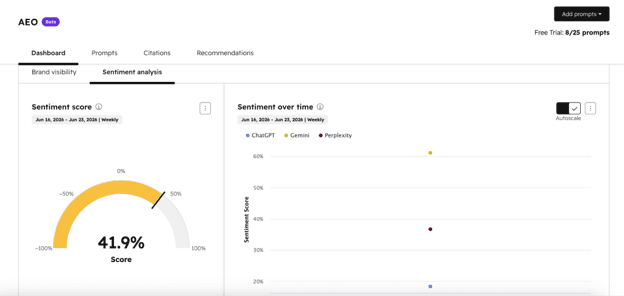
After setting everything up, we spent some time experimenting with the different features over a few days. We could easily drill into different metrics, including the menu of prompts we had decided to track, our featured citations and tailored recommendations for improving our visibility score.
It was also straightforward to adjust results for each of these categories by filtering for certain date ranges, location, customer profile and AI engine. If we were ever unsure what a feature was for, we could hover over it for a pop up that would explain the meaning and method behind each metric.
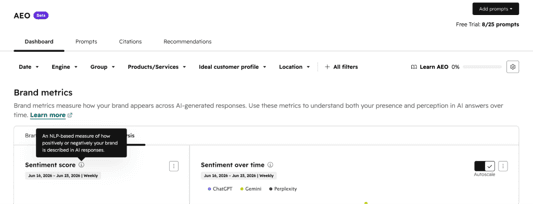
With HubSpot’s dashboard, it’s a good idea to review performance over time, as one day’s data doesn’t provide the full picture. We recommend tracking brand mentions and prompts for at least two to three weeks before making any assumptions about the data. During our free trial, we could see initial improvement in visibility over a relatively short period, but our score did fluctuate.
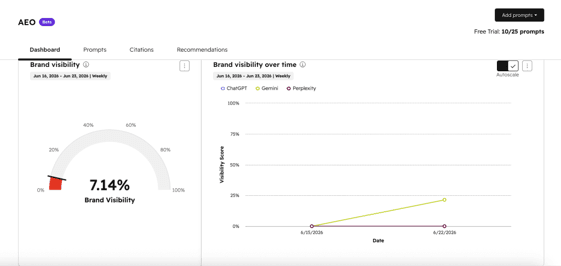
Our initial brand visibility score was under 5%, but grew to over 7% in just 24 hours. We liked that we had the options to look at both how we performed across multiple platforms and how we did within individual AI engines. Our brand visibility score was relatively low when we looked at how we performed across ChatGPT, Perplexity and Gemini. However, when we looked at just Gemini, our score tripled, signaling that our content was doing especially well on Gemini.
The dashboard also gave us a glimpse into how we stacked up among competitors. The Competitor Landscape feature, just below the brand visibility score, displayed top competitors with the greatest AI visibility, along with a breakdown of which competitors have the greatest share of voice.
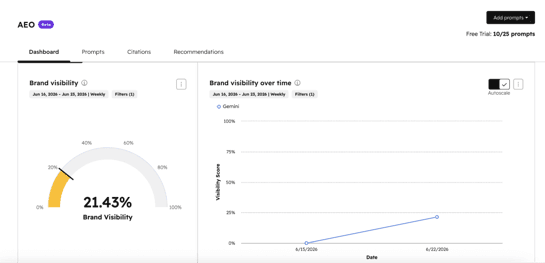
HubSpot AEO’s standard plan allows you to track up to 25 prompts at a time. The good news is that you’re not locked into your first set of prompts. If we didn’t find value in tracking a particular prompt, it was easy to delete and start over, and the removed prompts didn’t count against our total 25.
We had the option to either manually upload our own prompts or let HubSpot’s AI generate queries for us. With both options we were required to select our ideal customer profile, such as growing B2B and SaaS businesses in the U.S., along with the Buyers Journey stage we wanted to target.
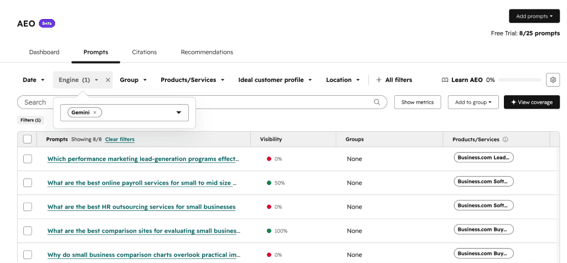
During testing, we wanted to add users in the Consideration phase to an existing prompt that was previously only tracking users in the Awareness phase of the customer journey. However, HubSpot advised against making adjustments to existing prompts, recommending that we instead delete and start over with a whole new prompt to avoid errors in tracking data. This extra step might be frustrating to some users, but we found it helpful for beginners who could use the extra guidance.
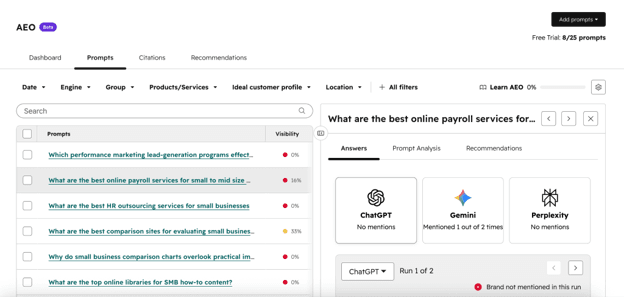
To that end, HubSpot AEO also provides detailed analysis for each prompt. We could click on an individual question, see exactly which AI answers included us as a source and when those answers included an actual mention of business.com. We could also see which specific links — both ours and our competitors — were cited within these AI answers. Insights also included a Prompt Analysis, showing how we ranked among competitors along with tailored recommendations for improving our visibility for that prompt.
It’s not enough to know when AI engines mention your brand. You want to know when specific pages and articles are actually being cited as an expert source. HubSpot AEO analyzes how often your brand is cited and how your citations rank compared to top competitors.
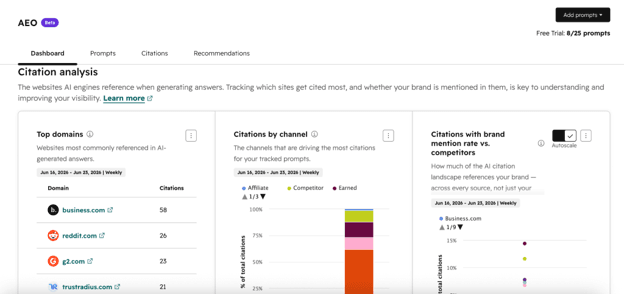
Before we looked at the Citation specific menu feature, the dashboard offered an initial glimpse with a Citation Analysis, breaking down overall top domains among competitors, our share of citation by channels, such as affiliate vs. earned media, and which share of citations explicitly mentioned our brand.
The dedicated Citations feature offers multiple overviews of how we ranked for citations based on our tracked prompts. We could see an overall percentage of how often we were cited compared to similar brands under Citations Performance Vs. Competitors, followed by a breakdown of citations by channel and media type, such as blog or comparison article.
At the bottom, we also could see an overview of citations for both us and similar brands, as well as our top owned citations specifically for business.com. It was helpful to have this data available in a formatted list of links, so we could see exactly which pages were being picked up by AI engines, and look at the specific links that were performing well from competitors.
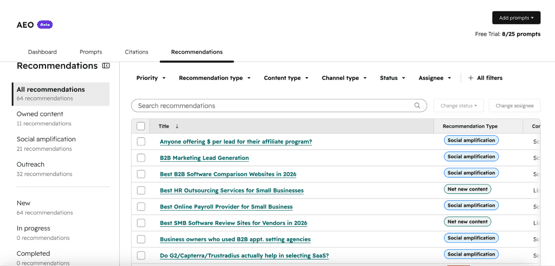
The world of AEO currently feels like one big guessing game, so we greatly appreciate that HubSpot offers detailed recommendations on how to improve. Recommendations are created based on high-performing citations from competitors. These include suggestions for new content, ways to amplify your brand with social media posts and videos, and recommended outreach for getting your brand featured on third party websites.
On our second day of testing, we had 64 overall recommendations, which could be filtered by low, medium and high priority. We were really impressed by the way this feature is designed for customers to take action and see results in real time. We could assign recommendations to specific team members and set the status to In Progress or Completed. According to HubSpot AEO’s guided tour, once users follow through with implementing recommendations, they can add that new url to the system and track when it ends up in an AI answer citation.
HubSpot AEO offers an affordable solution at only $50 per month, or $45 per month when you pay annually. The initial plan includes 25 prompts, but you can purchase additional prompts as needed. HubSpot offers a 28-day free trial, the longest free trial we encountered during our review of AI visibility platforms, so you can test out the product and see if it’s worth the investment for your brand.
HubSpot Marketing Hub Pro and Enterprise level customers also get access to HubSpot AEO, with the option to connect their CRM data for even more customized recommendations. These plans are best for larger businesses, as HubSpot Pro begins at $890 per month (or $800 when paid annually) for three core seats. HubSpot Enterprise starts at $3,600 per month and includes five core seats.
Since HubSpot AEO has such an intuitive interface, customers don’t have to worry about a huge learning curve. Getting started with the free trial was a simple process that took us about 15 minutes. It was relatively easy to figure out how to navigate each feature on day one.
HubSpot AEO offers some basic support for users during the free trial. When we signed up, we were immediately offered the opportunity to schedule a call with a representative to go over our initial questions. According to the rep we spoke to, the initial call is meant to be a discovery session, where a HubSpot rep can get a sense of your specific business goals so they can recommend a subscription plan. If you have specific technical questions, though, you’ll need to schedule a second call with a product specialist.
Guided onboarding is only available to HubSpot Pro plan customers for an additional one time fee of $3,000 for 12 guided sessions. All customers can access HubSpot’s Knowledge Base resource library for additional questions. However, when searching the Knowledge Base on our own, we did find that the available sources were somewhat limited when we wanted to gain more insight into how to properly utilize the Citations section. Users with specific technical questions will likely need to reach out to tech support, which is available to customers at all plan levels.
HubSpot Marketing Hub Starter plan customers have access to direct email support, while higher tiers are able to reach out by both phone and email. All customers can chat with other users in the HubSpot Community as well.
We did find negative reviews in our research, though, with mentions specifically for poor customer support. While HubSpot AEO has high ratings on G2, HubSpot’s overall Trust Pilot score is low at 1.7 out of 5 stars, with multiple comments noting it was difficult to get their questions answered.
While 25 prompts is a great start for smaller organizations with a narrow focus, this can be a challenge for larger businesses or marketing agencies that want to track multiple campaigns.
We also weren’t particularly impressed by the prompts generated by HubSpot’s AI. When we asked it to generate a prompt based on how our Buyer’s Guides perform among growing tech and SaaS companies, suggestions like “Why do small business comparison charts overlook practical implementation factors?” didn’t seem to accurately reflect our audience’s priorities.
We aren’t alone in our disappointment. In researching other customers’ experience with HubSpot AEO, we found numerous complaints and comments about the AI prompt generator, with many saying it didn’t seem to have a clear grasp of their business and product.
We researched the highest rated AEO services to determine the top AI visibility platforms. Our analysis included participating in free trials and conducting interviews with vendor representatives. We prioritized cost, usability, features and customer support when considering our best picks. We also conducted extensive research on customer feedback on community forums and review websites to get a general sense of other users’ experience.
We recommend HubSpot AEO for:
We don’t recommend HubSpot AEO for:
Check out The Best AI Visibility Platforms for 2026 business.com recommends.
