Business.com aims to help business owners make informed decisions to support and grow their companies. We research and recommend products and services suitable for various business types, investing thousands of hours each year in this process.
As a business, we need to generate revenue to sustain our content. We have financial relationships with some companies we cover, earning commissions when readers purchase from our partners or share information about their needs. These relationships do not dictate our advice and recommendations. Our editorial team independently evaluates and recommends products and services based on their research and expertise. Learn more about our process and partners here.
There’s more to the cost of business loans than just the interest rate. Here are the other factors you need to consider before accepting funding.


This article is sponsored by Big Think Capital.
When small business owners shop for financing, the first number they compare is almost always the interest rate. It makes intuitive sense that a lower rate should mean a cheaper loan. But, in practice, the interest rate is only one component of what a loan actually costs, and in many cases it is not even the most important one.
Origination fees, factor rates, repayment frequency, prepayment penalties and other structural features can dramatically change the total cost of capital. Two loans with nearly identical headline rates can differ by thousands of dollars in total repayment, depending on how they are structured. The result is that business owners who compare loans on rate alone routinely choose the more expensive option without realizing it.
This article breaks down the components that determine the true cost of business financing and walks through side-by-side examples that show how the math actually works. The goal is simple: to give you the tools to evaluate any loan offer on its real terms, not just the rate on the cover sheet.
Interest rate is a useful starting point, but it does not account for fees, repayment structure or term length, all of which affect what you actually pay. A loan at 10% APR repaid monthly over three years is a fundamentally different financial commitment than a loan at 10% APR repaid daily over 12 months, even though the stated rate is identical.
Part of the confusion stems from the fact that not all rates are calculated the same way. Traditional term loans and SBA loans are typically quoted in APR, which annualizes the total borrowing cost including certain fees.
Many alternative financing products, particularly merchant cash advances, use factor rates instead, a flat multiplier applied to the amount borrowed. A factor rate of 1.3 means you repay $1.30 for every $1.00 borrowed, regardless of how quickly or slowly you repay. That may sound straightforward, but it obscures the annualized cost, which can be significantly higher than a comparable APR figure.
The distinction matters because business owners comparing offers across different product types often find themselves looking at an APR on one term sheet and a factor rate on another. Without converting them to a common measure, a direct comparison is not possible.

Before signing any financing agreement, business owners should evaluate the following cost components. Not every loan will include all of them, but knowing what to look for prevents surprises after funding.
These are charged upfront, either as a flat dollar amount or a percentage of the loan. In some cases, origination fees are deducted directly from loan proceeds, meaning you receive less than the stated loan amount but repay the full balance. A $100,000 loan with a 3% origination fee nets you $97,000, but your repayment schedule is based on $100,000. That effective cost should be factored into any comparison.
Factor rates express total repayment cost as a simple multiplier. A $50,000 advance at a factor rate of 1.35 means you repay $67,500 total. To compare this against a traditional loan, you need to convert it to an approximate APR, which depends on the repayment term. Over six months, a 1.35 factor rate translates to a much higher annualized cost than over 18 months. Any lender that refuses to provide an APR equivalent should raise a red flag.
Some financing products charge a fee for early repayment, which may seem counterintuitive. The logic from the lender’s perspective is that early repayment reduces their expected interest income. For the borrower, this means paying off a loan ahead of schedule does not necessarily save money. Always ask whether the total repayment amount decreases if you pay early, and by how much.
Lines of credit often carry costs beyond the interest charged on drawn funds. Draw fees apply each time you access funds, and monthly or annual maintenance fees may apply whether you draw or not. These costs are easy to overlook during the application process but can add up substantially over the life of a revolving credit facility.
Repayment frequency directly affects cash flow. Daily ACH debits, common with merchant cash advances and some short-term loans, pull funds from your account every business day. Even if the total repayment amount is the same as a monthly-payment loan, the operational impact is different: daily pulls reduce your available working capital continuously and can create cash flow strain during slow periods. Beyond the cash flow impact, daily repayment effectively increases the annualized cost of capital because you are returning funds to the lender faster, reducing the time you have to use the money.
These are not direct dollar costs, but they are risk costs that should be weighed. A loan requiring a blanket lien on business assets or a personal guarantee exposes you to losses beyond the loan itself if the business cannot repay. Two otherwise identical loans may look very different when one requires a personal guarantee and the other does not.
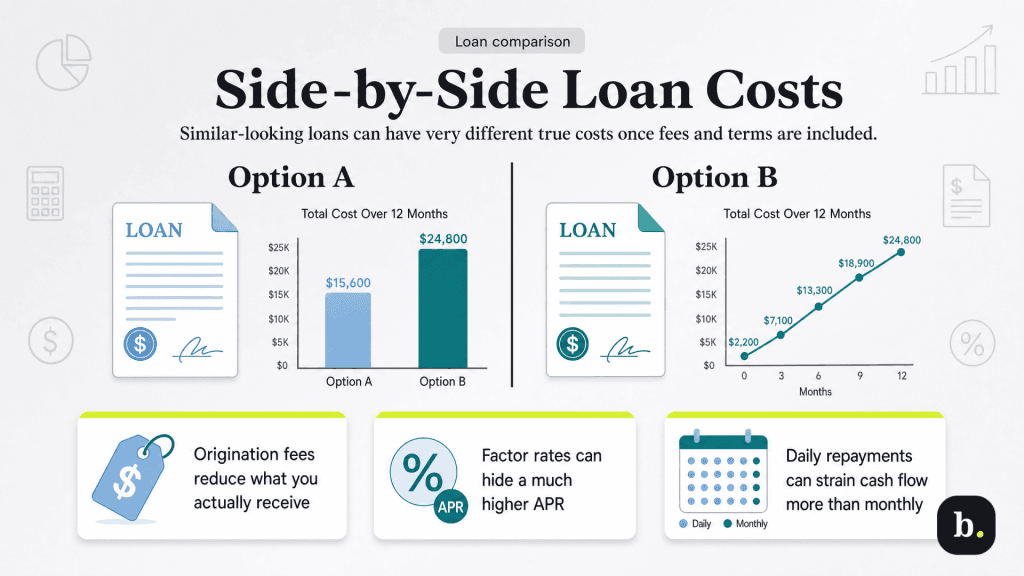
The following examples illustrate how structural differences change the true cost of financing, even when headline numbers look comparable.
Consider two term loans for $100,000 over 24 months:
Loan A | Loan B | |
|---|---|---|
Stated APR | 9% | 11% |
Origination Fee | 3% ($3,000) | None |
Net Proceeds | $97,000 | $100,000 |
Monthly Payment | ~$4,568 | ~$4,663 |
Total Repaid | ~$109,632 | ~$111,912 |
Total Cost of Capital | ~$12,632 | ~$11,912 |
Loan A | Loan B | |
Stated APR | 9% | 11% |
Origination Fee | 3% ($3,000) | None |
Net Proceeds | $97,000 | $100,000 |
Monthly Payment | ~$4,568 | ~$4,663 |
Total Repaid | ~$109,632 | ~$111,912 |
Total Cost of Capital | ~$12,632 | ~$11,912 |
Loan A has the lower rate, but after accounting for the origination fee, which reduces the actual proceeds to $97,000, the total cost of borrowing is higher. The borrower pays approximately $12,632 in total financing costs for Loan A versus $11,912 for Loan B. The loan that looked cheaper on paper is actually more expensive in practice, and the borrower receives less cash upfront.
A business owner is comparing a merchant cash advance with a short-term loan. Both provide $50,000 in funding:
MCA | Short-Term Loan | |
|---|---|---|
Rate | 1.35 factor rate | 28% APR |
Repayment Term | ~8 months (estimated) | 12 months |
Total Repaid | $67,500 | ~$57,903 |
Total Cost of Capital | $17,500 | ~$7,903 |
Approx. Effective APR | ~90%+ | 28% |
The factor rate of 1.35 sounds modest compared to 28% APR, but they are measuring entirely different things. The factor rate is a flat multiplier on the total advance. When annualized over the expected eight-month repayment period, the effective APR of the MCA exceeds 90% (dependent upon the frequency of repayment). The short-term loan at 28% APR, despite its seemingly high rate, costs less than half as much in total financing charges.
This is arguably the most common comparison trap in small business financing. Factor rates are not inherently predatory, but they require conversion to understand their true cost. Any business owner considering a factor-rate product should ask the lender to provide the approximate APR equivalent.
Two loans offer $75,000 at similar total repayment amounts over 12 months, but with different payment schedules:
Daily Repayment | Monthly Repayment | |
|---|---|---|
Loan Amount | $75,000 | $75,000 |
Payment | ~$365/business day | ~$7,266/month |
Total Repaid | ~$91,250 | ~$87,192 |
Cost of Capital | ~$16,250 | ~$12,192 |
Even setting aside the total cost difference, the daily repayment loan creates a fundamentally different cash flow experience. Approximately $365 leaves the business account every business day, reducing the operating cushion that most small businesses rely on to manage day-to-day expenses. During a slow week, those daily debits continue regardless of revenue, which can force a business to draw on other reserves or take on additional financing to cover operating costs, a cycle that compounds the cost of borrowing.
The monthly repayment loan, by contrast, gives the borrower predictable, once-a-month obligations that are easier to plan around and absorb within normal cash flow cycles.
The math matters, but you do not need a finance degree to protect yourself. Before signing any loan agreement, ask the following questions. A reputable lender will answer all of them clearly.
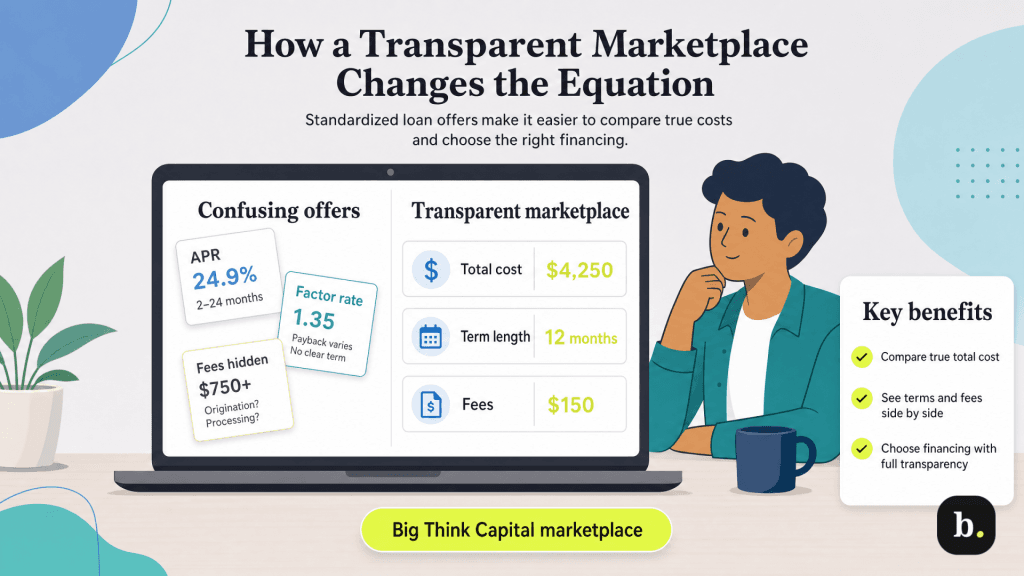
One of the practical challenges of comparing financing options is that each lender presents their offer differently. Some quote APR, others use factor rates. Some bury fees in fine print, while others deduct them from proceeds without clear disclosure. Business owners end up comparing apples to oranges, and the loan that markets itself most aggressively often wins out over the loan that is genuinely the best deal.
This is where marketplace-model lenders offer a structural advantage. Rather than negotiating with a single lender and hoping the offer is competitive, marketplaces allow business owners to review multiple offers in a standardized format, making it possible to compare total cost, repayment terms and fee structures across products.
Big Think Capital operates as this type of marketplace, connecting business owners with a range of financing options, including SBA loans, term loans, lines of credit, equipment financing and working capital, and presenting them with the transparency needed to make an informed comparison. Their approach is built around showing borrowers the full cost picture rather than leading with headline rates. For business owners who want to apply the framework outlined in this article to real offers, a marketplace that prioritizes transparency over volume is the right starting point.
Interest rate is a useful data point, but it is a poor decision-making tool when used in isolation. The true cost of business financing is determined by the interplay of fees, rate structure, repayment frequency, term length, and penalty provisions. Two loans that look similar on paper can differ by thousands of dollars in actual cost and produce very different cash flow experiences.
Before signing your next loan agreement, run the total repayment math yourself. Ask every question on the checklist above. And if a lender cannot clearly explain the total cost of their product, that is the most important piece of information they have given you.
