Your free business.com+ membership unlocks exclusive tech deals and advisor support
Join Free
BDC Hamburger Icon

Menu

Close
BDC Logo with Name
Search Icon
Search Icon
Advertise with us
Advertising Disclosure
Close
Advertising Disclosure

Business.com aims to help business owners make informed decisions to support and grow their companies. We research and recommend products and services suitable for various business types, investing thousands of hours each year in this process.

As a business, we need to generate revenue to sustain our content. We have financial relationships with some companies we cover, earning commissions when readers purchase from our partners or share information about their needs. These relationships do not dictate our advice and recommendations. Our editorial team independently evaluates and recommends products and services based on their research and expertise. Learn more about our process and partners here.

The Real Cost of Internet Downtime for Small Businesses

When your internet goes down, your business suffers. The costs can be steep, so finding reliable internet service is critical to keeping your business going.


author image
Written by:
Adam Uzialko, Senior Editor
author image
Editor verified:
Chad Brooks,Managing Editor
Last Updated Apr 28, 2026
Business.com earns commissions from some listed providers. Editorial Guidelines.
Table Of Contents Icon

Table of Contents

Open row

This article is sponsored by AT&T.

It’s 12:47 p.m. on a Friday. The lunch rush is in full swing, the line is out the door and then your credit card reader freezes. The POS system won’t process payments. You tell the next customer in line it’ll just be a minute. Then two minutes. Then five. By the time your internet comes back, half the line has walked out, your staff is frazzled and the negative Yelp reviews are already being typed.

Most small business owners don’t think about their business internet service until it fails. When it works, it’s invisible. When it doesn’t, it can bring operations to a complete halt, and the financial damage extends well beyond the minutes or hours you’re offline.

Understanding what downtime actually costs isn’t just an IT exercise. It’s a business continuity question, and the answer should shape how you think about one of the most foundational pieces of infrastructure your company relies on.

What internet downtime actually costs

The headline numbers around downtime are eye-watering, but they’re also easy to misread. According to the Information Technology Intelligence Consulting (ITIC) 2024 Hourly Cost of Downtime Survey, more than 90% of mid-size and large enterprises report that a single hour of downtime costs their organization over $300,000, and 41% put that figure between $1 million and $5 million per hour.

Those numbers apply to enterprises running mission-critical systems at scale. For small businesses, the math is different, but the relative impact can be just as damaging. Industry data from Sherweb puts small business downtime in the range of $127 to $427 per minute, meaning a three-hour outage could cost anywhere from roughly $22,500 to $77,000.

The reason those figures vary so widely is that downtime costs aren’t a single line item. They fall into three main categories:

  • Direct revenue loss: Direct losses refer to sales that don’t happen because customers can’t pay, orders can’t be processed or services can’t be delivered.
  • Labor costs during idle time: You’re still paying employees who can’t do their jobs. Multiply your average wage by your team size and the hours they’re blocked, and the number climbs fast.
  • Recovery and remediation: Recovery costs include IT support fees, overtime to catch up on lost work and any hardware, software or vendor costs required to get back online.

It’s also worth noting that downtime costs scale differently by industry. A retail shop that can’t process card payments for 90 minutes during a busy Saturday loses concrete revenue. A consulting firm that loses cloud access for the same 90 minutes may not lose revenue immediately, but it loses billable hours, breaks commitments to clients and erodes trust that’s much harder to rebuild.
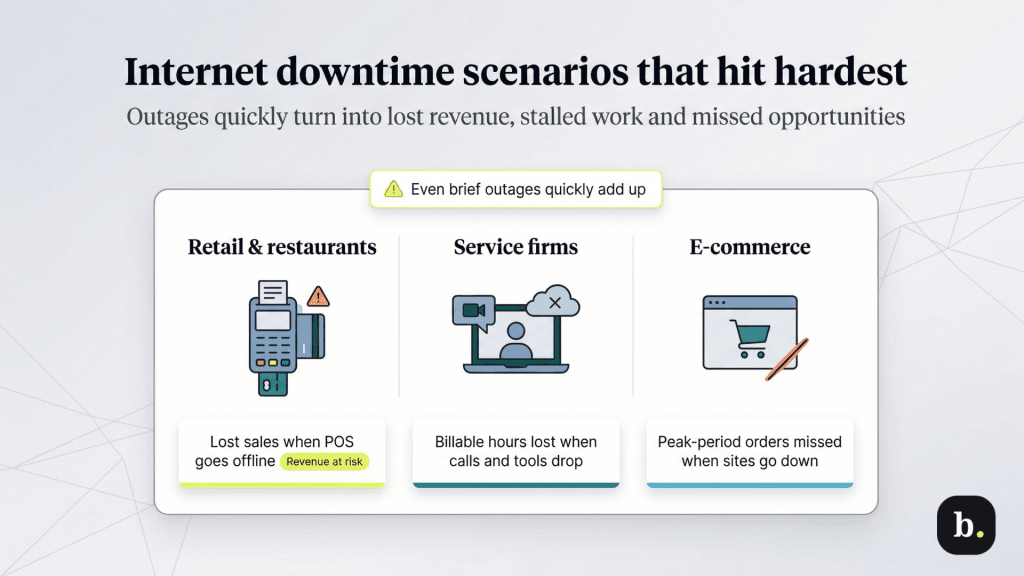
Internet downtime scenarios that hit hardest

Internet downtime scenarios graphic

The abstract numbers become a lot more concrete when you look at how downtime plays out in specific types of businesses.

Retail and restaurants

When the internet goes down, so does the POS system. Card payments fail, digital receipts don’t send and loyalty programs stop working. For a restaurant in the middle of lunch service or a retailer mid-sale event, even 30 minutes offline can mean dozens of abandoned transactions. 

Many of those customers don’t come back later — they just go somewhere else. A coffee shop doing $400 per hour at peak could realistically lose $1,000 to $1,500 during a typical outage window, before factoring in the customer who won’t return next week following the poor experience.

Service businesses and consultants

A dropped Zoom call during a pitch could ultimately cost a deal. Service providers increasingly run their businesses on cloud-based tools like project management platforms, document collaboration, client portals and VoIP phone systems. When internet service fails, all of it goes dark. 

A small consulting firm with five employees billing an average of $150 per hour loses $750 in billable capacity for every hour offline, on top of any reputational damage from missed meetings or late deliverables.

E-commerce and hybrid businesses

For businesses that sell online, internet downtime means the storefront is closed. Orders can’t be processed, inventory can’t sync between channels and customers who find your site down may not return. 

This is compounded during peak periods; a retailer whose site goes down for two hours on Black Friday isn’t just losing two hours of normal sales. They’re losing two hours of their highest-volume window of the year.
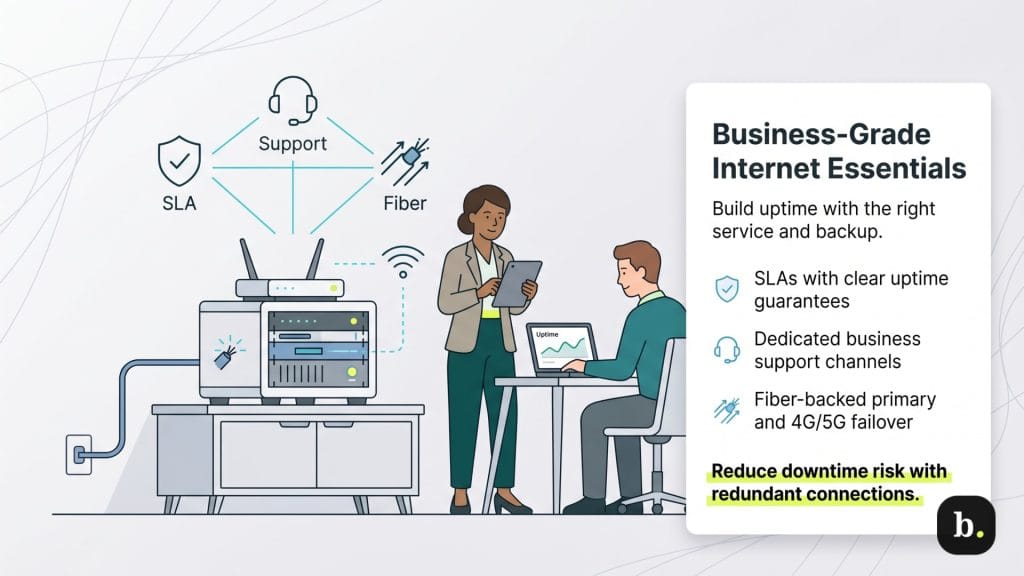
Hidden costs you don’t see on a balance sheet

hidden costs graphic

The direct costs of downtime are painful enough. The indirect costs are often larger, harder to measure and longer-lasting.

Lost productivity that extends beyond the outage

When the internet comes back, your team doesn’t immediately return to full productivity. There’s a backlog of emails, delayed tasks, missed meetings to reschedule and work to redo. Context-switching alone can meaningfully extend the productivity hit beyond the duration of the outage itself. Some research suggests businesses experience productivity losses of 60% to 76% during outages, with ripple effects lingering for hours after systems are restored.

Customer experience and reputation damage

A customer who has a frustrating experience during an outage doesn’t always give a second chance. They leave a negative review, tell a friend or quietly switch to a competitor. Small businesses, which often compete on service and reliability rather than price, are especially vulnerable. One bad interaction during an outage can undo months of relationship-building.

Opportunity cost

Some of the most significant costs of downtime are things that didn’t happen, such as the sales call that didn’t connect, the lead form that didn’t submit or the marketing email that went out 45 minutes late because your team couldn’t access the platform. These don’t show up on an invoice, but they show up in your growth numbers over time.

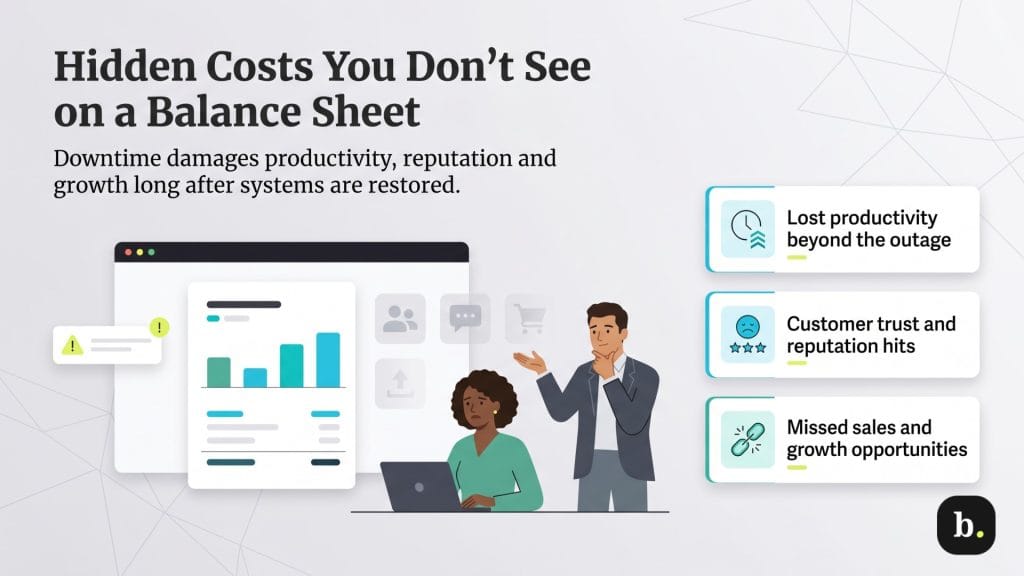
What reliable internet infrastructure actually looks like

reliable internet infrastructure graphic

Once you understand the cost of downtime, the next question is how to reduce your exposure. The good news is that the gap between consumer-grade and business-grade internet has become much more meaningful in recent years, and the latter is more accessible than many small business owners assume.

Business-grade internet typically differs from consumer service in a few key ways:

  • Service Level Agreements (SLAs): Contractual uptime guarantees with financial remedies if the provider doesn’t meet them. Consumer plans generally don’t include this.
  • Dedicated business support: Access to business-specific support channels, often with faster response times and technicians who understand commercial environments.
  • Higher reliability infrastructure: Fiber-optic connections, in particular, offer more consistent performance and fewer outages than legacy cable or DSL, with symmetric upload and download speeds that better match how businesses actually use the internet.

AT&T Business Internet is one example of a provider built around these requirements, offering fiber-backed service, SLA guarantees and dedicated support designed for commercial use. For small businesses evaluating their current setup, it’s a concrete reference point for what business-grade service includes and how it compares to what you’re currently paying for.

A reliable primary connection is the foundation, but for businesses where any downtime is unacceptable, redundancy matters too. A secondary internet connection, whether that’s a second wired line or a wireless failover through a 4G/5G backup, can keep operations running during a primary outage. Failover solutions have become more affordable and easier to deploy, making them realistic even for small businesses that previously considered redundancy an enterprise-only feature.

TipBottom line
We’ve reviewed some of the best business internet services on the market and selected our favorites. Check out our picks to see if any stand out as the right choice for your business.

How to assess your current risk

Before you can decide what level of infrastructure investment makes sense, you need a clear picture of where you stand today. A few questions to work through:

  • How often do you experience slowdowns or outages? Informal memory isn’t reliable here. Track incidents over a month or two to get a real baseline.
  • Do you have an SLA with your current provider? If not, you have no contractual recourse when service fails.
  • What’s your estimated hourly cost of downtime? Use the framework from Section 1: add direct revenue loss, labor costs for idle employees and any recovery costs you typically incur. Even a rough estimate is far better than none.
  • How dependent are your core operations on the internet? POS systems, VoIP phones, cloud-based tools, video conferencing — the more of your day-to-day that lives online, the higher your exposure.
  • Do you have any redundancy? A single connection with no failover is a single point of failure for your entire business.

Once you’ve answered these, compare what you’re currently spending on internet service to what even a handful of hours of downtime per year actually costs you. For most small businesses, the math heavily favors upgrading.

Bottom LineBottom line
Internet reliability is a business continuity concern. Every hour your business is offline is an hour of lost revenue, idle labor, damaged customer relationships and missed opportunities. The cost of upgrading to reliable, business-grade internet is, in nearly every case, less than the cost of even a few hours of meaningful downtime per year. If you’re evaluating your current setup, it’s worth exploring AT&T Business Internet plans to see what’s available in your area, including fiber options with SLA-backed uptime guarantees designed specifically for business use.
Did you find this content helpful?
Verified CheckThank you for your feedback!
author image
Written by: Adam Uzialko, Senior Editor
Adam Uzialko, the accomplished senior editor at Business News Daily, brings a wealth of experience that extends beyond traditional writing and editing roles. With a robust background as co-founder and managing editor of a digital marketing venture, his insights are steeped in the practicalities of small business management. At business.com, Adam contributes to our digital marketing coverage, providing guidance on everything from measuring campaign ROI to conducting a marketing analysis to using retargeting to boost conversions. Since 2015, Adam has also meticulously evaluated a myriad of small business solutions, including document management services and email and text message marketing software. His approach is hands-on; he not only tests the products firsthand but also engages in user interviews and direct dialogues with the companies behind them. Adam's expertise spans content strategy, editorial direction and adept team management, ensuring that his work resonates with entrepreneurs navigating the dynamic landscape of online commerce.