Business.com aims to help business owners make informed decisions to support and grow their companies. We research and recommend products and services suitable for various business types, investing thousands of hours each year in this process.
As a business, we need to generate revenue to sustain our content. We have financial relationships with some companies we cover, earning commissions when readers purchase from our partners or share information about their needs. These relationships do not dictate our advice and recommendations. Our editorial team independently evaluates and recommends products and services based on their research and expertise. Learn more about our process and partners here.
Many employers are cutting marijuana from their drug testing process. Learn the pros and cons of testing workers for weed use to see if it makes sense for your business.

Although marijuana is still a Schedule I substance and illegal under federal law, many states have legalized its use in recent years. A Pew Research Center analysis found that 54 percent of Americans now live in a state where marijuana is legal for both recreational and medical use, while 74 percent live in a state that allows either recreational or medical use. This widespread legalization may be good for some, but it can spell disaster for small businesses — especially those that operate in multiple states with different laws.
As more states move toward “puff, puff, pass-ing” laws that legalize pot use, human resources departments need to determine what the trend means for their employment screening process and background checks. So, should businesses still drug test for marijuana?
Support for marijuana legalization remains at historic levels. According to a Gallup poll, 70 percent of Americans believe marijuana should be legal. States must be listening to what the people want, because 40 states, three territories and Washington, D.C., have legalized the use of marijuana, be it medically, recreationally or both.
Many employers currently drug test workers for illicit substances, including marijuana, as part of their preemployment screening process. While this might have made sense when pot was an illegal substance across the entire country, the legalization of marijuana in parts of the United States has caused a domino effect of marijuana-related state laws and regulations that businesses should be aware of.
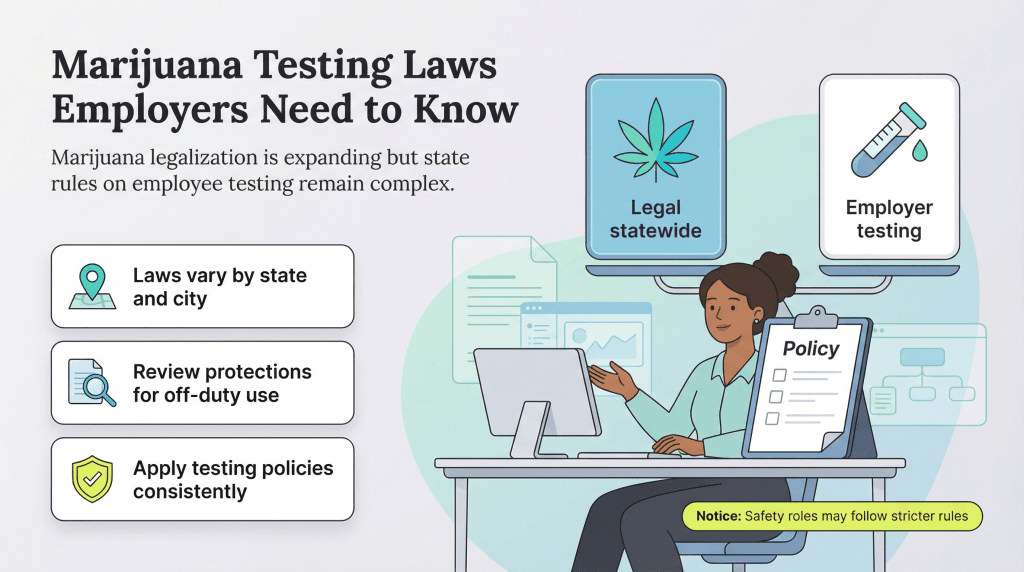
“As more and more states legalize marijuana, these states will also invariably pass laws protecting off-duty marijuana use,” Dan Kalish, managing partner and co-founder of HKM Employment Attorneys LLP, told us. “For this reason, it is imperative that any employer check the updated laws in their state (and city) before implementing a drug testing policy.”
For example, according to the Marijuana Policy Project, at least nine states have passed cannabis employment laws that offer some level of employment protection.
When reviewing current state employment laws, employers should note these key regulations:
On the flip side, there is no federal law that prevents marijuana drug testing and many states leave the decision up to the individual employer.
Strong arguments can be made in support of both, including and excluding weed in drug tests, so businesses should carefully weigh the pros and cons to determine if they should continue testing their job candidates and employees for marijuana use.
“Employers should be clear about their policies for marijuana and other drug testing and administer those policies consistently and in accordance with applicable law,” said Jackie Staple, labor and employment attorney and partner at Jackson Walker LLP.
Although some companies might forgo testing job candidates and employees for marijuana use — or cut drug testing altogether — there are still some benefits of continued drug testing to consider.
There are heavily regulated industries and certain professions, such as school bus driver, airline pilot and federal contractor, where job candidates and employees must be tested for drugs and marijuana is on the list of no-go substances. Employers operating in these regulated spaces should probably continue drug testing employees if they want to stay compliant with federal, state and local regulations.
“As mentioned, there are certain employers that are required to test, such as those subject to some certain federal regulations as well as government contractors,” Staple said. “Employers may also have contractual obligations to test, for example, staffing agencies or vendors.”
Another regulation to consider is the Occupational Safety and Health Act (OSHA). This legislation has a general duty clause that requires employers to provide a safe work environment for their employees. While OSHA might not set explicit standards for drug-free workplaces, substance abuse in the workplace can be a hazard to the user and others. If this is considered the case at your business, you are legally required to ensure your employees are drug-free (marijuana included) to avoid causing harm to themselves or others.
“Legally speaking, if an employer does not take the necessary steps to ensure its employees are not impaired, such as failure to test, the employer could potentially be liable for any accident or misconduct by the impaired employee,” Kalish said.
Speaking of keeping people safe, workplace safety is another reason why many employers choose to continue drug testing job candidates and employees. Drugs of any sort can cause workplace safety issues and marijuana alone can have side effects like lightheadedness, dizziness, drowsiness and fatigue. More serious side effects can include disorientation and even hallucinations. Since weed impairs judgment, attention and coordination, a staffer working in certain conditions while high could be a safety risk for other employees and your customers, which is something you want to prevent.
This is especially relevant for employees in specific industries or roles. For example, a graphic designer might not cause injury to others if they light up a joint while working on their computer remotely. However, a high employee operating heavy machinery can cause serious harm to themselves and others while working under the influence. By the same token, is it any wonder fleet safety compliance involves screening for controlled substances and alcohol use? You wouldn’t want an employee to get behind the wheel of a company vehicle after smoking up.
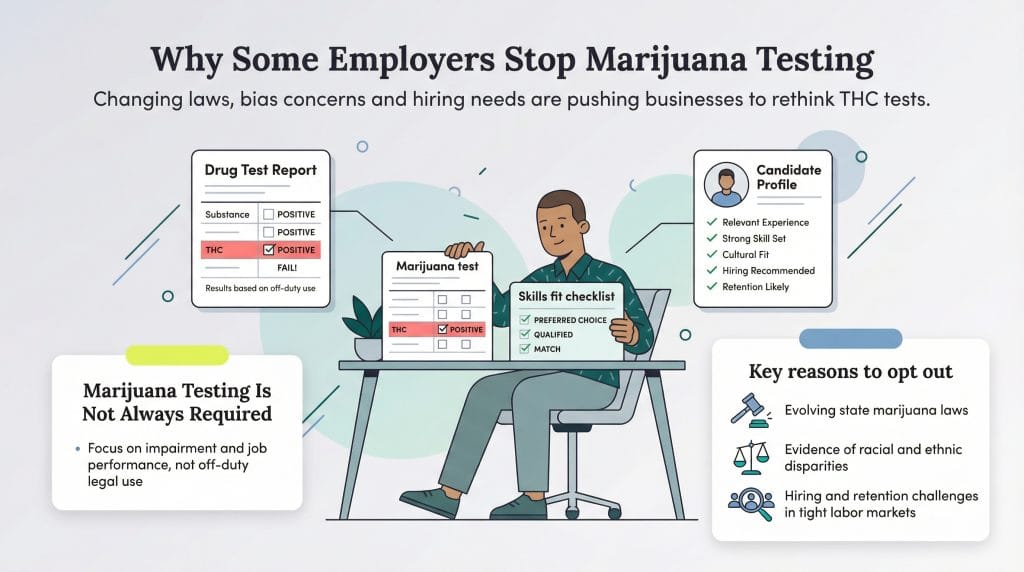
While some employers can still find value in drug testing employees and job candidates for marijuana use, others may question its necessity, especially as weed usage becomes legal in more states. To be fair, just as there are reasons to continue testing workers for pot, there are a few reasons to stop doing so as well.
Although marijuana remains illegal at the federal level, state laws and local regulations around marijuana usage are changing rapidly around the U.S. As more states move to legalize weed for medical and recreational use, it creates a gray area for employers when it comes to testing for the substance.
Additionally, whether a person is actively high on marijuana is usually challenging to prove. Unlike testing for the intoxication of other substances like alcohol, which can be identified easily with a breathalyzer, testing for traces of marijuana in a person’s system tells you only that they have previously used marijuana, not whether they are currently high.
Tetrahydrocannabinol (THC), the psychoactive component of marijuana, can be detected for up to 24 hours in saliva, up to 12 hours in blood, up to a month or longer in urine and up to 90 days in hair. Positive test results can depend on how often someone uses the drug as well as their metabolism and hydration levels.
So, if it’s medically or recreationally legal for your workers to use marijuana outside of work and current tests don’t serve as a clear indicator as to whether a person is actively high, you may question the relevancy of testing for it. In other words, it may not make sense to you to test for weed if it doesn’t conclusively prove someone is currently under the influence.
Recent data reveals persistent disparities in marijuana-related consequences. According to the American Civil Liberties Union, Black Americans are 3.6 times more likely than white Americans to be charged with marijuana possession, despite similar usage rates across racial groups. This disparity extends to workplace drug testing.
A study that dates back to 2010 and later shared in The American Journal on Addictions has proven this imbalance. The research indicated that racial differences in workplace drug testing exist within and across various occupations, with minorities, such as Black and Hispanic workers, being employed at a workplace that requires drug testing more often than their white counterparts.
To avoid perpetuating this imbalance, you may find that excluding marijuana from your list of drugs to test is the best way to go.
The unemployment rate is hovering around 4 percent and employers are feeling the squeeze of a tight labor market. The surging popularity of remote work has allowed businesses to cast a wider net in terms of new hires, but testing job candidates and employees for marijuana can quickly cut holes in your recruitment strategy.
“The biggest reasons I’ve heard from employers are recruitment and retention,” Staple said. “In some industries, it’s difficult to attract candidates and retain employees with strict drug testing, especially in states with legal marijuana use or with populations who have changing attitudes on marijuana use.”
About 19 percent of Americans use marijuana, according to the CDC. We can expect the number of pot users to increase as more states legalize the drug recreationally. Since this establishes that THC can be detectable for days ─ even months ─ after its use, this opens up the possibility of an influx in failed drug tests. If you aren’t hiring or retaining employees who fail marijuana drug tests, you may be eliminating an overwhelming number of people from your talent pool even though they are perfectly capable workers. To avoid doing so, you may want to eliminate testing for marijuana instead.
There are valid arguments on both sides of the testing debate. Whether to test employees for marijuana use is up to the employer to decide, barring industry regulations. Consider your sector, worker responsibilities, the marijuana laws in the state or states you operate and the pros and cons of testing for weed to determine the best option for your business.
Source interviews were conducted for a previous version of this article.