Business.com aims to help business owners make informed decisions to support and grow their companies. We research and recommend products and services suitable for various business types, investing thousands of hours each year in this process.
As a business, we need to generate revenue to sustain our content. We have financial relationships with some companies we cover, earning commissions when readers purchase from our partners or share information about their needs. These relationships do not dictate our advice and recommendations. Our editorial team independently evaluates and recommends products and services based on their research and expertise. Learn more about our process and partners here.
Learn how an IVR system can enhance your business by streamlining call management and boosting customer satisfaction.

Is your business overwhelmed by phone calls? Companies of all sizes are finding relief with the help of interactive voice response (IVR) systems. By automating routine inquiries and routing callers automatically, IVR helps free up staff to focus on other priorities. This can help boost your company’s efficiency and customer satisfaction.
Here’s more on how to decide if IVR is right for your organization.
IVR systems are programs designed to interact with live callers through voice recognition tools or telephone keypads. Instead of using a live person to direct calls, the IVR system provides a faster way to send callers to the right department. IVR systems are essential for organizations managing heavy call volumes, including customer service centers and small businesses.
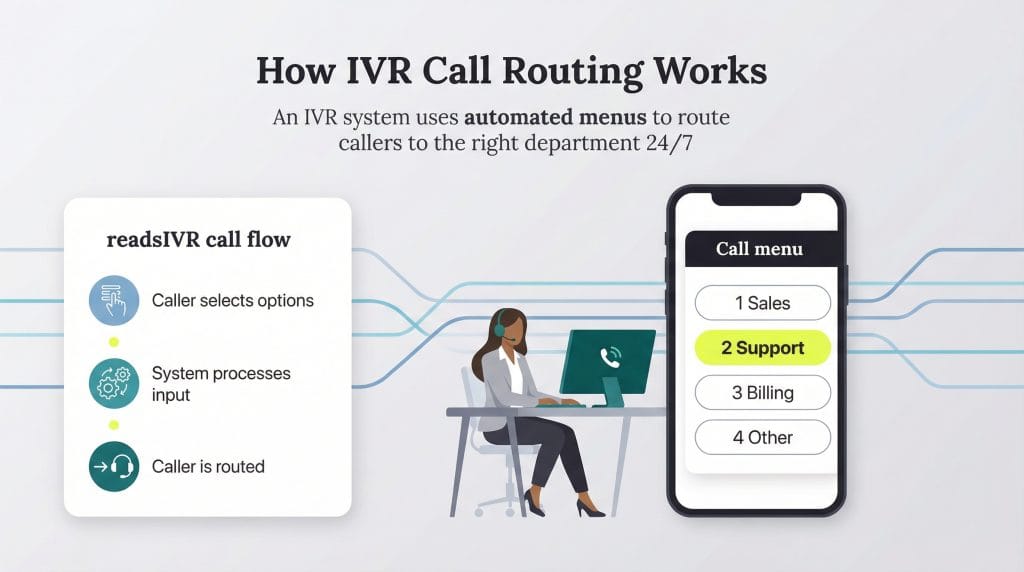
IVR develops a menu system within your call network that collects caller responses either through voice or keypad controls. The IVR system uses those responses to route callers to the correct department within an organization. Since the software allows for caller self-service, the system can run 24/7.
Each IVR system is different, but most follow a traditional sequence. First, the caller dials in and is greeted by a prerecorded message. The IVR may start off by asking about language preferences before presenting multiple menu options. An example could be, “Press 1 for sales. Press 2 for technical assistance. Press 3 for billing. Press 4 for all other inquiries.” Based on the caller’s response, the call is redirected to an appropriate agent or department.
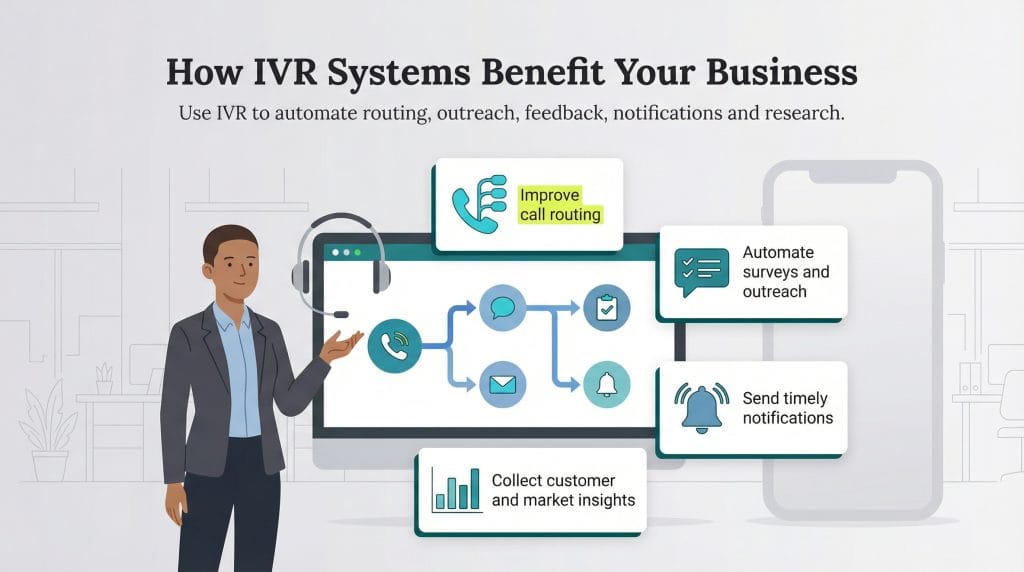
IVR systems aren’t only for major enterprises. Even small businesses and startups can benefit from IVR technology. These systems work for both inbound and outbound calls and, while efficient routing is a major benefit of an IVR, that’s not the only feature they offer.
Here are five ways IVR systems can benefit your business.
It might sound like a minor feature, but improving the inbound call routing at your business can make a big difference to your consumers. Customers want to work with businesses who are modern, reliable and quick to respond to queries. Touch-tone and speech recognition IVR systems streamline the inbound call routing process so you require less support staff and your clients get the service they need faster.
Outbound surveys and polls are an underrated feature of IVR systems. No matter your industry, understanding customer satisfaction is critical for business growth and retention.
You can use scripted IVR calls to reach out to customers you’ve worked with and have them take a quick touch-tone or voice poll. Finding out what your consumers like (and what they don’t) and asking for their suggestions is invaluable. When you use a recording to conduct the poll, clients are more likely to be honest in their replies.
When businesses explore IVR systems for customer engagement, one key application is automated outreach campaigns. Whether you’re confirming appointments, following up on service requests or conducting satisfaction surveys, mobile device marketing with IVRs can streamline these processes.
In-house IVR systems are typically less expensive than outsourcing campaigns to external call centers or insourcing them with your own staff. Data is also attached to IVR systems, so following the end of an outreach campaign, you can analyze which demographics responded the best to your calls and adjust accordingly.
Developing an interactive voice response system is an efficient way to decrease the follow-up and confirmation calls you make. With an IVR, you can let a customer know that their order is being shipped, confirm appointments, send reminders about services and push out notifications when you add a new service or feature to your business.
It’s important to remember that today’s consumers want the services they need as quickly as possible, with minimal interaction. [Read more about voice-over-internet-protocol technology.]
When you need to conduct market research, IVR systems are a valuable tool. Phone polls and survey data, especially those associated with a raffle prize or discount, are a great way to collect information about different demographics. Market research via IVR systems can be targeted based on purchased lead lists or regions and, because the process is automated, you can run this research as frequently as you want without falling behind on other tasks or hiring temporary staff.
In addition to making it easier to carry out customer engagement campaigns and surveys, many IVR systems can integrate with customer relationship management (CRM) software so you can import the information you glean from the automated calls for data analysis.
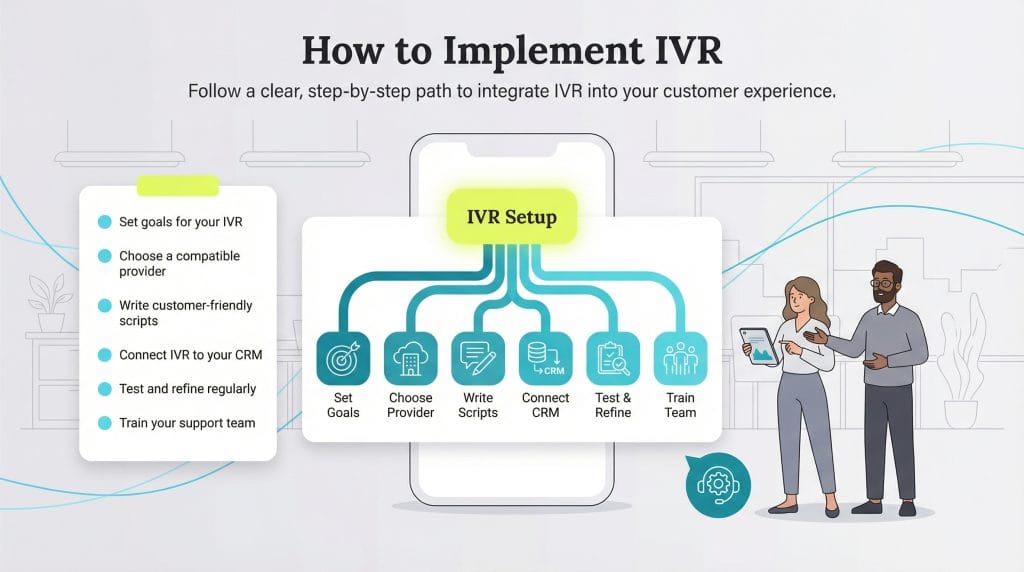
Integrating IVR into your current processes may be easier than you think. Here are six steps to ensure a smooth transition:
Danielle Fallon-O’Leary contributed to the reporting and writing in this article.