Business.com aims to help business owners make informed decisions to support and grow their companies. We research and recommend products and services suitable for various business types, investing thousands of hours each year in this process.
As a business, we need to generate revenue to sustain our content. We have financial relationships with some companies we cover, earning commissions when readers purchase from our partners or share information about their needs. These relationships do not dictate our advice and recommendations. Our editorial team independently evaluates and recommends products and services based on their research and expertise. Learn more about our process and partners here.
What Is Business Credit and Why Does It Matter? Learn how business credit works, why it matters, and the steps you can take to build a strong credit profile.

You can run a profitable business, pay your bills on time and still struggle to access financing or flexible payment terms. That’s because lenders and vendors aren’t just looking at your revenue: They’re looking at your business credit.
Business credit functions like personal credit in concept but operates on a separate infrastructure. It plays a key role in how your company accesses financing, manages cash flow and builds credibility with lenders, vendors and partners. Below, we’ll break down what business credit is, how it works and the steps you can take to build it and put your business on solid financial ground.
Business credit is a measure of your company’s financial reliability, specifically, how consistently and promptly your business pays its debts, vendors and financial obligations.
Your business credit profile is tied to your Employer Identification Number (EIN) and tracked by specialized business credit bureaus, while your personal credit is tied to your Social Security number and tracked by consumer bureaus like Equifax, Experian and TransUnion. Business credit bureaus may also assign your company a business credit score or rating that lenders and vendors use to assess risk.
A strong business credit profile can benefit your company in several ways:
Unlike personal credit, which accumulates naturally as you use credit cards, take out loans and pay bills, business credit requires intentional effort to establish. If you don’t take specific steps to build it, your business may have no credit profile at all, regardless of how long you’ve been operating or how responsibly you manage your finances.
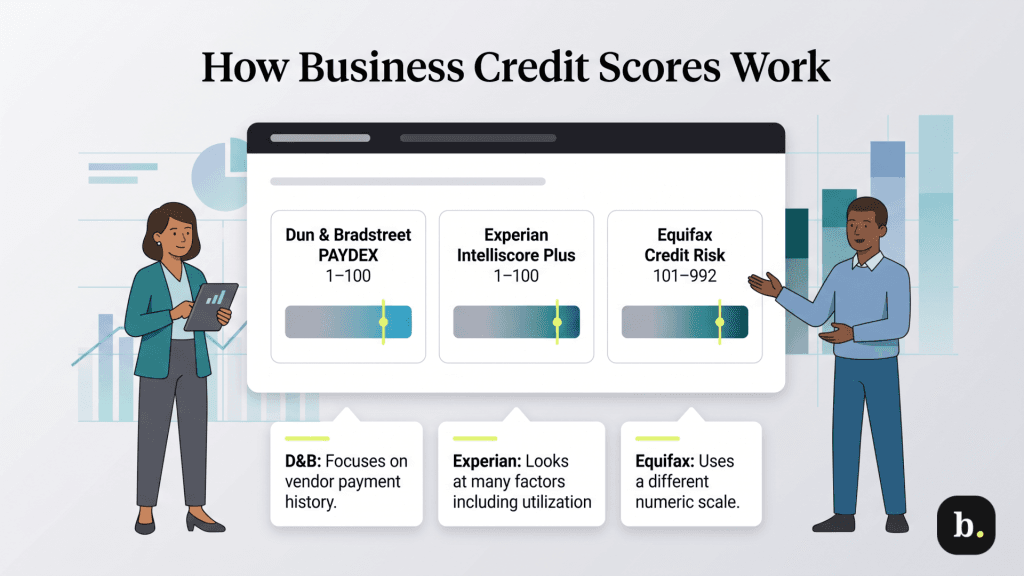
Business credit scores aren’t universal the way personal credit scores are. Instead, multiple business credit bureaus track your company’s activity, including how you manage business debt, and each uses its own scoring model and scale. That means your business may have different scores depending on who’s evaluating it.
Here’s a closer look at who’s tracking your business credit and what factors actually influence your score.
Three bureaus dominate business credit reporting, and each approaches scoring a bit differently:
Each bureau collects data independently, and not all vendors report to all three. As a result, your business credit profile may look different across bureaus, which is why it’s important to monitor each one.
While each bureau weighs factors differently, the same core elements influence business credit scores across the board:
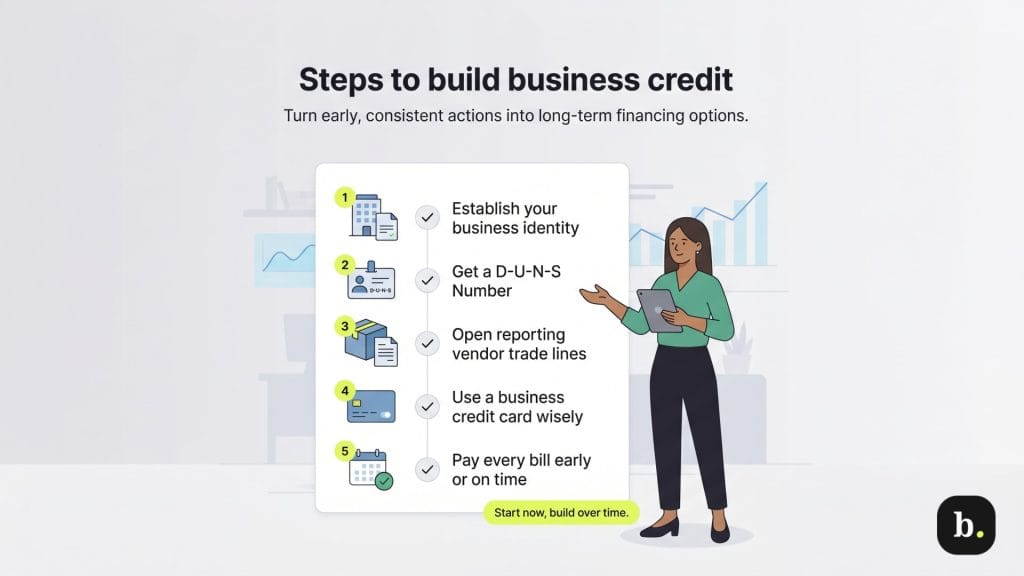
Building business credit takes time, but the process is straightforward once you know where to start. The key is to establish your business properly, open accounts that report to credit bureaus and consistently demonstrate responsible payment behavior.
Before any bureau can track your credit, your business needs to exist as a clearly identifiable entity in their systems. Start by incorporating or forming an LLC; sole proprietorships can build business credit, but having a formal entity makes the process cleaner and separates your business identity from your personal one.
Take the following steps to set up your business properly:
A D-U-N-S Number is a unique nine-digit identifier issued by Dun & Bradstreet to every business entity in its database. It’s free to request and essential for building business credit. Without it, D&B can’t generate a PAYDEX score for your company.
You can apply for a D-U-N-S Number directly through Dun & Bradstreet’s website. The standard process takes approximately 30 days, though expedited options are available for a fee. Once you have your D-U-N-S Number, it serves as your business’s identity within D&B’s system and is commonly requested by government agencies (it’s required for federal contracts and business grants), vendors evaluating your creditworthiness and lenders as part of their underwriting process.
This is where credit-building truly begins. Trade lines are accounts with vendors or suppliers that extend you credit and report your payment history to one or more business credit bureaus. The key is “reporting”; not all vendors share payment data with bureaus, and accounts that don’t report won’t help you build credit, no matter how reliably you pay.
Starter trade lines are vendors that offer net-30 terms (meaning you have 30 days to pay after receiving an invoice) to newer businesses and report those payment experiences to bureaus. Common examples include office supply companies, shipping and logistics providers and fuel card programs. When opening these accounts, confirm that the vendor reports to at least one major bureau — ideally Dun & Bradstreet or Experian.
A business credit card adds another layer to your credit profile and provides a revolving credit line that bureaus can track. When choosing a card, check whether it reports to business credit bureaus, as not all do. Some report only to consumer bureaus, which may help your personal credit but won’t contribute to your business profile.
If your business is new and lacks a credit history, you may need to start with a secured business credit card, which requires a cash deposit as collateral. Secured cards function the same as unsecured cards for credit-building purposes; the bureaus don’t distinguish between the two. As you build a payment track record, you can typically transition to an unsecured card with more favorable terms.
Keep your utilization low. As with personal credit, using a high percentage of your available credit can signal risk. Aim to keep your balance below 30 percent of your credit limit and pay the balance in full each month when possible.
This is the single most important habit you can build to establish excellent business credit. D&B’s PAYDEX score is based entirely on payment timeliness: paying 30 days early can earn a perfect 100, paying on time earns an 80 and paying late can quickly lower your score. Experian and Equifax also place significant weight on payment history.
Set up autopay for recurring obligations and use calendar reminders for invoices that require manual payment. The impact of even one missed payment — from late fees to potential damage to your credit profile — can outweigh the small effort it takes to stay on schedule.
Building business credit is typically straightforward, but a few common missteps can slow your progress or even undo some of the work you’ve already done. Here are some mistakes to watch for:
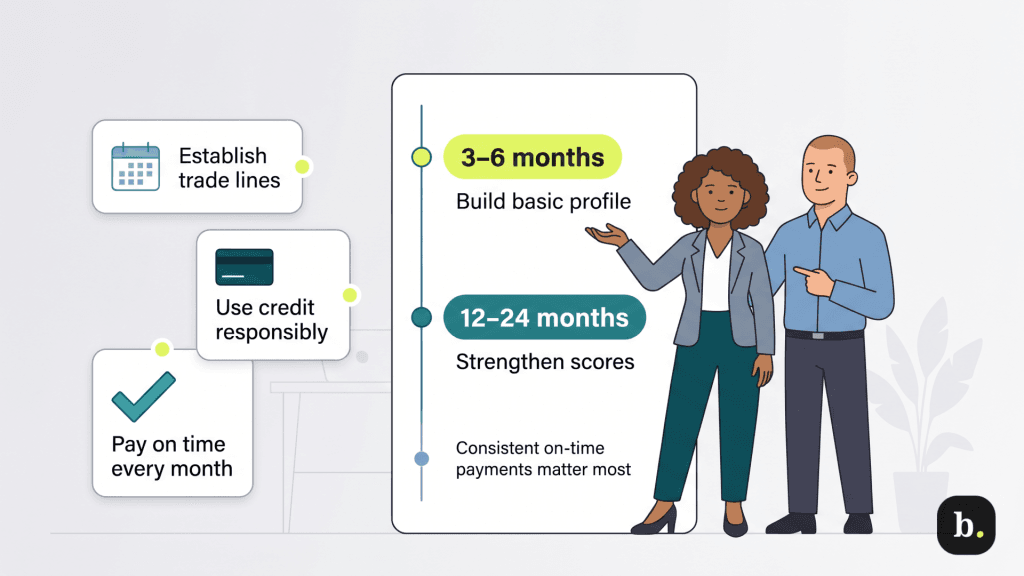
Business credit doesn’t build overnight, and anyone promising a strong score in 30 days is either misleading you or misunderstanding how the system works.
A realistic timeline: Most businesses can establish a basic credit profile (a D-U-N-S Number, two to three active trade lines and an initial PAYDEX score) within three to six months. Building that into a strong, well-rounded profile across all three bureaus typically takes 12 to 24 months of consistent activity: steady trade line payments, responsible credit card use and no negative marks.
The key is consistency. Business credit bureaus are looking for patterns, not one-time events. A year of on-time payments to three or four reporting vendors will do far more for your profile than a burst of activity followed by long gaps.
Business credit doesn’t build itself. Unlike personal credit, which accumulates through everyday financial activity, business credit requires you to take specific, intentional steps, such as registering with bureaus, opening trade lines with reporting vendors and paying everything on time or early.
The process isn’t complicated or expensive, but it does require consistency and attention over time. The payoff — better lending terms, vendor flexibility, reduced personal liability and stronger credibility — makes it one of the highest-return investments a business owner can make in their company’s financial infrastructure.
